

Therapeutic activities play an important role in helping patients recover movement, improve physical abilities, and return to everyday routines after an injury, illness, or surgical procedure. Physical therapists and occupational therapists use these treatments to address functional limitations that interfere with daily activities such as standing, lifting, reaching, transferring, and carrying objects.
The therapeutic activity CPT code is 97530, which identifies skilled rehabilitation services involving dynamic activities intended to improve functional performance. Healthcare providers report this code when treatment involves direct, one-on-one patient contact and medically necessary therapeutic interventions.
However, billing CPT 97530 requires careful attention to treatment documentation, timed service requirements, appropriate modifiers, and insurance reimbursement policies. Understanding these requirements helps healthcare providers select the correct procedure codes, avoid billing errors, and maintain accurate rehabilitation claims.
What is CPT code 97530?
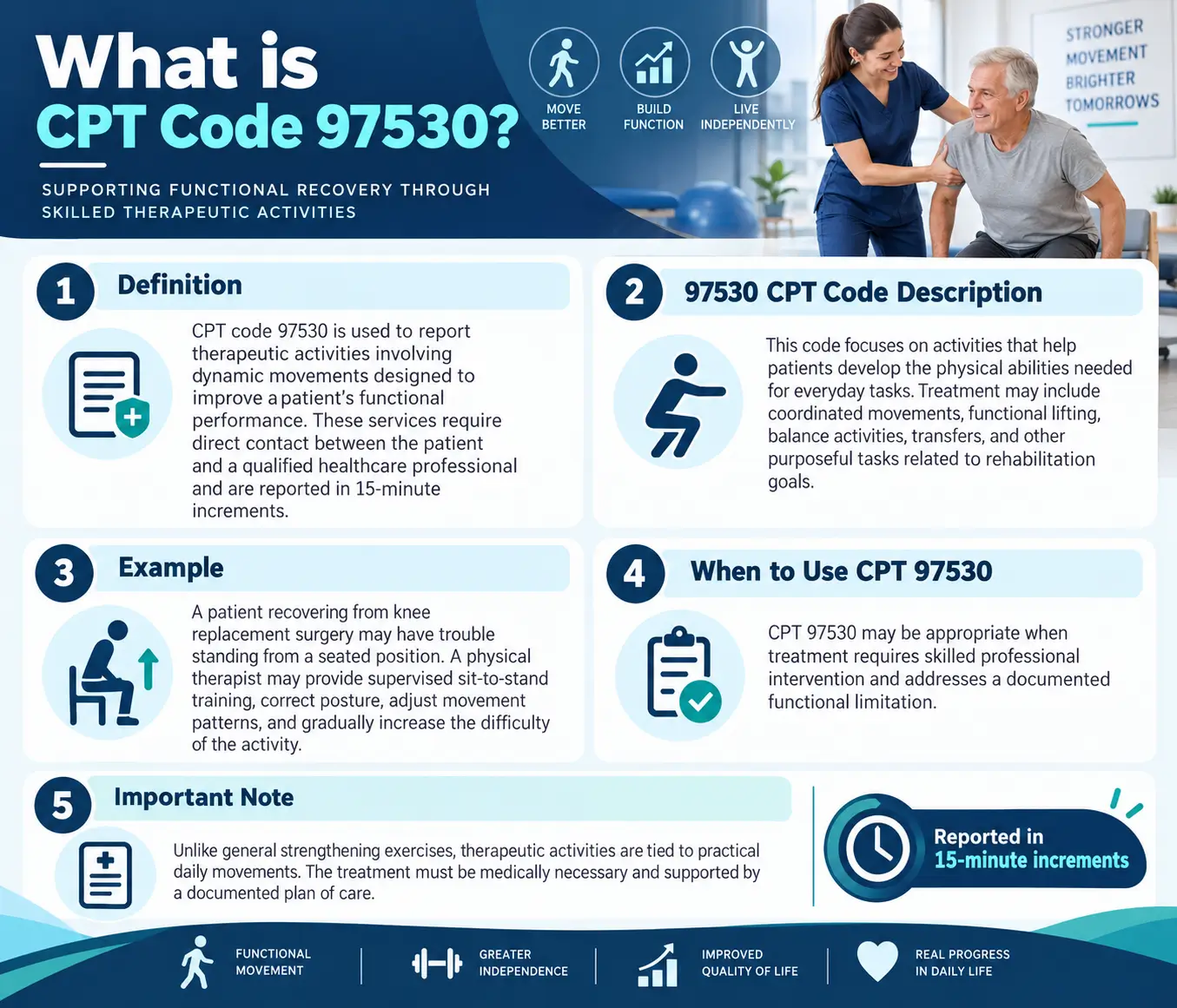
CPT code 97530 is used to report therapeutic activities involving dynamic movements designed to improve a patient’s functional performance. These services require direct contact between the patient and a qualified healthcare professional and are reported in 15-minute increments.
The 97530 CPT code description focuses on activities that help patients develop the physical abilities necessary to complete everyday tasks. Treatment may involve coordinated movements, functional lifting, balance activities, transfers, or other purposeful tasks related to the patient’s rehabilitation goals.
For example, a patient recovering from knee replacement surgery may experience difficulty standing from a seated position. A physical therapist may provide supervised sit-to-stand training while correcting posture, adjusting movement patterns, and gradually increasing the difficulty of the activity. When this treatment requires skilled professional intervention and addresses a documented functional limitation, CPT 97530 may be appropriate.
Unlike general strengthening exercises, therapeutic activities are closely connected to practical movements patients need in their daily lives. The treatment must be medically necessary and supported by a documented plan of care.
What is therapeutic activity in physical therapy?
Therapeutic activity in physical therapy refers to structured, purposeful movements that help patients improve their ability to perform everyday physical tasks. These interventions often combine strength, balance, coordination, mobility, and endurance to address functional difficulties resulting from injury, surgery, neurological conditions, or musculoskeletal disorders.
A therapist may incorporate activities such as lifting objects, reaching across different heights, transferring between surfaces, or practicing controlled bending movements. Each activity is selected according to the patient’s physical limitations and treatment objectives.
For instance, a patient experiencing lower back pain may struggle to pick up objects from the floor. During treatment, the physical therapist may introduce supervised lifting activities that teach the patient safer movement patterns while gradually improving functional tolerance.
Similarly, patients recovering from neurological conditions may participate in coordinated reaching or transfer activities to improve their ability to perform routine movements independently.
The defining feature of therapeutic activities is their relationship to functional performance. Activities must require skilled intervention rather than simply involve repetitive physical movements performed without professional assistance.
When should CPT code 97530 be used?
Healthcare providers should use CPT 97530 when therapeutic interventions involve dynamic activities intended to improve a patient’s functional capabilities. The treatment must address an identified limitation and contribute directly to measurable rehabilitation goals.
Physical therapists frequently use this code for patients experiencing difficulty with transfers, lifting, carrying, or other functional movements. Occupational therapists may also provide qualifying therapeutic activities that help patients regain the physical abilities required for household responsibilities, work-related tasks, and daily routines.
For example, a patient recovering from a stroke may have difficulty transferring from a wheelchair to a bed. The therapist may provide guided transfer training that involves balance, positioning, controlled movements, and appropriate physical assistance.
The activity must require the professional judgment and skills of a qualified therapist. Simply observing a patient performing an independent task generally does not establish sufficient justification for billing therapeutic activities.
CPT 97530 vs. 97110: Therapeutic activity vs. therapeutic exercise
Understanding the difference between therapeutic activity and therapeutic exercise is essential for accurate physical therapy billing. Although both interventions support rehabilitation, they address different treatment objectives.
CPT code 97110 identifies therapeutic exercises intended to improve strength, endurance, flexibility, and range of motion. These exercises generally target specific physical impairments that may contribute to a patient’s functional difficulties.
In comparison, CPT code 97530 identifies dynamic therapeutic activities designed to improve functional performance. These activities focus on movements that patients need to complete practical tasks.
For example, a patient performing resistance exercises to improve leg strength may receive therapeutic exercise under CPT 97110. When the same patient participates in supervised sit-to-stand activities to improve their ability to transfer independently, CPT 97530 may be appropriate.
The distinction depends on the purpose and nature of the intervention rather than the exercise equipment being used.
Therapists must also distinguish CPT 97530 from related rehabilitation procedures. CPT 97112 addresses neuromuscular reeducation, including coordination, balance, and movement control. CPT 97116 is used for qualifying gait training, while CPT 97535 identifies self-care and home management training. CPT 97140 describes manual therapy techniques requiring skilled hands-on treatment.
Although multiple services may be provided during one appointment, the documentation must clearly support each separately reported procedure.
CPT code 97530 billing guidelines
Billing therapeutic activities requires accurate reporting of treatment duration, skilled patient contact, medical necessity, and applicable insurance requirements. Healthcare providers should ensure that the services performed satisfy the code description and that documentation reflects the actual treatment provided.
Direct one-on-one patient contact
CPT 97530 requires direct, individual contact between the patient and the qualified healthcare professional providing treatment. The therapist must actively participate in delivering the skilled intervention rather than simply observe the patient performing exercises independently.
For example, a therapist providing individualized instructions, adjusting movement techniques, modifying activities, and monitoring functional performance may satisfy the direct-contact requirement when the other coding conditions are met.
However, when a therapist supervises several patients performing activities simultaneously, the service may not qualify for individual therapeutic activity billing. Depending on the circumstances, group therapy under CPT 97150 may be more appropriate.
CPT 97530 time requirements and the Medicare 8-minute rule
CPT 97530 is a timed rehabilitation procedure reported in 15-minute units. Medicare Part B uses specific time-based billing requirements commonly known as the 8-minute rule.
When CPT 97530 is the only timed service performed, treatment lasting between 8 and 22 minutes generally supports one billable unit. Treatment lasting 23 to 37 minutes supports two units, while 38 to 52 minutes supports three units. A total of 53 to 67 minutes supports four units.
Treatment lasting fewer than eight minutes does not support a separate unit when it is the only timed service performed.
When several timed rehabilitation procedures are provided during the same treatment session, Medicare considers the combined qualifying treatment minutes to determine the total number of billable units. Those units must then be allocated appropriately among the individual services based on the treatment time provided.
For example, suppose a patient receives 32 minutes of therapeutic activities under CPT 97530 and 12 minutes of therapeutic exercise under CPT 97110. The combined treatment duration is 44 minutes, which supports three total units under Medicare’s timed-service calculation. In this situation, two units may be assigned to CPT 97530 and one unit to CPT 97110, provided the documentation supports both interventions.
Commercial insurance companies may establish different rules for timed therapy services. Providers should verify the requirements of the patient’s insurance plan before submitting claims.
CPT code 97530 modifiers
Modifiers identify additional circumstances associated with a billed service. In physical and occupational therapy billing, modifiers help insurance companies determine the treatment discipline, provider involvement, and applicable payment conditions.
Modifier GP identifies services provided under an outpatient physical therapy plan of care. When therapeutic activities are performed as part of qualifying physical therapy treatment, CPT 97530-GP may be appropriate.
Modifier GO identifies services delivered under an outpatient occupational therapy plan of care. Occupational therapists commonly report CPT 97530-GO when providing qualifying therapeutic activities.
Medicare also requires modifier CQ for certain physical therapy services furnished in whole or in part by a physical therapist assistant. Modifier CO serves a similar purpose for occupational therapy assistant services. Under applicable Medicare rules, qualifying services subject to the therapy assistant payment reduction are generally reimbursed at 85% of the otherwise applicable Part B payment amount.
Modifier KX may be necessary when Medicare outpatient therapy expenditures exceed the annual threshold and the provider confirms that continued treatment meets medical necessity requirements.
Modifier 59 may be used in certain situations involving distinct procedures when the applicable National Correct Coding Initiative edits permit separate reporting. However, it should not be added automatically whenever CPT 97530 and another therapy procedure appear on the same claim.
Correct modifier selection depends on the patient’s treatment plan, the professional delivering the service, and the payer’s billing requirements.
CPT 97530 documentation requirements
Accurate clinical documentation provides the foundation for appropriate reimbursement of therapeutic activities. Insurance companies expect the medical record to demonstrate why the treatment was necessary, what services were performed, and how the intervention addressed the patient’s functional limitations.
A treatment note should identify the patient’s condition, relevant functional difficulties, specific therapeutic activities, treatment duration, level of professional assistance, and response to the intervention.
For example, documenting only that a patient completed therapeutic activities for 30 minutes does not adequately explain the clinical purpose of treatment.
A more useful note may describe how the patient completed supervised transfers from different seating heights while receiving verbal cues for weight distribution, posture, and controlled movement. The therapist may also record improvements in transfer independence or reductions in the assistance required.
Documentation should connect therapeutic activities with the established treatment goals and demonstrate the professional skills involved in providing care.
As rehabilitation progresses, providers should record measurable changes in functional abilities. These findings help establish whether continued treatment remains medically necessary and whether the existing plan of care requires modification.
CPT 97530 reimbursement rate in 2026
The CPT 97530 reimbursement rate varies depending on the patient’s insurance provider, treatment setting, geographic location, approved billing units, and applicable payment policies.
Medicare reimbursement is generally determined through the Medicare Physician Fee Schedule, which considers relative value units, geographic adjustments, and the conversion factor applicable to the date of service.
Commercial insurance companies may establish different reimbursement amounts through negotiated provider contracts. Consequently, two practices performing the same therapeutic activity may receive different payments depending on their payer agreements and locations.
The number of approved treatment units also affects reimbursement. Accurate treatment-time documentation is therefore necessary to prevent underbilling or unsupported claims.
Medicare additionally applies a multiple procedure payment reduction to the practice-expense component of certain therapy services when multiple qualifying procedures are furnished on the same day.
Under the applicable Medicare policy, the practice-expense component of subsequent qualifying therapy services may be reduced by 50%. This adjustment does not mean that the entire payment for every additional therapy procedure is reduced by half.
Providers should review the appropriate Medicare fee schedule and payer contracts to determine the expected reimbursement for CPT 97530.
Medicare therapy threshold for 2026
For calendar year 2026, Medicare established a $2,480 KX modifier threshold for physical therapy and speech-language pathology services combined. A separate $2,480 threshold applies to occupational therapy services.
These thresholds do not establish absolute annual limits on covered therapy. Instead, they identify the point at which additional billing requirements apply and providers must confirm that continued treatment remains medically necessary.
Medicare also maintains a $3,000 targeted medical review threshold for each corresponding therapy category in 2026. Reaching this amount does not automatically result in every claim being reviewed, but services may be selected for additional examination under applicable Medicare policies.
Healthcare providers should monitor accumulated therapy expenditures, maintain adequate supporting documentation, and apply the appropriate modifiers when required.
Common CPT 97530 billing mistakes
One of the most common mistakes in therapeutic activity billing involves reporting CPT 97530 for services that more accurately meet the description of therapeutic exercise.
Although therapeutic exercises and therapeutic activities may involve similar movements, the correct code depends on the clinical purpose and the actual skilled service performed.
Incorrect treatment-time calculations can also create reimbursement problems. Some billing departments mistakenly assign individual units to every procedure without considering Medicare’s combined timed-service requirements. This approach may result in unsupported billing units.
Incomplete documentation presents another concern. Treatment notes that do not identify functional limitations, skilled intervention, measurable objectives, or patient progress may fail to establish medical necessity.
Modifier-related mistakes can also delay claim processing. Missing GP or GO modifiers, incorrect therapy assistant modifiers, or unsupported use of modifier 59 may cause claim rejections or payment discrepancies.
Another problem occurs when providers continue reporting therapeutic activities without documenting meaningful clinical progression or the ongoing need for skilled treatment.
Reviewing treatment records before claim submission helps billing professionals identify these problems and maintain consistent coding practices.
Frequently asked questions about CPT 97530
Can physical therapists bill CPT 97530?
Yes. Qualified physical therapists can bill CPT 97530 when they provide medically necessary therapeutic activities involving direct one-on-one patient contact. The treatment must address functional limitations and satisfy applicable documentation, time, and insurance requirements.
Can occupational therapists use CPT 97530?
Yes. Occupational therapists may report CPT 97530 for qualifying dynamic therapeutic activities intended to improve functional performance. When the service is provided under a Medicare outpatient occupational therapy plan of care, modifier GO is generally required.
Can CPT 97530 and CPT 97110 be billed together?
CPT 97530 and CPT 97110 may be billed during the same treatment session when the therapist provides distinct, medically necessary interventions that satisfy the requirements of each code. The documentation must support the treatment performed, and the billing units must reflect the actual qualifying treatment time.
Does Medicare cover CPT code 97530?
Medicare Part B generally covers therapeutic activities reported under CPT 97530 when the services meet applicable medical necessity, documentation, coverage, and billing requirements. Coverage depends on the patient’s circumstances and whether the treatment qualifies as skilled rehabilitation care.
Can a home exercise program be billed using CPT 97530?
A home exercise program does not automatically qualify for CPT 97530. The appropriate procedure code depends on the skilled treatment provided during the appointment. For example, individual therapeutic exercise instruction may support a different procedure code. Time spent independently performing exercises at home cannot be billed as direct one-on-one therapeutic activity treatment.
Key considerations for CPT 97530 billing
The therapeutic activity CPT code 97530 identifies skilled rehabilitation interventions involving dynamic activities designed to improve a patient’s functional performance. Physical therapists and occupational therapists use this procedure when treatment addresses practical movement limitations affecting everyday activities.
Appropriate reimbursement depends on correct procedure selection, documented medical necessity, direct patient contact, accurate treatment-time calculations, and compliance with payer-specific billing policies.
Healthcare providers must distinguish therapeutic activities from therapeutic exercise, gait training, neuromuscular reeducation, and self-care interventions. Each service should be supported by documentation that explains the patient’s limitations, the skilled treatment delivered, and the functional improvements being pursued.
For medical billing professionals, reviewing these details before submitting claims helps support accurate coding, appropriate reimbursement, and compliance with Medicare and commercial insurance requirements.