
For a bilateral lower extremity reflux study, the venous insufficiency bilateral reflux CPT code is 93970 in most cases, and 93971 when the scan is unilateral or limited. The choice looks simple until a claim is denied because the report never named the veins examined, the diagnosis missed the payer’s list, or an arterial study was billed on the same day.
This guide explains how to choose between the two codes, which diagnoses and documentation support medical necessity, how modifiers and components work, and why payment differs from one claim to the next. Medicare details come from the published policy of Novitas Solutions, the Medicare contractor for Jurisdictions H and L. Other payers write their own rules, and the text flags where that matters.
What the venous insufficiency bilateral reflux CPT code reports
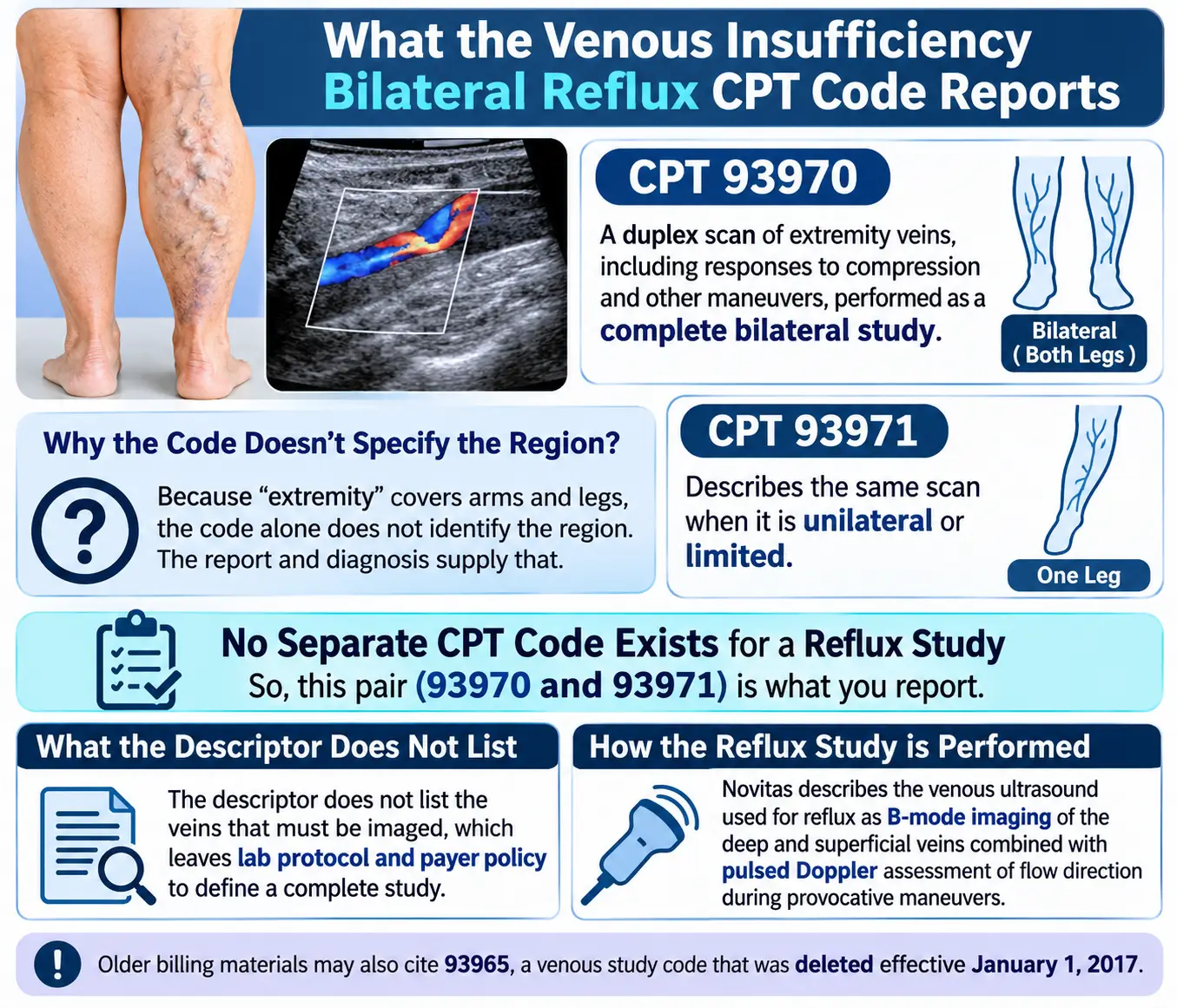
CPT 93970 is a duplex scan of extremity veins, including responses to compression and other maneuvers, performed as a complete bilateral study. Because “extremity” covers arms and legs, the code alone does not identify the region. The report and diagnosis supply that. CPT 93971 describes the same scan when it is unilateral or limited. No separate CPT code exists for a reflux study, so this pair is what you report.
The descriptor does not list the veins that must be imaged, which leaves lab protocol and payer policy to define a complete study. Novitas describes the venous ultrasound used for reflux as B-mode imaging of the deep and superficial veins combined with pulsed Doppler assessment of flow direction during provocative maneuvers. Older billing materials may also cite 93965, a venous study code that was deleted effective January 1, 2017.
93970 vs 93971: choosing between them
Novitas’ billing article states that 93971 reports either a limited bilateral study or a complete unilateral one.
CPT 93970 | CPT 93971 | |
Scope | Complete bilateral study | Complete unilateral study, or a limited study of one or both sides |
Reflux example | Both legs examined across the deep and superficial segments the protocol requires | One leg only, or both legs with a restricted protocol |
Modifier -50 | Not needed, since the code is already bilateral | Not appropriate for a limited bilateral study |
The examples below are hypothetical. A patient with swelling and heaviness in both legs has a standing reflux study, and the technologist records the deep and saphenous segments of each leg with reflux times. That supports 93970. In a second case, a cast blocks access to the left leg and only the right is scanned, so 93971 applies. In a third, both legs are scanned but only the proximal deep veins are imaged. That is a limited bilateral study and also belongs under 93971, without modifier -50.
Diagnosis coding and medical necessity
What the Novitas policy requires
Novitas LCD L35451 (effective January 28, 2024) treats objective venous testing as reasonable in chronic venous insufficiency when it evaluates post-thrombotic syndrome in symptomatic patients, confirms suspected valvular incompetence in symptomatic venous insufficiency or symptomatic varicose veins before treatment, or assesses the result of a venous ablation. It lists asymptomatic varicose veins and routine screening as not reasonable and necessary. That makes 93970 medical necessity a question of documented symptoms, not of the scan itself.
ICD-10-CM codes and laterality
The companion article, A52993 (revision effective October 1, 2024), lists I87.2, venous insufficiency (chronic) (peripheral), among the diagnoses supporting both 93970 and 93971. The list also includes varicose vein codes with ulcer, inflammation, pain or other complications, postthrombotic syndrome, chronic venous hypertension, and certain leg ulcer and edema codes. Z09 and Z01.810 support 93971 only. Z09 covers follow-up after a venous ablation, and Z01.810 covers vein graft mapping before bypass.
Reflux is an ultrasound finding, not a diagnosis, so the claim should carry the diagnosis the clinician documents. The ICD-10-CM outpatient guidelines direct coders to confirmed diagnoses in the physician’s interpretation when the final report is available at the time of coding.
I87.2 has no laterality. Related codes do, such as I83.813 for varicose veins of both lower extremities with pain, so the record should show why both legs needed testing. Other payers’ lists may differ from Novitas’, so check each policy for the date of service.
Documentation that supports a bilateral reflux study
Novitas expects a legible record with patient identifiers, an order from the treating practitioner, stored images of relevant areas (normal and abnormal), and a signed final report. The report should describe findings in anatomic terms, state an impression, note any standard views not obtained, and mention comparison with prior imaging when it was reviewed.
For reflux specifically, add detail that shows the study was complete on each side:
- The deep segments examined (common femoral, femoral, popliteal) and the superficial ones (great saphenous, small saphenous, and any accessory or perforator veins relevant to the question)
- Patient position and the provocation method, such as Valsalva or distal compression and release
- Reflux time for each segment, with vein diameter where it informs treatment
- A clear statement of which leg each finding belongs to
Consensus thresholds make reflux time worth recording precisely. The Society for Vascular Surgery and American Venous Forum guideline (Gloviczki and colleagues, 2011) recommends a 1-second cutoff for abnormal reflux in the femoral and popliteal veins, and a 0.5-second cutoff for the great and small saphenous, tibial, and deep femoral veins. Comparing measured times to those cutoffs shows why a segment was called incompetent. The same report often supports a later ablation request, which falls under separate treatment policies such as Novitas LCD L34924.
Modifiers, components and same-day rules
Does CPT 93970 need a modifier?
Not on a global claim. When the technical and professional components are billed separately, the interpreting physician reports -26 and the facility or testing site reports -TC. Fee schedule data list 93970 with a PC/TC indicator of 1 (diagnostic test), global status XXX, and a medically unlikely edit of 1. Report one unit, then, because the code already includes both sides. Modifier -50 does not belong on it.
Does CPT 93971 need a modifier?
The component modifiers work the same way. Novitas states that -50 is inappropriate on 93971 for a limited bilateral study. Some coding references suggest -59 on a second venous duplex code when a different body area is scanned. Novitas, however, treats multiple extremity duplex scans on the same day as not reasonable and necessary, with rare exceptions considered on redetermination, so a modifier alone will not rescue that claim.
Arterial and venous studies on the same day
Novitas’ article says 93970 and 93971 cannot be billed on the same day as the listed noninvasive arterial studies (93922, 93923 and 93924 through 93931). Practices that expect a patient to need both should confirm the payer’s position before scheduling.
Reimbursement and preauthorization
No single payment figure applies to 93970. Payment depends on the payer’s fee schedule, the site of service, whether the claim is global or split into components, the geographic adjustment, and the date of service. For Medicare, the CY 2026 physician fee schedule uses a conversion factor of $33.57 for qualifying APM participants and $33.40 for others, and applies a 2.5 percent efficiency adjustment to work values for non-time-based services. Fee schedule data also place the technical component of 93970 under the special payment rules for multiple diagnostic cardiovascular services. Look up the code for your locality and setting in the current files, or use your contract rate for commercial claims.
Preauthorization is payer-specific. Commercial and Medicare Advantage plans may require it, sometimes through a benefit manager, so check before scheduling. Under the Novitas LCD, compliance may be monitored through post-payment data analysis and medical review audits, so the claim documentation has to hold up after payment as well.
Common reasons these claims are denied
- 93970 reported when the report covers one leg or a restricted set of veins
- A diagnosis outside the payer’s list, or documentation describing asymptomatic varicose veins or screening
- An arterial duplex or physiologic study billed on the same date
- No order, an unsigned report, or missing stored images
- Modifier -50 added to either code
- A report that states bilateral reflux without segment-by-segment findings for each leg
Claim review before submission
The venous insufficiency bilateral reflux CPT code is 93970 when both legs receive a complete duplex study and 93971 when the study is unilateral or limited. Support it with a symptomatic diagnosis such as I87.2 that matches the payer’s policy, a signed report listing every segment and reflux time for each leg, and a modifier approach that fits global or component billing. Payment varies by payer, locality, setting and date of service.
Before submitting, put the report beside the claim. Count the limbs and segments scanned, confirm the diagnosis is on the payer’s list, check for same-day arterial studies, and verify which policy version applied on the date of service.