
40 mg injection can be paid in full or denied back. Often it's just one incorrect billing unit.
Drug claims are more money per line than almost anything else you bill. Payers look at every field that is attached to the drug claim. Units, code, NDC, modifier, and diagnosis. Miss one, and the whole queue is stopped. It is usually found in a stack of old claims months later . The leak is in practices that treat HCPCS codes for medications as an afterthought.
This guide shows you where drug claims break and how to fix each spot. The team at A2Z Billings has handled medication billing across specialties with 150+ years of combined experience, and the same few mistakes show up again and again. Fix these mistakes, and more claims will be paid on the first submission, so your staff will stop rebilling the same drug claim three times.
What HCPCS drug codes cover
CPT ends and HCPCS Level II begins, with drugs being its largest category. Most injected and infused drugs fall in the J-code range. The drugs used in chemotherapy are coded from J9000 to J9999. Biosimilars receive Q codes. Sometimes hospital outpatient departments use C codes for new drugs that don’t yet have a permanent J code.
Each code represents one drug and one billing unit. That's the part people often miss. J1100 Dexamethasone sodium phosphate, 1 mg J3301 Triamcinolone acetonide, 10 mg. 1 unit onabotulinumtoxinA (J0585). The descriptor tells you what one unit is. It almost never corresponds to the size of the vial in your fridge.
The code set also moves; CMS updates it every quarter. One recent quarterly update to the ASC payment system added twelve drug codes with pass-through status, deleted ten, and changed the payment status on twenty-one more, according to CMS Transmittal 13983. Bill deleted the code, and the claim was rejected.
A coder who checks every quarterly release against your charge master catches these before a claim leaves the building. That is routine work for a good medical coding team, and it stops a whole category of rejections.
Billing units: where most denials start
The units consistently trip drug claims. The rule is simple. Bill the number of descriptor units you gave, not the number of vials or the number of millilitres.
Get a 40 mg shot of triamcinolone. J3301 is billed per 10 mg, so you would bill 4 units. Bill 1 unit because it was a one-shot deal and you gave away 75% of the payment. Bill 40 because the dose reads 40 mg and the payer's unit cap rejects the line.
Medicare uses medically unlikely edits to limit the number of units it will accept for a code on a day.
Go to the source of the problem. Store the conversion next to each drug in your charge master - dose, descriptor and units. No one should be made to do maths at the checkout.
NDC numbers: the second code on the claim
Many payers want the National Drug Code beside the HCPCS code. Medicaid programmes require it. Anthem asks for it on professional and outpatient claims with drug services, saying payment is not approved if NDC information is incorrect or missing.
The NDC has 11 digits in a 5-4-2 format, with no hyphens. Labels are usually printed with 10 digits, so add a zero to the short segment: at the front for a 4-4-2 label, in the middle for 5-3-2, and at the end for 5-4-1.
The NDC is entered on a CMS-1500 in the shaded area on lines 24A through 24G . Start with the N4 qualifier, then the 11 digits, the unit of measure (UN, ML, GR or F2, ME if the plan accepts it) and the quantity. The same data is in Loop 2410 of an 837P as in the shaded area of lines 24A through 24G.
Here, people face two traps. The NDC quantity is not the HCPCS unit count. Payers will compare the two. One drug billed as 8 HCPCS units can be 4 mL on the NDC line, and when they disagree, the line contradicts. The second pitfall is partial quantities. Report 0.5 mL as 0.5, not 1.
JW and JZ modifiers: report what you threw away
Medicare wants to know what happened to the leftover drug. Open a single-dose vial, give part of it, and discard the rest, and the discarded amount gets the JW modifier. Nothing thrown away? That gets JZ.
With waste, you use two lines. The first carries the administered amount with no modifier. The second carries the discarded amount with JW, and each line shows its units. For example, a 100-unit vial of onabotulinumtoxinA is opened, and 80 units are administered to the patient. Line one reads J0585 times 80. Line two reads J0585 JW times 20.
No waste means one line with JZ and the units given. Units administered and units wasted must be reflected in the medical record.
The policy does not cover some drugs: multi-dose vials, influenza, pneumococcal and COVID-19 vaccines, and drugs that are not separately payable. Unclassified codes such as J3490 do need the modifier. Leave both modifiers off, and Medicare may return the claim as unprocessable, requiring you to resubmit and wait again.
There is an additional reason to ensure the process is done correctly. Manufacturers are required to provide CMS with a credit when the total discarded amounts for a drug surpass 10 percent of the total allowed charges for a quarter. CMS determines this figure using JW units on claims. Commercial payers have specific guidelines, so be sure to review each policy beforehand.
Unclassified drug codes: what payers want attached
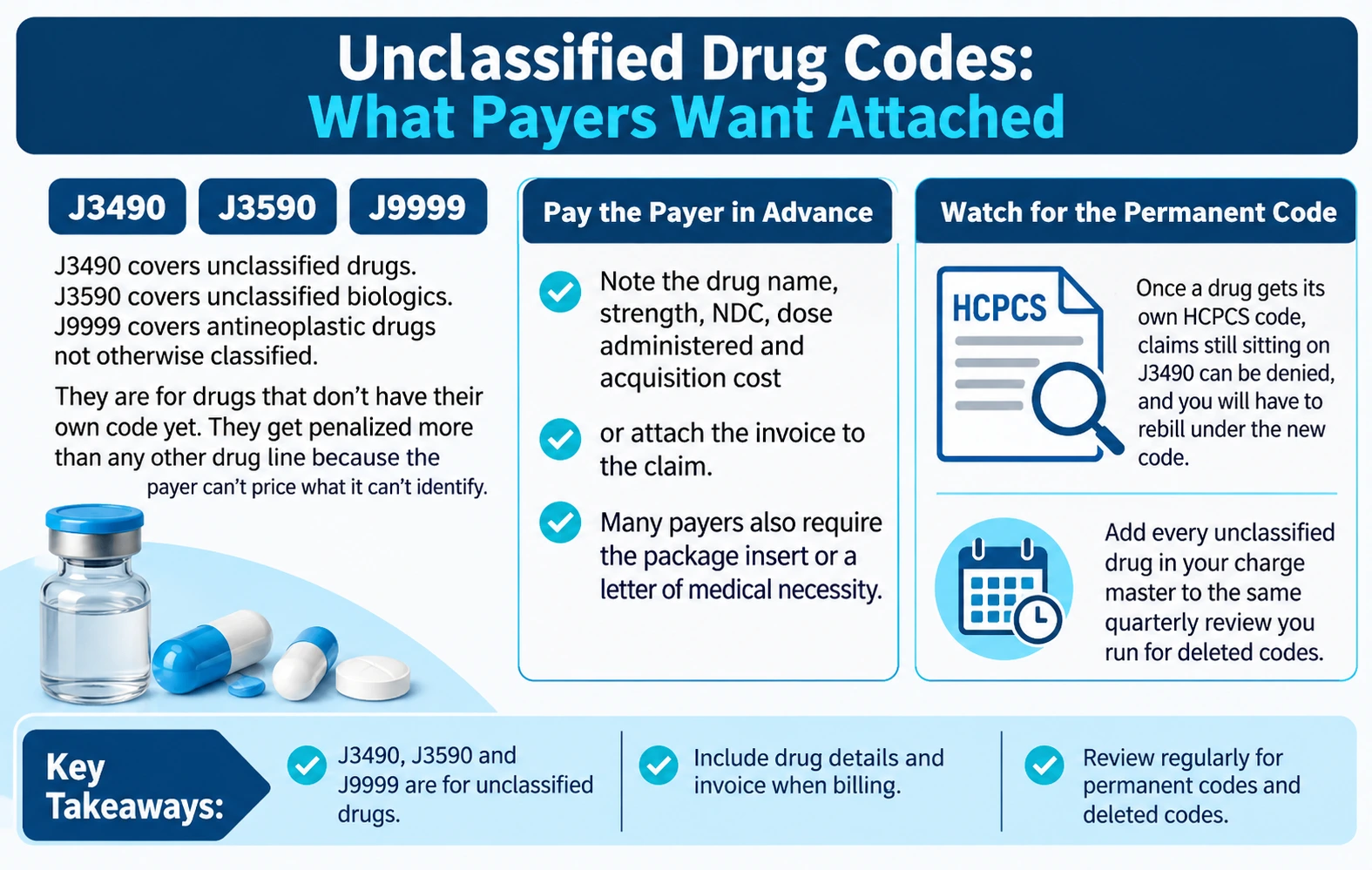
J3490 covers unclassified drugs. J3590 covers unclassified biologics. J9999 covers antineoplastic drugs not otherwise classified. They are for drugs that don’t have their own code yet. They get penalized more than any other drug line because the payer can’t price what it can’t identify.
Pay the payer the full amount in advance. Note the drug name, strength, NDC, dose administered and acquisition cost or attach the invoice to the claim. Many payers also require the package insert or a letter of medical necessity.
Then watch for the permanent code. Once a drug gets its own HCPCS code, claims still sitting on J3490 can be denied, and you will have to rebill under the new code. Add every unclassified drug in your charge master to the same quarterly review you run for deleted codes.
How drugs get paid
Medicare Part B pays most separately payable drugs at the average sales price plus 6%. CMS issues new ASP payment limits each quarter, so the same drug can pay a little different one quarter to the next. Variation: ASP + 6% or 8% of the ASP of the Reference Product (depending on the product). Biosimilars . The sequestration cuts the Medicare portion so your bill is a little less than the listed rate.
Take your quarterly pricing file and check every drug in stock and what you paid for it. A drug that pays less than the acquisition cost is one to know about before the next order, not after the quarter closes. Drug-heavy specialities such as oncology require that check at the line level because chemotherapy claims have the biggest dollar amounts.
Commercial plans set their own rates. Some discount the ASP, some use a fee schedule, and some pay a percent of billed charges. Read the drug section of every contract, then enter those rates into your system so underpayments flag themselves.
Denial triggers and what the chart must show
Most drug denials come from a short list:
- Units that don't fit the descriptor or go over the daily cap
- A missing, expired, or non-conforming 10-digit NDC number that does not correspond to the HCPCS code
- No JW or JZ modifier
- No prior authorization on a drug that needs one
- A diagnosis that does not support medical necessity for that drug
- No administration code, such as 96372 for an injection
The drug code pays for the drug. The administration code pays for the work of distributing it. Buy one without the other, and you will miss out on the full payment. Our guide to office visit CPT codes explains when that applies. If the visit is on the same day, the E/M requires modifier 25 to indicate that it was a distinct visit.
If a drug claim does come back, correct the cause and refile quickly. Working rejected claims by pattern instead of one at a time is what stops repeats.
Your chart should back up every line you bill:
- Drug name, strength, and NDC
- Dose, route, and injection site
- Units administered and units discarded
- The diagnosis that justifies the drug
- The prior authorization number, if there was one
- The name and signature of the clinician who gave it
FAQs about HCPCS drug billing
What are J-codes in medical billing?
J-codes are HCPCS Level II codes for drugs, mostly injectables and infusions. The J9000 to J9999 range covers chemotherapy drugs. Each code names one drug and one billing unit.
How often do HCPCS drug codes change?
Every quarter. CMS adds codes, deletes codes, and updates payment limits on a quarterly cycle. Review your charge master against each release so retired codes never reach a claim.
Do I need an NDC on every drug claim?
It depends on the payer. Medicaid programs and many commercial plans, Anthem among them, require the NDC on drug claims. Check each payer's policy and store the NDC with each drug in your charge master.
When do I use JW and JZ?
If a portion of a single-dose vial is discarded, use JW on a separate line for the amount that is discarded. If nothing is discarded, use JZ on one line. The rule isn’t for multi-dose vials and some vaccines.
What Do I Bill If a Drug Doesn’t Have an HCPCS Code?
Use the proper unclassified code: J3490 for drugs, J3590 for biologics, and J9999 for antineoplastic drugs. Attach drug name, NDC, dosage and invoice cost. The payer will want to see the records.
Why do payers deny drug claims for units?
Usually the units do not match the descriptor, or they are above a daily maximum. Convert the dose to descriptor units and compare that number to the NDC quantity. The pair of numbers should tie in.
Are drug claims subject to prior approval?
Many expensive drugs do, and payers update their lists frequently. Check the payer's list prior to scheduling the dose and put the authorisation number on the claim.
Get your drug claims paid the first time
Drug billing punishes guesswork. Units, NDCs, modifiers, and payer rules are shifting beneath you, and every mistake costs real dollars on a line that should be making good money.
A2Z Billings brings 150+ years of billing and coding experience and a 98% clean claims rate to every account. We verify units and match NDCs. We apply JW and JZ correctly. We chase each denied drug line until it pays or, you know, exactly why it will not.
Book an appointment or contact us, and bring your last batch of denied drug claims. We will show you what went wrong on each one.