

The cause of a chest CT scan requested to monitor a lung nodule and billed as a screening scan will typically be found in a single code choice. The core of such a decision is CPT 71250. It appears straightforward on paper: one scan, no contrast, one code. It is surrounded by a Medicare policy that determines which diagnoses are reimbursed, a distinct screening code for a particular patient category, and contrast codes listed next to it.
The official description, the clinical circumstances in which a non-contrast chest CT is ordered, the differences between 71250 and 71260, 71270, and 71271, the applicable modifiers, Medicare coverage, and what the chart must display are all covered in this guide.
What is described in CPT 71250
"Computed tomography, thorax, diagnostic; without contrast material"
It is the CPT descriptor. It is listed by AAPC under Diagnostic Radiology procedures of the chest. The code was added on January 1, 1990, and it was last modified on January 1, 2021, when the word "diagnostic" was added to the description. According to the American College of Radiology, 71250, 71260, and 71270 were changed editorially as diagnostic studies in order to distinguish them from 71271, the CT code for thorax screening.
The scan includes the heart, great vessels, chest wall, mediastinum, and lungs. There is no intravenous contrast administered. The Medicare price schedule shows that 71250 has a professional/technical component indicator of 1 and a global surgery indicator of XXX. This indicates that the service can be divided into a professional and a technical part and that the global period concept does not apply.
New coders are tripped up by one point. There is no unique designation for high-resolution chest CT, the method used to assess interstitial lung disease. 71250 is still recorded for a high-resolution study conducted without contrast.
When a chest CT scan without contrast is requested
Since lung tissue is in contact with air, many thoracic issues are clearly visible without contrast. Follow-up of a pulmonary nodule, interstitial lung illness, pleural disease, hemoptysis, and staging of a known cancer are common reasons to order 71250. Adenopathy, pleural effusion, suspected lung or pleural nodules or masses, and other findings not deemed benign are among the aberrant findings described in the Medicare local coverage determination for thorax CT.
On imaging performed for a different purpose, incidental nodules follow their own interval logic. The Fleischner Society established follow-up schedules based on nodule size and patient risk in their 2017 guidelines for incidental lung nodules published in Radiology (MacMahon et al.). That schedule is the source of many of the repeat scans that are invoiced under 71250.
When a mediastinal mass or arteries are involved, contrast is added. The order is then changed to a new code.
CPT 71250 versus 71260, 71270, and 71271
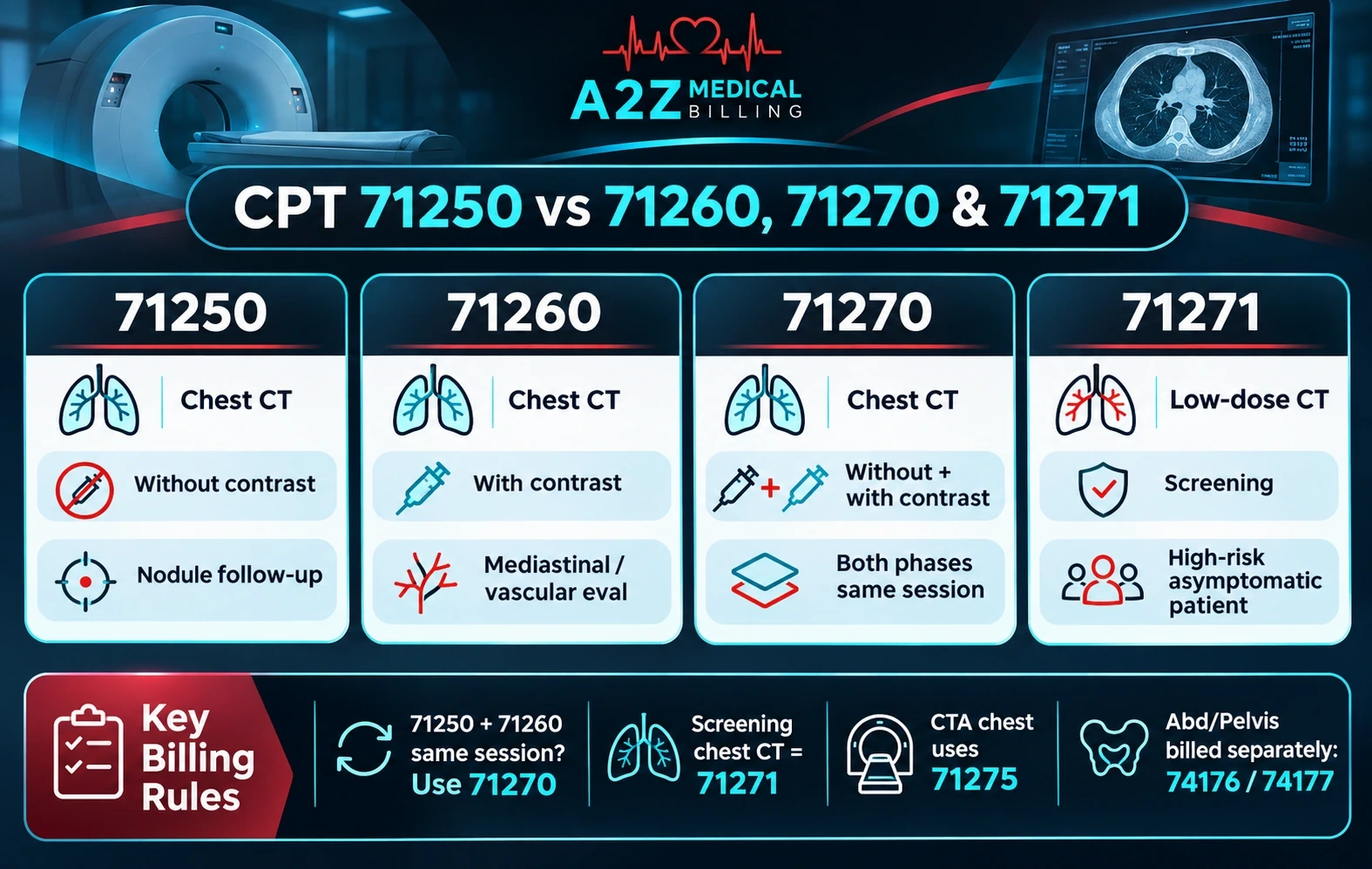
Four codes cover most chest CT claims, and the contrast status of the scan decides among them.
| Code | Descriptor in short | Typical use |
|---|---|---|
| 71250 | Diagnostic CT thorax, without contrast | Nodule follow-up, interstitial lung disease, pleural disease |
| 71260 | Diagnostic CT thorax, with contrast material(s) | Mediastinal evaluation, vascular and oncologic questions |
| 71270 | Diagnostic CT thorax, without contrast, followed by contrast material(s) and further sections | Mass characterization needing both phases |
| 71271 | CT thorax, low dose, lung cancer screening, without contrast | Annual screening of asymptomatic high-risk patients |
When one session includes both a non-contrast and a contrast series, 71270 is reported. Billing 71250 and 71260 together for the same session is a common error, and payers treat the two as mutually exclusive. CT angiography of the chest, noncoronary, has its own code, 71275.
The screening line matters most. Per ACR guidance and the Medicare national coverage determination for lung cancer screening (NCD 210.14, implemented through MLN Matters MM12691), screening scans use 71271 and need to meet separate eligibility rules. A scan billed as 71250 when the record calls it screening is likely to deny, even if the patient has risk factors. The reverse is also a problem: a diagnostic scan billed under a screening code is a compliance issue.
Abdominal and pelvic imaging are frequently conducted in conjunction with a chest CT scan. These studies are presented on separate lines and have their own codes, 74176 for CT of the abdomen and pelvis without contrast and 74177 with contrast. The payer's policy and the claim scrubber should be examined because payer edits on same-day combinations differ.
Modifiers relevant to 71250
A modifier is not necessary for every claim under CPT 71250. The person doing the work determines which one is required.
71250 is billed worldwide without a modifier when a single organization both owns the scanner and interprets the study. The facility bills 71250-TC and the radiologist bills 71250-26 when a hospital or imaging center performs the scan and a radiologist reads it independently. The report and interpretation are covered under Modifier 26. The equipment, materials, and technician are covered by Modifier TC.
There are two less common repeat-service modifiers. When the same doctor performs the scan again on the same day of service, Modifier 76 is applied. When a different doctor repeats it that day, Modifier 77 is utilized. Payers interpret same-day repeats as duplicates unless otherwise indicated, therefore either one requires a recorded explanation in the record.
Medicare coverage for CPT 71250
Medicare covers 71250, with limits. Palmetto GBA's local coverage determination for computerized axial tomography of the thorax (L33459) and its billing and coding article (A56580) list the clinical indications and the ICD-10 diagnosis codes that support medical necessity. If the diagnosis on the claim is not on the article's list, the claim can deny.
Diagnosis codes such as R91.1 (solitary pulmonary nodule), R04.2 (hemoptysis), and J90 (pleural effusion) are examples of the type of code involved, but the current article is the only reliable list. Other Medicare Administrative Contractors publish their own policies, so the jurisdiction of the billing provider decides which document applies.
Commercial plans add their own rules. Blue Cross Blue Shield of Florida's medical guideline 04-70450-21 (reviewed June 2025), for example, limits oncologic CT thorax imaging under 71250 through 71270 to four scans per coverage period. Many plans also route chest CT through a radiology benefit manager, which means prior authorization may apply before the scan is scheduled.
Reimbursement for CPT 71250
Under the rules put forward by the American Medical Association, Medicare Bills CPT Code 71250 under the Physician Fee Schedule. MPFS takes RVUs into account by multiplying them with a conversion factor. This also takes the overhead costs into consideration, so reimbursement in a clinic in an Urban setting will be a tad higher.
In recent years, the rates have decreased. According to Healthcare Administrative Partners' research of radiology practices, Medicare payment for 71250 decreased by 3.78% between 2024 and 2025. In the final rule released in the Federal Register on November 5, 2025 (2025-19787), CMS determined two conversion factors for 2026, one for participants in eligible alternative payment models and one for everyone else. The CMS Physician Fee Schedule lookup tool provides the current dollar amount for a certain locality.
Denial triggers and documentation
Most 71250 denials come from a short list:
- A diagnosis code that is not on the payer's supported list
- The record describes a screening exam but the claim uses 71250
- 71250 and 71260 billed for the same session
- A repeat scan without a documented change in condition
- No prior authorization where the plan requires one
- Professional and technical components billed by the wrong party
The chart should back up every line. It needs a signed order with the clinical indication, the symptoms or prior finding that prompted the scan, a statement that no contrast was given, a comparison to earlier imaging when it exists, and a signed radiology report. For repeat scans, the note should say what changed since the last study.
FAQs about CPT 71250
Does CPT 71250 need a modifier?
Not by default. A globally billed service carries no modifier. Modifier 26 goes on the radiologist's interpretation claim and modifier TC on the facility's technical claim. Modifiers 76 and 77 apply to same-day repeat scans.
Is CPT 71250 covered by Medicare?
Yes, with limits. Coverage depends on a local coverage determination, such as Palmetto GBA's L33459 and article A56580, and the diagnosis on the claim has to match the indications listed there.
What is the difference between CPT codes 71250 and 71260?
The contrast material. 71250 is a chest CT without contrast and 71260 is a chest CT with contrast. A session with both a non-contrast and a contrast series is reported as 71270.
Can CPT 71250 be used for lung cancer screening?
No. Low-dose CT screening of eligible patients is reported with 71271, and some payers still accept the older HCPCS code G0297. 71250 is a diagnostic code.