
Since Jan. 1, 2023, Medi-Cal has covered doula care. After three years, the benefit pays a doula up to $3,152.65 for a single vaginal birth client under the fee-for-service rate, and more for a C-section. The toughest thing is getting the money.
To charge Medi-Cal, a doula has to get through four independent gates: an NPI, state enrollment via the PAVE portal, credentialing and contract with each managed care plan, and then clean claims with the correct procedure code, modifier and diagnosis code. Each gate has a different set of rules. Miss one and the claims are dismissed again.
This tutorial takes you through all of the steps in the order that a doula really goes through using the current rules issued by the California Department of Health Care Services (DHCS). It also addresses the most frequently asked questions from doulas about rates, visit limitations, denials and how the 2027 MCO tax shift would affect pay.
Who can bill Medi-Cal as a doula?
Any doula who meets the baseline criteria set by the DHCS and registers as a Medi-Cal provider can bill. In California, doulas do not need to be licensed by the state and the DHCS does not need certification from any one training organization. Applicants must be 18 years or older, have current adult and infant CPR certification from the American Red Cross or American Heart Association and certify completion of basic HIPAA training. There are two paths to becoming a doula.
The training track includes 16 hours of training in lactation support, birthing education, anatomy of pregnancy and childbirth, nonmedical comfort measures and labor support techniques, and developing a list of community resources. The candidate additionally certifies that she has attended 3 or more births as a birth doula.
The experience pathway is for doulas who have worked, paid or volunteer, for at least five of the last seven years. It requires three testimonial or recommendation letters written within the last seven years, and at least one must come from a licensed provider, a community-based organization or an enrolled doula. DHCS publishes letter templates on its Doula Application Information page.
After enrollment, every doula needs three hours of continuing education in maternal, perinatal or infant care every three years, and must be able to show proof if DHCS asks.
Step 1: Get an NPI with the doula taxonomy code
DHCS requires every doula to have a National Provider Identifier before enrolling. The NPI is free and is issued through the federal NPPES registry.
When filling out the NPI application, choose taxonomy code 374J00000X (Doula) as the primary taxonomy. Managed care plans check this field during credentialing, and Partnership HealthPlan of California lists taxonomy codes as a required part of a clean doula claim in its 2026 doula billing training. A doula who picked a different taxonomy years ago for another role should update the record in NPPES before starting PAVE.
A doula who plans to bill as a group, with several doulas working under one business, needs a Type 2 (organization) NPI for the group plus a Type 1 NPI for each individual doula.
Step 2: Enroll in Medi-Cal through the PAVE portal
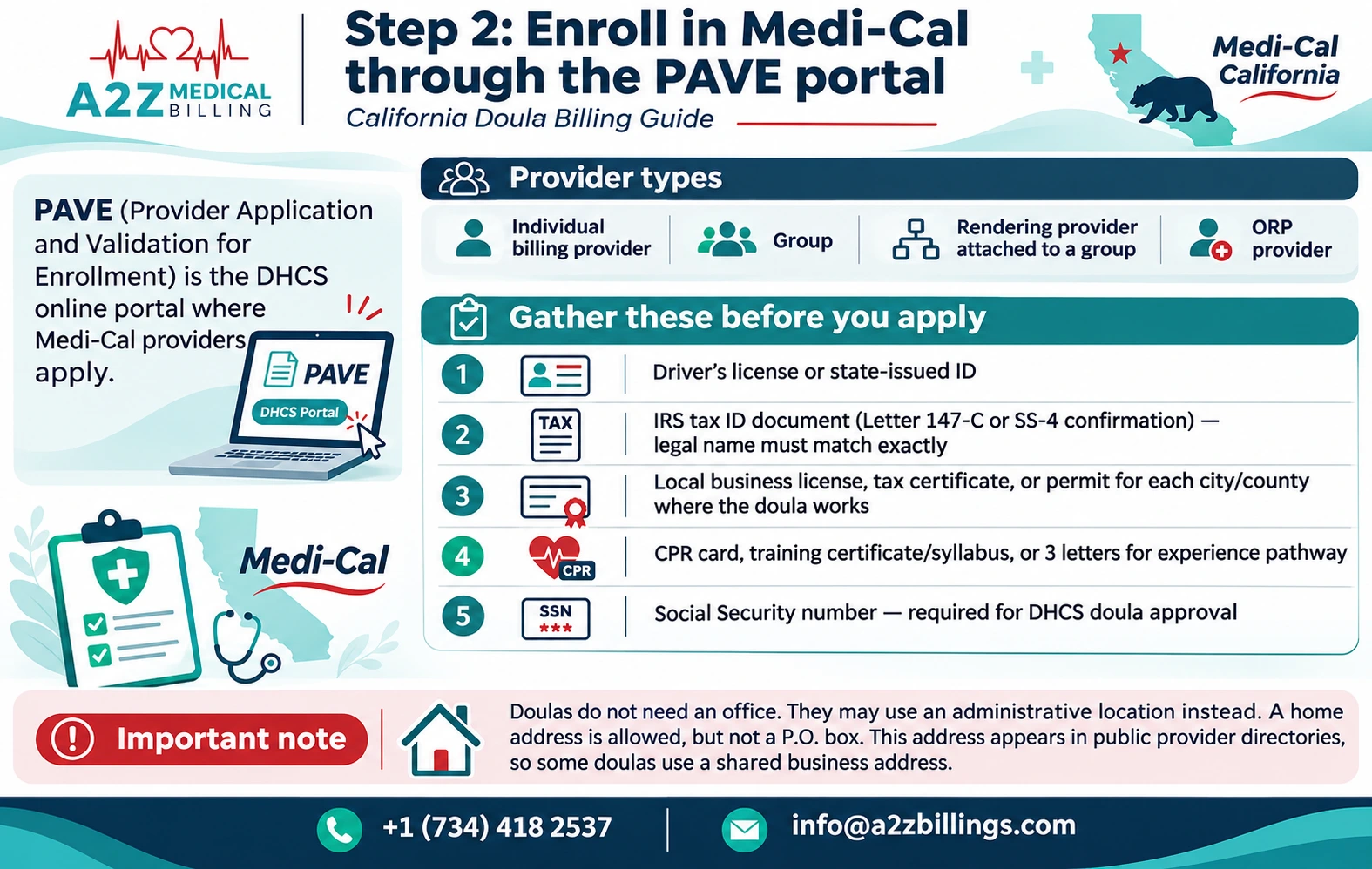
PAVE (Provider Application and Validation for Enrollment) is the DHCS online portal where every Medi-Cal provider applies. Doulas can enroll as an individual billing provider, a group, a rendering provider attached to a group, or an ordering/referring/prescribing (ORP) provider.
Before opening the application, gather these documents. DHCS asks that every attachment be legible and that names and addresses match across documents.
- A driver's license or state-issued ID.
- An IRS-generated document confirming the business tax ID, such as Letter 147-C or the SS-4 confirmation notice. The legal name on the application must match the IRS document exactly.
- A local business license, tax certificate or permit for each city or county where the doula works, with the same business name and address used in PAVE.
- The CPR card, the training certificate or syllabus (training pathway), or the three letters (experience pathway).
- A Social Security number. DHCS states it can only approve doula applications that include an SSN.
Doulas do not need an office. DHCS exempts them from the usual place-of-business rule and lets them report an "administrative location" instead, which can be a home address but not a P.O. box. That address appears in public provider directories, so some doulas use a shared business address.
Step 3: Get credentialed and contracted with Medi-Cal managed care plans
PAVE approval lets a doula bill fee-for-service Medi-Cal. It does not, by itself, get a doula paid for members enrolled in a managed care plan (MCP), and most Medi-Cal members are in one. DHCS counted roughly 15.2 million beneficiaries in managed care across all 58 counties in its April 2024 doula workgroup update.
DHCS describes three separate requirements for managed care billing in its managed care doula FAQ:
- Enrollment as a Medi-Cal provider through PAVE.
- Credentialing by each plan, which is a federal requirement. Plans re-verify credentials every three years.
- A signed contract with each plan, called a Network Provider Agreement.
These steps do not carry over automatically. A plan can rely on PAVE screening to avoid repeating work, but it still has to complete its own credentialing, and DHCS says plans are not required to contract with every PAVE-enrolled doula. Doulas can contract with several plans, depending on which plans operate in the counties they serve.
The doula provider training at Molina Healthcare of California specifically outlines the order: satisfy the minimal qualifications, receive an NPI, enroll in PAVE, sign a contract with Molina, complete onboarding, and then verify member eligibility before each visit. Partnership HealthPlan, Health Plan of San Mateo and California Health & Wellness also have doula billing or referral instructions posted, so check each plan’s provider site before calling.
What doula services does Medi-Cal cover, and do clients need a recommendation?
Federal rules treat doula care as a preventive service, which means it needs a written recommendation from a physician or other licensed practitioner. California removed that hurdle for most visits. On November 1, 2023, DHCS Medical Director Dr. Karen Mark signed a statewide standing recommendation covering every Medi-Cal member who is pregnant or was pregnant within the past year. Doulas should note the standing recommendation in each client's record.
The standing recommendation authorizes, per pregnancy:
- one initial visit of at least 90 minutes
- up to eight more visits, prenatal or postpartum in any mix
- support during labor and delivery (including stillbirth), miscarriage or abortion
- up to two extended three-hour postpartum visits
A second recommendation unlocks up to nine additional postpartum visits. It can be written in the member's medical record by a licensed provider or signed on the DHCS form titled "Medi-Cal Doula Services Recommendation: Additional Postpartum Visits." The recommending provider does not need to be enrolled in Medi-Cal or be in the member's plan network. Some plans, Partnership HealthPlan among them, also require a Treatment Authorization Request for these extra visits.
New billers run into a few constraints. Members are allowed only a single visit each day. The limits are per pregnancy, not per doula, so if two doulas share a client, they’re pulling from the same pot and only one of them can bill for labor, miscarriage or abortion support. Doula care postpartum support time is one year after the pregnancy ends. Covered doula services extend up to one year postpartum. Services can be rendered in person or via telehealth, across all birth and postpartum settings including homes, offices, hospitals, and birth centers.
Medi-Cal doula billing codes, modifiers and diagnosis codes
Medi-Cal doulas bill 9 procedure codes. 3 things need to be on each line of the claim: procedure code, modifier XP, and an acceptable ICD-10 diagnosis code. doulas use the same codes that physicians and midwives use for maternity care, and the XP modifier notifies the payer the treatment originated from a doula, not a licensed practitioner. DHCS needs XP on fee-for-service and managed care claims.
Since November 1, 2024, a claim without a diagnosis code, or with a diagnosis code that does not match the procedure code, is denied. Doulas do not diagnose anyone, so DHCS built a crosswalk of general codes that describe what happened at the visit. The table below follows the crosswalk in the Medi-Cal Provider Manual: Doula Services.
| Code | Service | Limit | Allowed ICD-10 codes |
|---|---|---|---|
| Z1032 | Extended initial visit, 90 minutes | 1 per pregnancy | Z32.2, Z32.3, Z39.1, Z39.2 |
| Z1034 | Prenatal or postpartum visit | Up to 8 | Z32.2, Z32.3 |
| 59409 | Support during vaginal delivery | 1 per pregnancy (bill one delivery code only) | Z33.1, Z39.0 |
| 59612 | Support during vaginal birth after cesarean | 1 per pregnancy | Z33.1, Z39.0 |
| 59620 | Support during cesarean birth | 1 per pregnancy | Z33.1, Z39.0 |
| T1033 | Support during or after miscarriage | 1 per pregnancy | Z33.1 only |
| 59840 | Support during or after abortion | 1 per pregnancy | Z33.1 only |
| T1032 | Extended three-hour postpartum visit | Up to 2 | Z39.0, Z39.1, Z39.2 |
| Z1038 | Additional postpartum visit | Up to 9, second recommendation required | Z39.0, Z39.1, Z39.2 |
On the CMS-1500 form, the diagnosis code goes in field 21A and is entered without the decimal point (Z331, not Z33.1), as both Partnership HealthPlan and Health Plan of San Mateo instruct. Z1032, Z1034 and Z1038 are Medi-Cal-specific codes, so other payers will usually reject them.
Medi-Cal doula reimbursement rates for 2026
The 2026 fee-for-service rates are the Targeted Rate Increase (TRI) rates that took effect for services on or after January 1, 2024. DHCS last updated its doula billing codes chart in April 2026 and still lists these as current.
| Code | Service | Rate before TRI | Current rate per visit |
|---|---|---|---|
| Z1032 | Initial visit, 90 minutes | $126.31 | $197.98 |
| Z1034 | Prenatal or postpartum visit | $60.48 | $162.11 |
| 59409 | Vaginal delivery support | $544.72 | $685.07 |
| 59612 | VBAC support | $544.72 | $768.69 |
| 59620 | Cesarean support | $544.72 | $795.73 |
| T1033 | Miscarriage support | $250.85 | $250.85 |
| 59840 | Abortion support | $250.85 | $250.85 |
| T1032 | Extended postpartum visit | $180.00 | $486.36 |
| Z1038 | Additional postpartum visit | $60.48 | $162.11 |
Using every visit the standing recommendation allows, a doula can earn up to $3,152.65 per vaginal birth client, $3,236.27 for a VBAC and $3,263.31 for a cesarean. With a second recommendation and all nine extra postpartum visits, DHCS adds another $1,458.99. The 2023 maximum, before the increase, was $1,514.87.
Managed care plans pay their contracted rates. DHCS required plans to pay the TRI to eligible network providers and to attest by December 31, 2024 that they had done so (All Plan Letter 24-007). Doulas paid under a letter of agreement are not guaranteed the TRI.
Will Doula rates change in 2027?
The TRI is supported using California’s managed care organization (MCO) tax, and the current iteration of that tax expires December 31, 2026. Federal reforms under H.R. 1 prohibited taxes that charged Medi-Cal plans more than commercial plans, and so the old system could not continue.” Governor Newsom signed SB 125 on June 29, 2026, which imposes a flat tax of $8.85 per enrollee per month for 2027 through 2029, commencing January 1, 2027 or upon federal approval, whichever is later. That revenue is essential to sustaining the 2024 rate increases for maternity care in the 2026-27 Budget Act. Until CMS authorizes the new tax, take 2027 doula rates as “expected but not final” and consult the DHCS table in January.
How to submit a doula claim: fee-for-service vs. managed care
The first question on every claim is who pays. Check the member's eligibility before each visit, because the answer decides where the claim goes.
Enrolled doulas will charge DHCS directly for fee-for-service Medi-Cal participants electronically or on a hardcopy CMS-1500. Claim Forms and Training Doula: Training and Medi-Cal Providers portion of the DHCS website.
If the member is in a managed care plan, the claim is sent to that plan and processed via the plan’s own process. For example, Partnership HealthPlan receives electronic claims via Office Ally or hardcopy CMS-1500 forms. Each plan trains their hired doulas on clean claims and requires plans to accept bills from doulas that are not able to submit electronically.
Timely filing is rigid. Under Welfare and Institutions Code section 14115, fee-for-service Medi-Cal claims are subject to a six-month time limit from the month of service. Late claims (without approved reason for delay) are paid at 75% in the 7th, 8th and 9th months and at 50% in the 10th, 11th and 12th months and refused thereafter. Managed care plans have their own deadlines that are established in the provider contract, so read that section before the first claim is submitted.
Once a plan receives a clean claim, state law gives it 30 days to pay. A plan that misses that window owes interest under All Plan Letter 23-020 and Health and Safety Code section 1371.
Why doula claims get denied, and how to fix them
Denials hit doulas hard. In a March 2025 LAist report, a San Gabriel Valley doula estimated she had been paid for less than 10% of the Medi-Cal services she provided since the previous June, and doula groups sent DHCS a letter describing denied and delayed claims. The DHCS and plan billing rules point to seven errors worth checking before any claim goes out.
- A missing diagnosis code, or one that does not match the procedure code. Check every line against the crosswalk table above; T1033 and 59840 accept only Z33.1.
- A missing XP modifier. DHCS requires it on every doula claim line, in fee-for-service and managed care.
- A visit limit has already been reached. Limits are per pregnancy, so another doula's visits count too. Ask new clients early whether they have worked with another doula during this pregnancy.
- Z1038 billed without a second recommendation. Keep the signed DHCS form or the licensed provider's chart note on file before the first additional postpartum visit.
- The wrong payer. Members change plans or move from fee-for-service into managed care, so recheck eligibility at each visit.
- No contract with the plan. A PAVE-enrolled doula without a Network Provider Agreement cannot collect contract rates from that plan.
- An NPI or taxonomy mismatch. The NPI on the claim must match PAVE and the plan's credentialing file, with taxonomy 374J00000X.
When a plan denies or ignores a clean claim, file a provider dispute resolution (PDR) with the plan.
Frequently asked questions about Medi-Cal doula billing
Do I need a dual certification to enroll in Medi-Cal as a Doula?
No particular certification is required. Doulas qualify with 16 hours of training in the required topics plus three attended births, or with five years of doula work in the last seven years plus three letters.
Can I bill Medi-Cal without a managed care contract?
Yes, for members in fee-for-service Medi-Cal. Members enrolled in a managed care plan are billed to that plan, which requires credentialing and a Network Provider Agreement.
Do doulas need liability insurance to enroll?
DHCS does not require individual doulas to carry insurance for fee-for-service enrollment. Managed care plans set their own contract terms, so check each plan's agreement.
What modifier do doulas use on Medi-Cal claims?
XP, on every line, for both fee-for-service and managed care claims.
Can two doulas bill for the same client?
Yes. Visit limits apply per pregnancy, though, and only one doula can bill for labor, miscarriage or abortion support.
Does Medi-Cal cover doula support for miscarriage, stillbirth or abortion?
Yes. Support during or after a miscarriage bills under T1033, abortion support under 59840, and labor resulting in a stillbirth under the delivery codes. Postpartum visits after any of these outcomes are also covered.
Can doula visits be done by telehealth?
Yes. DHCS allows visits in person or virtually, in any setting including a home, office, hospital or birth center.