

The EOB lists a "fee schedule" adjustment and two reduction codes. Nobody at the front desk can say if they're right.
Most Michigan no-fault billing problems look like this. The insurer has a bill review vendor repricing every line. Your clinic has one biller and no time. This post walks through how those cuts work by specialty, and where the insurer's math tends to go wrong.
For expert legal advice, please hire a legal attorney. We only look after the billing aspect.
What no-fault billing is ?
Michigan's no-fault law took effect on October 1, 1973. Under it, a crash patient's own auto insurer pays their medical bills through personal injury protection (PIP), no matter who caused the accident. No-fault billing just means sending those claims to the auto insurer instead of the health plan. For more than 45 years, every policy carried unlimited lifetime medical coverage and providers were paid a "reasonable" charge. The 2019 reform changed both. Drivers have been able to pick lower PIP limits since July 2020, and payments have been capped by a fee schedule since July 2021. Since then, clinics have been getting smaller checks and more denials on these claims, and far more questions from the insurer.
How the insurer prices your claim
You bill your normal charge. The insurer ignores it and reprices each line.
For any code Medicare pays, the Michigan no-fault fee schedule caps payment at 190% of the Medicare amount for most providers. That rate comes from MCL 500.3157 and applies to current dates of service.
For services Medicare doesn't pay at all, the cap is 52.5% of what you charged on January 1, 2019, raised each year for medical inflation.
So the first check on any PIP claim is simple. Take the Medicare allowed amount for the code, multiply by 1.9, and compare.
Two things go wrong at this step more than any other:
- Wrong locality. Medicare splits Michigan into Detroit and the rest of Michigan, and Detroit rates run higher. A clinic in Southfield priced at the outstate rate is short on every line.
- Sequestration. Medicare's 2% sequestration cut doesn't belong on a no-fault payment. The statute excludes it by name.
The cuts that come after the cap
The cap is only the starting number. Insurers then apply Medicare's own payment rules, and the Michigan Court of Appeals said in a published 2025 opinion that they can. That covers the multiple procedure payment reduction (MPPR), bundling edits and billing modifiers.
So you can't fight the fact that these cuts exist. You can fight how they were calculated, and bill review software gets that wrong often enough to be worth checking.
Physical therapy no-fault billing
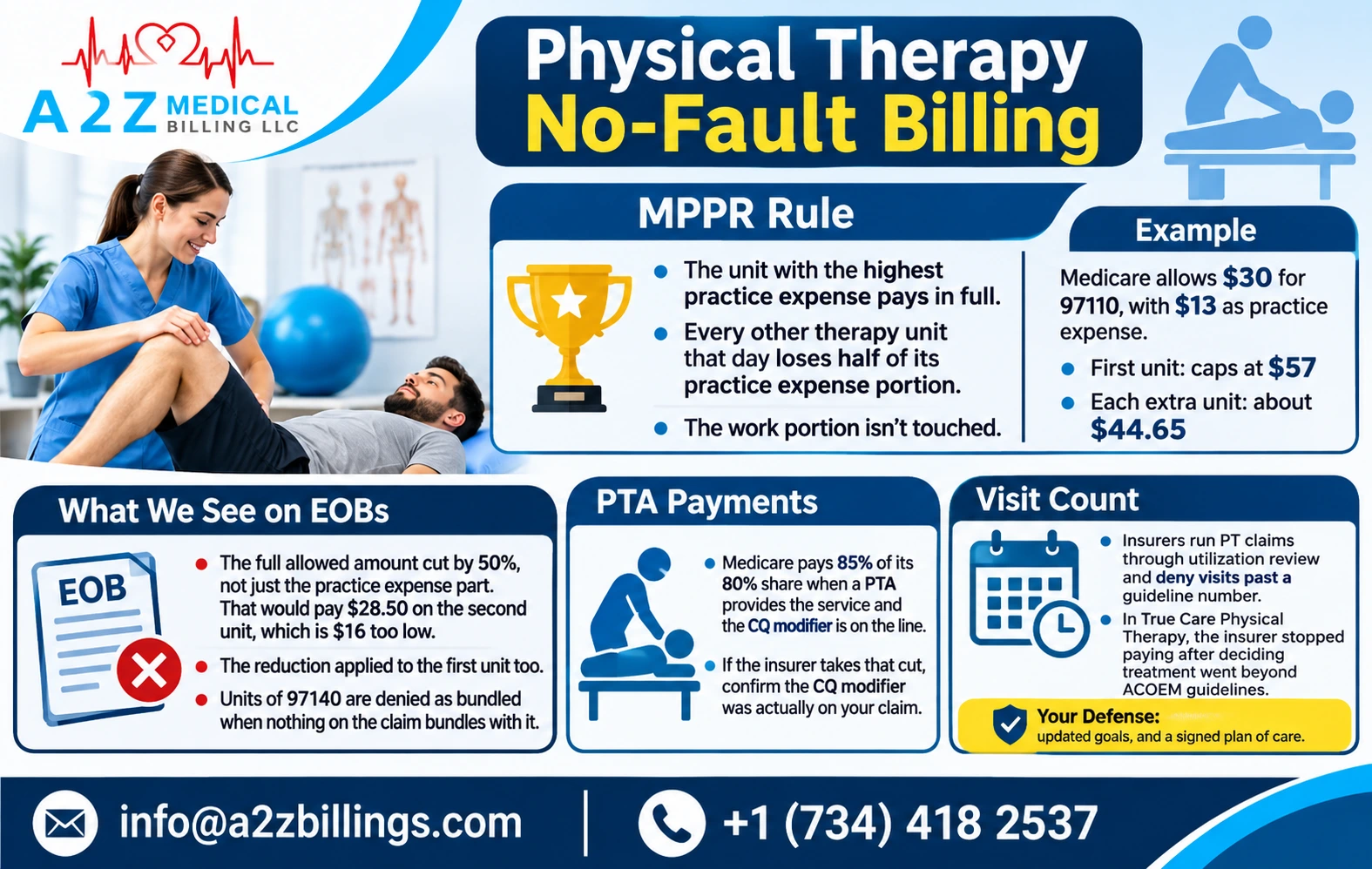
PT clinics take the biggest MPPR hit, because almost everything they bill is on Medicare's therapy list.
Here's how it should work. The unit with the highest practice expense pays in full. Every other therapy unit that day loses half of its practice expense portion. The work portion isn't touched.
An example with round numbers: say Medicare allows $30 for a unit of 97110, and $13 of that is practice expense. The first unit caps at $57. Each extra unit should cap at about $44.65.
What we see on EOBs instead:
- The full allowed amount was cut by 50%, not just the practice expense part. That would pay $28.50 on the second unit, which is $16 too low.
- The reduction applied to the first unit too.
- Units of 97140 are denied as bundled when nothing on the claim bundles with it.
PT assistants are another one. Medicare pays 85% of its 80% share when a PTA provides the service and the CQ modifier is on the line. If the insurer takes that cut, confirm the CQ modifier was actually on your claim.
Then there's the visit count. Insurers run PT claims through utilization review and deny visits past a guideline number. In True Care Physical Therapy, the insurer stopped paying after deciding treatment went beyond ACOEM guidelines. Your defense is the chart: measurable progress, updated goals, a signed plan of care.
No-fault billing for chiropractors
Chiropractors deal with a problem the other specialties don't have. Under MCL 500.3107b, a no-fault insurer only has to pay for chiropractic services that fell inside the scope of practice as Michigan defined it on January 1, 2009.
Spinal manipulation (98940 to 98942) is inside that scope. Insurers often deny newer services by pointing to the 2009 date. Before you write those off, check whether the service really was outside the 2009 scope, because insurers apply that denial broadly.
The second issue is bundling. Medicare's edits treat 97140 as part of the manipulation when both are done on the same region. If you did manual therapy on a different region, the note has to name the region and the line needs modifier 59 or XS. Without both, expect a denial.
Chiropractic offices that bill therapy codes get MPPR too. ChiroOne Centers of Michigan was one of the providers in the 2026 Court of Appeals case that confirmed it.
Speech therapy and OT after a crash
Speech-language pathologists mostly see no-fault patients after a brain injury. Two billing details matter here.
First, 92507 is an untimed code. It pays once per day no matter how long the session runs. Clinics that bill it in units get the extra units denied, and that denial is correct.
Second, MPPR crosses disciplines. If the same clinic bills PT, OT and speech for one patient on one day, the reduction runs across all of it. Only one unit in the whole day pays in full. Rehab programs that schedule all three back to back often don't realize how much that costs them.
Cognitive rehab codes (97129 and 97130) follow the same rule. OT lines need the GO modifier and speech lines need GN, or the bill review system may reject them before pricing.
One more point for brain injury programs. Many of these patients were hurt years ago. Anyone injured before June 11, 2019 falls outside the fee schedule after Andary v. USAA. Their care should be paid at a reasonable charge, not 190% of Medicare. We'd check every long-term patient's injury date against how their claims are being priced.
Home care and attendant care
Home health aide and skilled nursing visits have a Medicare rate, so DIFS says the Medicare-based cap applies (Bulletin 2026-15-INS).
Attendant care has no Medicare rate. It pays at 52.5% of your January 2019 charge plus the yearly CPI increase. Check that the increase was added. Family-provided care is limited to 56 hours a week unless the insurer agrees to more.
A quick check by specialty
| Specialty | First thing to check on the EOB |
|---|---|
| Physical therapy | MPPR taken on practice expense only, and not on the first unit |
| Chiropractic | 2009 scope denials, and 97140 bundled with manipulation |
| Speech therapy | MPPR shared with PT and OT lines the same day |
| Occupational therapy | GO modifier present, MPPR math |
| Home health | 190% of the Medicare visit rate |
| Attendant care | CPI increase on the 2019 charge |
When the insurer questions your care
Utilization review runs on short deadlines, and missing one can cost you the claim:
- The insurer has 30 days from getting your bill to ask for a written explanation.
- You have 30 days to answer.
- The insurer has 30 days to send its decision.
- You have 90 days to appeal to DIFS on form FIS 2356.
DIFS only hears disputes about how much care was given or what it cost. A plain coding denial goes back to the insurer.
Don't let unpaid PIP claims sit, either. Under the one-year-back rule, you generally can't recover for care given more than a year before a lawsuit is filed.
Frequently asked questions
Does the Michigan no-fault fee schedule apply to chiropractors and physical therapists?
Yes. Both are priced at 190% of the Medicare amount for each code, then reduced by MPPR and bundling edits where they apply.
Can we bill the patient for what the auto insurer didn't pay?
Generally no. In Auto-Owners v. Compass Healthcare, the Court of Appeals stopped a provider from collecting a balance bill from a crash patient. Dispute the payment with the insurer instead.
Can the insurer apply MPPR to speech therapy?
Yes. Speech codes are on Medicare's therapy list, and the reduction is shared with any PT or OT your clinic billed for that patient the same day.
Our patient was injured in 2016. Does the fee schedule apply?
No. Injuries before June 11, 2019 are paid under the older reasonable charge standard. If those claims are being repriced to Medicare rates, review them.
We're in the insurer's network. Can they take both discounts?
They shouldn't. The insurer can pay the contract rate or the fee schedule rate. It can't reprice to the fee schedule and then take the network discount off that lower number.
Want a second look at your EOBs?
We at A2Z Billings handle auto accident billing for PT, chiropractic, speech and rehab clinics across Michigan. Send us 90 days of no-fault EOBs. We'll re-run the math on each line and show you which payments look short and why.