A Michigan BCBA can hold valid BACB certification and still be unable to bill a single claim. The state treats certification and licensure as separate credentials, and every payer then runs its own enrollment on top of both. A missed step early in the sequence, such as a license still pending or a lapsed CAQH attestation, holds up every application behind it.
This guide covers the order of operations for behavior analysts and ABA practice owners in Michigan, from the state license through Medicaid and commercial panels.
The sequence at a glance
| Step | System | What it depends on |
|---|---|---|
| 1. State license | LARA (MiPLUS) | Active BACB certification |
| 2. NPI | NPPES | Matching name, address, and tax ID |
| 3. CAQH profile | CAQH Provider Data Portal | License, certificate, malpractice face sheet |
| 4.Medicaid enrollment | CHAMPS | License, NPI, taxonomy code |
| 5. Medicaid network | PIHP or CMHSP, Medicaid Health Plans | Active CHAMPS enrollment |
| 6.Commercial panels | Each payer’s portal | Attested CAQH profile |
Phase 1: Preparation before any payer submission
BACB certification and Michigan state licence
Applied behaviour analysis practice has been required to be licensed since January 7, 2020 per Public Act 403 of 2016. A BCBA must not only be certified, but also must be eligible to practise and bill.
Applications are made via the MiPLUS application system at LARA. The BACB sends a copy of the certification immediately to LABA and the applicant completes a criminal background check and 2 hours of implicit bias training. LARA’s licensing guide says the application fee including a four-year licence is $452.40 and renewal is $374.40.
There are two renewal clocks running at the same time. BACB certification is a two year renewal and the state licence is a four year renewal. To be eligible for Medicaid, both have to be current. The behavioural health treatment Medicaid state plan amendment for Michigan states that the provider must be currently BACB certified and licensed in Michigan.
NPI and Taxonomy Codes
A solitary BCBA needs a Type 1 NPI number for a Behaviour Analyst (taxonomy code 103K00000X). A group, LLC or agency billing under its own tax ID requires a Type 2 or Organisational NPI. The legal name, practice address, tax ID and taxonomy must be consistent on NPPES, IRS letter, CAQH, CHAMPS and all contracts. Codes 97151 – 97155 A generic mental health taxonomy on an ABA claim is often a source of denials.
CAQH profile
CAQH ProView is now the CAQH Provider Data Portal. Profile must include LARA licence, BACB certificate, diploma, W-9, malpractice insurance face sheet. Then you have to authorise each payer to view it. A payer reporting it cannot access a profile is typically unauthorised or the attestation has expired.
The profile must be attested every 120 days. If the deadline is missed, the profile status is changed to Expired. Some credentialing guides suggest a 90-day reminder as a buffer.
Phase 2: Michigan Medicaid
Medicaid ABA in Michigan is offered within the community mental health system and not through a single front door. Families begin with their local CMHSP or PIHP which is responsible for evaluation, eligibility and prior authorisation for behavioural health treatment. Services must be given under the guidance of a licensed behaviour analyst.
Enrolments in CHAMPS
According to the state plan amendment, providers participating in Medicaid deliver behavioural health treatment services, including ABA. You enrolll through a MiLogin account in CHAMPS, the state Medicaid enrolment and claims system. A BCBA enrols as a solitary proprietor (person) or as a rendering provider of a group or agency.
Application must have NPI, tax ID, licence and taxonomy that exactly match NPPES and IRS records. CHAMPS approval means eligibility with the state. It does not network the BCBA into any scheme.
Credentialing: PIHP and CMHSP
The Medicaid autism benefit is largely delivered through Prepaid Inpatient Health Plans (PIHPs) and County Community Mental Health Services Programs (CMHSPs). Examples include Detroit Wayne Integrated Health Network, Oakland Community Health Network and Macomb County Community Mental Health. A BCBA shall apply to the PIHP or CMHSP for each county in which services will be provided.
The application packet is also where to see how the network supervises RBTs and how unit-based codes such as 97153 are billed under the BCBA’s rendering ID. Rates are from the contract. For 97155 there is no state rate in Michigan and for 97153 only a minimum, the remainder is up to PIHP contracts. Therefore, the two networks may offer different prices for the same code.
The policy itself is changing. CMS approved state plan modification MI-25-0020 on February 19, 2026, with an implementation date of June 1, 2026. MDHHS has a policy notice proposed for May 2026 that identifies board-certified and licensed behaviour analysts among providers who may provide behavior-plan work and states that the PIHP provides prior authorisation when ABA is medically essential. That notice was a proposal so the wording in the Medicaid Provider Manual is the language to follow .
Medicaid Managed Care Plans
MHPs are Medicaid Health Plans that sit alongside the PIHP system. According to MDHHS’s explanation of the autism benefit, the MHPs provide the medical and physical assessments and screening. The proposed notification in 2026 adds that members who are determined to be ineligible for PIHP enrolment may be referred to the Medicaid Health Plan.
After CHAMPS is live, a practice that wants such referrals contracts with the MHPs individually uses the plan’s credentialing papers or the Michigan Association of Health Plans common enrolment form. Plans offered in the state include Priority Health Choice, Blue Cross Complete, McLaren, Meridian and Molina.
Phase 3: Market Insurance
Commercial coverage is based on a 2012 statute. Michigan Public Acts 99 and 100 of 2012 mandate Blue Cross Blue Shield, HMOs and other private insurers to provide ABA for autism under state-regulated plans. Because self-funded employer plans are not subject to state rules and might use alternate terminology, the member’s plan type should be included with each benefits check.
Blue Cross Blue Shield of Michigan and Blue Care Network
The BCBSM sequence begins with CAQH: completed, attested and authorised for BCBSM. Then, a request to participate goes through the BCBSM provider enrollment site, followed by a Blue Care Network practitioner or group contract once BCBSM replies.
Enrolling students is only half the job. A change of the plan’s rules in September 2026 says that Blue Cross commercial and Medicare Plus Blue plans require prior authorisation for outpatient ABA. The treatment provider must get authorisation for the member’s autism diagnostic evaluation prior to the member undergoing the evaluation. The licensed behaviour analyst must also be a provider for the member's health plan.
That last rule has led to actual denials. In a 2025 external review filing from Michigan’s Department of Insurance and Financial Services, BCBSM declined an ABA prior authorisation request because the treatment agency was not a participant with the local Blue Cross plan.
Priority Health and other commercial payors
Priority Health, Aetna, Cigna and UnitedHealthcare with Optum all do enrolment through their own provider portals with the CAQH profile linked and authorised. Each has its own rules to authorise, codes to cover, and age limits for ABA. So those are confirmed in writing before the first session. Approvals do not carry over from one payer to another.
Time lines
The most foreseeable move is licensing. According to one online ABA education directory, most Michigan applicants acquire the license within four to six weeks of submitting a complete application. No formal pledge is published by each agency and plan for CHAMPS, PIHPs, CMHSPs and commercial payers. Practices commonly plan in months, submit the LARA application first, and establish a tracker with application dates, follow-up dates and the contact person at each payer.
Common pitfalls
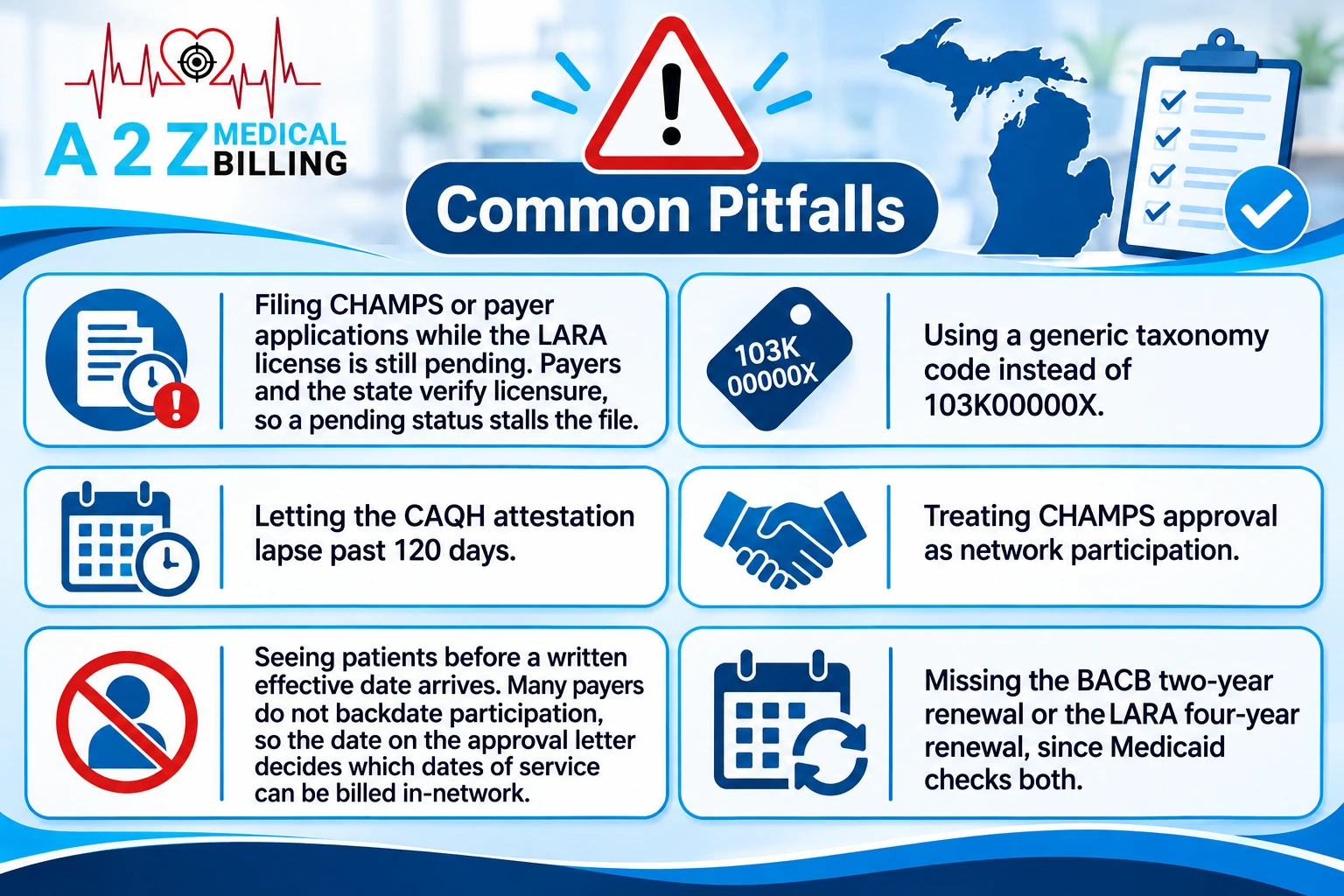
- Filing CHAMPS or payer applications while the LARA license is still pending. Payers and the state verify licensure, so a pending status stalls the file.
- Using a generic taxonomy code instead of 103K00000X.
- Letting the CAQH attestation lapse past 120 days.
- Treating CHAMPS approval as network participation.
- Seeing patients before a written effective date arrives. Many payers do not backdate participation, so the date on the approval letter decides which dates of service can be billed in-network.
- Missing the BACB two-year renewal or the LARA four-year renewal, since Medicaid checks both.
Frequently asked questions
Does a BCBA need a Michigan license to bill insurance?
Yes. Practicing ABA in Michigan has required a LARA license since January 7, 2020, and Medicaid lists both BACB certification and state licensure as qualifications.
Does CHAMPS enrollment put a BCBA in the Medicaid network?
No. CHAMPS confirms state eligibility. Network participation comes from contracting with the PIHP or CMHSP, or with a Medicaid Health Plan.
How often does CAQH need attestation?
 Every 120 days. A profile that misses the date changes to Expired status, and payers lose access to it.
Does BCBSM require prior authorization for ABA?
Yes, for Blue Cross commercial and Medicare Plus Blue plans, after the member completes an autism diagnostic evaluation.
What does the Michigan behavior analyst license cost?
LARA lists $452.40 for the application plus a four-year license, and $374.40 to renew.
Conclusion
A2Z Billings Credentialing services in Michigan moves in a fixed order: BACB certification, the LARA license, NPI and CAQH, then CHAMPS, then the PIHP, CMHSP, or MHP contract, and commercial panels alongside. A BCBA who files the LARA application first, keeps CAQH attested every 120 days, and holds a written effective date before the first billable session removes the most common causes of delay.