


The 96372 CPT code represents the administration of a therapeutic, prophylactic, or diagnostic injection. Healthcare providers and medical coders use this code to document injections delivered via subcutaneous or intramuscular routes. Properly applying the 96372 billing guidelines ensures accurate claim submission and prevents claim denials from Medicare and commercial payers.
CPT 96372 definition and description
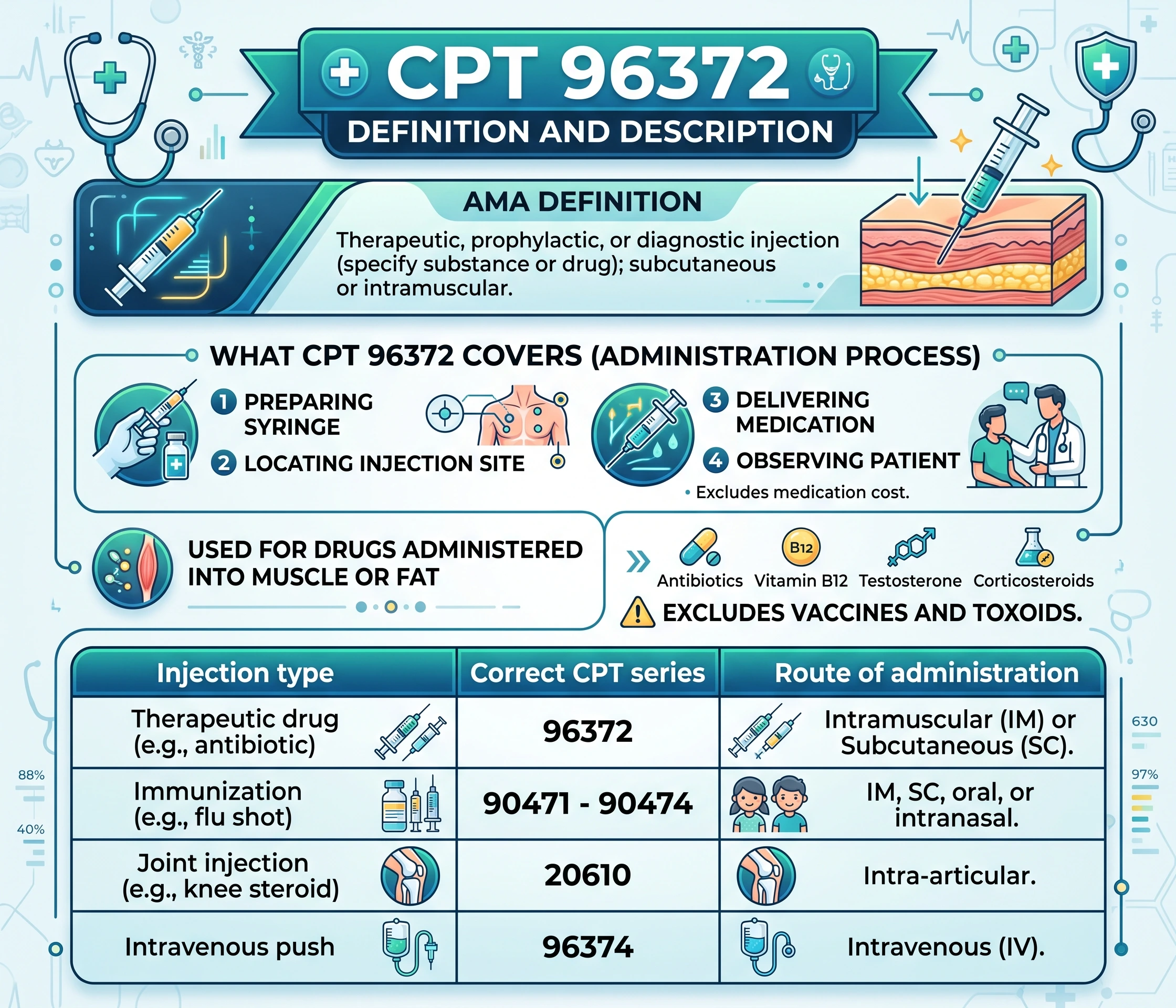
According to the American Medical Association (AMA), the CPT 96372 description is “Therapeutic, prophylactic, or diagnostic injection (specify substance or drug); subcutaneous or intramuscular.”
This CPT 96372 definition applies strictly to the administration process. It does not cover the cost of the medication itself. The code designates the physical work and practice expense involved in preparing the syringe, locating the injection site, delivering the medication, and observing the patient for immediate adverse reactions.
The code specifically excludes vaccines and toxoids. CPT 96372 is reserved for drugs like antibiotics, vitamin B12, testosterone, or corticosteroids administered directly into muscle or fat tissue.
Injection type | Correct CPT series | Route of administration |
Therapeutic drug (e.g., antibiotic) | 96372 | Intramuscular (IM) or Subcutaneous (SC) |
Immunization (e.g., flu shot) | 90471 – 90474 | IM, SC, oral, or intranasal |
Joint injection (e.g., knee steroid) | 20610 | Intra-articular |
Intravenous push | 96374 | Intravenous (IV) |
96372 billing guidelines and Medicare rules
Medicare pays for CPT 96372 under the Physician Fee Schedule when the service meets “incident to” requirements. According to the Centers for Medicare and Medicaid Services (CMS), billing a service incident to a physician’s professional services requires direct supervision.
Direct supervision means the physician is present in the office suite and immediately available to provide assistance. The physician does not need to be in the exact room where the clinical staff administers the injection. If the physician is entirely off-site, clinical staff cannot bill 96372 to Medicare under that provider’s National Provider Identifier.
Required documentation for CPT 96372
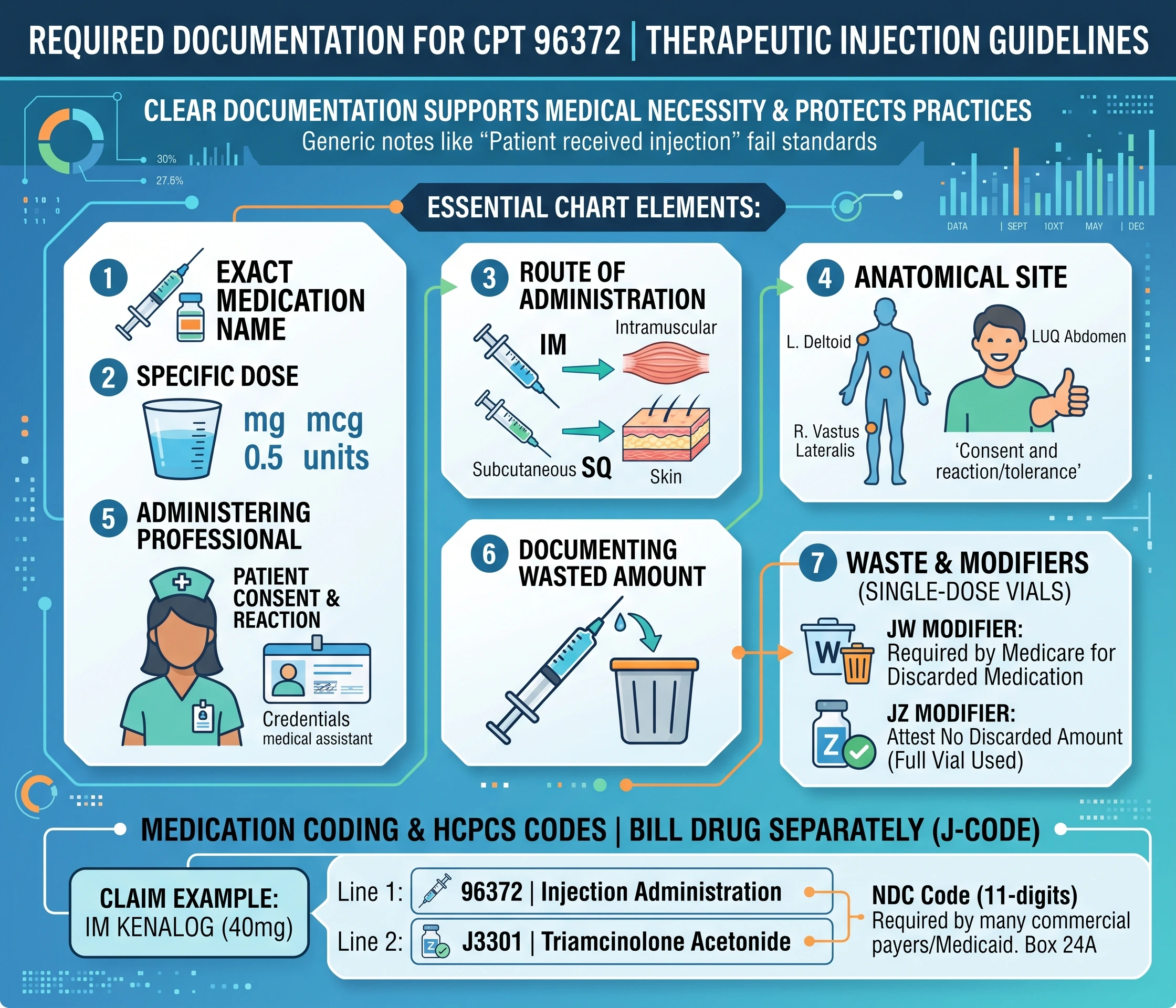
Clear CPT 96372 documentation supports medical necessity and protects practices during audits. The patient’s chart must contain specific details about the injection administration. A generic note stating “patient received injection” fails to meet CMS and commercial payer standards.
Required chart elements include:
- The exact name of the medication administered.
- The specific dose given measured in milligrams, micrograms, or units.
- The route of administration (intramuscular injection or subcutaneous injection).
- The anatomical site of the injection (such as the left deltoid, right vastus lateralis, or left upper quadrant of the abdomen).
- The identity and credentials of the professional administering the drug.
- The patient’s consent and their physical reaction or tolerance to the procedure.
If a practice uses a single-dose vial and discards a portion of the medication, the documentation must record the exact wasted amount. Medicare requires the JW modifier on the drug code line to reimburse for discarded medication from single-use vials. Providers must also use the JZ modifier to attest that there were no discarded amounts from a single-dose container when the full vial is administered.
Medication coding and HCPCS codes
CPT 96372 covers the physical work of giving the shot. Practices must bill the actual drug separately to receive payment for the substance. This requires a Healthcare Common Procedure Coding System (HCPCS) code, commonly known as a J-code.
For example, if a medical assistant administers 40 milligrams of Kenalog (triamcinolone acetonide) via intramuscular injection, the claim requires two separate lines. Line one lists 96372 for the administration. Line two lists J3301 for the triamcinolone medication.
Many commercial payers and state Medicaid programs also require the National Drug Code (NDC) in addition to the J-code. The NDC is an 11-digit number found on the medication packaging. When submitting the claim, billers place the NDC code in the electronic equivalent of box 24A on the CMS-1500 form.
96372 modifier use and bundling rules
Medical coders frequently ask if an Evaluation and Management (E/M) code like 99214 and 96372 can be billed together. The direct answer is yes. However, doing so requires specific documentation and modifier usage.
Does CPT 96372 need a modifier? The injection code itself rarely requires a modifier when billed alongside an E/M service. Instead, the modifier attaches to the E/M code. When a provider performs a separately identifiable E/M service on the same day as a 96372 injection, the biller must append modifier 25 to the E/M code (for example, 99214-25).
The medical record must show that the provider performed a significant evaluation distinct from the routine assessment required to safely administer the injection.
If a patient presents with a severe sore throat, fever, and swollen glands, the physician will take a history, perform an examination, and make a medical decision. If the physician diagnoses strep throat and orders an intramuscular injection of Rocephin (ceftriaxone), the practice bills the E/M with modifier 25, the 96372 administration code, and the J0696 drug code.
If the patient comes to the office solely for a scheduled weekly B12 shot and the provider does not perform a separate evaluation, the practice bills only 96372 and the medication code. Billing an E/M code without a separately identifiable service violates National Correct Coding Initiative (NCCI) directives.
CPT 96372 reimbursement Medicare and commercial coverage
Is 96372 covered by Medicare? Medicare Part B covers this code when the injection treats a diagnosed medical condition and meets all documentation standards.
The CPT 96372 reimbursement rate relies on Relative Value Units (RVU) established by CMS. For the 2024 calendar year, the total non-facility RVU for 96372 is 0.44. Multiplying this by the 2024 Medicare conversion factor (approximately $33.2875) yields a national unadjusted Medicare reimbursement of roughly $14.65.
This rate fluctuates based on the Geographic Practice Cost Index (GPCI). Practices located in regions with higher labor and overhead costs receive a slightly higher payment. Rural areas typically see a lower rate.
Commercial insurance companies set their own fee schedules. They often calculate their 96372 reimbursement at a percentage above the standard Medicare rate. Some commercial payers have policies that reduce the reimbursement for an E/M service by 50% when billed on the same day as a minor procedure like 96372.
96372 frequency limit and billing multiple units
Patients sometimes require more than one therapeutic injection during a single visit. The 96372 frequency limit allows providers to bill multiple units if they administer different drugs or the same drug in different anatomical sites.
When a nurse administers two separate injections, the biller lists 96372 twice. To indicate that the second injection is a distinct procedure, the coder appends modifier 59 (Distinct Procedural Service) or the XU modifier to the second administration line. The documentation must clearly state that the injections occurred in separate locations, such as the left deltoid and the right deltoid.
If a specific drug requires a larger volume than a single muscle can safely absorb, the nurse may divide the dose into two syringes and inject two separate sites. In this scenario, AMA guidelines permit billing two units of 96372 with the appropriate modifiers. Attempting to bill multiple units of 96372 for a single drug drawn into one syringe and administered in one location will result in an immediate claim denial.
Revenue codes and facility billing
Reimbursement rules shift depending on the place of service. When an independent clinic or private practice performs the injection, they bill the non-facility rate on a CMS-1500 form. When a hospital outpatient department administers the injection, the facility bills under the Outpatient Prospective Payment System.
In a hospital or facility setting, billers must use the appropriate 96372 revenue code on the UB-04 claim form. Revenue code 0761 (Treatment Room) or 0260 (IV Therapy) are frequently attached to injection administrations. The professional performing the service in a hospital setting cannot bill 96372 on their professional claim. CMS considers the practice expense of the injection administration bundled into the facility payment.
Medical necessity and Local Coverage Determinations
Meeting the 96372 medical necessity standard requires an appropriate ICD-10 diagnosis code linked to the injection. Payers match the diagnosis to the medication given to ensure the treatment aligns with accepted medical standards.
Medicare Administrative Contractors publish Local Coverage Determinations (LCD policy) that dictate which diagnosis codes support specific drug injections. For example, injecting vitamin B12 (J3420) requires a documented diagnosis of pernicious anemia, specific gastrointestinal disorders, or verified vitamin deficiencies.
If a provider orders a B12 injection for general fatigue without laboratory evidence of a deficiency, Medicare will deny both the J-code and the 96372 administration code. Providers should issue an Advance Beneficiary Notice (ABN) to the patient if they suspect Medicare will reject the injection due to a lack of medical necessity. This ensures the patient understands their financial responsibility before the service takes place.
Proper application of CPT code 96372 requires precise documentation of the administration site and route, accurate matching of the drug J-code, and strict adherence to modifier guidelines. Accurate charting of these elements allows medical practices to capture legitimate reimbursement for the resources consumed during patient care.