


Physicians frequently under-code their most complex outpatient visits. A common scenario involves dropping a legitimate 99215 CPT code claim down to a level four to avoid triggering Medicare reviews. This defensive coding strategy drains private practice revenue and misrepresents the actual clinical work performed in the exam room.
Correct usage of this code relies on strict adherence to specific American Medical Association rules. The AMA completely overhauled evaluation and management scoring in 2021. They eliminated the archaic requirements to count bullet points in the patient’s history and physical exam. Today, providers who capture precise time metrics and document exact clinical risks face very little danger of recoupment. This guide details exactly how to substantiate these claims using both time-based and complexity-based criteria.
99215 CPT code description and Core Criteria
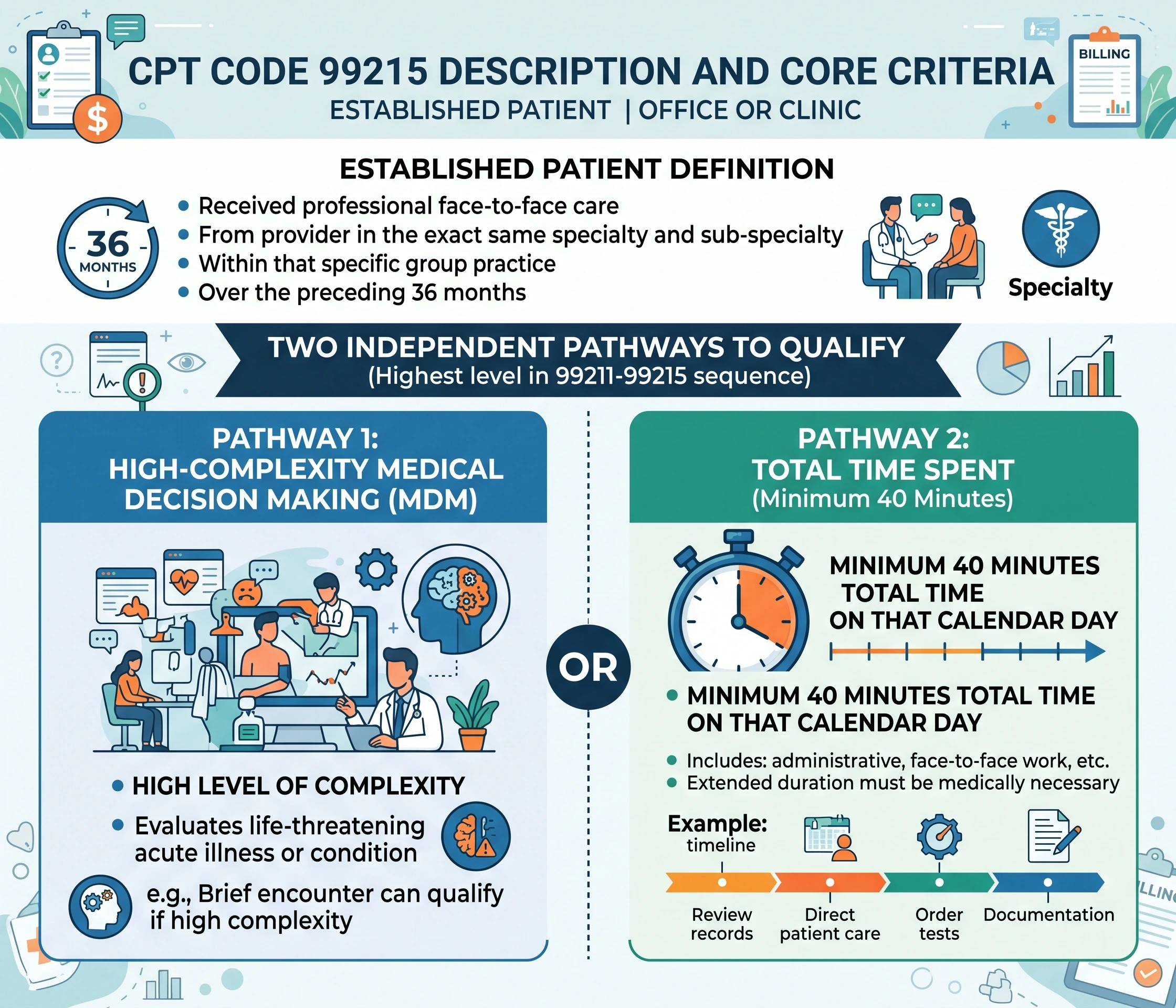
The official 99215 CPT code description designates an evaluation and management service provided to an established patient in a clinic or office setting. Medical billing regulations define an established patient as an individual who has received professional face-to-face care from a provider in the exact same specialty and sub-specialty within that specific group practice over the preceding 36 months.
This code represents the absolute peak of the outpatient CPT 99211-99215 sequence. To legally submit it, practitioners must cross one of two distinct thresholds. They must either perform medical decision making that qualifies as high-complexity, or they must dedicate a minimum of 40 minutes of total time to the patient’s care on that calendar day.
These pathways operate independently. A brief, 15-minute face-to-face encounter qualifies for CPT 99215 if the physician manages a life-threatening acute illness. Alternatively, a routine medication check that requires 42 minutes of total administrative and face-to-face work qualifies based on the clock, assuming the extended duration was medically necessary for the patient’s condition.
The 99215 time requirement and tracking rules
Modern time-based coding determines the appropriate code based on the total time the billing provider spends with the patient on the date of service. The strict CPT 99215 time requirement mandates a window of 40 to 54 minutes.
Unlike older guidelines that only counted direct face-to-face interaction, the current system allows physicians to aggregate multiple tasks. Billable minutes include reviewing outside medical records before entering the exam room. They also include the time spent obtaining the patient’s history, conducting a physical examination, discussing treatment options with family members, placing pharmacy orders, and typing the clinical note into the electronic health record.
However, auditors actively look for double-dipping. Physicians cannot count time spent on tasks performed by nurses, medical assistants, or front-desk staff. If a triage nurse spends eight minutes gathering vital signs and updating a patient’s allergy list, those eight minutes remain excluded from the physician’s tally.
Furthermore, you must subtract the time associated with separately billable procedures. If a doctor spends 45 minutes total with a patient, but 10 of those minutes involve administering a joint injection (which has its own distinct billing code), the remaining 35 minutes fall short of the 99215 time requirement. That specific visit drops to a lower tier.
Billing prolonged services beyond 54 minutes
Encounter times occasionally exceed the 54-minute ceiling. When this happens, billing departments must apply prolonged service add-on codes. The specific code you use depends entirely on the patient’s insurance carrier.
Commercial health plans generally recognize CPT code 99417. Medical billers attach this modifier as soon as the physician’s total time reaches 55 minutes.
The Centers for Medicare & Medicaid Services rejects 99417. Instead, Medicare contractors require HCPCS code G2212. Furthermore, Medicare enforces a completely different time threshold. Under federal guidelines, a provider cannot append G2212 until the total daily time hits 69 minutes. A Medicare visit lasting 60 minutes caps out at the standard 99215 payment rate, with no extra compensation for the overflow time.
High-complexity E/M medical decision making
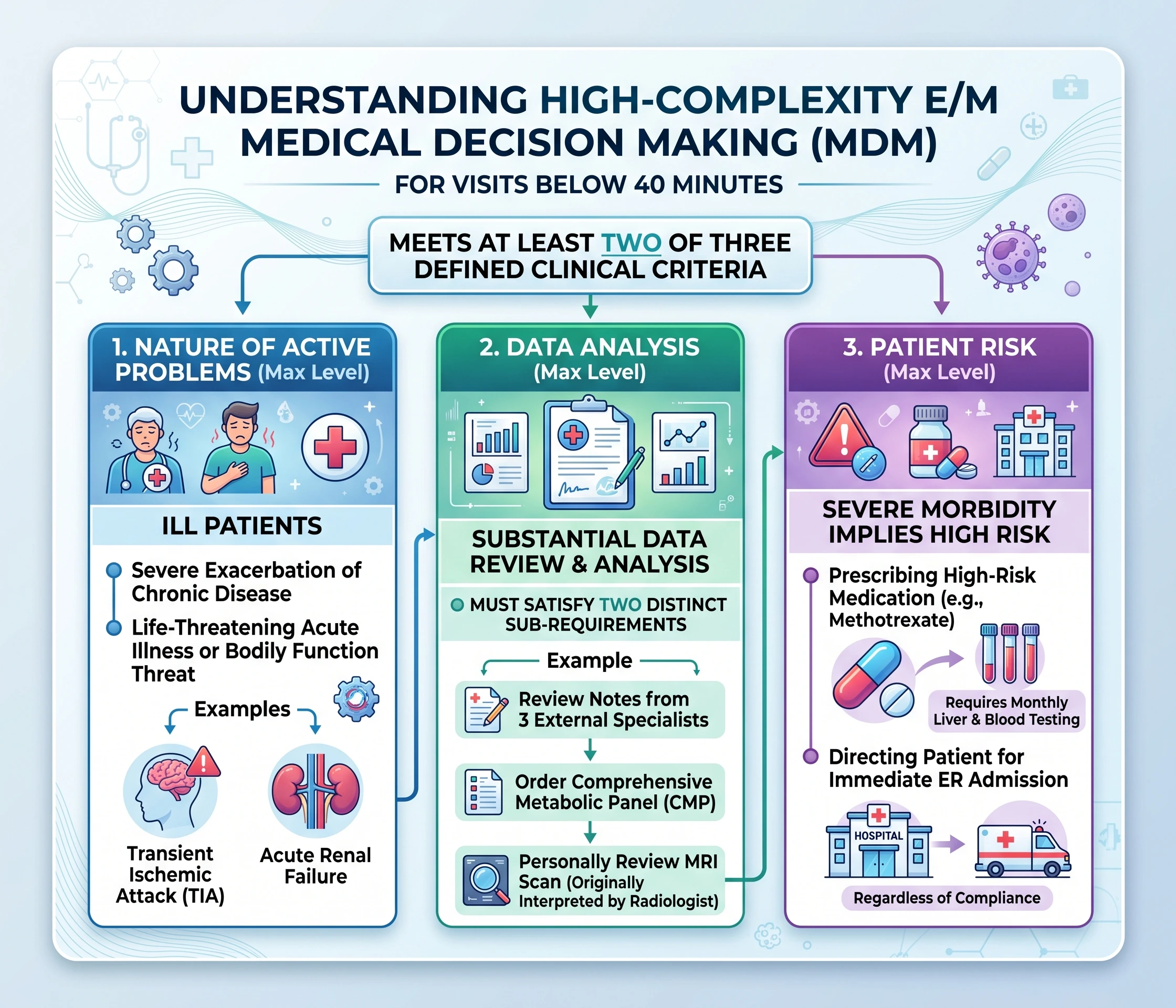
When visits fall below the 40-minute mark, the provider’s clinical judgment must substantiate the level of service. High-complexity medical decision-making requires the physician to meet at least two of three defined clinical criteria.
The first category evaluates the nature of the active problems. To hit the maximum level, the provider must manage a chronic disease experiencing a severe exacerbation. They can also qualify by treating an acute illness that physically threatens the patient’s life or bodily function. A patient presenting with a sudden transient ischemic attack or acute renal failure meets this standard.
The second category measures data analysis. High-complexity medical decision-making involves reviewing and analyzing a substantial amount of medical information. The provider must satisfy two distinct sub-requirements. For example, they might review notes from three external specialists, order a comprehensive metabolic panel, and personally review an MRI scan originally interpreted by a radiologist.
The third category weighs patient risk. High risk implies severe morbidity. A rheumatologist prescribing Methotrexate, a medication that requires monthly liver enzyme and blood count testing, meets this criteria. Directing a patient to the emergency room for immediate admission also qualifies as high risk, regardless of whether the patient actually follows the medical advice.
CPT 99214 vs 99215: Clinical and financial differences
Medical auditors frequently target the boundary between level four and level five visits. The distinction between CPT 99214 vs 99215 centers entirely on moderate versus high clinical thresholds.
CPT 99214 applies when the encounter involves moderate medical decision-making or 30–39 minutes of total time spent on the date of service. Clinically, this typically involves managing chronic conditions that are stable or experiencing only mild fluctuations. The risk profile is moderate, which usually translates to standard prescription management without the need for intense laboratory toxicity monitoring.
The financial delta between these two codes impacts practice viability.
Feature | CPT 99214 | CPT 99215 |
Decision Level | Moderate | High |
Minute Range | 30 to 39 | 40 to 54 |
Condition Severity | Mildly unstable chronic issue | Life-threatening or severely exacerbated issue |
Patient Risk | Standard prescription management | Elective major surgery or intensive drug monitoring |
Estimated 2026 Work RVU | 1.92 | 2.80 |
The 99215 vs 99214 reimbursement difference is mathematically stark. Bumping a legitimate claim from a level four to a level five increases the payout by almost 30%. Failing to code a genuine high-complexity visit costs a private practice approximately $44 per encounter. Multiplied across hundreds of patient visits annually, this behavior results in tens of thousands of dollars in lost legal revenue.
2026 99215 CPT code reimbursement and RVU data
Understanding how to bill CPT 99215 effectively requires looking at the government’s valuation formulas. The federal government uses Relative Value Units to price every medical procedure.
The 99215 CPT code RVU breaks down into three separate components. These include the physician’s labor, the overhead expenses of the practice, and the cost of malpractice liability insurance. The physician work RVU sits at roughly 2.80. This specific number measures the mental effort and technical skill required to manage complex cases. It does not change based on geography or setting.
Location completely alters the final payment. When a doctor treats a patient in an independent clinic, Medicare assigns a higher practice expense RVU to cover the doctor’s rent, equipment, and staff salaries. This non-facility setting generates a 2026 Medicare reimbursement for 99215 of roughly $192.38.
If that exact same physician treats the exact same patient in an outpatient hospital department, the hospital absorbs the overhead costs. Consequently, Medicare drops the physician’s facility reimbursement rate to approximately $125.58. Commercial health maintenance organizations negotiate their own specific fee schedules, but they universally use this federal RVU methodology as their baseline pricing metric.
99215 documentation checklist and audit triggers
Payer algorithms automatically flag practices that bill level five codes at rates higher than their specialty peers. A rigid 99215 documentation checklist provides the only defense against post-payment reviews and revenue clawbacks.
When utilizing the 40-minute pathway, exact numerical documentation is mandatory. A note stating “extended visit today” holds zero legal weight during an audit. The chart must state a specific integer. The provider must write, “I spent 42 minutes total today on the date of the encounter.” Furthermore, the provider must include a brief sentence detailing how they spent that time, such as reviewing lab results, physically examining the patient, and coordinating care with a local cardiologist.
When utilizing the complexity pathway, the assessment section must prove severity. Listing “asthma” is insufficient. The provider must explicitly write “severe asthma exacerbation failing current steroid regimen.” If the provider decides to escalate care, the note must detail the specific risks discussed with the patient regarding that escalation.