

The 20610 CPT code identifies aspiration, injection, or both involving a major joint or bursa without ultrasound guidance. Knee, hip, shoulder, and subacromial bursa procedures fall within its scope. Selecting the code requires attention to the treated structure and the technique documented, not simply the presence of an injection.
A claim also needs the correct units, laterality, supporting diagnosis, and any separately billable medication. Reviewing these elements separately helps distinguish a coding error from a coverage problem.
What does the 20610 CPT code describe?
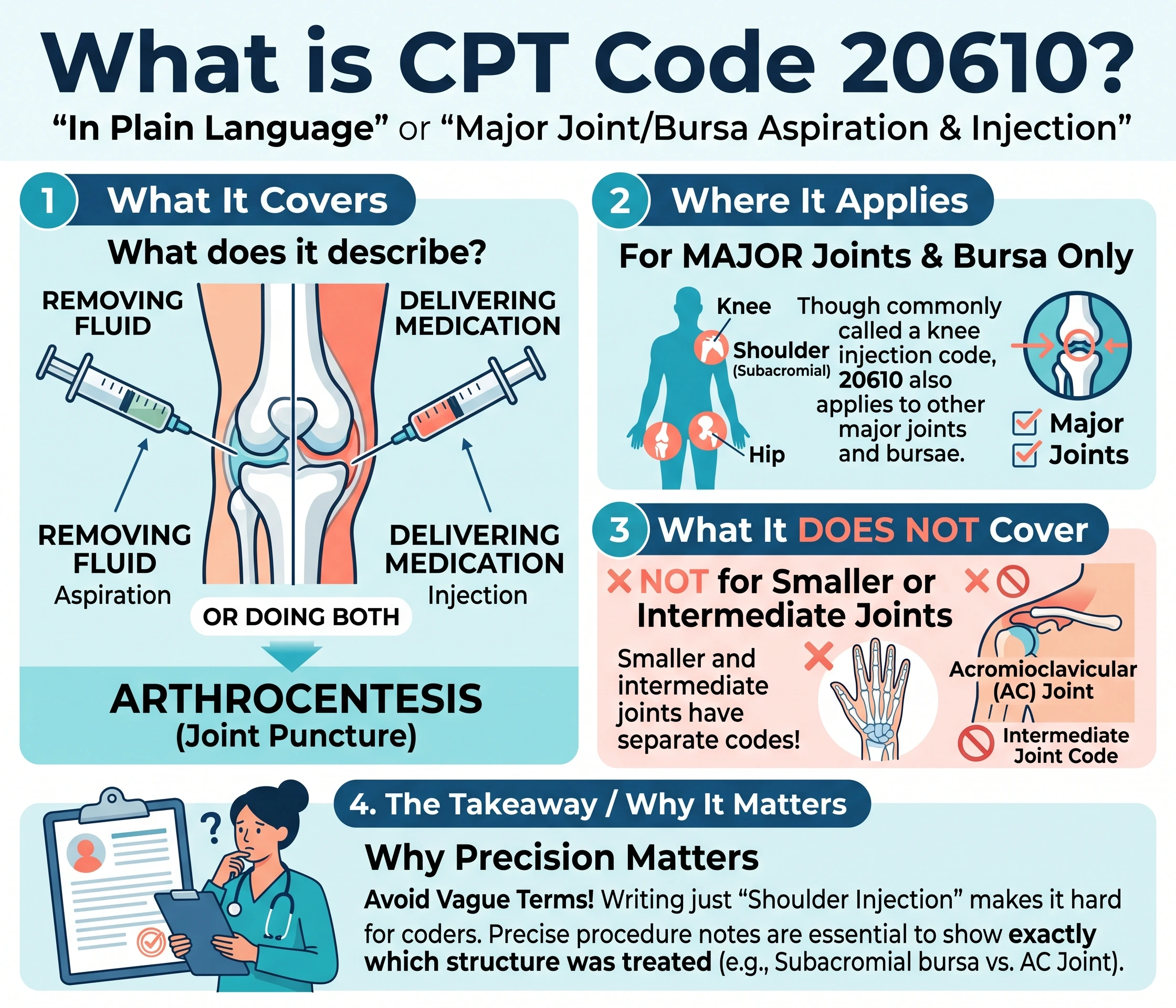
In plain language, the CPT code 20610 description covers removing fluid from a major joint or bursa, delivering medication into that structure, or performing both actions. Arthrocentesis refers to joint puncture, commonly performed to obtain fluid.
Although often described as a knee injection CPT code, 20610 also applies to other major joints and qualifying bursae. It is not a universal intra-articular injection CPT code. Smaller and intermediate joints have separate codes. For example, the acromioclavicular joint belongs to the intermediate-joint category, even though it is located in the shoulder region.
That anatomical distinction makes precise procedure notes useful. “Shoulder injection” alone may leave the coder uncertain about which structure was treated.
20611 vs 20610: How ultrasound changes code selection
The California Medical Association’s April 30, 2015, coding guidance explains the distinction between these procedure codes.
Feature | CPT 20610 | CPT 20611 |
Target | Major joint or bursa | Major joint or bursa |
Ultrasound guidance | Not included | Included |
Ultrasound documentation | Not applicable to this code | Permanent recording and reporting required |
CMS’s Medicare NCCI Correspondence Language Manual, dated February 28, 2025, specifically identifies the restriction against reporting 76942 with 20610 or 20611. Do not reconstruct an ultrasound-guided major joint injection by billing 20610 plus 76942.
If the note says ultrasound guided the needle but lacks the required recording or report, query the clinician. Automatically substituting 20610 would leave the claim inconsistent with the documented technique.
20610 billing guidelines for units and multiple sites
CMS’s 2026 Medicare NCCI Policy Manual, Chapter IV, effective January 1, 2026, defines the unit as a joint together with its surrounding bursae. Aspirating a shoulder joint and treating two surrounding bursae therefore supports one unit of 20610. Multiple needle placements do not establish additional units.
Likewise, aspiration followed by injection in the same knee during one session supports one procedure unit. Palmetto GBA’s billing article A59030, revised January 1, 2026, expressly applies this rule to knee viscosupplementation.
For an encounter involving multiple sites, review the anatomical targets individually. Identify whether the services involve paired joints, distinct structures, or one joint and its surrounding bursae before choosing units and modifiers.
Medicare also bundles arthrocentesis into an open or arthroscopic procedure performed on the same joint. A separate procedure note does not override that rule.
Does CPT 20610 need a modifier?
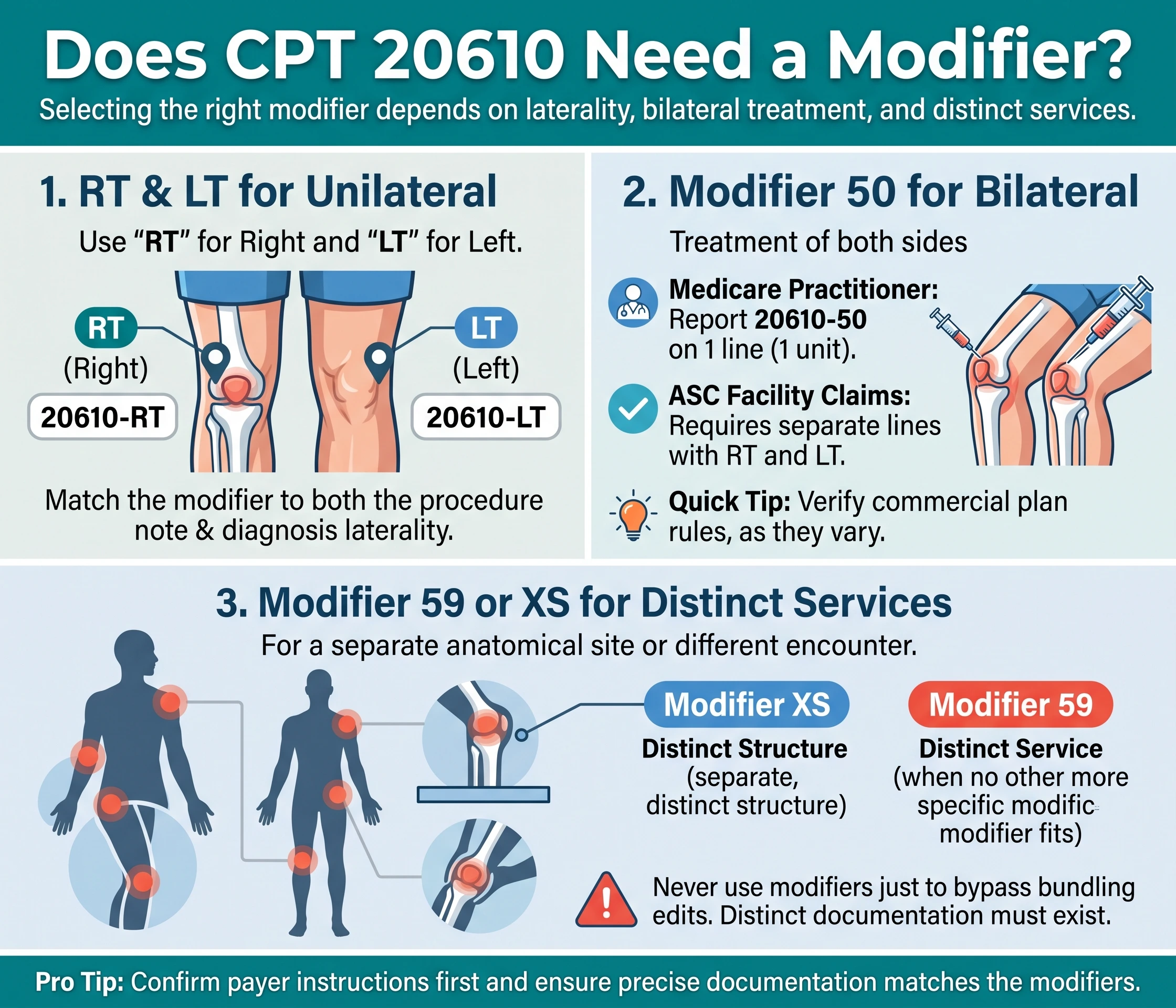
The appropriate 20610 modifier depends on laterality, bilateral treatment, other services, and payer instructions.
RT and LT for unilateral procedures
For unilateral knee injections addressed in Palmetto GBA Article A59030, use modifier RT for the right knee and modifier LT for the left knee. Thus, 20610-RT identifies a right-sided procedure, while 20610-LT identifies a left-sided procedure. Match the modifier to both the procedure note and diagnosis laterality.
Modifier 50 for CPT 20610
For a Medicare practitioner claim involving both knees, report 20610-50 on one line with one unit. Medicare’s bilateral reporting requirements vary for ASC facility claims, which require separate claim lines with RT and LT modifiers. Do not copy the facility’s format automatically onto the clinician’s claim.
Confirm the individual plan’s bilateral submission instructions before applying this format to a commercial claim.
Modifier 59 or XS for distinct services
A second anatomical site does not justify adding modifier 59 automatically. CMS’s April 2026 booklet, Proper Use of Modifiers 59, XE, XP, XS & XU, directs providers to use more specific modifiers when applicable.
Review the actual edit and documented circumstances. Modifier XS describes a separate structure; modifier 59 applies when no more specific modifier appropriately explains the distinction. Neither should be used simply to force payment for services that remain bundled.
Billing an office visit on the injection date
Modifier 25 belongs on the E/M code, not on 20610. The American Medical Association’s Reporting CPT Modifier 25, addressing the 2023 code set, explains that the visit must involve significant, separately identifiable evaluation and management beyond the procedure’s usual work.
Consider two illustrative situations:
- A patient returns for an already planned injection, with only the assessment needed to perform it. That encounter does not automatically support a separate office visit.
- A patient receives an injection and also undergoes a documented evaluation of another problem requiring its own assessment and management. A separately reportable E/M service may be appropriate.
A different diagnosis is not mandatory. The documentation must establish the additional work. Neither a new-patient designation nor the decision to inject, by itself, establishes a separately billable visit.
Medicare guidelines for CPT 20610 and LCD coverage
When searching for “CPT 20610 LCD policy,” first identify the treatment being provided and the Medicare contractor responsible for the claim. A code’s availability does not establish coverage for every drug, diagnosis, or treatment schedule.
For example, Palmetto GBA’s LCD L39260, Hyaluronic Acid Injections for Knee Osteoarthritis, effective August 21, 2022, requires documented symptomatic knee osteoarthritis, radiographic support, and qualifying prior treatment. Repeat series have additional requirements, including at least six months since completion of the previous series.
Those requirements apply to that hyaluronic acid policy. They should not become a blanket six-month rule for every aspiration or corticosteroid injection billed under 20610.
Before treatment, verify the applicable coverage document, covered diagnosis requirements, product restrictions, and repeat-treatment criteria. Keep the policy version effective on the service date available for claim review.
Documentation requirements for CPT 20610
Use the following as a practical documentation checklist, then add the applicable payer’s requirements:
- Exact joint or bursa and laterality.
- Clinical indication and findings supporting medical necessity.
- Whether aspiration, injection, or both were performed.
- Medication, concentration, administered dose, and relevant discarded amount.
- Guidance technique, with required images and reporting when applicable.
- Response to previous treatment when repeat-treatment coverage depends on it.
For knee hyaluronic acid injections, LCD L39260 specifically requires supporting history and examination, radiographic evidence, prior conservative treatment, the knee treated, dosage and frequency, and response to treatment. It also requires support for the need for ultrasound guidance.
Avoid completing these fields through assumptions. If the note identifies a drug concentration but omits the administered volume or dose, obtain clarification before calculating the claim’s medication units.
Billing the injected medication
The procedure and medication represent separate claim elements. WPS Government Health Administrators’ article A56157, Intraarticular Knee Injections of Hyaluronan, explains that the procedure may be billed and that a drug charge must represent an expense incurred by the physician.
Select the HCPCS drug code for the actual product. Calculate units from its billing increment rather than the number of syringes. As a hypothetical calculation, a drug code defined per 10 mg would require four units for a documented 40 mg dose.
Also review container type. CMS’s JW and JZ Modifier FAQs, accessed October 14, 2026, distinguish discarded amounts from zero wastage for separately payable Part B drugs supplied in single-dose containers. Eligible discarded quantities are reported separately with JW; JZ identifies applicable administrations with no discarded amount. These modifiers attach to drug lines, not 20610.
Do not apply single-dose-container rules automatically to multidose products.
20610 CPT code reimbursement and RVUs
There is no single CPT 20610 reimbursement rate that applies to every practice. Medicare payment depends on the service year, locality, setting, and applicable payment adjustments.
CMS’s PFS Look-up Tool Overview, updated February 9, 2026, explains that payment uses work, practice-expense, and malpractice RVUs, with geographic adjustments. A quoted “20610 RVU” is incomplete unless it identifies the year and whether it means work RVUs or total RVUs.
For a usable estimate, search 20610 in the Medicare Physician Fee Schedule for the correct year and locality. Select the appropriate facility or nonfacility amount, then review modifier-related payment rules. Consult the practice’s contracted fee schedule for commercial reimbursement.
Record separately any payable medication. Combining the drug payment with the procedure allowance can distort comparisons between claims.
Check the claim against the actual procedure
Accurate 20610 CPT code billing begins with the documented anatomical target and guidance technique. Reconcile laterality, units, medication quantity, and coverage before submission. For Medicare, additional injections around the same joint do not automatically create additional billable services.