A claim for a 45-minute therapy session gets denied in Ohio, and the reason has nothing to do with the clinical note. The provider enrolled under a category that does not match the service. Or a child on OhioRISE was seen by a therapist who never contracted with the youth plan.
The fix takes minutes. Finding the cause can take weeks.
Ohio splits behavioral health billing into rule sets that rarely appear in the same document. Standard Medicaid members belong to one of seven managed care organizations, and youth with complex needs may belong to OhioRISE, which Aetna Better Health of Ohio runs. This guide shows how the pieces fit, how credentialing works, where it goes wrong, and what a practice needs in place before the first claim goes out.
How Ohio splits behavioral health billing
The Ohio Department of Medicaid (ODM) organizes its behavioral health guidance into two groups. One is community behavioral health providers certified by the Ohio Department of Mental Health and Addiction Services (OhioMHAS), covered by OAC Chapter 5160-27. The other is independent providers who are not certified by OhioMHAS, covered by OAC rule 5160-8-05.
OhioMHAS-certified agencies
The first track is built around the agency. An entity that meets the certification requirements in Revised Code 5119.36 and OAC Chapters 5122-24 through 5122-29 can enroll as a Medicaid provider. Its licensed practitioners render services as employees or independent contractors.
ODM's behavioral health manual puts certification first. Once an agency holds it, the agency applies for provider type 84 to bill the mental health benefit, provider type 95 for the substance use disorder benefit, or both. A specialty must be selected for each type, and an application fee may apply.
Independent practitioners
The second track is built around the clinician. Rule 5160-8-05 is titled "Behavioral health services-other licensed professionals." It lets Medicaid pay physician group practices, clinics, community behavioral health centers, physicians, advanced practice registered nurses, physician assistants, licensed psychologists in independent practice and independent practitioners in independent practice.
The independent-level licenses named in the related rules include licensed independent social workers (LISW), licensed professional clinical counselors (LPCC), licensed independent marriage and family therapists (LIMFT) and licensed independent chemical dependency counselors (LICDC). Ohio does not use the LCSW title, so a social worker billing independently is an LISW.
Supervised practitioners and trainees
The same rule covers supervised practitioners and trainees. A supervising entity or independent practice can bill for their services, but only when the supervision conditions in the rule are met.
Which track fits a practice
| OhioMHAS-certified agency | Independent practice | |
|---|---|---|
| Governing rule | OAC Chapter 5160-27 | OAC rule 5160-8-05 |
| Who bills | The certified entity | The licensed practitioner or group |
| Medicaid enrollment | Provider type 84, 95 or both, after OhioMHAS certification | Individual or group enrollment for the practitioner's license |
| Typical settings | Community mental health and SUD treatment agencies, certified FQHCs and RHCs | Solo therapists, psychologists and small group practices |
A practice that straddles both worlds is where problems start. A group that employs LPCCs and LISWs, offers agency-level services such as case management and holds no OhioMHAS certification cannot bill those services under an independent enrollment.
The reverse happens too. A certified agency that adds an independent clinician has to decide whether that person bills under the agency or as a separate provider. The answer changes whose NPI appears on the claim.
The credentialing process, step by step
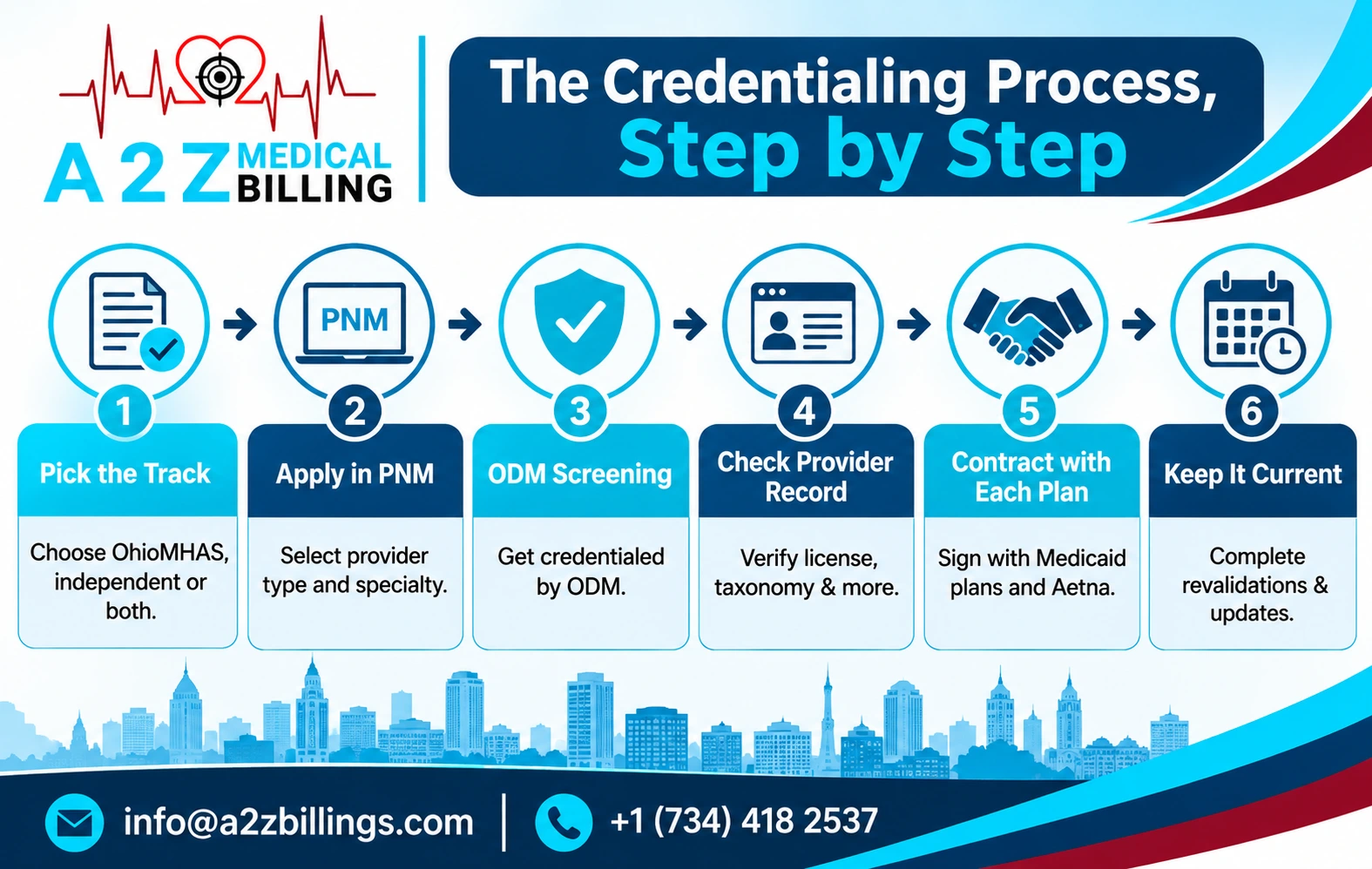
Ohio centralized provider enrollment and credentialing in the Provider Network Management (PNM) module. ODM calls it the single point for enrollment, credentialing and provider self-service. ODM screens and credentials providers under federal rules (42 CFR 455, subpart E), so the managed care plans and OhioRISE do not run a second credentialing process for behavioral health providers.
Aetna's OhioRISE provider manual says the same thing: credentialing happens through ODM and not through Aetna. The process below follows that structure.
Step 1: Pick the track and gather documents
Decide first whether the practice is an OhioMHAS-certified agency, an independent practice or both. Agencies need their OhioMHAS certification in hand before applying. Independent clinicians need an active license at the independent level, an NPI, a tax ID, a practice location and ownership disclosures where they apply.
Step 2: Apply in PNM
All enrollment applications go through PNM. The applicant selects a provider type and then a specialty. Agencies choose type 84, 95 or both, and the fee that applies to those types gets paid at this stage. Picking the wrong type here is the most common source of denials later.
Step 3: ODM screening and credentialing
ODM screens the application and credentials the provider. One credentialing record covers Medicaid, OhioRISE and MyCare. Turnaround varies, so a practice should start well before its first scheduled visit and avoid booking Medicaid patients on the assumption of a fixed approval date.
Step 4: Check the Medicaid provider record
Once approved, the provider receives an Ohio Medicaid provider ID. The next job is reading the record line by line: license, taxonomy, address, group affiliation and specialties. A typo here follows every claim.
Step 5: Contract with each plan
Credentialing does not place a provider in a plan's network. A practice signs a contract with each Medicaid managed care plan it wants to bill, plus Aetna Better Health of Ohio if it will see OhioRISE members. The plans check the PNM record as the system of record.
Step 6: Keep the record current
Revalidation notices, new clinicians, address changes and added specialties all go through PNM. A lapsed revalidation can end an active enrollment, and a stale record can cause denials months after the change that triggered them.
Common ODM enrollment mistakes
Several enrollment errors repeat across practices:
- Enrolling under the wrong provider type for the service being billed
- Missing a specialty that a program requires, including OhioRISE specialties
- Leaving old addresses or group affiliations in PNM after a move or staffing change
- Skipping revalidation notices
- Entering a multi-license clinician under one credential only
Multi-license clinicians
The last item needs its own note. ODM's behavioral health manual says practitioner modifiers are optional unless a practitioner holds more than one license, and in that case ODM's dual licensure grid applies.
A clinician who is both a licensed social worker and a chemical dependency counselor, for example, needs an enrollment and a claim that agree on which license covers the service.
Seven managed care plans, one credentialing record
Most Medicaid members receive care through managed care. ODM lists seven plans: AmeriHealth Caritas Ohio, Anthem Blue Cross and Blue Shield, Buckeye Community Health Plan, CareSource Ohio, Humana Healthy Horizons in Ohio, Molina Healthcare of Ohio and UnitedHealthcare Community Plan of Ohio.
Contracting is separate
Each plan has its own claims portal, authorization rules and appeal process. Practices with a small caseload often contract with two or three plans, then find new patients arriving on the others. The first denial of that kind reads like a network problem, and the cause is usually a contract that was never signed.
Fee-for-service members
Some Medicaid members, such as those in fee-for-service categories, bill through ODM directly. An eligibility check at the start of each month catches those cases before the first session.
OhioRISE: a separate plan for youth with complex needs
OhioRISE is a specialized managed care program for youth with complex behavioral health and multi-system needs. ODM selected Aetna Better Health of Ohio to run it, and ODM determines eligibility using a Child and Adolescent Needs and Strengths (CANS) assessment.
Most children covered by Medicaid stay in their regular managed care plan. A pediatric caseload can therefore include both kinds of members at once.
What providers need
Two rules matter. ODM requires providers to add the right specialty to an existing enrollment type to bill some new and enhanced OhioRISE services, and behavioral health respite is one example. Providers must also contract with Aetna to serve OhioRISE members. ODM enrollment alone does not put a therapist in the OhioRISE network.
How to credential with OhioRISE as a therapist
- Confirm active Ohio Medicaid enrollment in PNM, or apply if the practice has none.
- Add the OhioRISE specialty in PNM if the services require one.
- Complete ODM's centralized credentialing, which covers OhioRISE, Medicaid and MyCare.
- Contract with Aetna Better Health of Ohio for OhioRISE through its network team.
- Check each member's OhioRISE enrollment before a session, and match modifiers to ODM's dual licensure grid when a clinician holds two licenses.
When a child changes plans
Step five catches many practices. A child can move into or out of OhioRISE as needs change, which means the payer for the same patient can change between visits.
Where the denials come from
Most denials trace back to a mismatch among three records: the PNM enrollment, the payer contract and the claim. A short list covers the usual causes.
- A provider type or specialty that does not match the service billed
- A billing or rendering NPI that differs from the PNM record
- No contract with the plan that pays for the member, whether a standard managed care plan or OhioRISE
- A missing or wrong modifier for a dually licensed clinician
- A claim sent to the wrong plan after a member changed coverage
- Filing past the deadline
The filing deadline
Under OAC rule 5160-1-19, Medicaid claims are timely when ODM receives them within 365 days of the date of service, with exceptions listed in the rule, such as claims that follow a third-party payment reversal. ODM does not accept paper claims unless it directs otherwise.
Disputes follow separate routes. Fee-for-service claims use ODM's Medical Claim Review Request, and managed care claims go through the plan's own appeal process.
A short checklist before the first claim
- Decide whether the practice is OhioMHAS-certified, independent or both, and enroll under the matching rule.
- Check the PNM record for license, taxonomy, address, group affiliation and specialties.
- Contract with each Medicaid plan the practice intends to bill, plus Aetna for OhioRISE where it applies.
- Record which clinicians hold more than one license and apply the dual licensure grid.
- Verify member eligibility and plan at the start of each month, and again for youth who may move into OhioRISE.
- Calendar the revalidation date for every provider and track the 365-day filing limit on open claims.
Where billing support fits
Enrollment decisions belong to ODM and the plans. A billing company cannot approve a provider or grant a contract.
What a billing team can do is compare the PNM record with the claims being sent, check each clinician's licenses against modifier requirements, track revalidation and filing dates, and work denials back to their cause. Mental Health Billing does this review at the start of an Ohio account and again whenever a clinician, address or payer changes.
Frequently asked questions
What is the difference between OhioMHAS certification and Medicaid enrollment?
OhioMHAS certification is the state's approval for an agency to provide mental health or substance use disorder services. Medicaid enrollment, handled by ODM, lets that agency bill. ODM's manual requires certification before an agency can enroll as provider type 84 or 95.
Can an independent therapist bill Ohio Medicaid without OhioMHAS certification?
Yes, if the therapist holds an eligible independent-level license and meets the requirements of OAC rule 5160-8-05. Agency-level services outside that rule still need an OhioMHAS-certified entity.
Does ODM credentialing cover OhioRISE?
Yes. ODM's centralized credentialing covers Medicaid, OhioRISE and MyCare, and Aetna's manual says credentialing does not happen through Aetna. A provider still needs a contract with Aetna to join the OhioRISE network.
How long do providers have to file Ohio Medicaid claims?
OAC rule 5160-1-19 sets a 365-day limit from the date of service, with listed exceptions. Managed care plans may have their own appeal steps for late or denied claims.
Why was a claim denied when the provider is enrolled?
Enrollment alone does not match a claim. The provider type, specialty, NPI, license and plan contract all have to line up with the service billed and the member's plan on the date of service.