

Joining a Blue Cross Blue Shield (BCBS) provider network requires more than submitting an application. Healthcare providers must complete credential verification, meet network participation requirements, sign applicable agreements, and receive confirmation of their effective dates before providing services as participating providers.
For physicians, therapists, nurse practitioners, and medical practices, mistakes during BCBS Credentialing & Enrollment can delay network participation and affect reimbursement. An incomplete CAQH profile, mismatched tax information, or missing supporting documents may hold up an otherwise eligible application.
The process also differs across Blue Cross Blue Shield companies. Understanding these differences helps providers prepare accurate applications, monitor enrollment progress, and avoid billing services under an incorrect network status.
What is BCBS credentialing and provider enrollment?
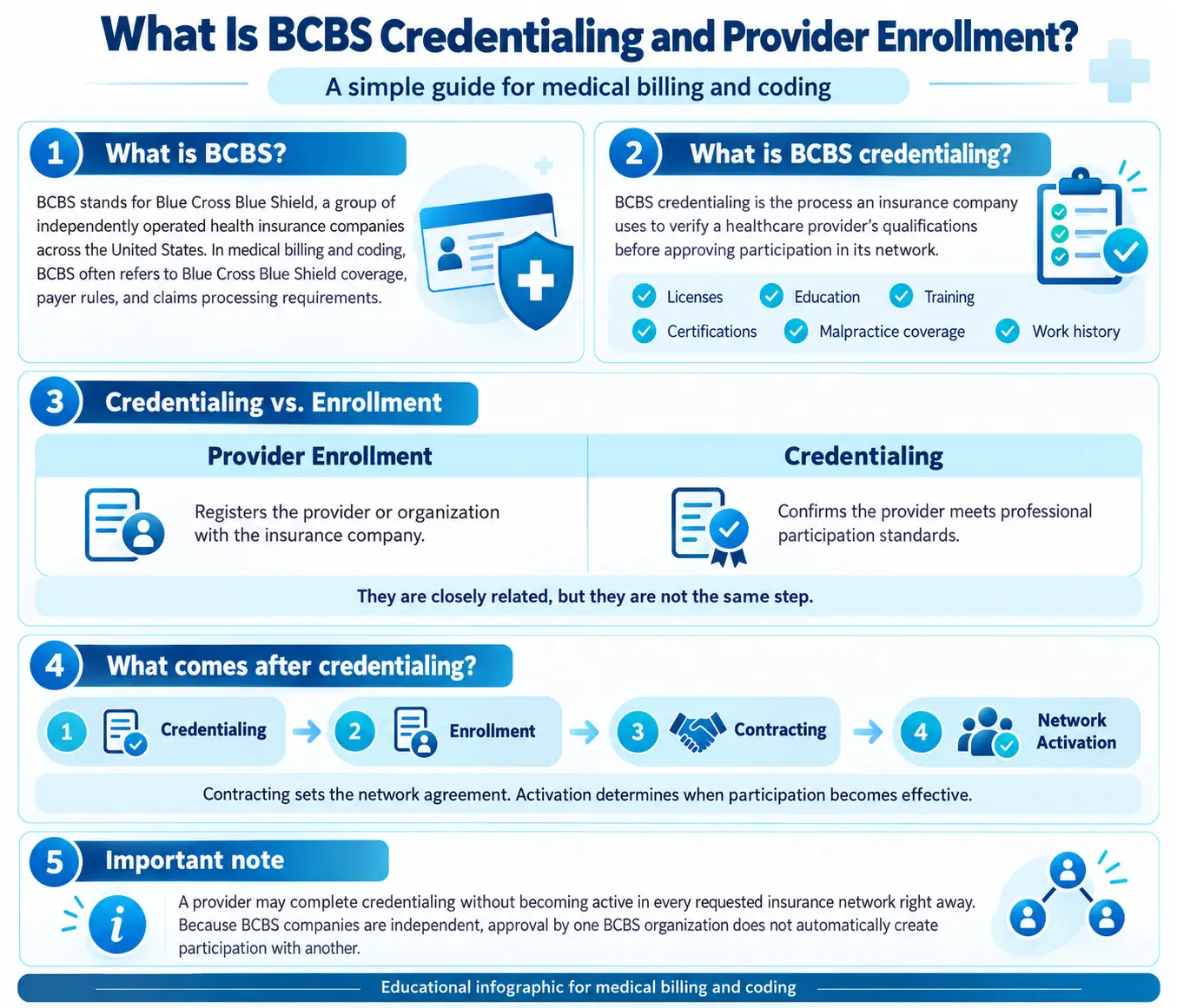
BCBS stands for Blue Cross Blue Shield, a group of independently operated health insurance companies serving members throughout the United States.
In medical billing and coding, BCBS is commonly used to identify Blue Cross Blue Shield insurance coverage, payer requirements, and claims processing arrangements.
BCBS credentialing is the process through which an insurance company verifies a healthcare professional’s qualifications before approving participation in its provider network.
Credentialing generally involves reviewing professional licenses, education, training, certifications, malpractice coverage, work history, and other information relevant to the provider’s specialty.
Although credentialing and enrollment are closely connected, they serve different purposes.
Provider enrollment registers a healthcare professional or organization with an insurance company. Credentialing establishes whether the provider meets professional participation standards. Contracting establishes the applicable network agreement, while network activation determines when participation becomes effective.
A provider may complete credentialing without immediately becoming active in every requested insurance network.
The Blue Cross Blue Shield Association consists of independent companies, so approval by one BCBS organization does not automatically establish participation with another.
How to get credentialed with BCBS
The BCBS provider enrollment process begins with identifying the correct insurance company and the networks a medical practice wants to join.
Step 1: Identify the appropriate BCBS company
Determine which Blue Cross Blue Shield organization serves the provider’s practice location.
For example, providers in Michigan may work with Blue Cross Blue Shield of Michigan, while Texas providers may apply through Blue Cross and Blue Shield of Texas.
Confirm whether the practice wants to participate in commercial PPO, HMO, Medicare Advantage, Medicaid managed care, or other available networks.
Each product may have separate participation requirements.
Step 2: Prepare provider information
Before starting the BCBS provider application, verify that all professional and business information is accurate.
The provider’s legal name, NPI, practice address, specialty, and tax information should match the information maintained by licensing boards and other authoritative records.
Step 3: Complete the CAQH profile
Many BCBS companies use the CAQH Provider Data Portal, formerly known as CAQH ProView, to obtain credentialing information.
Providers must complete the applicable sections, upload supporting documents, authorize the insurance company to access their information, and attest that the submitted details are accurate.
An existing CAQH account does not eliminate the need to complete the BCBS-specific enrollment process.
Step 4: Submit the enrollment application
Complete the application through the relevant BCBS company’s enrollment system.
Depending on the organization and provider type, this may involve an online onboarding form, provider roster, or additional facility documentation.
Step 5: Complete verification and contracting
The insurance company reviews the submitted information and may request corrections or additional documents.
Once approved, the provider must complete any required contracting and activation procedures.
Do not assume in-network status until the applicable participation effective date has been confirmed.
BCBS credentialing requirements and documents
BCBS credentialing requirements depend on the provider’s professional category, insurance network, and participating BCBS company.
Most individual healthcare professionals should prepare the following information:
- Individual NPI (Type 1) and organizational NPI (Type 2), when applicable
- Active professional license and relevant board certification
- CAQH account information and current attestation
- Malpractice insurance documentation
- Education, training, and professional work history
- Tax Identification Number (TIN) and completed W-9
- Practice locations, contact information, and provider affiliations
- DEA registration and hospital privileges, when applicable
Additional documentation may be necessary for facilities, behavioral health providers, physician groups, and other specialized organizations.
For example, Blue Cross and Blue Shield of Texas requires certain new applicants to provide official IRS documentation supporting their tax identification information.
One frequent application problem involves inconsistent business information. A group may submit its organizational NPI while accidentally listing an individual provider’s tax details.
Reviewing these identifiers before submission can prevent administrative corrections.
How long does BCBS credentialing take?
Providers frequently ask how long it takes to get credentialed with BCBS or Blue Cross Blue Shield.
There is no single nationwide BCBS credentialing timeline.
Processing depends on the participating company, completeness of the application, primary-source verification, network requirements, and contracting arrangements.
For example, Blue Cross and Blue Shield of Texas states that provider onboarding cases may take up to 90 days to complete.
The same company reports that certain initial CAQH application completeness reviews average 8–10 calendar days. However, that shorter period refers to a specific review step, not guaranteed completion of the entire credentialing process.
Practices should plan sufficient lead time before scheduling patients as participating providers.
For an accurate estimate, ask the relevant BCBS company whether its quoted timeline covers credentialing alone or includes contracting and network activation.
What can extend the timeline?
Applications may require additional processing when a license needs verification, a document has expired, or information differs between the enrollment application and CAQH.
Network participation decisions can also involve additional review.
A practical approach is to maintain separate status records for credentialing, contracting, and network activation rather than treating them as one approval.
BCBS credentialing phone numbers and provider portals
There is no universal BCBS credentialing phone number for all participating companies.
The correct contact depends on the state, insurance product, and type of provider inquiry.
BCBS organization | Provider contact | Purpose |
Blue Cross and Blue Shield of Texas | 800-972-8088 | Commercial provider customer service |
BCBS of Texas | 877-560-8055 | STAR/CHIP provider customer service |
BCBS of Texas | 877-784-6802 | STAR Kids provider customer service |
Blue Cross Blue Shield of Michigan | 800-822-2761 | Provider enrollment and credentialing inquiries |
These are published provider contact numbers, not dedicated credentialing hotlines in every case. For a specific credentialing application, the assigned network management representative or credentialing status system may be the appropriate contact.
How to access the BCBS provider login
BCBS provider login options vary by company.
Many BCBS organizations use Availity Essentials for administrative transactions, including eligibility verification, claim status inquiries, and certain payer-specific functions.
However, an Availity account does not necessarily replace the individual BCBS company’s onboarding or credentialing system.
Providers should use the official payer provider portal and maintain their CAQH credentials separately.
BCBS of Texas credentialing and enrollment
Blue Cross and Blue Shield of Texas (BCBSTX) provides a useful example of how payer-specific requirements affect enrollment.
BCBSTX requires providers to obtain a Provider Record ID for each tax identification number under which they bill.
Receiving this identifier does not automatically establish in-network participation.
An applicant seeking network participation must complete the relevant onboarding requirements, submit credentialing information, and satisfy applicable contracting requirements.
BCBSTX provides separate tools for checking onboarding case status and credentialing status.
Providers can check onboarding progress using their assigned case number. Credentialing status can be checked using their NPI or license number.
The company also states that failure to finalize a required CAQH application within 45 days causes the credentialing process to be discontinued, requiring the applicant to restart.
Expedited credentialing in Texas
BCBSTX describes a provisional network participation process for certain eligible applicants.
Requirements include a valid Provider Record ID, submitted signed contract, complete authorized CAQH information or an applicable alternative application, and a valid Texas professional license in good standing.
This provisional process is subject to the company’s rules and does not guarantee eligibility for every practitioner.
Providers should also distinguish between a contract’s effective date and the network participation date assigned after onboarding activities are completed.
Common BCBS credentialing denials and delays
Credentialing denials and application rejections should not be confused with medical claim denials.
A credentialing denial concerns a provider’s eligibility or approval for network participation. A claim denial concerns payment for a billed healthcare service. Credentialing applications may be delayed or rejected because of missing information, expired professional documentation, unresolved verification discrepancies, or failure to meet participation requirements.
A closed network or an adverse credentialing determination may also prevent an applicant from joining a requested panel. Consider a licensed therapist applying through BCBS with an existing CAQH account. The therapist updates their professional license but forgets to complete the required CAQH attestation. The insurer may be unable to proceed using the incomplete or outdated information.
The appropriate correction is to update the profile, complete the attestation, confirm payer authorization, and verify whether the application remains active. If the insurer issues an adverse decision, request the written explanation and review the applicable reconsideration or appeal procedures.
BCBS credentialing for newly licensed healthcare providers
Newly licensed physicians and practitioners should begin preparing enrollment information before their intended practice start date.
However, eligibility to submit an application before completing training differs among BCBS companies.
Blue Cross Blue Shield of Michigan states that new graduates may submit an enrollment form up to 60 days before completing training.
In contrast, BCBS of Texas requires providers to complete their residency before proceeding with certain onboarding or contracting processes.
These differences make it important to verify the local company’s rules before applying.
New providers should also confirm that their licensure, NPI information, CAQH profile, and professional specialty are consistent.
An incorrect specialty designation may influence network categorization and the accuracy of provider directory listings.
Strategies for successful BCBS credentialing and enrollment
Accurate applications require more than completing the required fields. Medical practices benefit from an organized enrollment process that identifies missing documents before submission and tracks outstanding payer requests.
Verify information across all systems
Compare the provider’s NPI records, licensing information, CAQH profile, W-9, enrollment application, and business records.
Even minor demographic discrepancies can require additional review.
Monitor CAQH attestation requirements
CAQH generally requires providers to reattest every 120 days, with a 180-day schedule applicable to Illinois practitioners under CAQH guidance.
Individual payer instructions may also establish additional update requirements.
Maintain an enrollment tracking record
Record each provider’s application date, insurance company, requested network, case number, current status, outstanding requirements, and confirmed effective date.
This becomes particularly useful for multi-provider practices applying across different states.
Verify network activation before billing
Once approval is received, confirm the participating network, effective date, billing identifiers, and contracted practice locations.
A provider appearing in a directory is useful supporting information, but direct confirmation of participation should remain part of the practice’s final onboarding review.
Frequently asked questions about BCBS credentialing
Can I apply to multiple BCBS companies using one CAQH account?
Yes. CAQH allows eligible organizations to access authorized provider information. However, each participating BCBS company may require its own enrollment application, contracting process, and approval.
How do I check my BCBS credentialing application status?
Use the relevant BCBS company’s credentialing status checker or contact its provider enrollment department. Keep the provider’s NPI, application reference number, and relevant tax information available.
How often does BCBS require recredentialing?
Recredentialing requirements differ by insurer and provider type. For instance, Blue Cross Blue Shield of Michigan requires providers to undergo recredentialing every three years.
Does credentialing approval mean I can begin billing BCBS as in-network?
Not necessarily. Confirm contracting, network activation, and the effective participation date before submitting claims as a participating provider.
Is BCBS credentialing the same as workers’ compensation credentialing?
No. Workers’ compensation billing and credentialing may involve separate insurers, networks, employer arrangements, and state requirements. Approval in a BCBS commercial network does not automatically establish participation in a workers’ compensation program.
Maintaining successful BCBS network participation
Successful BCBS credentialing and enrollment depend on accurate professional records, completing applications on time, and verifying the applicable network effective date.
Healthcare providers should pay particular attention to CAQH authorization, licensing information, payer-specific deadlines, and differences between credentialing and contracting.
Once enrolled, practices must continue maintaining accurate provider demographics and completing required recredentialing activities.
The most reliable practice is to keep an organized record of each payer’s requirements and obtain written confirmation before treating a provider as active in a requested BCBS network.