


Medical practices utilize the 96127 CPT code to report brief emotional and behavioral assessments. The American Medical Association established this code in 2015. The addition aligned medical billing practices with preventive care mandates outlined in the Affordable Care Act. The code captures the administrative practice expense of administering, scoring, and documenting standardized screening instruments. These screenings identify conditions such as depression, anxiety, substance abuse, and attention-deficit/hyperactivity disorder.
96127 CPT code description and approved instruments
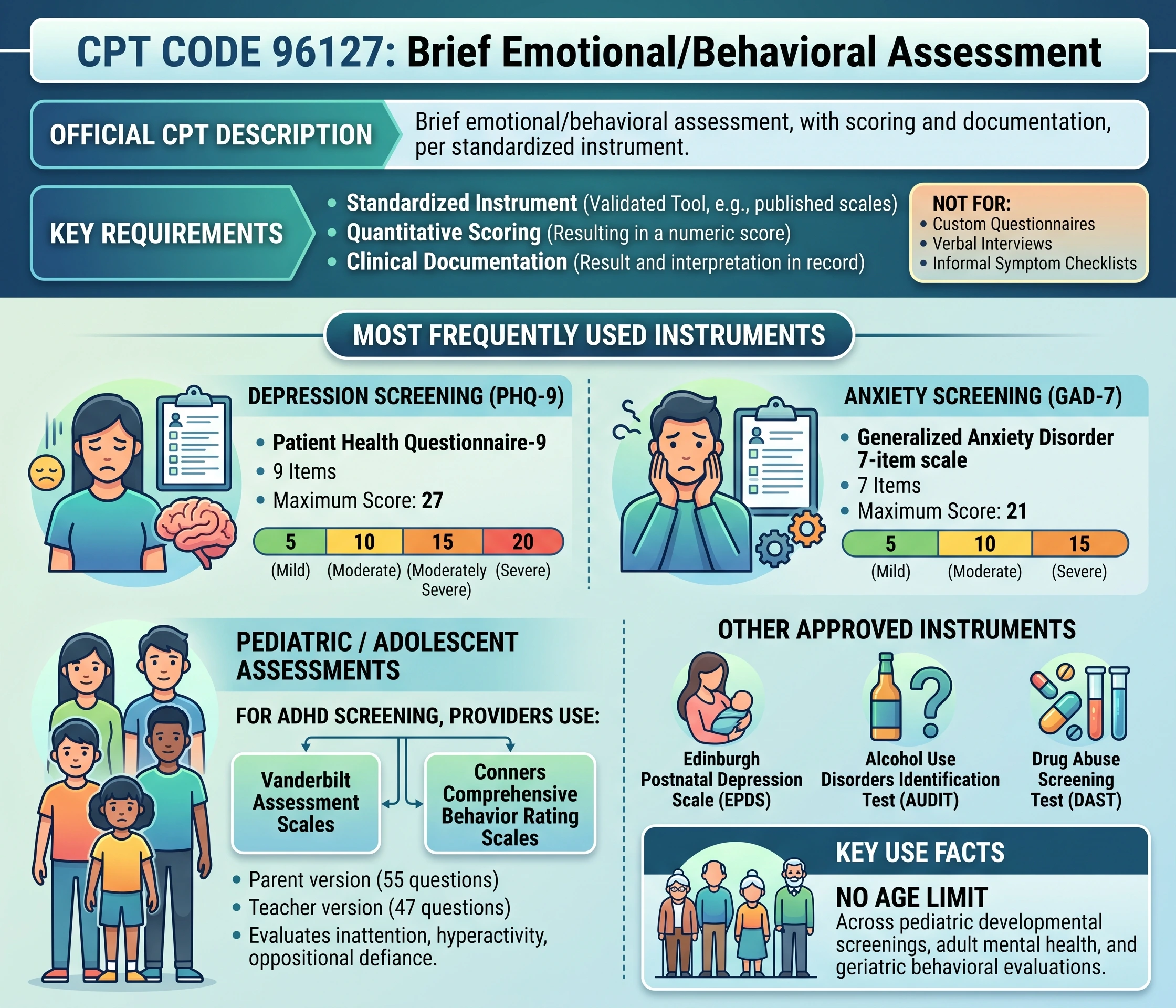
The official 96127 CPT code description is “Brief emotional/behavioral assessment, with scoring and documentation, per standardized instrument.” This definition requires clinical staff or providers to use a recognized, validated screening tool with a quantitative scoring system. Custom questionnaires, verbal interviews, or informal symptom checklists do not meet the criteria for this code.
Providers most frequently use 96127 to report the PHQ-9 CPT code for depression screening. The Patient Health Questionnaire-9 contains nine items, producing a maximum score of 27. Providers use specific score thresholds of 5, 10, 15, and 20 to determine the severity of depression symptoms.
The GAD-7 procedure code for anxiety screening also falls under the 96127 designation. The Generalized Anxiety Disorder 7-item scale yields a maximum score of 21. Medical staff use thresholds of 5, 10, and 15 to categorize mild, moderate, or severe anxiety.
When evaluating pediatric or adolescent patients, practices use 96127 as the ADHD screening CPT code. Providers typically rely on the Vanderbilt Assessment Scales or the Conners Comprehensive Behavior Rating Scales. The Vanderbilt parent scale contains 55 questions, while the teacher version contains 47 questions. Both versions evaluate symptoms of inattention, hyperactivity, and oppositional defiance.
Practices also bill 96127 for the Edinburgh Postnatal Depression Scale, the Alcohol Use Disorders Identification Test, and the Drug Abuse Screening Test. The AMA does not apply a specific age limit to 96127. Providers use it across pediatric developmental screenings, adult mental health assessments, and geriatric behavioral evaluations.
Differences between 96127 and complex testing codes
Medical billers must distinguish 96127 from psychological testing evaluation codes. CPT codes 96130 and 96131 represent psychological testing evaluation services by a physician or psychologist. Codes 96136 and 96137 cover the actual administration and scoring of these complex tests.
Code 96127 covers brief, single-issue screening tools that clinical staff can score in minutes. Complex testing codes cover hours of multi-faceted cognitive, psychiatric, and personality testing, such as the Minnesota Multiphasic Personality Inventory or comprehensive IQ testing. Practices cannot bill 96127 for administering complex psychological tests.
CPT 96127 billing guidelines and units
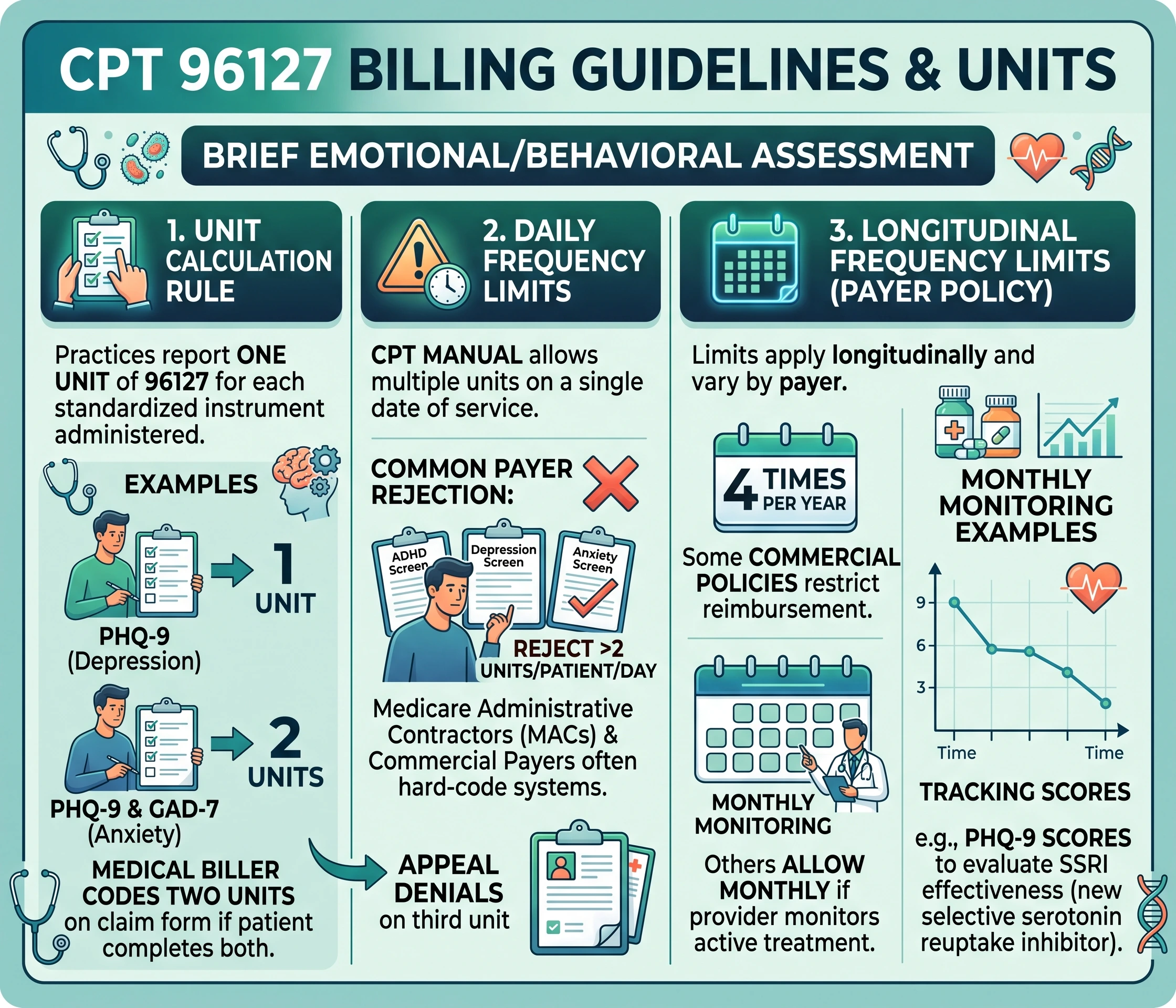
Proper application of 96127 billing guidelines requires strict attention to unit calculations. Practices report one unit of 96127 for each standardized instrument administered. If a patient completes both a PHQ-9 and a GAD-7 during the same visit, the medical biller codes two units of 96127 on the claim form.
Many payers impose a 96127 frequency limit. The CPT manual technically allows multiple units on a single date of service. However, regional Medicare Administrative Contractors and commercial payers often hard-code claim systems to reject more than two units per patient per day. If a provider administers an ADHD screen, a depression screen, and an anxiety screen simultaneously, the biller may need to submit medical records to appeal denials on the third unit.
The frequency limits also apply longitudinally. Some commercial policies restrict reimbursement for 96127 to four times per calendar year per patient. Other payers allow it monthly if the provider uses the instrument to monitor active treatment, such as tracking PHQ-9 scores to evaluate the effectiveness of a new selective serotonin reuptake inhibitor.
Modifiers for 96127
The 96127 CPT code modifier requirements depend entirely on the payer and the concurrent services provided. Because 96127 carries a multiple procedure fee reduction indicator of “0”, it does not require a modifier when billed as the only service on a claim.
If a practice bills multiple units, automated clearinghouses often deny the second and third units as duplicates. Billers prevent this by appending modifier 59 (Distinct Procedural Service) to the subsequent units.
When a practice bills 96127 alongside a standard Evaluation and Management code, they must append modifier 25 to the E/M code (such as 99213 or 99214). This modifier indicates the evaluation was a significant, separately identifiable service from the assessment administration.
Under the Affordable Care Act, many commercial insurance plans must cover preventive mental health screenings at 100 percent, with no patient copayment or deductible. To trigger this preventive benefit, billers append modifier 33 (Preventive Services) to the 96127 code. If the provider administers the test for diagnostic purposes because the patient presented with active psychiatric symptoms, the practice does not use modifier 33.
Documentation requirements for 96127
Documentation requirements for 96127 mandate four specific elements in the medical record. Auditors will recoup payments if any of these elements are missing.
The chart must state the exact name of the standardized test administered. It must list the quantitative numerical score. The provider must document their clinical interpretation of that score. Finally, the record must include a treatment plan or specific next steps based on the results.
A deficient medical record entry simply states, “Patient screened for depression, results negative.” This fails an audit because it lacks the instrument name and the numerical score.
A compliant medical record entry states, “PHQ-9 administered today by medical assistant. Total score: 14. Interpretation: Moderate depressive symptoms. Treatment plan: Discussed therapy options, initiated Escitalopram 10mg daily, and scheduled follow-up via telehealth in four weeks.”
The actual paper or digital questionnaire completed by the patient does not need to be submitted with the claim, but the practice must retain it in the patient’s local file in case of an audit. Many modern Electronic Health Records integrate these forms into patient portals. The patient completes the questionnaire on their phone in the waiting room, and the EHR automatically tallies the score and pastes the required text block into the provider’s progress note.
96127 reimbursement and RVU data
The 96127 reimbursement rate reflects the low practice expense associated with the service. According to the Centers for Medicare & Medicaid Services 2024 Physician Fee Schedule, the 96127 RVU is 0.15 total non-facility relative value units.
This valuation translates to a national Medicare payment of roughly $4.90 to $5.50 per unit. The exact dollar amount fluctuates based on regional geographic practice cost indices. A provider in Manhattan receives a slightly higher reimbursement rate than a provider in rural Nebraska due to local overhead cost adjustments. Commercial payers typically reimburse 96127 between $5.00 and $12.00 per unit, depending on the practice’s negotiated fee schedule.
While the reimbursement per unit is low, the cumulative revenue impacts primary care and pediatric practices significantly. A pediatric clinic seeing 30 adolescents a day, administering a PHQ-9 to each, generates approximately $150 in daily additional revenue for administrative work the staff already performs.
Medicare guidelines and diagnosis linkage
Medicare guidelines for CPT 96127 dictate that the program covers behavioral assessments when they are medically necessary. Providers must link the code to a supporting ICD-10 diagnosis code on the CMS-1500 claim form.
Common screening diagnosis codes include Z13.31 (Encounter for screening for depression) or Z13.32 (Encounter for screening for maternal depression). If the patient already has an established diagnosis, providers use specific behavioral health codes like F41.1 (Generalized anxiety disorder) or F32.A (Depression, unspecified).
Medicare will deny 96127 claims if the assessment serves purely as a routine screen without a suspected underlying condition, unless the practice bills it alongside an Annual Wellness Visit. During a Medicare Annual Wellness Visit (codes G0438 or G0439), depression screening is a required component, and practices can bill 96127 concurrently to capture the scoring of the standardized tool.
Telehealth policies implemented after 2020 allow practices to bill 96127 for remote services. Providers can bill 96127 as telehealth by appending modifier 95. The biller must also use the appropriate place of service code, such as POS 02 (Telehealth provided other than in patient’s home) or POS 10 (Telehealth provided in patient’s home).
Provider types and coding combinations
Physicians, nurse practitioners, physician assistants, and clinical psychologists can bill 96127 under their National Provider Identifier. State scope of practice laws dictate who holds the legal authority to formally interpret the test results and prescribe treatment. However, clinical staff (such as medical assistants, licensed practical nurses, or registered nurses) can administer the physical test under the general supervision of the billing provider.
Medical coders frequently handle claims involving 96127 alongside other specific service codes. CPT code 99406 covers smoking and tobacco use cessation counseling, intermediate (greater than 3 minutes up to 10 minutes). A provider can bill both 96127 and 99406 during the same encounter. The provider must address both issues and maintain entirely separate documentation for the behavioral assessment and the tobacco counseling. The time spent interpreting the behavioral assessment does not count toward the time-based requirements of the tobacco counseling code.
Billing CPT 96127 with 90792 (Psychiatric diagnostic evaluation with medical services) is also standard practice in psychiatric clinics. The National Correct Coding Initiative does not bundle 96127 into 90792. The diagnostic evaluation code represents the psychiatrist’s clinical interview, mental status examination, and medical decision-making. The 96127 code strictly captures the distinct administrative burden of processing the standardized questionnaire