


A pediatrician writes “delayed milestones” in a chart note, and three different coders could reach for three different codes. That inconsistency is common, and it’s expensive. Claims bounce back for clarification, referrals for early intervention stall, and quality reporting gets muddier than it needs to be.
The developmental delay ICD 10 code set looks small on paper, a handful of R-codes and F-codes. In practice, the right choice depends on exactly what the clinician documented and how old the child is. This guide covers the codes billers and coders actually use for developmental delay, what separates an unspecified code from a global developmental delay diagnosis, and where claims tend to run into trouble.
What “developmental delay” means before a code gets picked
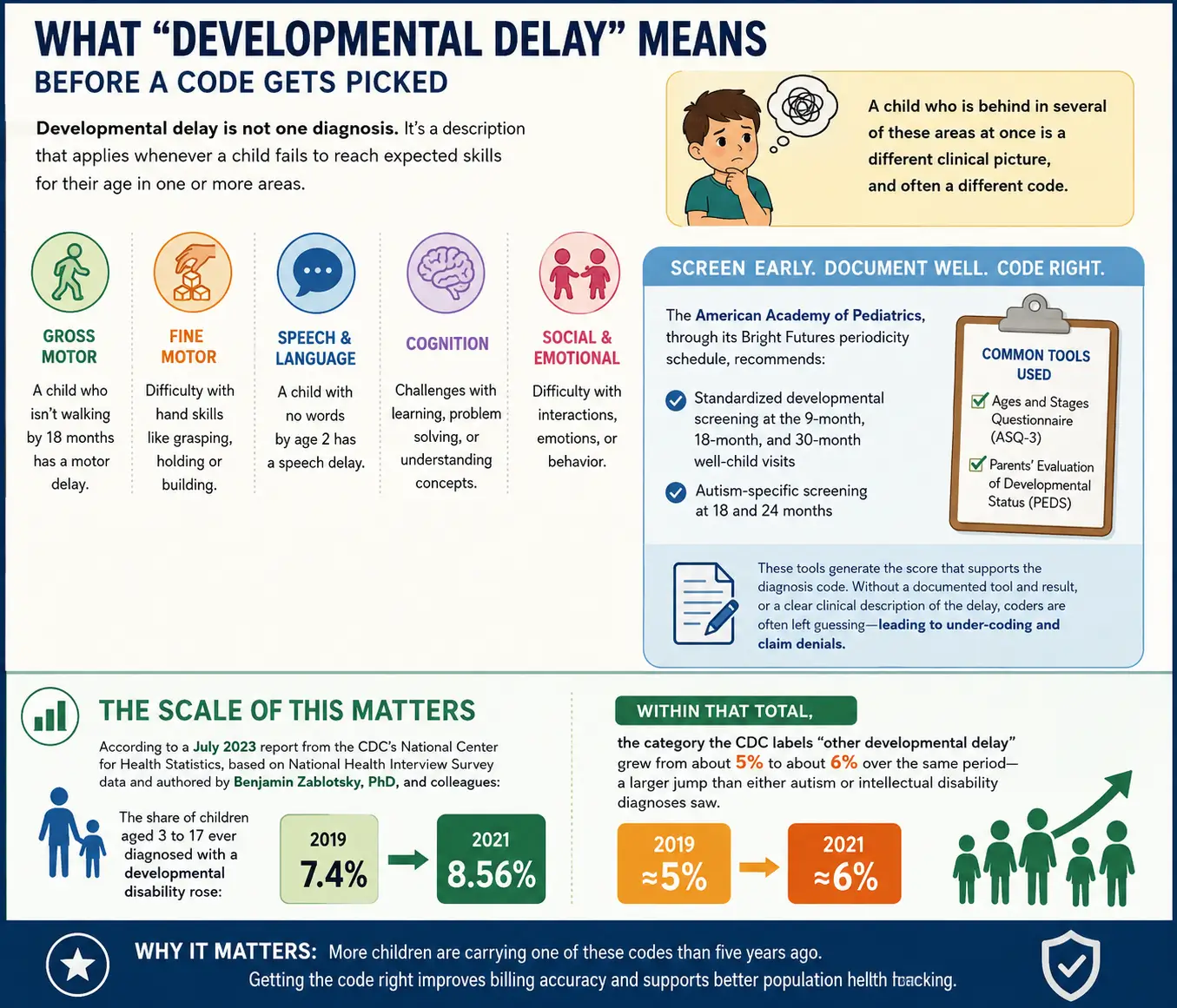
Developmental delay is not one diagnosis. It’s a description that applies whenever a child fails to reach expected skills for their age in one or more areas: gross motor, fine motor, speech and language, cognition, or social and emotional development. A child who isn’t walking by 18 months has a motor delay. A child with no words by age 2 has a speech delay. A child who is behind in several of these areas at once is a different clinical picture, and, as covered below, often a different code.
The American Academy of Pediatrics, through its Bright Futures periodicity schedule, recommends standardized developmental screening at the 9-month, 18-month, and 30-month well-child visits, with autism-specific screening added at 18 and 24 months. Tools such as the Ages and Stages Questionnaire (ASQ-3) and the Parents’ Evaluation of Developmental Status (PEDS) are the ones most practices use to generate the score that ends up supporting the diagnosis code. Without a documented tool and result, or a clear clinical description of the delay, coders are often left guessing, which is exactly how claims end up under-coded.
The scale of this matters more than it used to. According to a July 2023 report from the CDC’s National Center for Health Statistics, based on National Health Interview Survey data and authored by statistician Benjamin Zablotsky and colleagues, the share of children aged 3 to 17 ever diagnosed with a developmental disability rose from 7.4% in 2019 to 8.56% in 2021. Within that total, the category the CDC labels “other developmental delay” grew from about 5% to about 6% over the same period, a larger jump than either autism or intellectual disability diagnoses saw. More children are carrying one of these codes than five years ago, which makes getting the code right a bigger deal for both billing accuracy and population health tracking.
ICD-10 codes for developmental delay: the full list
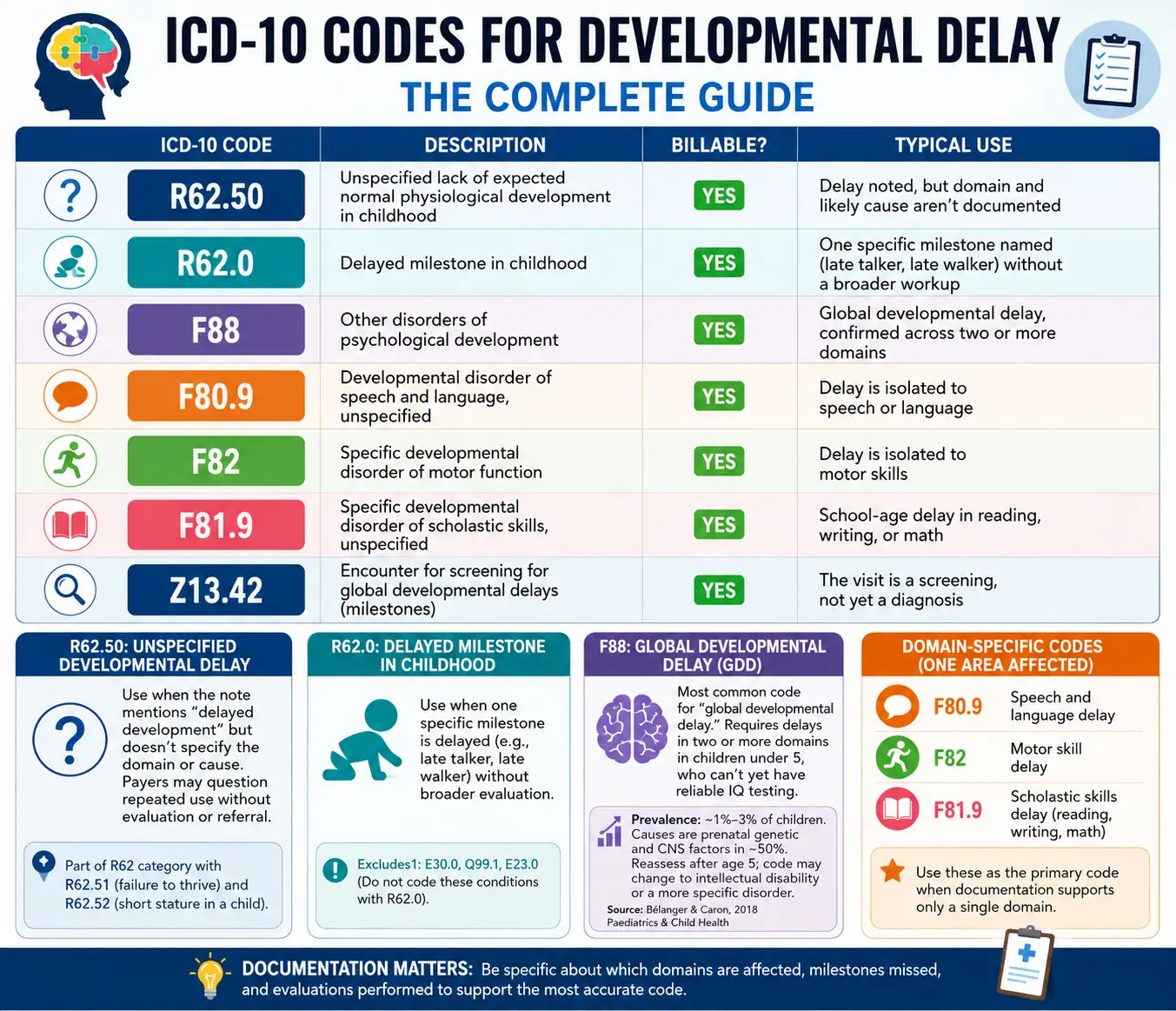
Code | Description | Billable | Typical use |
R62.50 | Unspecified lack of expected normal physiological development in childhood | Yes | Delay noted, but domain and likely cause aren’t documented |
R62.0 | Delayed milestone in childhood | Yes | One specific milestone named (late talker, late walker) without a broader workup |
F88 | Other disorders of psychological development | Yes | Global developmental delay, confirmed across two or more domains |
F80.9 | Developmental disorder of speech and language, unspecified | Yes | Delay is isolated to speech or language |
F82 | Specific developmental disorder of motor function | Yes | Delay is isolated to motor skills |
F81.9 | Specific developmental disorder of scholastic skills, unspecified | Yes | School-age delay in reading, writing, or math |
Z13.42 | Encounter for screening for global developmental delays (milestones) | Yes | The visit is a screening, not yet a diagnosis |
R62.50: the unspecified developmental delay ICD 10 code
R62.50 sits under category R62 in Chapter 18 of ICD-10-CM, the chapter reserved for signs, symptoms, and abnormal findings not yet tied to a confirmed disorder. It’s the code to reach for when a note says something like “delayed development, further evaluation needed” without naming which skills are affected. That vagueness is also its weakness. Payers increasingly flag R-codes billed repeatedly without a corresponding evaluation or referral, since the code implies a workup is still pending. R62.50 shares its parent category with R62.51 (failure to thrive) and R62.52 (short stature in a child), so a note describing growth failure rather than skill delay belongs under one of those siblings instead.
R62.0: delayed milestone in childhood
R62.0 is more specific than R62.50 despite sitting in the same chapter. Its official inclusion terms are narrow: delayed attainment of an expected physiological developmental stage, late talker, and late walker. It fits a note that names one milestone without describing a pattern across domains. One coding detail catches people off guard: R62.0 carries an Excludes1 note against delayed puberty (E30.0), gonadal dysgenesis (Q99.1), and hypopituitarism (E23.0), meaning those conditions must be coded separately and never alongside R62.0 for the same encounter.
F88: the code behind most “global developmental delay ICD 10” searches
When people search for the global developmental delay ICD 10 code, F88 is what they’re after. ICD-10-CM lists global developmental delay as an inclusion term under F88, alongside developmental agnosia and other specified neurodevelopmental disorder, and the code lives in Chapter 5 (Mental, Behavioral and Neurodevelopmental Disorders) rather than the symptom chapter that houses the R62 codes.
The clinical bar for F88 is higher than for either R62 code. The DSM-5 (American Psychiatric Association, 2013) reserves the diagnosis of global developmental delay for children younger than 5 who fail to meet milestones in two or more domains and who are too young for reliable standardized IQ testing. A 2018 review by Bélanger and Caron in Paediatrics & Child Health puts the prevalence at roughly 1% to 3% of children, with prenatal genetic and central nervous system causes accounting for close to half of identified cases. The diagnosis is meant to be revisited: as the child ages past 5 and can undergo formal cognitive testing, the diagnosis often shifts to intellectual disability or a more specific neurodevelopmental disorder, and the code should shift with it.
Domain-specific codes worth knowing
When only one area is affected, ICD-10-CM usually has a code more precise than any of the three above. F80.9 covers unspecified speech and language delay, F82 covers an isolated motor delay, and F81.9 covers a school-age scholastic skills delay. These aren’t secondary keywords to sprinkle into a note; they’re the correct primary code whenever the documentation only supports a single domain.
R62.50 vs R62.0 vs F88: matching the code to the note
R62.50 | R62.0 | F88 | |
Domains documented | Not specified | One named milestone | Two or more |
Typical patient age | Any | Usually under school age | Under 5 |
Standardized testing referenced | Not required | Not required | Expected, or explicitly deferred due to age |
Chart language that supports it | “Developmental delay, etiology unclear” | “Not yet walking, otherwise developing normally” | “Delayed in gross motor, fine motor, and expressive language” |
Follow-up expectation | Referral for evaluation | Recheck at next well visit | Reassessment closer to age 5 |
Documentation that actually supports the code
Coders can only work with what’s on the page. A note that supports anything beyond R62.50 usually includes:
- Which domain or domains are affected (motor, speech, cognitive, social)
- The screening tool used (ASQ-3, PEDS, or similar) and the resulting score
- How the child’s performance compares to age-matched peers
- Whether a referral to early intervention, a developmental pediatrician, or a specialist was made
- A stated plan for reassessment, particularly for a global developmental delay diagnosis in a child under 5
Missing any of these tends to push the claim back toward an unspecified code by default, even when the clinical picture was actually more specific.
Coding developmental delay in children: from screening to diagnosis
Two families of codes get confused constantly: the Z13.4x screening codes and the R62/F88 diagnosis codes. Z13.40 (unspecified developmental delay screening), Z13.41 (autism screening), Z13.42 (global developmental delay screening), and Z13.49 (other developmental delay screening) all describe the encounter itself, billed alongside CPT 96110 when a standardized instrument was scored. They’re appropriate when the visit’s purpose was screening and no delay has been confirmed yet. Once a screening comes back positive and the child is diagnosed with an actual delay, the encounter needs an R62 or F-series code instead, not a continued Z13.4x code. Billing a screening code on a visit where a diagnosis was already established is one of the more common errors payers catch.
Coding mistakes that trigger denials or audits
- Defaulting to R62.50 when the note already names a single milestone (use R62.0) or multiple domains (use F88 or a specific F80-F84 code)
- Ignoring the R62.0 Excludes1 note and coding it alongside delayed puberty, gonadal dysgenesis, or hypopituitarism for the same encounter
- Leaving F88 on the chart past age 5 without updating it once formal testing has been completed, since the DSM-5 treats the diagnosis as provisional by design
- Coding a screening visit as a diagnosis, or the reverse, confirming a diagnosis but still billing under Z13.4x
- Skipping the domain detail in documentation, which strips coders of the information needed to move past an unspecified code
Picking the right developmental delay ICD 10 code comes down to reading what the clinician actually documented: which domains, what tool, what age, and what happens next. When the note supports it, F88 and the domain-specific F80 through F84 codes carry far more clinical information than R62.50 ever will, and that extra specificity is usually what keeps a claim from bouncing back for clarification.