


Patient education is an integral component of physical therapy. Teaching patients about their condition, explaining home exercise programs, and discussing fall prevention strategies are standard practices in most therapy sessions. However, physical therapists frequently struggle with how to bill for these educational services. The Centers for Medicare & Medicaid Services (CMS) and commercial payers have specific guidelines regarding when and how patient education can be reimbursed.
Navigating the current procedural terminology (CPT) codes related to education requires a clear understanding of payer rules. Often, education is bundled into other procedural codes. Understanding when education qualifies as a separately billable service prevents claim denials and ensures accurate reimbursement for the time spent teaching patients self-management strategies.
Physical Therapy Billing Guidelines for Education
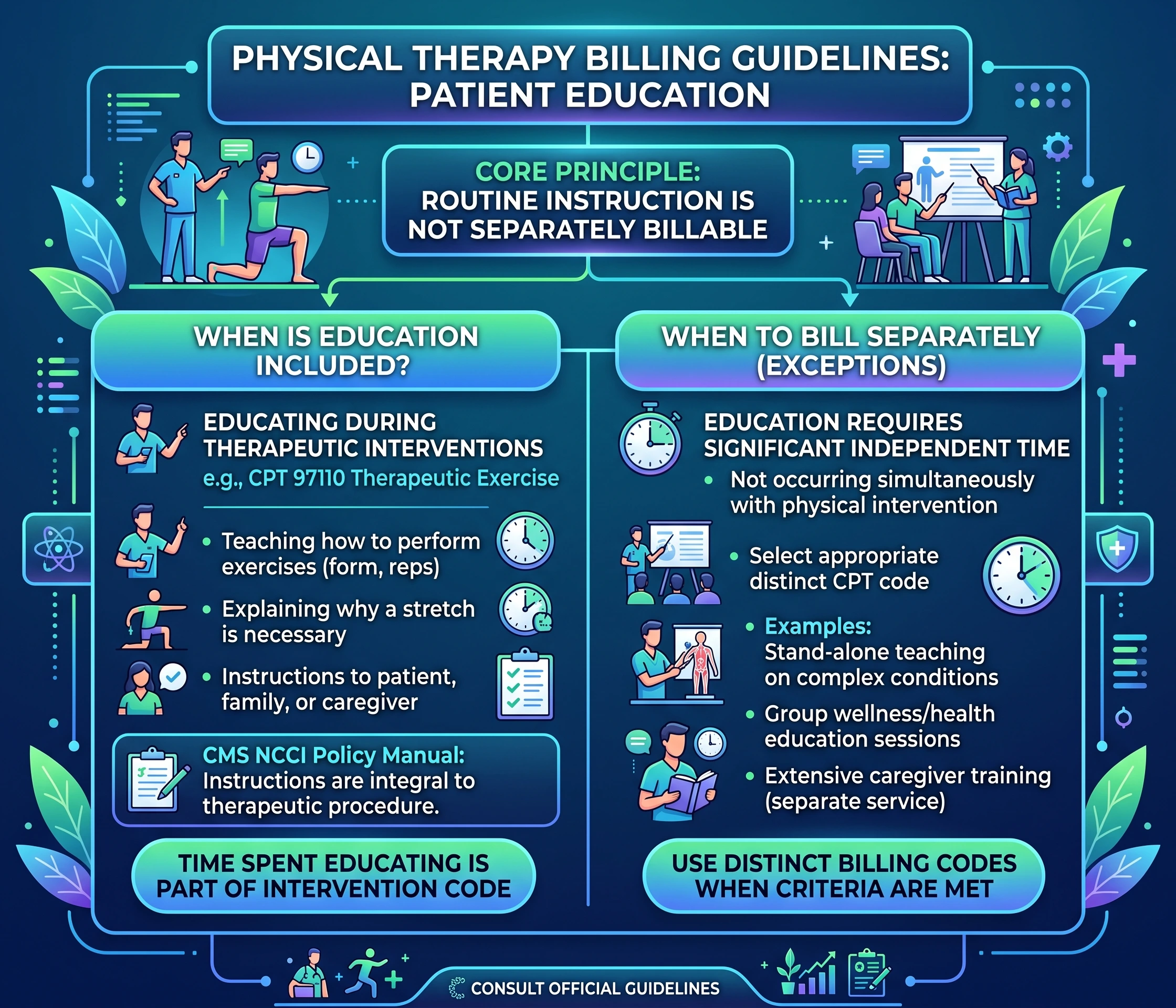
The core principle governing physical therapy billing guidelines for education is that routine instruction is not separately billable. When a physical therapist teaches a patient how to perform an exercise during a therapeutic exercise session (CPT 97110), the time spent educating the patient is included in that code. The CMS National Correct Coding Initiative (NCCI) Policy Manual states that instructions to the patient, family, or caregiver are integral to the therapeutic procedure being performed.
This means you cannot bill a separate patient education CPT code simply for telling a patient how many repetitions of a squat to perform or explaining why a specific stretch is necessary. If the education happens concurrently with a therapeutic intervention, the billing code for that intervention covers the educational component.
However, situations exist where education requires significant time independent of a physical intervention. In these specific scenarios, physical therapists must select the appropriate CPT code that accurately reflects the nature of the teaching.
CPT Code for Patient Education Physical Therapy
When patient teaching occurs outside the scope of a standard therapeutic procedure, therapists typically look to specific codes designed for education and training. The two primary codes discussed in this context are CPT 98960 and CPT 97535.
CPT 98960 Billing Guidelines
CPT 98960 describes education and training for patient self-management by a qualified, nonphysician health care professional using a standardized curriculum, face-to-face with the patient (could include caregiver/family), each 30 minutes.
While this code seems applicable to physical therapy, its use is heavily restricted. The American Physical Therapy Association (APTA) notes that Medicare does not reimburse physical therapists for CPT 98960. CMS assigns a status indicator of “B” (bundled) or “N” (non-covered) to this code when billed by therapists, meaning they consider the payment for this service to be included in the payment for other services provided on the same day.
Commercial payers vary in their coverage of CPT 98960. Some accept it, while others follow Medicare guidelines. Before using CPT 98960, therapists must verify the specific payer requirements. If a commercial payer does cover it, strict CPT 98960 documentation requirements apply. The therapist must document the standardized curriculum used for the self-management education. Handing out a generic sheet on pain science education does not meet the standard. The curriculum must be a recognized, structured program designed to help the patient manage their specific condition.
Because of the 30-minute time requirement and the need for a standardized curriculum, CPT 98960 is rarely the appropriate code for standard physical therapy education.
Self-Care and Home Management Training: CPT 97535
A more commonly applicable code for physical therapists is CPT 97535 (Self-care/home management training). This code covers training in activities of daily living (ADLs), compensatory training, meal preparation, safety procedures, and instructions in use of assistive technology devices or adaptive equipment. It requires direct one-on-one contact and is billed in 15-minute increments.
CPT 97535 is appropriate when the primary focus of the time segment is teaching the patient or caregiver how to manage their condition safely at home.
Examples of appropriate use for CPT 97535 include:
- Teaching a patient with a recent total hip arthroplasty how to adhere to hip precautions while getting in and out of bed.
- Instructing a caregiver on safe transfer techniques for a patient with a spinal cord injury.
- Providing extensive fall prevention education, including environmental modifications in the home, for an elderly patient with a history of falls.
- Teaching a patient how to properly don and doff a complex orthotic device.
The distinction between CPT 97535 and routine education bundled into other codes lies in the focus and intensity. If the therapist spends 15 minutes exclusively teaching a spouse how to assist the patient with a transfer board, that time is billable under 97535.
Neuromuscular Reeducation and Patient Teaching
Therapists often provide exercise counseling and movement retraining that requires significant instruction. CPT 97112 (Neuromuscular reeducation of movement, balance, coordination, kinesthetic sense, posture, and/or proprioception for sitting and/or standing activities) is frequently used in these scenarios.
While 97112 is a treatment code, it inherently involves a high degree of patient teaching. Reeducating a patient’s posture or kinesthetic sense requires continuous verbal, tactile, and visual feedback. If a therapist spends 15 minutes analyzing a patient’s gait, explaining the biomechanical faults causing their knee pain, and instructing them on specific cues to alter their movement pattern, this time is appropriately billed as 97112. The education is the mechanism of the neuromuscular reeducation.
Documentation Requirements for Educational Services
Accurate physical therapy documentation billing is required to support the codes selected. When billing for time spent on education, the medical record must clearly demonstrate medical necessity.
Auditors look for specific elements in the documentation when reviewing claims for patient education. The documentation must detail exactly what was taught. A note that simply says, “Provided patient education,” is insufficient and will likely lead to a denial.
Effective documentation should include:
- The specific topic of the education (e.g., fall prevention strategies, home exercise program progression, transfer techniques).
- Who received the education (the patient, a family member, or a caregiver).
- The patient’s or caregiver’s response to the education, demonstrating their understanding. This is often documented by stating the patient performed a return demonstration of the skill or accurately verbalized the precautions discussed.
- The time spent on the educational intervention, especially if billing a time-based code like 97535.
- The relationship of the education to the patient’s functional goals.
For example, a strong documentation entry for 97535 might read: “Spent 15 minutes instructing the patient’s spouse on contact guard assist techniques for tub transfers. Spouse performed a return demonstration safely and verbalized understanding of body mechanics to prevent back injury. This training is necessary to allow the patient to bathe safely at home upon discharge.”
When Education is Not Separately Billable
The most common billing error regarding education is attempting to bill separately for instruction that is a routine part of another intervention.
If a therapist is providing manual therapy (CPT 97140) and simultaneously explaining the anatomy of the shoulder and why the joint mobilization is necessary, that education time cannot be billed separately. The time spent talking is bundled into the time billed for the manual therapy.
Similarly, reviewing a home exercise program while the patient is actively performing therapeutic exercises (CPT 97110) in the clinic does not warrant an additional education code. The instruction is considered an integral part of ensuring the therapeutic exercise is performed correctly.
The rule of thumb is that if the education occurs concurrently with another billable service and does not require a distinct, separate block of time focused solely on training for self-management or safety, it is not separately billable.
The Role of Pain Science Education
Pain science education has become a prominent component of physical therapy, particularly for patients with chronic pain. This intervention involves teaching patients about the neurobiology of pain, aiming to alter their pain perception and reduce fear-avoidance behaviors.
Billing for pain science education presents a challenge. It does not fit neatly into traditional physical therapy codes. Some therapists attempt to use CPT 98960, but as discussed, Medicare bundles this code, and commercial payer coverage is inconsistent.
When pain science education is integrated into a therapeutic exercise session, altering how the patient approaches the movement, it is typically billed under the code for that movement intervention (e.g., 97110 or 97112). If the therapist spends a distinct 15-minute block of time exclusively discussing pain neurobiology without any physical intervention, establishing medical necessity and finding an appropriate, reimbursable CPT code is difficult under current CMS guidelines. The APTA continues to advocate for better recognition and reimbursement for cognitive interventions provided by physical therapists.
Accurate billing for patient education requires therapists to distinguish between routine instruction bundled into treatment codes and distinct, time-intensive training sessions focused on self-care, safety, or home management. By understanding the specific requirements of codes like 97535 and the limitations of codes like 98960, clinics can ensure compliance with payer guidelines and secure appropriate reimbursement for the necessary educational services provided to patients and caregivers. Careful documentation that clearly outlines the content, recipient, and patient comprehension of the education remains the primary defense against claim denials.