
On January 1, 2027, Medicare Advantage plans, state Medicaid and CHIP programs, Medicaid managed care plans and qualified health plans on the federal exchange must have electronic prior authorization connections in place. The requirement comes from the CMS Interoperability and Prior Authorization Final Rule, known as CMS-0057-F, which CMS released on January 17, 2024.
Part of the rule is already running. Since January 1, 2026, the same payers have had to meet decision deadlines, give a specific reason for every denial and post prior authorization statistics on their websites. The 2027 phase adds the technology: four application programming interfaces (APIs) built on the HL7 FHIR standard.
The effect on practices will be uneven. A clinic that bills mostly employer-sponsored plans may notice very little. A practice with a large Medicare Advantage or Medicaid managed care panel, and a schedule full of services that need approval, will see the change in its daily work. This guide covers what the rule requires, what it leaves out, and which practices should be prepared first.
Which payers the rule covers
CMS calls the payers under this rule "impacted payers." There are five types:
- Medicare Advantage organizations
- State Medicaid and CHIP fee-for-service programs
- Medicaid managed care plans
- CHIP managed care entities
- Qualified health plan (QHP) issuers on the federally facilitated exchanges
Traditional Medicare is not on the list. HHS noted in its 2024 announcement that Medicare fee-for-service had already built its own electronic prior authorization API. Employer-sponsored commercial plans are not on the list either, so a practice's largest commercial payers may not change their process at all.
Drugs sit outside the rule. The decision deadlines, the denial-reason requirement and the API data all cover medical items and services only. In April 2026, CMS proposed a separate rule (CMS-0062-P) that would extend electronic prior authorization to drugs, with most requirements starting October 1, 2027. That rule is still a proposal.
What already changed on January 1, 2026
Three process rules took effect for impacted payers at the start of 2026.
The first is a decision deadline. Impacted payers, except QHP issuers on the federal exchanges, must send a decision within 72 hours for expedited (urgent) requests and within seven calendar days for standard requests.
The second covers denials. Every impacted payer must give a specific reason when it denies a prior authorization request, no matter how the request was sent. CMS says the reason is there to help providers resubmit or appeal.
The third is public reporting. Each impacted payer must post prior authorization statistics on its website once a year. The first report, covering calendar year 2025, was due by March 31, 2026. It includes the share of requests approved and denied and the average and median time from request to decision.
For billing staff, the denial-reason rule has the most direct effect on rework. A denial that names the missing document or the unmet criterion can often be corrected and resubmitted within days. When an impacted payer still sends a denial with no usable reason, staff can point to the federal requirement when they call.
What starts on January 1, 2027
The 2027 deadline covers four FHIR-based APIs. Dates vary slightly by payer type. Medicare Advantage organizations and state Medicaid and CHIP fee-for-service programs must comply by January 1, 2027. Medicaid and CHIP managed care plans must comply by the rating period starting on or after that date, and exchange QHP issuers by plan years starting on or after it, according to the final rule in the Federal Register.
| API | What the payer must provide | What it means for a practice |
|---|---|---|
| Prior Authorization API | A list of services that need approval, the documentation each one requires, request submission, and a response that approves, denies with a reason, or asks for more information | Staff can check requirements and submit from the EHR instead of a payer portal, if the EHR supports it |
| Provider Access API | Claims, encounter, clinical and prior authorization data for patients in a treatment relationship with an in-network provider (patients can opt out) | A practice can see a new patient's history and past authorizations with that plan |
| Payer-to-Payer API | Up to five years of claims, clinical and prior authorization data sent to a patient's new plan (patients opt in) | The new plan can see what the old plan approved |
| Patient Access API | Prior authorization requests and decisions added to the data patients can pull into apps | Patients can check their own request status |
The Prior Authorization API is the one front desks and billers will use most. It is built on the HL7 Da Vinci implementation guides, known as Coverage Requirements Discovery (CRD), Documentation Templates and Rules (DTR) and Prior Authorization Support (PAS). In practice, a scheduler orders an MRI, the EHR asks the payer whether approval is needed, pulls the payer's documentation questions into the chart, and sends the request without anyone logging into a portal.
What practices are and are not required to do
The rule puts the build requirement on payers. Practices are not required to buy software or connect to the APIs, and portals, phone and fax will keep working.
Two federal programs do push practices toward the new process. The 2024 rule added an "Electronic Prior Authorization" measure to the MIPS Promoting Interoperability category, starting with the 2027 performance period. A clinician meets it by attesting that at least one non-drug prior authorization was requested through a payer's Prior Authorization API using certified EHR technology, or by claiming an exclusion. In July 2026, CMS proposed making the measure optional for 2027, worth 10 bonus points. MIPS clinicians should check the final 2027 Quality Payment Program fact sheet for the policy that was adopted. For hospitals and critical access hospitals, the FY 2027 inpatient final rule made the measure an optional bonus measure for 2027 and mandatory from 2028.
The HIPAA standard for prior authorization is still the X12 278 transaction. In February 2024, HHS announced enforcement discretion, which means covered entities using an all-FHIR Prior Authorization API under this rule will not face HIPAA enforcement for skipping the X12 278. In December 2025, the CMS National Standards Group held a listening session on replacing the X12 278 with FHIR and said the input will inform future rulemaking.
Which practices will feel it most
Three factors decide the impact: payer mix, specialty and EHR readiness. The table ranks common practice types.
| Practice type | Expected impact | Why |
|---|---|---|
| Practices with a high Medicare Advantage or Medicaid managed care share | High | Most of their prior authorizations go to impacted payers, so deadlines, denial reasons and APIs apply to most requests |
| Imaging centers, orthopedics, spine, pain management, cardiology and sleep medicine | High | These specialties request approval for many medical services, which are inside the rule's scope |
| Physical, occupational and speech therapy, and Medicaid behavioral health | High | Frequent visit-based authorizations and reauthorizations, often with managed Medicaid plans |
| Practices in New Jersey, Ohio, Oklahoma, Texas, Arizona or Washington | High | The CMS WISeR model, which started January 1, 2026, added prior authorization for select services in traditional Medicare in these six states |
| Small practices on older or uncertified EHRs | Medium to high | Electronic submission depends on the EHR vendor; without it, staff stay on portals while payers move to APIs |
| Oncology, infusion and other drug-heavy practices | Low for now | Most of their authorizations are for drugs, which stay outside the rule unless the drug proposal is finalized |
| Practices billing mostly employer-sponsored plans | Low | Employer plans are not impacted payers |
The WISeR model runs from 2026 through 2031 and uses technology vendors, including AI tools with clinician review, for selected services that CMS considers prone to waste or misuse. Providers in those six states can request prior authorization or let the claim go through pre-payment medical review. Practices there now handle prior authorization in traditional Medicare as well as Medicare Advantage.
What stays the same
The rule changes the process, not the list of services. Each payer still decides which items and services need approval. In June 2025, a group of health plans made voluntary commitments, published by CMS, to cut the number of services subject to prior authorization and to expand real-time approvals for most requests by 2027. Those commitments are pledges, not regulation.
The deadlines are ceilings. Seven calendar days for a standard request is still too long for many scheduled procedures, so practices should keep submitting as early as possible. Drug authorizations, employer plans and traditional Medicare outside the WISeR states follow their existing rules.
How practices can prepare before January 1
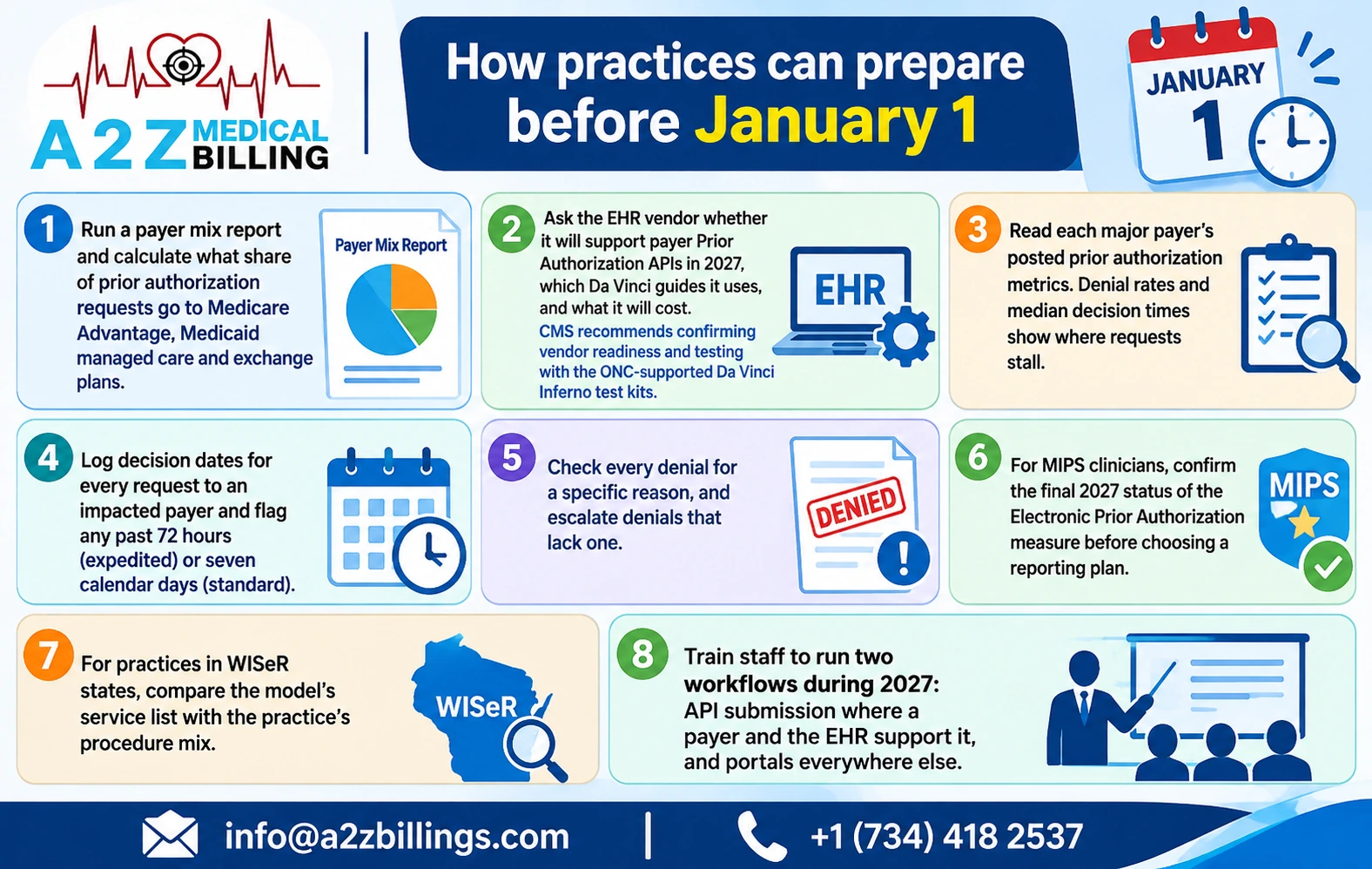
- Run a payer mix report and calculate what share of prior authorization requests go to Medicare Advantage, Medicaid managed care and exchange plans.
- Ask the EHR vendor whether it will support payer Prior Authorization APIs in 2027, which Da Vinci guides it uses, and what it will cost. CMS recommends confirming vendor readiness and testing with the ONC-supported Da Vinci Inferno test kits.
- Read each major payer's posted prior authorization metrics. Denial rates and median decision times show where requests stall.
- Log decision dates for every request to an impacted payer and flag any past 72 hours (expedited) or seven calendar days (standard).
- Check every denial for a specific reason, and escalate denials that lack one.
- For MIPS clinicians, confirm the final 2027 status of the Electronic Prior Authorization measure before choosing a reporting plan.
- For practices in WISeR states, compare the model's service list with the practice's procedure mix.
- Train staff to run two workflows during 2027: API submission where a payer and the EHR support it, and portals everywhere else.
How A2Z Billings helps with prior authorization
A2Z Billings manages prior authorization requests and denial follow-up for practices across the United States. For a review of how a practice's top payers handled prior authorization in 2025 and what will change in 2027, contact the A2Z Billings team.
FAQs
Are practices required to use the Prior Authorization API in 2027?
No. CMS-0057-F requires impacted payers to build and maintain the API. Practices can keep using portals, phone and fax. MIPS clinicians and hospitals have a related Promoting Interoperability measure, covered above.
Does CMS-0057-F apply to traditional Medicare?
No. Traditional Medicare is not an impacted payer. Separately, the WISeR model added prior authorization for selected services in traditional Medicare in six states starting January 1, 2026.
Does the rule cover prescription drugs?
No. Drugs are excluded from the deadlines, denial-reason requirements and APIs. CMS proposed drug requirements in April 2026, with most proposed to start October 1, 2027.
What should a practice do when a denial gives no reason?
Since January 1, 2026, impacted payers must give a specific reason for every prior authorization denial. Staff should ask the payer for the reason in writing and keep a record of payers that do not comply.