
CMS issued the final CY 2027 Medicare Physician Fee Schedule rule on November 4, 2026. It takes effect January 1, and most Part B practices will be paid less per RVU than they are today. It also retires G2211, introduces modifiers B1 and B2, and reduces payment for some office visits billed with a procedure on the same day.
CMS Administrator Mehmet Oz said the rule moves away from payment that “rewarded volume over value.” Practice owners and billing managers are asking narrower questions. How much less will Medicare pay? Does the new modifier make up for it? Which claims need new coding? The sections below answer them in that order.
How much less will Medicare pay per RVU?
Medicare multiplies each service’s RVUs by a conversion factor to set the payment rate. For clinicians who are not qualifying APM participants, the 2027 factor is $32.63. That is $0.77 below the 2026 figure of $33.40, a cut of 2.31%. Qualifying APM participants drop from $33.57 to $32.95, a cut of $0.62, or 1.83%.
The July proposal was gentler, at 1.68% and 1.19%. Three changes moved the final numbers about 0.6 points lower:
- A one-year 2.50% increase for 2026, enacted in Public Law 119-21, expires on schedule. CMS says current law therefore builds a 2.50% reduction into 2027.
- The statutory update is small: +0.75% for qualifying APM participants and +0.25% for everyone else.
- The budget neutrality adjustment is -0.12%. CMS softened the same-day visit cut (more on that below), which gave up savings the conversion factor had been relying on.
The two factors are also drifting apart. The gap was about $0.17 per RVU in 2026 and is about $0.33 in 2027, so practices outside value-based models carry more of the reduction.
For scale: A group with $1.5 million in annual Medicare allowed charges and no QP status would lose about $34,650 at the same volume. Commercial contracts priced as a percentage of Medicare will pass along part of that loss.
What replaces G2211?
For dates of service from January 1, 2027, G2211 is no longer payable. CMS is moving the visit complexity payment onto the E/M code itself through modifier B1. Billing-firm summaries of the rule say B1 applies to office and outpatient visits and to home or residence visits. It raises payment by 16% at every visit level, where G2211 paid one flat amount regardless of how complex the visit was.
Modifier B2 raises payment by 32%. Only practitioners in a Shared Savings Program ACO or participant providers in a LEAD Model ACO may use it, and use is voluntary. According to the CMS fact sheet, B2 can be billed for any beneficiary the participant treats, whether or not the patient is assigned to the ACO. Those claims count toward assignment, benchmarks, and performance-year spending in both programs.
The cutoff follows the date of service. A visit on December 31, 2026 still carries G2211, even if the claim goes out in February. A visit on January 2 needs B1 or B2 on the E/M line, and a claim that still carries G2211 will be rejected.
Will modifier B1 offset the conversion factor cut?
It depends on how the 16% is applied, and two sources read it differently. CMS describes B1 as a 16% increase in the payment for the E/M code. Doctors Management, a physician consulting firm, models a 99214 at 4.02 total RVUs rising to 4.33 with B1. That is about 7.7% more payment, roughly $10 per visit.
Take a primary care practice with $250,000 in Medicare revenue, $150,000 of it from visits that qualify for B1. The 2.31% cut costs about $5,775.
| Scenario | B1 Add-on | Net Result |
|---|---|---|
| Full 16% B1 payment | $24,000 | $18,225 ahead |
| 7.7% payment lift | $11,550 | $5,775 ahead |
If B1 pays the full 16%, the add-on is worth $24,000 and the practice finishes $18,225 ahead. If the real lift is closer to 7.7%, the add-on is about $11,550 and the net gain shrinks to about $5,775.
Either result depends on actually capturing the modifier. A practice that leaves G2211 logic in its EHR on January 1 will collect nothing for the complexity it documents. Early paid claims will show which reading CMS’s payment files follow, and the final Addendum B RVUs should be checked before anyone commits to a budget.
How does the same-day visit rule work?
The July proposal would have paid the higher-valued service at 100% and anything else billed that day at 50%, across 0-day, 10-day, and 90-day global procedures. The final rule is narrower on both points.
It applies only to 0-day global procedures. The lower-valued service is paid at 80%, a 20% reduction. It covers a separately identifiable office or outpatient E/M visit billed on the same day as the procedure by the same physician or a physician in the same practice. CMS’s press release describes it as ending duplicate payment for work already counted in the procedure’s value.
Same-day payment illustration
A simple illustration, with round numbers rather than fee schedule amounts: a $130 visit billed with modifier 25 next to a $60 joint injection.
| Service | Old Rules | New Rule |
|---|---|---|
| Office visit | $130 | $130 |
| Joint injection | $60 | $48 |
| Total | $190 | $178 |
Under the old rules both paid in full, for $190. Under the new rule the visit pays $130, the injection pays $48, and the encounter totals $178. Where the procedure is worth more than the visit, the visit takes the 20% cut instead.
A rough way to size the exposure: count how many same-day visit and procedure pairs the practice billed in a typical month, then multiply by 20% of the lower-valued service. Suppose a clinic bills 40 such pairs a month and the lower-valued service averages $60. That is $480 a month, or $5,760 a year, on top of the conversion factor cut. The figures are hypothetical, but the arithmetic works the same with a practice’s own claim history.
Coders should expect closer attention to these pairs. The modifier 25 note has to stand alone and describe the evaluation work that was separate from the procedure’s usual pre- and post-service work.
Which practices are likely to feel the most pressure?
The rule does not hit every practice the same way. Groups outside any value-based model absorb the larger conversion factor cut and cannot use B2. Practices that regularly pair visits with 0-day procedures, such as joint injections, face the same-day reduction on top of that. A practice with a high share of longitudinal primary care visits sits on the other side of the ledger, since B1 applies at every visit level. Most groups will land somewhere between those profiles, which is why repricing real claim volume matters more than reading headline percentages.
What should ACO participants know?
Beyond modifier B2, the rule lets approved ACOs reduce or eliminate Part B cost-sharing for many services delivered to assigned beneficiaries starting April 1, 2027. CMS also raised shared savings rates for eligible ACOs and added incentives for first-time participants. Patient statements for assigned beneficiaries may change as a result, so the front desk needs to know which waivers a given ACO has adopted.
What changed for telehealth and remote monitoring?
For mental health, the CAA 2026 provision that waives the in-person visit requirement runs through December 31, 2027. Rural health clinics and FQHCs can also keep billing non-behavioral telehealth visits through that date.
Remote monitoring rules are tighter. RTM is limited to established patients, and RPM or RTM billing now requires a separately reportable initiating visit. CMS delayed until January 1, 2029 the requirement that monitoring be performed by clinical staff on the practice’s own payroll, so contracted vendors can continue until then.
Are there new codes worth adding?
CMS finalized separate coding or payment for:
- Shared medical appointments, with a time-based add-on
- Health and well-being coaching under general supervision
- Diagnosis and treatment of vaccine adverse effects
- Advance care planning by clinical staff (G0572 and G0573), with CPT 99497 and 99498 reserved for time the billing practitioner spends personally
Smoking cessation and SBIRT services join the final year of the timed behavioral health code transition, and CoCM work RVUs rise.
What else could move revenue?
Three smaller items matter for specific groups. CMS is phasing out the indirect practice cost index over two years and replacing it with a practice expense stabilizer, so specialties with heavy practice expense should compare final Addendum B values against 2026. Clinical lab payment reductions tied to private payor rates are capped at 15% a year through 2029. And the rule implements Public Law 119-21’s limit on Medicare eligibility to four groups: citizens and nationals, lawful permanent residents, Cuban and Haitian entrants, and people residing under a Compact of Free Association. Eligibility staff should know how their verification process handles a coverage termination.
Traditional MIPS reporting also has an end date. It runs through the 2030 performance period, and CMS finalized three new MIPS Value Pathways for diabetes, hypertension, and hospitalists.
What should a practice do before January 1?
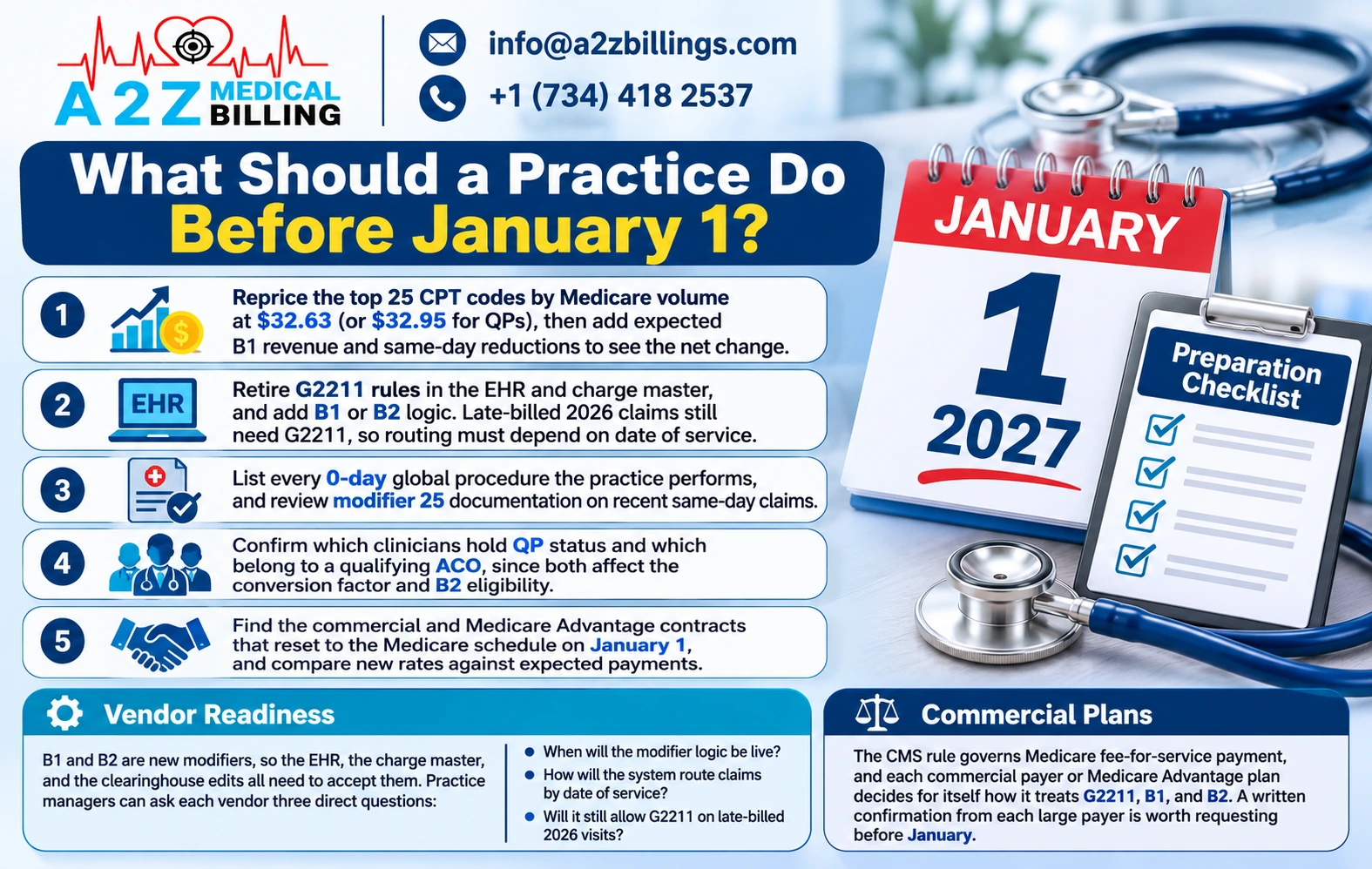
- Reprice the top 25 CPT codes by Medicare volume at $32.63 (or $32.95 for QPs), then add expected B1 revenue and same-day reductions to see the net change.
- Retire G2211 rules in the EHR and charge master, and add B1 or B2 logic. Late-billed 2026 claims still need G2211, so routing must depend on date of service.
- List every 0-day global procedure the practice performs, and review modifier 25 documentation on recent same-day claims.
- Confirm which clinicians hold QP status and which belong to a qualifying ACO, since both affect the conversion factor and B2 eligibility.
- Find the commercial and Medicare Advantage contracts that reset to the Medicare schedule on January 1, and compare new rates against expected payments.
Vendor readiness deserves its own checklist item.
Vendor readiness deserves its own checklist item. B1 and B2 are new modifiers, so the EHR, the charge master, and the clearinghouse edits all need to accept them. Practice managers can ask each vendor three direct questions: when will the modifier logic be live, how will the system route claims by date of service, and will it still allow G2211 on late-billed 2026 visits?
Commercial plans are a separate matter. The CMS rule governs Medicare fee-for-service payment, and each commercial payer or Medicare Advantage plan decides for itself how it treats G2211, B1, and B2. A written confirmation from each large payer is worth requesting before January.
Frequently asked questions
Can the conversion factor still change?
Only Congress can change it. Doctors Management noted that lawmakers have stepped in during most recent years, though its analysis found no 2027 action yet. Practices should build budgets on the final numbers and revisit them if Congress acts.
Does the same-day reduction apply to 10-day and 90-day procedures?
No. Only 0-day global procedures billed with a separately identifiable office or outpatient E/M visit are affected.
Who can bill modifier B2?
Practitioners in a Shared Savings Program ACO and participant providers in a LEAD Model ACO.
Can contracted vendors still run remote monitoring?
Yes, until January 1, 2029. After that, payment requires clinical staff on the practice’s own payroll.
Where is the rule published?
The Federal Register lists it as document 2026-22743. CMS posted fact sheets on cms.gov.
Practices that want help running these numbers can ask a billing team for a fee schedule readiness review before January claims go out.