A clinician joins your practice. Their credentialing comes back approved, the first claims go out, and then the denials start coming back. Remark code N290. "Rendering provider not associated with billing provider." Nobody did anything obviously wrong, but the payer can't connect the person who saw the patient to the business that sent the bill.
That gap between the individual and the group is one of the most common enrollment problems we fix at A2Z Billings, and it's almost always avoidable. This guide covers when you need individual enrollment, when you need group enrollment too, how payers link the two, and what to do when the NPIs on your claims don't line up.
Type 1 and Type 2 NPIs in plain terms
Every enrollment decision starts with the National Provider Identifier. There are two kinds, and mixing them up causes most of the trouble.
A Type 1 NPI belongs to a person: a physician, therapist, nurse practitioner or counselor. You get one for life, and it follows you from job to job. A Type 2 NPI belongs to an organization, such as a group practice, clinic or agency.
The part that confuses people is the solo clinician. NPPES is clear that "a sole proprietorship is not eligible for an organizational NPI." If you practice under your own name and Social Security number, your Type 1 NPI is all you have. Once you form a PLLC, LLC or corporation, though, the business becomes its own entity, and CMS's NPI fact sheet confirms that an incorporated clinician can hold a Type 1 NPI personally and a Type 2 NPI for the company.
So a "solo practice" can still need two NPIs. What decides it is how the business is set up legally, not how many people work there.
Say a counselor in Grand Rapids has billed under her own name for years, then forms a PLLC for liability reasons. The day that PLLC starts collecting payments under its own tax ID, it needs a Type 2 NPI and group enrollment with each payer, and she has to be linked to it as the rendering clinician. Her personal NPI doesn't change. Everything around it does.
When individual enrollment is enough, and when you need both
Here's the short version.
Individual enrollment only usually works when:
- You're a sole proprietor billing under your own name and SSN
- Payments go to you personally, not a business account
- No one else bills under your practice
Group and individual enrollment together is needed when:
- Your practice is a PLLC, LLC, corporation or partnership with its own tax ID
- More than one clinician sees patients and the business collects payment
- You hire someone new who will bill under the practice
- A clinician works for more than one practice, each with its own tax ID
In the second situation, the group enrolls with its Type 2 NPI and tax ID, and each clinician enrolls with their own Type 1 NPI. Then the payer has to be told that the clinician works for that group. Skipping that last step is where the denials come from.
How payers connect the clinician to the group
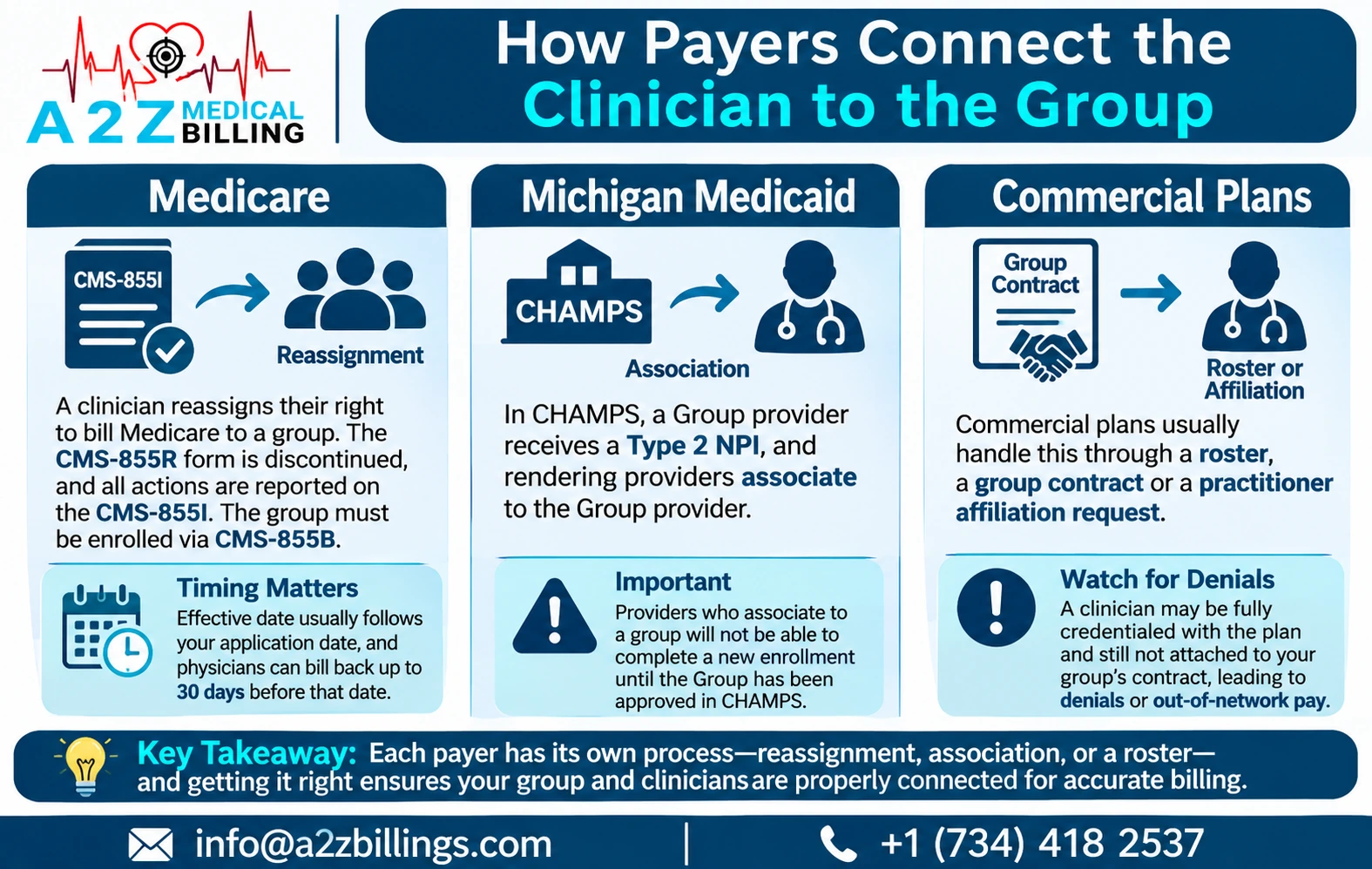
Each payer links individuals to groups in its own way, and the name for it changes too.
Medicare
Medicare calls it reassignment. A clinician who works for a group reassigns their right to bill Medicare to that group. Reassignment used to need its own form, the CMS-855R, but that form is gone now. CMS says all reassignment actions are reported on the CMS-855I and that the CMS-855R "has been discontinued." Most practices handle it in PECOS. The group must be enrolled through the CMS-855B, and the clinician through the CMS-855I with the reassignment section filled in.
Timing matters as well. Medicare's effective date usually follows the date your application was filed, and under 42 CFR 424.521 a physician can bill back up to 30 days before that date, if certain conditions are met. If a new hire starts seeing Medicare patients before anyone submits their enrollment, visits outside that 30-day window may not be billable at all.
Michigan Medicaid
Michigan Medicaid calls it association. In CHAMPS, "a Group provider would receive a Type 2 NPI and rendering/servicing providers would associate to the Group provider." The order is strict, too. MDHHS says providers who associate to a group "will not be able to complete a new enrollment until the Group has been approved in CHAMPS."
Commercial plans
Commercial plans usually handle it through a roster, a group contract or a practitioner affiliation request. The clinician may be fully credentialed with the plan and still not attached to your group's contract. When that happens, claims either deny or pay at an out-of-network rate.
Where each NPI goes on the claim
Even with every enrollment approved, a claim can fail if the numbers land in the wrong boxes. On a professional claim, two fields matter most:
| Field | CMS-1500 | 837P loop | Whose NPI |
|---|---|---|---|
| Billing provider | Item 33a | 2010AA | The group's Type 2 NPI, or a sole proprietor's Type 1 |
| Rendering provider | Item 24J | 2310B | The Type 1 NPI of the clinician who saw the patient |
The billing provider is the entity getting paid. The rendering provider is the person who actually delivered the service. In a group, those are different NPIs, and payers check that they belong together.
Michigan Medicaid spells this out clearly. MDHHS requires the organization NPI in the billing provider field, while a sole proprietor reports their own Type 1 NPI there instead.
One more detail trips up behavioral health and primary care groups in particular: the rendering NPI should belong to whoever actually provided the service. Putting a supervising physician's NPI on a visit an NP or therapist delivered may look harmless, but some payers treat it as a reporting error. Where documentation doesn't back it up, it can also turn into a compliance problem.
What happens when the NPIs don't match
NPI mismatches tend to follow a few patterns. Medicare contractors list three usual causes: a missing or invalid rendering NPI, a missing or invalid billing NPI, or a rendering NPI in Item 24J that isn't associated with the group NPI in Item 33a.
The remark codes you'll usually see:
- N290: missing, incomplete or invalid rendering provider identifier
- N257: missing, incomplete or invalid billing provider identifier
- CO-16: claim lacks information needed for adjudication, often paired with one of the above
Here's what's usually behind them, and the fix for each.
Their individual enrollment is approved, but no reassignment, CHAMPS association or roster update was ever submitted. The fix is to file the link, then resubmit once it's active.
This happens after an ownership change, a new tax ID or a second location that got its own Type 2 NPI. The fix is to match the billing NPI and tax ID to the enrollment record exactly.
A provider profile is set to bill under the individual instead of the group, or the reverse. One wrong setting can deny weeks of claims before anyone notices the pattern.
An old address or taxonomy in NPPES that doesn't match the payer's record can cause rejections even when the enrollment itself is fine.
Old reassignments and associations should be ended when someone leaves. Otherwise you get confusing denials, or payments landing with the wrong practice.
Correct the record first, and then resubmit. Sending the same claim again before the enrollment is fixed usually just earns the same denial.
What Michigan practices should watch for
Michigan adds a layer that catches many practices off guard. MDHHS requires providers who serve Medicaid health plan members to enroll in CHAMPS, and it bars the plans from paying "rendering, referring, ordering, operating, billing, supervising, and attending providers not enrolled in CHAMPS."
In practice, that means a Medicaid health plan contract isn't enough by itself. The group and each rendering clinician also need active CHAMPS records, correctly associated to each other, or the plan can't pay the claim.
A few habits help:
- Enroll the group in CHAMPS before the clinicians, since associations can't be submitted until the group is approved
- Check that the specialty and taxonomy match between NPPES, CHAMPS and each health plan
- Send BCBSM, Priority Health and other commercial plans updated rosters whenever a clinician joins or leaves
- Track Medicare reassignments in PECOS separately, since PECOS and CHAMPS don't share data
A quick NPI match checklist
Before a new clinician's first claim goes out, confirm:
- The practice's legal structure, and whether it needs a Type 2 NPI
- NPPES records for both NPIs, including address and taxonomy
- Group enrollment approved with every payer you plan to bill
- Individual enrollment approved for the clinician with each payer
- The link between them: Medicare reassignment, CHAMPS association, commercial roster
- Practice management settings: billing NPI in 33a, rendering NPI in 24J
- A test claim, or a careful look at the first few remits
How A2Z Billings helps
Our credentialing team handles group and individual enrollment together, so the linking step doesn't fall through the gap between two people's to-do lists. We set up the reassignment, CHAMPS association and commercial rosters, check NPPES against every payer record, and review the first claims for each new provider before a small error turns into a pattern.
If N290 denials or out-of-network payments are already piling up, we can trace each one back to the enrollment gap behind it and fix the record before resubmitting.
Frequently asked questions
Can a solo provider have both a Type 1 and a Type 2 NPI?
Yes, if the practice is incorporated as a PLLC, LLC or corporation. A sole proprietor gets only a Type 1 NPI.
Which NPI goes in box 33a?
The billing provider's NPI. For a group, that's the Type 2 NPI. For a sole proprietor, it's their Type 1 NPI.
Is the CMS-855R still used for Medicare reassignment?
No. Reassignment is now reported on the CMS-855I or through PECOS.
Why did my claim deny with N290 when the provider is credentialed?
Usually because the clinician's individual enrollment isn't linked to the group on the claim, or the NPI in 24J doesn't match the payer's record.
Do Michigan Medicaid health plans require CHAMPS enrollment?
Yes. Health plans can't pay providers who aren't enrolled in CHAMPS, and that includes rendering clinicians.