A therapist gets her NPI, joins her first insurance panel and sends her first claim. It bounces. Her license is active, her NPI is correct and the diagnosis is fine. The problem is a ten-character code she picked in two minutes while applying for the NPI, and it does not match the specialty the payer has on file.
Taxonomy codes rarely get attention until they cause a denial. By then the wrong code may sit in three places: the NPI record, the payer's file and the billing software. Fixing it means touching all three.
This guide explains what a taxonomy code is, how to pick the right one for a therapist, a nurse practitioner or a group, where the code must match, and how to correct it when it does not.
What a taxonomy code does
A taxonomy code is a ten-character code that names a provider's type and specialty. The National Uniform Claim Committee (NUCC) maintains the Health Care Provider Taxonomy code set, and it is the set used in the electronic health care transactions that HIPAA standardizes. Providers choose their codes in the National Plan and Provider Enumeration System (NPPES), the CMS system that issues NPIs.
The code is not a license number and it is not a billing code. The NPI says who the provider is. The taxonomy code says what kind of provider that is. Payers read it to decide how to price and cover the service.
Each code has three layers: a provider grouping, a classification and, for many, a specialization. Counselor, Mental Health is one code. Social Worker, Clinical is another.
An NPI record can hold more than one taxonomy code, up to 15, and one has to be marked as primary.
Picking the code by license
Therapists and counselors
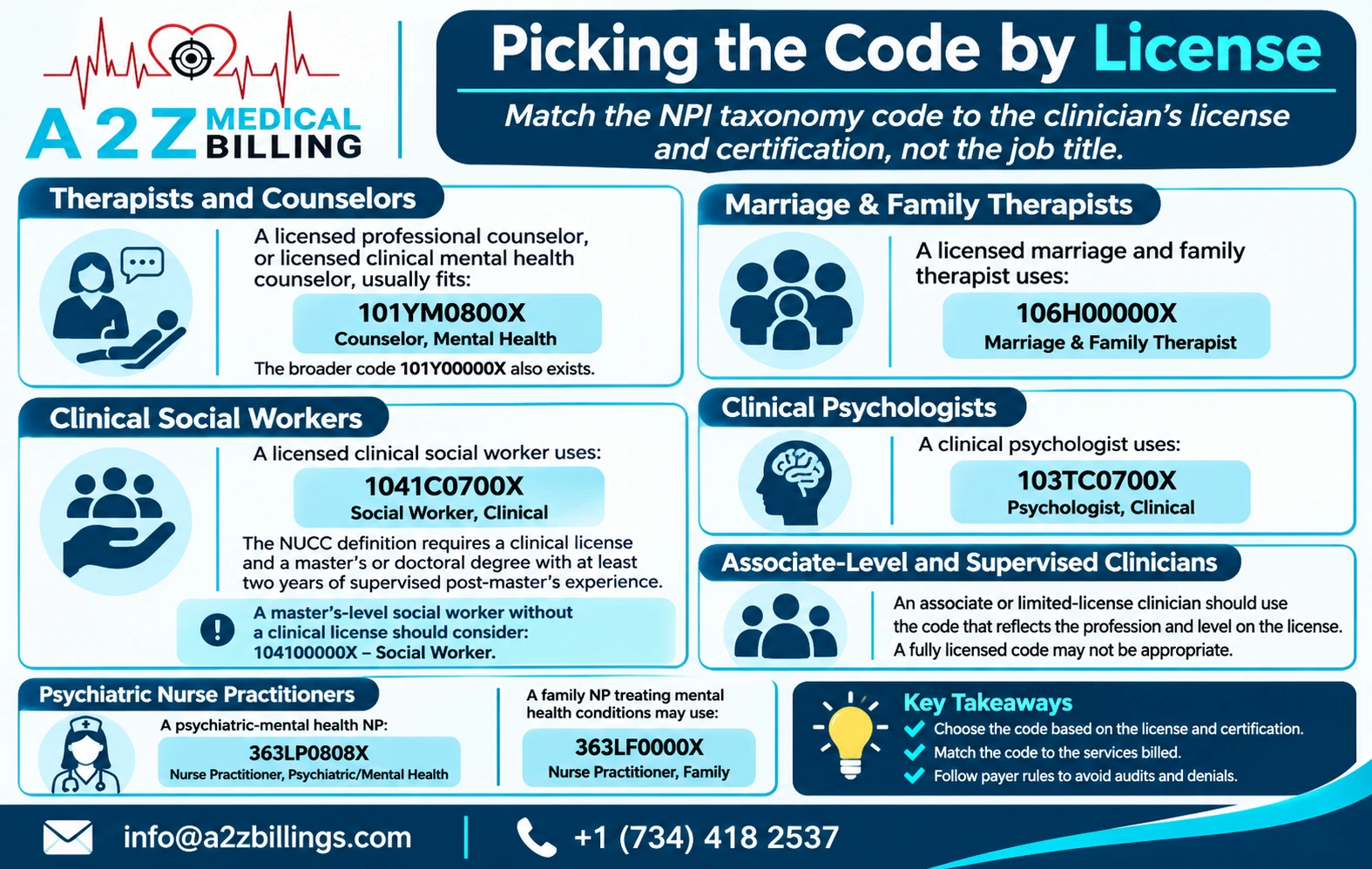
The code follows the license the clinician holds, not the job title on the door.
A licensed professional counselor, or a licensed clinical mental health counselor, usually fits Counselor, Mental Health, code 101YM0800X. The broader Counselor code, 101Y00000X, also exists, and some payers prefer the more specific one.
A licensed marriage and family therapist uses 106H00000X, Marriage & Family Therapist.
A licensed clinical social worker uses 1041C0700X, Social Worker, Clinical. The NUCC definition says the social worker must be licensed, certified or registered at the clinical level in the state, and it describes a master's or doctoral degree plus at least two years of supervised post-master's clinical experience. A master's-level social worker whose license is not clinical level should not pick that code by default. The general Social Worker code, 104100000X, exists for that case, and the payer's own policy decides which one it accepts.
A clinical psychologist uses 103TC0700X, Psychologist, Clinical.
Associate-level and supervised clinicians
An associate or limited-license clinician follows the same principle. The code should describe the profession and level on the license, and each payer decides whether it will credential or pay that clinician at all. The taxonomy is not the place to borrow a supervisor's credential. Picking a fully licensed code for a limited license can create a mismatch that shows up in audits and denials later.
Psychiatric nurse practitioners
A psychiatric-mental health nurse practitioner fits 363LP0808X, Nurse Practitioner, Psychiatric/Mental Health. A family nurse practitioner who treats mental health conditions might hold 363LF0000X, Nurse Practitioner, Family, because that is the certification on file.
The code should match the certification and the services billed. A nurse practitioner who bills psychotherapy under a primary care taxonomy invites questions from the payer, and the opposite mismatch causes the same trouble. The state nursing license and national certification are the reference points.
Group practices and organizations
Groups have their own NPI, a Type 2 NPI, and their own taxonomy. NUCC defines a group as a business made up of one or more individual practitioners. A single-specialty group, 193400000X, is a group where all the practitioners share the same specialization. A multi-specialty group, 193200000X, is one where they do not.
A group of five licensed counselors is single specialty. A practice that employs counselors, a psychiatric NP and a psychologist is multi-specialty. NUCC also notes that a single provider can be a valid group when it operates as a business entity, such as a professional corporation. A solo therapist with a PLLC or a PC may therefore hold both an individual NPI and a group NPI.
Licensed facilities use the clinic or center codes instead. Clinic/Center, Mental Health (Including Community Mental Health Center), 261QM0801X, is the common one, and adult and child-specific versions exist.
When the claim is built, the billing provider's taxonomy and the rendering provider's taxonomy are different fields. The billing provider is the group, and the rendering provider is the clinician who treated the patient. On an electronic professional claim, those sit in separate loops. The group's code goes with the group NPI, and the clinician's code goes with the clinician's NPI.
Quick reference for behavioral health
| Provider | Common taxonomy code | Description |
|---|---|---|
| Licensed professional counselor | 101YM0800X | Counselor, Mental Health |
| Marriage and family therapist | 106H00000X | Marriage & Family Therapist |
| Clinical social worker | 1041C0700X | Social Worker, Clinical |
| Social worker (non-clinical level) | 104100000X | Social Worker |
| Clinical psychologist | 103TC0700X | Psychologist, Clinical |
| Psychiatric NP | 363LP0808X | Nurse Practitioner, Psychiatric/Mental Health |
| Single-specialty group | 193400000X | Group, Single Specialty |
| Multi-specialty group | 193200000X | Group, Multi-Specialty |
| Mental health clinic | 261QM0801X | Clinic/Center, Mental Health |
This list is a starting point, not a ruling. The NUCC code set and each payer's policy decide what is accepted.
Primary and secondary codes
The primary code is the one that represents what the provider mainly does. It shows up in the public NPI Registry and tends to be the code payers check first.
Secondary codes cover additional roles. A therapist who is both a licensed counselor and a certified addiction counselor might list two. A claim should carry only the code that matches the service on that claim, which means billing software has to pick the right one for each clinician.
A longer list is not better. Extra codes add chances for a mismatch, and every code needs to match a license or certification the provider can prove.
Where the code has to match
The same code usually needs to appear in four places:
- The NPPES record
- The payer's enrollment or credentialing file
- The provider's credentialing profile
- The claim, as sent by the billing software
A mismatch among these is a familiar cause of denials, credentialing delays and re-submissions. Payers often compare the claim against the NPPES record and the specialty they enrolled, and some state Medicaid programs apply their own edits that limit which taxonomies are allowed for which procedure codes. Publicly posted payer guides spell this out, so a practice should read the guide from each payer it bills.
The billing software sends whatever taxonomy was entered when the clinician was set up. If that entry is older than the NPPES update, the claims will not reflect the fix.
Common mistakes
- Choosing a code in a hurry during the NPI application and never revisiting it
- Picking a code for a license the provider does not hold
- Using a clinical-level code for a non-clinical license
- Changing NPPES without telling payers or updating the credentialing profile
- Leaving old taxonomy settings in the billing software after a change
- Listing a primary code that no longer reflects what the provider does
- Assuming a group inherits its clinicians' codes
How to change a taxonomy code in NPPES
Federal rules put the responsibility on the provider. Under 45 CFR 162.410, a covered provider has to tell NPPES about changes to its required data within 30 days. Taxonomy is one of those data elements.
The update itself takes a few steps:
- Sign in to NPPES at nppes.cms.hhs.gov with the provider's Identity and Access credentials.
- Open the NPI record and go to the Taxonomy section.
- Add, edit or remove codes, entering the license number and issuing state where NPPES asks for them.
- Select the radio button next to the code that should be primary.
- Submit the change and keep the confirmation tracking number.
The work is not finished at NPPES. Update each payer file, the credentialing profile and the billing software afterward, then send a test claim and check what went out.
How A2Z Billings handles taxonomy problems
A2Z Billings starts with a side-by-side audit. The team pulls the NPPES record, the taxonomy each payer has on file, the credentialing profile and a sample claim for each clinician and group. Anything that does not match gets flagged, along with the license that supports the correct code.
From there, A2Z Billings handles the follow-up that tends to stall: the NPPES update, notices to payers, billing software setup and a check of the next batch of claims. It matters most for new practices, groups that are adding clinicians and practices that have seen provider-type denials they cannot explain.
A practice with a rejected claim or a stalled credentialing file can book an appointment or contact A2Z Billings for a review.
Frequently asked questions
What is the taxonomy code for a therapist?
It depends on the license. A licensed professional counselor typically uses 101YM0800X, a marriage and family therapist uses 106H00000X and a clinical social worker uses 1041C0700X. The code should match the license and what the payer has on file.
Can a provider have more than one taxonomy code?
Yes. An NPI record can list up to 15 taxonomy codes, and one has to be marked primary. A claim should carry the code that matches the service billed.
What is the taxonomy code for a psychiatric nurse practitioner?
A psychiatric-mental health nurse practitioner commonly uses 363LP0808X. A nurse practitioner with another certification, such as family practice, may need a different code that matches that certification.
Which taxonomy code does a group practice use?
A group uses a group code with its Type 2 NPI: 193400000X for a single-specialty group or 193200000X for a multi-specialty group. A licensed clinic may use a clinic or center code instead.
Can a wrong taxonomy code cause a denial?
Yes. Payers compare the claim with the NPPES record and the specialty they enrolled, so a mismatch can lead to a rejection, a denial or a manual review.