

A therapist spends three months getting credentialed with a commercial plan, signs the contract and opens her calendar to new patients. Her first remittance shows an allowed amount that is a third lower than the rate she had been charging. Another therapist across town drops every panel, raises her fee and finds she has more empty slots than she can afford.
Both made a reasonable choice. Neither one did the math first.
The in-network question has no universal answer. It depends on the caseload a practice can fill, the patients nearby, the specialty and how much administrative work the owner can take on. This guide breaks down what each model means, runs a worked example, covers the federal rules that apply, and lists the questions to answer before signing a payer contract.
What each model means for a practice
In-network
An in-network provider signs a contract with a payer and agrees to accept its allowed amount for each service. The patient pays a copayment, coinsurance or deductible, and the plan pays the rest. The practice cannot charge the patient the difference between its usual fee and the allowed amount, except for cost sharing.
The trade is volume for rate. The payer lists the provider in its directory and sends referrals, and the practice takes a lower and more predictable payment. Credentialing has to finish before billing starts, and that part takes time.
Out-of-network
An out-of-network provider has no contract with the plan. The practice sets its own fee and the patient pays it. Many patients then submit a superbill to their plan and get partial reimbursement, if their policy includes out-of-network benefits. The practice is not a party to that reimbursement, and the amount depends on the patient's plan.
There is no credentialing wait and no allowed-amount ceiling. There is also no directory listing, so the practice has to find its own patients.
The revenue math, with a worked example
The numbers below are assumptions for illustration, not benchmarks. Change them to match the real practice.
Suppose a therapist charges $175 per session out of network. Her average in-network contracted rate is $110, and she assumes 8% of in-network revenue goes to billing costs, which leaves about $101 per session.
Out-of-network: $175 × 15 sessions = $2,625 per week.
In-network: $110 contracted rate less 8% billing costs = approximately $101 per session.
Break-even: Approximately 26 in-network sessions to match the $2,625 weekly revenue.
At $175 a session, an out-of-network practice that fills 15 slots a week brings in $2,625. An in-network practice at about $101 net per session has to fill roughly 26 slots to earn the same amount.
The break-even ratio is simple. At these numbers, in-network has to fill about 1.7 sessions for every one session the out-of-network practice fills. If panels can bring a full caseload in a few months, in-network wins. If the patient base for a $175 fee exists and fills the calendar, out-of-network wins.
Three other items belong in the comparison. Cancellations and no-shows hurt a cash practice and an insured practice alike. Collection timing differs, because out-of-network patients pay at the visit and insurers pay after a claim. And billing cost is real for in-network work, whether it comes as staff time or an outsourced fee.
When in-network is worth it
In-network tends to pay off in these situations:
- A new practice that needs patients. Directory listings and referrals fill a calendar faster than word of mouth.
- A community where most patients rely on insurance. Cash-pay demand is thin in many markets, and a practice priced above it sits empty.
- Specialties that insurers cover heavily, such as psychiatry, psychological testing and medication management.
- A group practice with billing support that can absorb the claim work.
- Medicare and Medicaid patients. Neither program reimburses a practice that stays out of network in the usual way.
Medicare deserves a closer look
A Medicare-participating provider agrees to accept assignment on all claims, which means accepting Medicare's approved amount. A non-participating provider can still accept assignment case by case and receives 5% less. If the provider does not accept assignment, the patient can be charged up to the limiting charge, which is 115% of the non-participating fee schedule amount, as CMS and Medicare.gov explain.
Since January 1, 2024, marriage and family therapists and mental health counselors can bill Medicare directly. CMS requires them to enroll first, using the new provider specialty codes for those professions. For a practice that had written off Medicare, that opened a new payer.
When out-of-network is the better fit
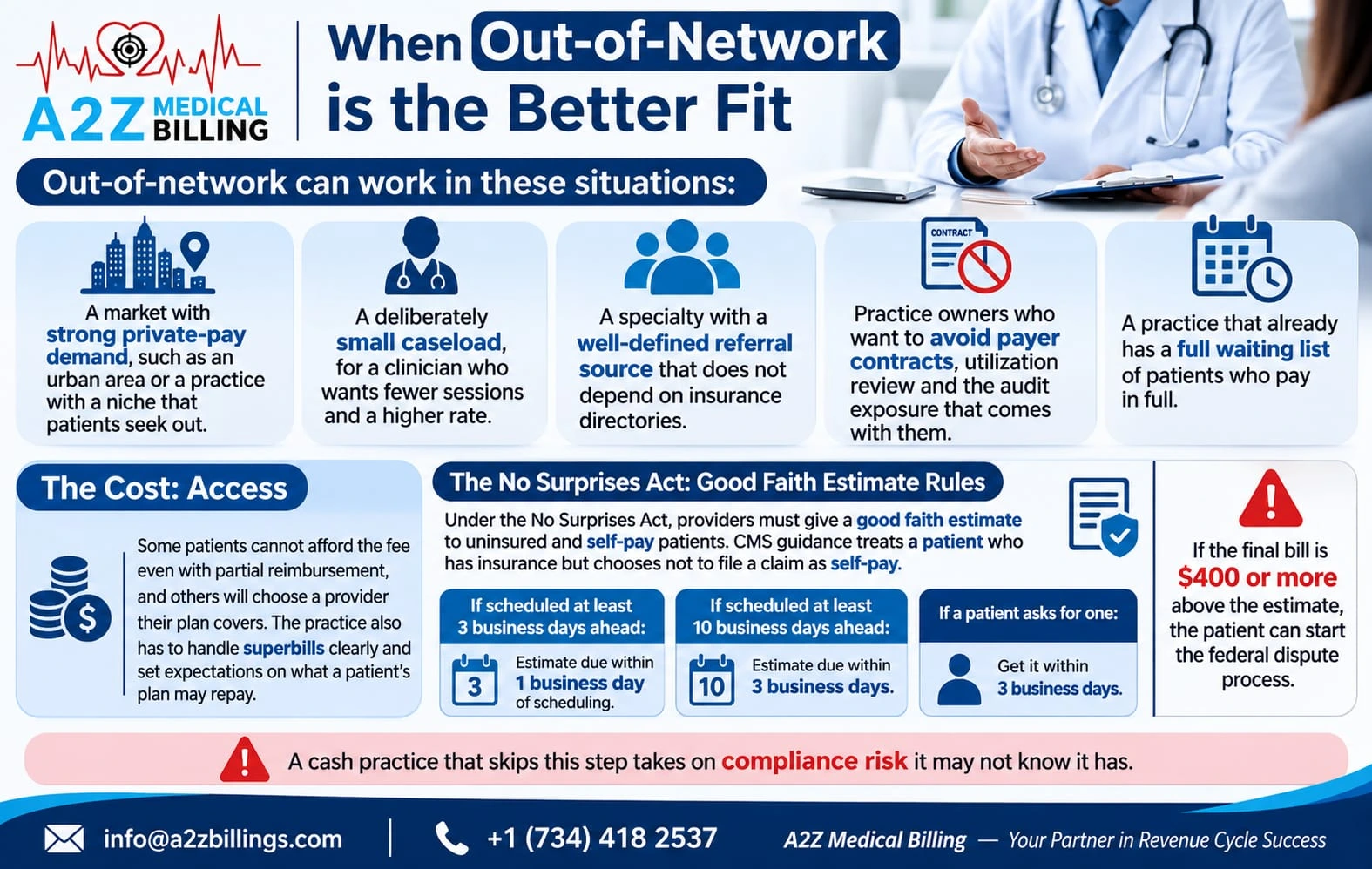
Out-of-network can work in these situations:
- A market with strong private-pay demand, such as an urban area or a practice with a niche that patients seek out.
- A deliberately small caseload, for a clinician who wants fewer sessions and a higher rate.
- A specialty with a well-defined referral source that does not depend on insurance directories.
- Practice owners who want to avoid payer contracts, utilization review and the audit exposure that comes with them.
- A practice that already has a full waiting list of patients who pay in full.
The cost is access. Some patients cannot afford the fee even with partial reimbursement, and others will choose a provider their plan covers in full. The practice also has to handle superbills clearly and set expectations on what a patient's plan may repay.
Federal rule: No Surprises Act
One federal rule applies here. Under the No Surprises Act, providers must give a good faith estimate to uninsured and self-pay patients. CMS guidance treats a patient who has insurance but chooses not to file a claim as self-pay. When the service is scheduled at least 3 business days ahead, the estimate is due within 1 business day of scheduling. When it is scheduled at least 10 business days ahead, the estimate is due within 3 business days. A patient who asks for one gets it within 3 business days. If the final bill is $400 or more above the estimate, the patient can start the federal dispute process.
A cash practice that skips this step takes on compliance risk it may not know it has.
The hybrid approach
Many practices do not pick one side. A common setup keeps two to four in-network panels that fit the local market and leaves the rest out of network. Some clinicians reserve a portion of their calendar for private pay and the rest for insured patients.
The approach works when the panels are chosen deliberately. Panels with strong rates and large local enrollment make sense. Panels with low rates and heavy utilization review often do not. A contract's terms matter as much as its rate, so a practice should read the clauses on rate changes, audits, recoupments and termination.
Questions to answer before deciding
A practice that answers these seven questions has most of what it needs:
- What is the contracted rate for each code the practice bills most, and how does it compare with the current fee?
- How many sessions per week can the practice realistically fill in-network, and how fast?
- Is the panel open to new providers in this specialty and area?
- How long will credentialing take, and what is the plan for income during the wait?
- Who handles claims, denials and follow-up, and what does that cost?
- What share of local patients carry insurance with out-of-network benefits?
- If the practice stays out of network or takes self-pay patients, is the good faith estimate process in place?
The fourth question gets overlooked. A clinician cannot bill a payer until the effective date, so months of credentialing are months of no income from that payer. A practice that starts the process well before it needs the revenue avoids the gap.
What credentialing involves
In-network status is a paperwork project before it is a revenue strategy. A provider needs an NPI, a current license, malpractice coverage, a complete credentialing profile and a payer application for each plan. Medicare and Medicaid enrollment run through government systems, and each commercial plan has its own review.
Mistakes in this stage cost more than they appear to. A mismatch between the NPI record, the payer file and the claim can delay approval and trigger denials. Many practices find that credentialing consumes more staff time than they planned.
How A2Z Billings helps practices decide and follow through
A2Z Billings works through the decision with the numbers first. The team compares each payer's contracted rates against the practice's current fees for the codes it bills most, looks at how many sessions the practice can fill and lays out the break-even point for in-network, out-of-network and hybrid options.
For practices that choose to join panels, A2Z Billings handles the credentialing and enrollment paperwork, follows up on stalled applications and sets up claims once effective dates are confirmed. For practices that choose out-of-network, the team can support superbill workflows and good faith estimate documentation.
A practice weighing its options can book an appointment or contact A2Z Billings for a free credentialing review.
Frequently asked questions
Is it better to be in-network or out-of-network?
Neither is better in every case. In-network brings referrals and steady claims at a lower rate. Out-of-network brings a higher fee and fewer admin tasks, and the practice has to find its own patients. The break-even point depends on how fast the calendar fills.
Can a provider be in-network with some insurers and out-of-network with others?
Yes. Many practices join a few panels and stay out of the rest. Each payer contract stands on its own.
Do out-of-network providers have to give a good faith estimate?
The requirement applies to uninsured and self-pay patients. CMS treats an insured patient who chooses not to file a claim as self-pay. The estimate is due within 1 or 3 business days, depending on how far ahead the service is scheduled.
What is the Medicare limiting charge?
It is the most a non-participating provider can charge a patient for a covered service on a claim where the provider does not accept assignment. It is 115% of the non-participating fee schedule amount, and some states set a lower cap.