

A claim goes out for a visit that happened last week. The provider who saw the patient applied to the payer six weeks ago, and the application is still open. Nobody at the practice knows whether the claim will pay, deny, or sit in a queue. That uncertainty is what "pending credentialing" feels like in a billing office.
The status itself is simple. The payer has not finished approving the provider, so its claim system may not recognize the provider yet. What happens to the claim depends on how the payer is set up, which date the approval carries, and what the practice did with the claim in the meantime. This article walks through each of those points, using Medicare, Medicaid, and commercial examples. A2Z Billings is a Michigan-based company that handles credentialing and billing for practices in many states, and held claims are one of the most common problems it sees when a new provider joins a group.
What "pending" means inside the payer
Credentialing and enrollment are related but separate steps. Credentialing is the review of a provider's license, training, work history, and malpractice coverage. Enrollment or contracting is the step where the payer loads that provider into its system with a network status, a fee schedule, and an effective date. An application can sit at either stage and still be called pending.
The claim system only knows what is loaded. When a claim arrives, the payer compares the rendering provider's NPI with its provider file. A provider who is in review has either no record yet or a record with no effective date. The claim then fails a check, and the system treats the provider as unrecognized. Nothing about the quality of the visit enters into it.
Three ways a submitted claim can end
Front-end rejection. Some claims never reach adjudication. The clearinghouse or the payer's first-level edit finds that the NPI is not on file, and the claim bounces with an error. A rejection is not a denial. It carries no appeal rights, and the practice has to fix the problem and send the claim again. The timely filing clock keeps running during all of this.
Denial on the remittance. Other claims get past the first edit and come back denied. Two reason codes appear often. CARC 185 says the rendering provider is not eligible to perform the service billed, and CARC 242 says the service was not provided by network or primary care providers. Medicaid plans frequently add remark code N767, which states that the provider must be enrolled in the member's Medicaid program before any claim benefits are processed.
Payment that changes later. A smaller group of claims pays, and then something shifts. The payer may have paid at out-of-network rates because the provider was not yet contracted. In other cases a payer pays while the file is open and later takes the money back, after a review finds the date of service fell before the effective date. A paid claim on a pending provider should be marked in the A/R system as unconfirmed until the effective date is in writing.
The effective date decides the outcome
Almost every pending-credentialing question comes back to one date: the day the payer says the provider's participation begins. Services before it are exposed. Services on or after it are billable under normal rules.
For Medicare, federal regulation sets the effective date for physicians and non-physician practitioners as the later of two dates: the date the Medicare contractor received an enrollment application that was later approved, or the date the provider began furnishing services at a new practice location (42 CFR 424.520). The regulation also allows retrospective billing for up to 30 days before that effective date, but only if circumstances precluded enrollment before the services were provided (42 CFR 424.521). A 90-day window applies only after a presidentially declared disaster. Decisions from the HHS Departmental Appeals Board note that some Medicare contractors have mixed up the effective date and the retrospective billing date, which makes it worth reading the approval letter line by line.
Medicaid works differently in each state. Each state sets its own rule for the effective date, and it can differ from the date the application was filed. The state provider manual and the enrollment approval notice state which date applies. Medicaid managed care plans add their own contracts on top.
Commercial payers set the date in the participation agreement, and it may follow the committee's approval instead of the application date. A backdated start is possible, but it is a negotiated exception and not a right. Any promise to backdate should arrive in writing.
Hold the claims or send them?
Both choices carry risk, and the right answer depends on the filing deadline.
The timely filing clock runs from the date of service. It does not pause for credentialing. Medicare, for instance, requires a claim within 12 months of the date of service (42 CFR 424.44), and each commercial contract states its own limit. A practice that holds claims for ten weeks can still be safe on a 12-month deadline. The same hold on a 90-day commercial limit can leave very little room.
A workable approach has three parts. First, ask the payer in writing how it handles claims for a provider whose application is open, and whether it will reprocess them once the effective date is set. Second, hold claims for dates of service that the payer is likely to cover once approval arrives, and list each held claim by patient, date, and deadline. Third, when a filing deadline gets close, send the claim anyway and keep the clearinghouse acceptance report. A denial for provider status can be appealed with that proof, and a claim that was never filed cannot be.
Sending the same claim every week does not help. Each submission can create another denial and another line to clear.
Billing under another provider's name
The temptation at this stage is to put a credentialed provider's NPI on the claim so that it pays. The rendering provider field is meant to identify the person who performed the service. Listing someone else can be treated as a false claim, with consequences that go well beyond a denied payment.
A few narrow arrangements exist. Medicare has strict incident-to rules, and some payers publish supervision or new-provider policies in writing. Where a payer allows billing under a supervising provider during a gap, the policy should be in hand before the first claim is filed. Without that written policy, the safer course is to hold the claim.
What patients owe in the meantime
A pending provider also creates a patient question. Medicaid members cannot be billed for covered services in most cases, because providers must accept the Medicaid payment as payment in full (42 CFR 447.15). A denial for provider enrollment therefore becomes a write-off or a reprocessing item for the practice, and does not turn into a patient balance.
Commercial plans vary. Some treat the visit as out of network and apply out-of-network cost-sharing. Others deny it entirely. Patient statements should wait until the payer has made a final decision, and patients who are scheduled with a pending provider should hear about the situation before the visit, not after the explanation of benefits arrives.
Reprocessing after approval
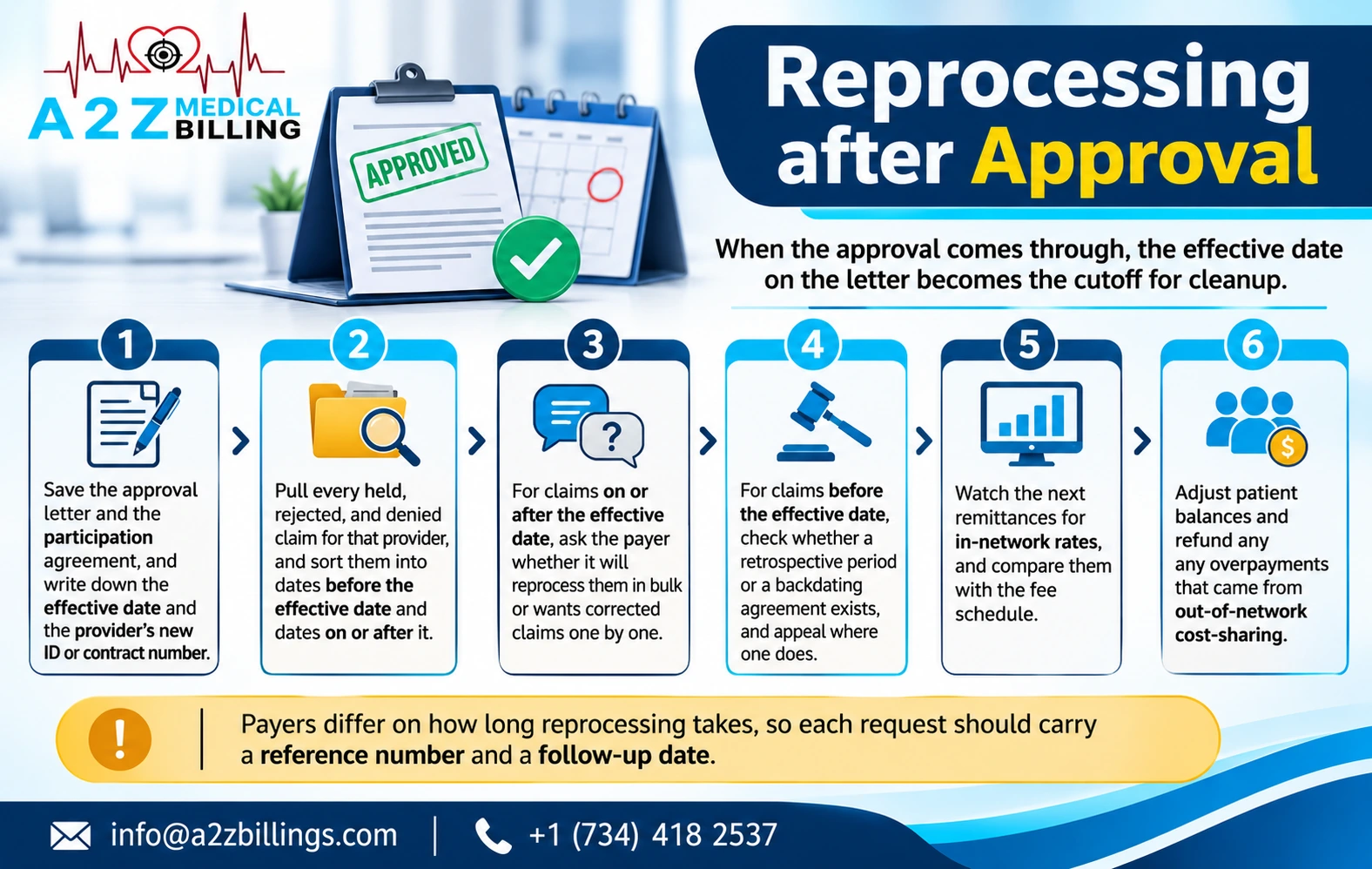
When the approval comes through, the effective date on the letter becomes the cutoff for cleanup.
- Save the approval letter and the participation agreement, and write down the effective date and the provider's new ID or contract number.
- Pull every held, rejected, and denied claim for that provider, and sort them into dates before the effective date and dates on or after it.
- For claims on or after the effective date, ask the payer whether it will reprocess them in bulk or wants corrected claims one by one.
- For claims before the effective date, check whether a retrospective period or a backdating agreement exists, and appeal where one does.
- Watch the next remittances for in-network rates, and compare them with the fee schedule.
- Adjust patient balances and refund any overpayments that came from out-of-network cost-sharing.
Payers differ on how long reprocessing takes, so each request should carry a reference number and a follow-up date.
Tracking a file that is still open
A pending application needs the same attention as an open claim. The details worth recording are the date the application was submitted, the payer's reference number, the date of the last contact, the documents requested, and the expected decision date if the payer gave one. A call every one to two weeks keeps a file from stalling quietly, and every call should end with a name, a date, and a next step.
Practices with several new providers can lose track of which payer is waiting on which document. A single tracker, kept by provider and payer, prevents that and gives the billing team a list of which claims to hold.
How A2Z Billings handles claims for pending providers
A2Z Billings keeps a hold list for each provider whose credentialing is open, with the patient, date of service, payer, and filing deadline on every line. The billing team checks that list against each payer's timely filing limit and flags any claim that needs to go out before approval. When the effective date arrives, the same list becomes the reprocessing worklist. Because credentialing and billing sit in the same company, the person who knows where the application stands also sees the claims that depend on it.
Practices that have claims stuck behind an open application can contact A2Z Billings through the website for a review of the claims and the application status.
Frequently asked questions
Sometimes. A payer may pay at out-of-network rates or process the claim and recover the money later. A paid claim is only settled once the effective date is confirmed in writing.
No. The clock runs from the date of service, so held claims need a deadline list.
Federal regulation allows up to 30 days before the effective date when circumstances precluded enrollment, and 90 days only after a presidentially declared disaster.
Medicaid members generally cannot be billed. For commercial plans, the contract and the plan's policy decide, so statements should wait for the final payer decision.