
Choosing the best medical billing software for family practice is an important decision for healthcare providers seeking accurate insurance claims, efficient administrative workflows, and consistent revenue collection. Family medicine practices handle numerous services, including preventive examinations, chronic disease management, vaccinations, diagnostic testing, and routine office visits. Each service involves specific coding, documentation, and reimbursement requirements.
Modern family practice billing software helps physicians and administrative teams manage these responsibilities through electronic claims submission, insurance eligibility verification, payment posting, denial management, and financial reporting. Many platforms also integrate with Electronic Health Records (EHR), allowing practices to manage clinical and billing activities within connected systems.
However, selecting appropriate medical billing software requires careful consideration of practice size, patient volume, available functionality, pricing, and technical support. This guide explains the leading family practice medical billing software options for 2026, their essential features, and the factors healthcare providers should consider before choosing a platform.
What is family practice medical billing software?
Family practice medical billing software is a specialized digital system that helps primary care providers manage insurance claims, patient payments, medical coding, and revenue cycle operations. It connects healthcare services with the financial processes required to obtain accurate reimbursement.
The software generally supports Current Procedural Terminology (CPT) codes, ICD-10-CM diagnosis codes, and applicable Healthcare Common Procedure Coding System (HCPCS) codes. These standardized coding systems communicate the services performed and the medical conditions addressed during patient encounters.
For example, a family physician treating a patient with diabetes may perform an office evaluation, review laboratory results, adjust medications, and recommend additional testing. The billing system helps staff record the appropriate charges, review coding information, and prepare the insurance claim.
Advanced family practice medical billing and management software may also include appointment scheduling, patient registration, electronic health records, billing analytics, and accounts receivable management. These functions support clinical and administrative staff throughout the patient encounter and reimbursement process.
Why family practices need medical billing software
Family medicine practices provide services to patients with different medical conditions, insurance plans, and treatment requirements. Managing these activities manually can create administrative delays and increase the possibility of billing errors.
Primary care medical billing software helps organize patient information, verify insurance eligibility, monitor claim status, and identify unpaid balances. Automated claims processing can also detect certain missing or inconsistent billing details before submission.
Family practices frequently bill evaluation and management services, preventive visits, chronic care management, and minor procedures. Each category follows specific documentation and coding guidelines.
For example, Medicare Annual Wellness Visits have different billing requirements from routine office evaluation and management services. An effective billing system can help practices manage these distinctions while supporting accurate claim preparation.
Medical billing management software also improves financial visibility by providing reports on insurance payments, outstanding accounts, rejected claims, and patient responsibilities.
Best medical billing software for family practice in 2026
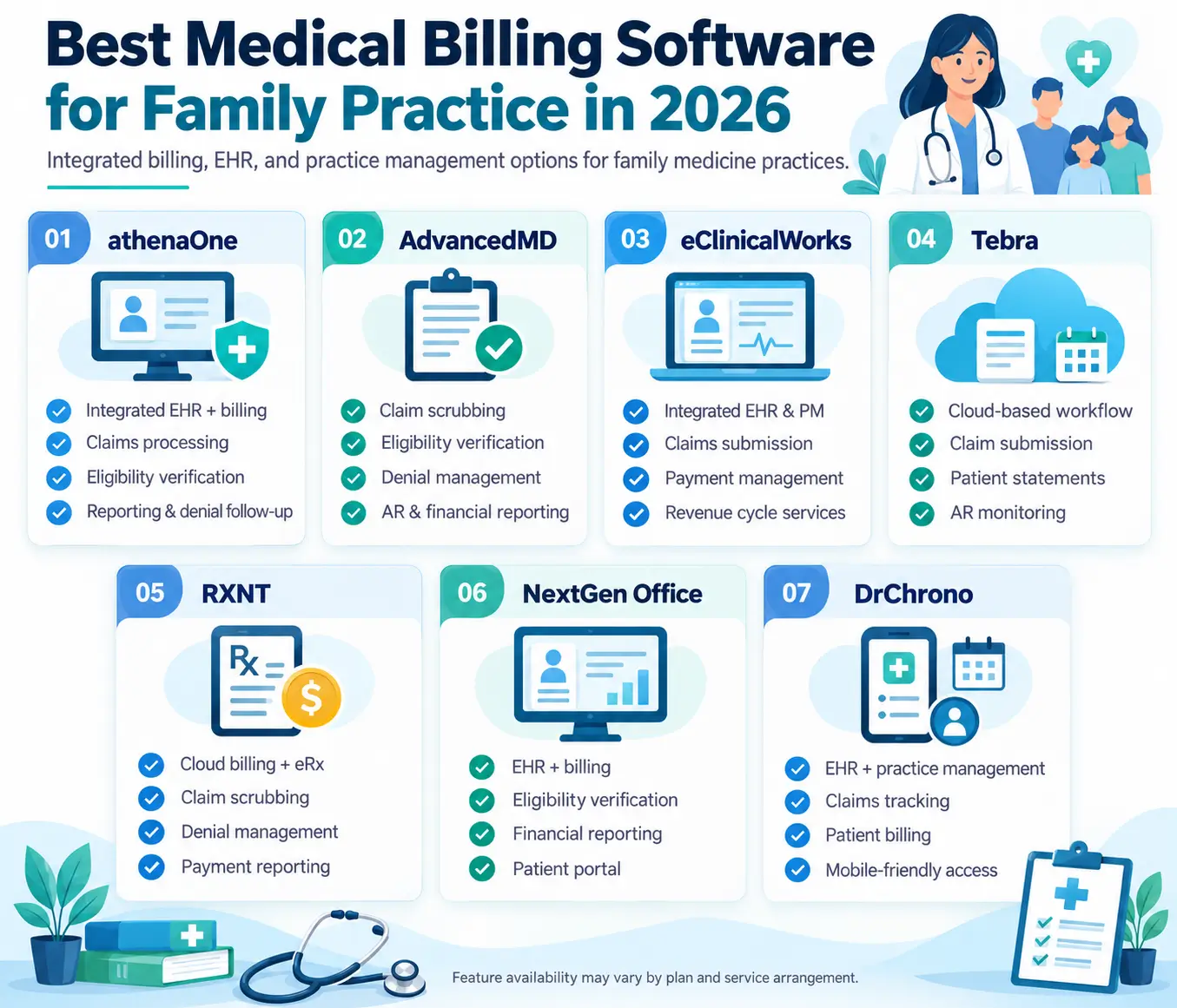
Several established medical billing software solutions support family medicine practices. Their features address different aspects of clinical documentation, financial management, and patient administration.
1. athenaOne by athenahealth
athenaOne is an integrated healthcare technology platform that combines electronic health records, practice management, medical billing, and patient engagement functions.
Its billing tools support electronic claims processing, charge capture, eligibility verification, payment management, and denial follow-up. The platform also offers revenue cycle services that help practices manage insurance reimbursement.
Family physicians can use connected documentation and billing workflows to organize clinical encounters and reduce repeated administrative data entry.
athenaOne also provides reporting tools that help practices monitor financial performance and outstanding insurance claims. It is particularly relevant for healthcare organizations seeking integrated clinical and revenue cycle functionality.
2. AdvancedMD
AdvancedMD provides family practice medical billing software alongside EHR, scheduling, patient communication, and practice management tools.
Its billing functionality includes electronic claim submission, claim scrubbing, insurance eligibility verification, payment posting, denial management, and accounts receivable reporting.
The platform supports customizable clinical documentation workflows, making it useful for practices handling preventive examinations, chronic care management, and routine primary care visits.
AdvancedMD also offers financial reporting capabilities that help administrators monitor unpaid claims, reimbursement patterns, and billing performance.
Family medicine clinics with multiple healthcare providers may benefit from centralized management of appointments, documentation, and financial activities.
3. eClinicalWorks
eClinicalWorks provides integrated EHR, practice management, medical billing, patient engagement, and revenue cycle management services.
The platform supports documentation of clinical encounters, electronic claims submission, eligibility verification, scheduling, and insurance payment management.
Its practice management functionality allows billing staff to review claims, monitor insurance payments, and identify outstanding patient balances.
eClinicalWorks also offers additional revenue cycle services for practices seeking assistance with billing administration and collections.
Family physicians can use its clinical documentation tools to manage routine examinations, chronic disease treatment, medication management, and preventive services.
The platform is suitable for practices seeking a connected EHR and medical billing environment with extensive administrative features.
4. Tebra
Tebra offers medical billing, EHR, patient scheduling, payment management, and patient engagement functionality for independent healthcare practices.
Its medical billing software supports electronic claim submission, insurance verification, payment posting, patient statements, and accounts receivable monitoring.
The platform also includes patient communication and online payment capabilities that help administrative teams manage patient financial responsibilities.
For family medicine providers, integrated scheduling and billing workflows can reduce repetitive administrative work.
Tebra is an option for small family practices that want cloud-based medical billing software with practice management and patient communication tools.
The availability of specific features depends on the selected subscription package and service arrangements.
5. RXNT
RXNT provides cloud-based medical billing software, electronic health records, electronic prescribing, and practice management solutions.
Its medical billing functionality includes electronic insurance claims, eligibility verification, claim scrubbing, denial management, and payment reporting.
RXNT also supports appointment scheduling and patient billing activities, helping small practices organize administrative responsibilities.
The platform allows practices to manage billing information through cloud-based access while maintaining centralized financial records.
Independent family physicians may find RXNT relevant when looking for billing software that includes essential practice management capabilities.
Its reporting features help billing staff evaluate reimbursement activity, identify outstanding balances, and monitor claims requiring follow-up.
6. NextGen Office
NextGen Office offers electronic health records, medical billing, scheduling, and practice management functionality for independent medical practices.
Its billing tools support electronic claims processing, insurance eligibility verification, financial reporting, and payment management.
The platform connects clinical documentation with administrative workflows, allowing family physicians to manage patient encounters and related billing information.
NextGen Office also includes patient portal functionality for communication and administrative activities.
Small family medicine clinics can evaluate the platform for managing medical records, appointments, insurance claims, and patient financial information through an integrated system.
7. DrChrono
DrChrono provides EHR, practice management, medical billing, scheduling, and patient engagement functionality.
Its medical billing features include electronic claims processing, insurance eligibility verification, payment posting, claim tracking, and patient billing.
The platform supports connected clinical documentation and administrative workflows, helping physicians manage patient encounters and associated insurance charges.
DrChrono also provides mobile-oriented functionality that may support physicians who need convenient access to clinical and practice information.
Independent family practitioners can evaluate its available subscription packages based on their documentation requirements, billing volume, and preferred administrative workflows.
Essential features of family practice medical billing software
EHR integration and automated charge capture
The best all-in-one EHR and medical billing software for family practice should connect clinical documentation with billing workflows. Integrated systems allow authorized billing staff to review encounter details, diagnoses, and documented procedures without repeatedly transferring information between applications.
Automated charge capture can improve workflow efficiency, although qualified staff must confirm that reported services are supported by the medical record.
Insurance eligibility verification and claims processing
Insurance eligibility verification software helps administrative teams review patient coverage information before appointments.
Medical billing software with claims processing supports claim preparation, clearinghouse transmission, rejection identification, and claim status monitoring.
Effective claims scrubbing can identify selected formatting problems, missing information, and coding inconsistencies. However, software cannot guarantee payment because reimbursement depends on coverage requirements, medical necessity, and applicable payer policies.
Denial management and accounts receivable
Medical billing software with denial management helps practices organize denied claims, identify recurring reimbursement problems, and assign follow-up activities.
Accounts receivable reporting allows billing teams to monitor unpaid insurance and patient balances according to their age and financial status.
These capabilities are particularly useful for family practices handling substantial numbers of recurring patient visits.
Patient billing and payment management
Medical billing software with integrated payment processing helps practices manage patient statements, copayments, deductibles, and outstanding financial responsibilities.
A medical billing software platform with an integrated patient portal may allow patients to review statements and make payments electronically.
Clear financial information can also reduce administrative confusion and support more consistent patient communication.
Family practice medical billing and coding requirements
Accurate family practice medical billing and coding depends on appropriate documentation, correct code selection, and compliance with applicable insurance requirements.
Family physicians commonly report office evaluation and management services, preventive examinations, immunizations, chronic care management, and transitional care management.
For example, Medicare uses HCPCS code G0438 for an initial Annual Wellness Visit and G0439 for a subsequent Annual Wellness Visit. These services have specific eligibility and documentation requirements.
A separately identifiable evaluation and management service may also be reported when medically necessary and appropriately documented, subject to applicable coding and modifier requirements.
Medical billing and coding software can help staff identify relevant claim information, but professional review remains necessary.
Healthcare providers must follow current CMS regulations, CPT guidelines, payer coverage policies, and medical necessity requirements when submitting claims.
Medical billing software pricing for family practices
Medical billing software pricing in 2026 depends on the number of providers, subscription arrangements, selected features, implementation requirements, and additional services.
Some vendors charge monthly subscription fees per provider, while others offer customized pricing or revenue cycle management arrangements based on collected revenue.
Practices should consider the complete operating cost, including software subscriptions, clearinghouse services, training, technical support, electronic payment processing, and data migration.
Affordable medical billing software for small practices should provide the functions needed for daily billing without unnecessary administrative complexity.
Before purchasing, healthcare providers should review contract terms, cancellation policies, data access arrangements, and potential additional charges.
How to choose the best medical billing software for small family practices
Selecting the best medical billing software for small physician practices begins with understanding existing administrative challenges.
A solo family physician may need straightforward appointment scheduling, electronic claims processing, eligibility verification, and patient payment management. A multi-provider practice may require centralized reporting, advanced user permissions, and additional accounts receivable functionality.
Healthcare organizations should request software demonstrations and evaluate how each platform handles realistic billing situations.
For example, a practice can review how the software processes a routine office visit, identifies an insurance rejection, posts a payment, and generates an outstanding claims report.
Customer support and employee training also deserve consideration. Medical billing software customer support should provide reliable assistance during implementation and ongoing operations.
Security is another essential requirement. Practices must evaluate HIPAA-related responsibilities, access controls, data protection measures, and applicable business associate agreements.
The selected software should also accommodate future operational needs as the practice adds providers, expands patient services, or increases billing volume.
Choosing the right billing software for family medicine
The best medical billing software for family practice is one that supports accurate claims processing, efficient patient administration, reliable financial reporting, and appropriate clinical documentation.
Platforms such as athenaOne, AdvancedMD, eClinicalWorks, Tebra, RXNT, NextGen Office, and DrChrono provide established medical billing and practice management functionality.
Before selecting a platform, family physicians should assess their billing requirements, available resources, software integration needs, and long-term operational goals.
An appropriate medical billing system, supported by trained billing professionals and accurate clinical documentation, can help family practices manage reimbursement consistently and reduce avoidable administrative work.