
A pharmacy can dispense every prescription correctly and still lose money on the back end. The loss usually happens in a reject code nobody worked, a Medicare Part D claim paid below cost, or an underpayment that nobody compared against the contract. Finding the best pharmacy billing company in Michigan for accurate claims processing starts with understanding where those losses occur and which parts of the process an outside team can realistically fix.
This guide is written for healthcare providers weighing outsourced pharmacy billing services and for students of medical billing and coding who want to see how pharmacy claims differ from medical claims. It covers the claim path, the Michigan regulatory picture, Medicare Part D rules that change payment, and a practical checklist for evaluating vendors.
Why Michigan pharmacies are looking harder at billing
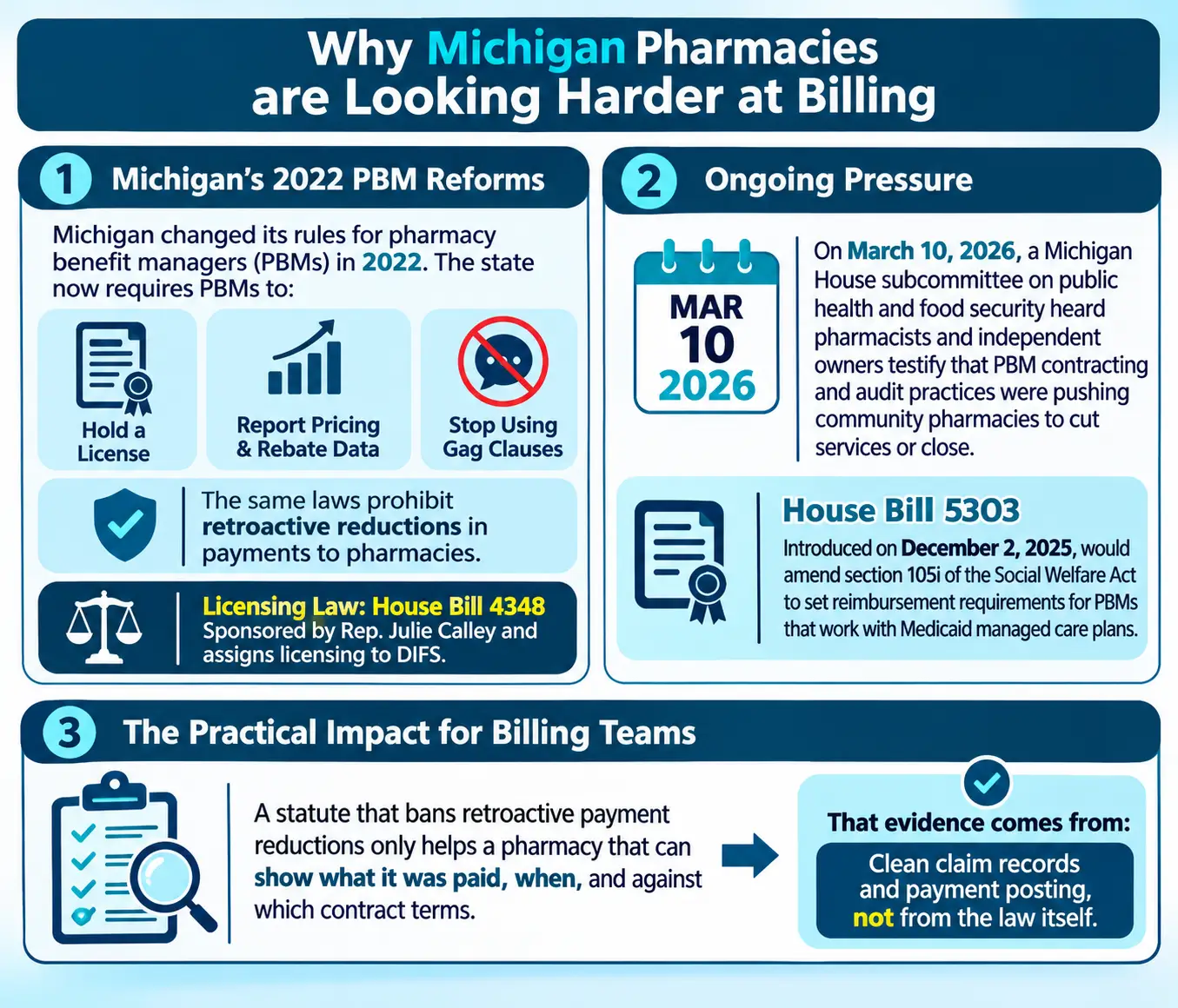
Michigan changed its rules for pharmacy benefit managers (PBMs) in 2022. According to a brief from the Center for Healthcare Research & Transformation, the state began requiring PBMs to hold a license, report pricing and rebate data, and stop using gag clauses. The same laws prohibit retroactive reductions in payments to pharmacies. The licensing law, House Bill 4348, was sponsored by Rep. Julie Calley and assigns licensing to the Department of Insurance and Financial Services (DIFS).
The pressure has not stopped. On March 10, 2026, a Michigan House subcommittee on public health and food security heard pharmacists and independent owners testify that PBM contracting and audit practices were pushing community pharmacies to cut services or close. And House Bill 5303, introduced on December 2, 2025, would amend section 105i of the Social Welfare Act to set reimbursement requirements for PBMs that work with Medicaid managed care plans.
For a billing team, the practical consequence is documentation. A statute that bans retroactive payment reductions only helps a pharmacy that can show what it was paid, when, and against which contract terms. That evidence comes from clean claim records and payment posting, not from the law itself.
How a pharmacy claim moves through adjudication
Pharmacy claims run on a different standard than physician or hospital claims. They are submitted in real time using the NCPDP Telecommunication Standard, and version D.0 has been the HIPAA-required version since January 1, 2012. A claim carries the plan identifiers (BIN, PCN and group number), the NDC of the dispensed product, quantity, days’ supply, and the prescriber’s NPI. The PBM adjudicates the claim in seconds and returns either a paid response with a patient pay amount or a reject.
Medical claims move differently. They go out on the 837 transaction, are coded with CPT and HCPCS, and are paid on a remittance days or weeks later.
Reject codes worth knowing
Students often ask which rejects come up most. These NCPDP codes appear in daily pharmacy work:
- 65: patient not covered
- 70: product or service not covered
- 75: prior authorization required
- 76: plan limitations exceeded
- 79: refill too soon
- 41: submit bill to other processor or primary payer
A 65 usually points to an eligibility problem, such as a plan change or an inactive member ID. Running insurance eligibility verification before the first fill removes many of these. A 75 needs a clinician’s documentation and a payer’s decision, so it belongs in a tracked work queue with a due date, not in a pile of rejected claims.
Where medical and pharmacy billing overlap
Some drugs are billed under the medical benefit instead. Provider-administered injectables are the common example: they go out on an 837 with a HCPCS J-code, not through the NCPDP pathway. Payers and vendors describe the combined view as unified medical and pharmacy claims processing, and it matters for specialty pharmacies and infusion practices where one patient may have drugs covered under both benefits. CAQH, through its CORE operating rules, publishes standards for eligibility and benefits transactions in healthcare, which is part of why medical-side eligibility checks tend to be more standardized than pharmacy-side ones.
Where pharmacy revenue leaks
There are four places where money disappears, and each calls for a different skill.
- Unworked rejects. A reject that is not corrected within the payer’s timely filing window becomes a permanent write-off. Filing limits vary by plan, so a good billing team tracks them by payer, not by a single house rule.
- Underpayments. Many PBM contracts reimburse generics against a maximum allowable cost (MAC) list. If the paid amount sits below acquisition cost, or below the MAC on the date of service, someone has to catch it. Payment posting that compares each remittance to the expected amount is how that gets caught.
- Audit recoupments. PBM audits can claw back payments for documentation errors. Michigan’s licensing law includes an audit process for PBMs, which gives pharmacies a procedural basis for disputing findings.
- Unmanaged accounts receivable. Third-party pharmacy claims that sit unpaid for 60 or 90 days need follow-up with a named contact at the payer. Pharmacy accounts receivable management is mostly this: aging reports reviewed weekly and disputes escalated with evidence attached.
Denial management is the thread running through all four. Pharmacies tend to treat a reject as a dispensing event instead of a billing event, which is why outsourced teams often recover revenue that in-house staff did not have time to chase.
Medicare Part D rules that change what a pharmacy is paid
Medicare pharmacy benefits have shifted in ways that affect cash flow. Since January 1, 2024, a CMS rule has required Part D plans to apply pharmacy price concessions at the point of sale, which replaced the older model where direct and indirect remuneration (DIR) fees were taken back months after dispensing. Pharmacies now see the lower negotiated price at adjudication, so margin problems appear on the claim itself instead of in a delayed adjustment.
The Inflation Reduction Act also capped annual out-of-pocket spending for Part D enrollees. The cap was $2,000 in 2025 and is $2,100 in 2026, according to CMS. Patients reach it faster on expensive specialty drugs, which changes copay collection patterns during the year, and pharmacies should expect high patient pay amounts in January and near zero later in the year for those patients.
One more figure for timing: federal regulation at 42 CFR 423.520 requires Part D plans to pay clean electronically submitted claims within 14 days. A billing vendor should be able to report how often its client claims are paid inside that window.
What the best pharmacy billing company in Michigan should be able to show you
Pharmacy billing companies sound alike in their marketing. These questions separate them.
- Reject rate and first-pass paid rate. Ask for the figure by payer type (commercial, Medicare Part D, Medicaid managed care), measured on the client’s own data, not an industry average.
- Process for PBM contract analysis. A vendor that cannot read a MAC schedule or a dispensing fee clause cannot find underpayments.
- Michigan payer knowledge. The vendor should know how Michigan Medicaid managed care plans route pharmacy claims and which commercial plans in the state use which PBM.
- Credentials and compliance. Ask whether staff hold certifications such as CPC or CPhT, and how the company handles HIPAA obligations under a business associate agreement.
- Reporting. Monthly reports should show accounts receivable aging, reject reasons, and recovered underpayments in dollars.
- Exit terms. Confirm who owns the data and how quickly it is returned if the contract ends.
In-house versus outsourced billing
Factor | In-house | Outsourced |
Staffing | Salaries, benefits and training for each billing employee | Per-claim or percentage-of-collections fee, set by contract |
Coverage during absences | Gaps when staff leave or are out | Team coverage, depending on the vendor |
Payer-specific expertise | Limited to what staff have learned | Broader, if the vendor serves many pharmacies |
Control over patient communication | Direct | Needs defined handoffs |
Cost visibility | Fixed and predictable | Varies with claim volume |
Outsourcing does not suit every pharmacy. A small pharmacy with low claim volume and an experienced billing lead may spend more on a percentage fee than it recovers. A pharmacy with growing specialty volume and frequent prior authorization rejects is more likely to benefit.
Evaluating A2Z Billings
A2Z Billings is one company a Michigan pharmacy can put through the checklist above. The website lists its pharmacy billing and coding services, so the useful step is to request the specifics in writing: reject rates on comparable clients, the denial management workflow, reporting samples, and the business associate agreement. Any vendor’s answers should be checked against a reference pharmacy of similar size and payer mix before a contract is signed.
Summary
The best pharmacy billing company in Michigan for accurate claims processing is the one that can prove its accuracy with the pharmacy’s own numbers. Michigan’s 2022 PBM laws and the pending Medicaid bill raise the value of clean records. The Part D point-of-sale pricing rule makes underpayments visible at adjudication, and the $2,100 out-of-pocket cap in 2026 changes patient collections. A vendor worth hiring will show first-pass paid rates by payer, explain NCPDP rejects in plain terms, and report recovered underpayments in dollars.