

Doctor referrals are essential to patient care, but their financial and operational impact often receives little attention. A physician may recommend a specialist, document the referral, and assume the patient will receive the necessary care. Unfortunately, many referrals never result in a completed appointment.
The Surprising Secret Behind Doctor Referrals is the role revenue cycle management (RCM) plays in coordinating referrals, verifying insurance requirements, preventing administrative delays, and protecting reimbursement.
Medical billing teams can identify missing authorizations, eligibility problems, incomplete documentation, and other obstacles before they disrupt treatment or claims processing.
For healthcare providers, understanding the connection between physician referrals and RCM creates opportunities to improve patient access, strengthen referral coordination, and reduce avoidable revenue losses.
The surprising secret behind doctor referrals: Why RCM matters
Most healthcare professionals associate revenue cycle management (RCM) with medical coding, claims processing, payment posting, and denial management.
However, many financial problems originate before the patient receives treatment.
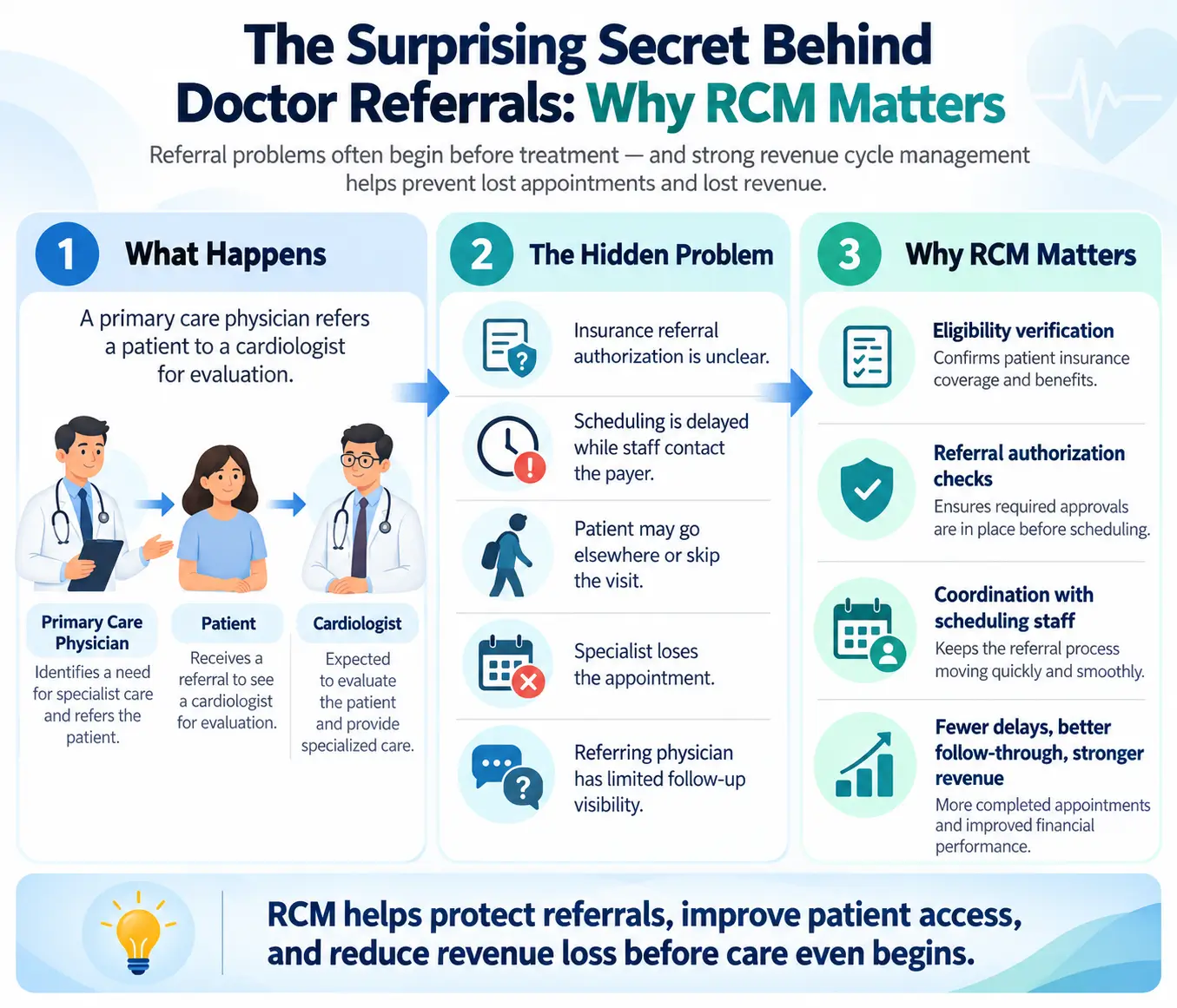
Consider a primary care physician who refers a patient to a cardiologist for an evaluation. The referral is clinically appropriate, but the specialist’s office cannot confirm whether the patient’s insurance requires a referral authorization.
The appointment is delayed while staff contact the insurance company. The patient may eventually seek another specialist or abandon the appointment.
The cardiology practice loses a potential appointment, while the referring physician has limited information about whether the recommended evaluation occurred.
RCM professionals can help prevent these problems through insurance eligibility verification, referral authorization checks, and coordination with scheduling personnel.
What research reveals about incomplete referrals
A 2018 study by Malhar P. Patel and colleagues, published in the Journal of General Internal Medicine, examined referral activity across a large academic healthcare system.
Researchers analyzed 103,737 referral scheduling attempts involving 20 medical and surgical specialties. Only 34.8% resulted in documented completed specialist appointments.
The researchers identified missing appointment documentation, scheduling difficulties, waiting times, and geographic barriers as contributing factors.
Importantly, the findings represented documented completion within one healthcare system. They did not establish that every remaining patient failed to receive specialist care.
Nevertheless, the study demonstrated how difficult it can be to track referrals from the initial recommendation through the completed consultation.
Effective referral management requires coordination between clinical teams, scheduling departments, and revenue cycle staff.
Understanding the doctor referral process
The doctor referral process begins when a healthcare professional determines that a patient needs evaluation or treatment from another qualified provider.
Common examples include a primary care physician referring a patient to a cardiologist, an orthopedic specialist recommending physical therapy, or a family physician requesting a gastroenterology consultation.
A typical patient referral workflow includes documenting the clinical reason, identifying an appropriate specialist, checking insurance requirements, transmitting supporting records, scheduling the appointment, and obtaining the specialist’s report.
Each stage creates opportunities for administrative errors.
A referral may reach the wrong department. The receiving practice may lack medical records. Insurance information may be outdated, or an appointment may remain unscheduled because the patient could not be contacted.
Referral coordination addresses these problems by establishing clear responsibilities and tracking the patient’s progress.
Referral authorization versus prior authorization
Referral authorization and prior authorization are related but distinct insurance requirements.
A referral authorization generally concerns a health plan’s requirement for approval or direction from a primary care provider before a patient visits another clinician.
Prior authorization involves obtaining a payer’s approval for a particular service, procedure, medication, or treatment before it is provided.
For example, a health maintenance organization (HMO) may require a primary care referral for a cardiology consultation. A subsequent cardiac imaging procedure may require separate prior authorization.
According to Medicare.gov, patients with Original Medicare generally do not need specialist referrals, whereas Medicare Advantage HMO plans usually require them.
Medical billing specialists must verify requirements under the patient’s specific policy instead of assuming that every insurance plan follows identical rules.
How revenue cycle management improves physician referrals
Insurance eligibility verification before appointments
Eligibility verification establishes whether a patient’s insurance coverage is active and identifies applicable benefits, network limitations, and financial responsibilities.
For referred patients, verification should occur before the scheduled consultation whenever practical.
RCM teams can confirm whether the receiving specialist participates in the patient’s insurance network and whether additional approval is required.
This helps reduce avoidable eligibility-related claim denials and unexpected patient expenses.
However, eligibility confirmation alone does not guarantee reimbursement. Medical necessity, benefit exclusions, authorization conditions, and other payer rules may still affect payment.
Referral documentation and medical billing accuracy
Incomplete referral documentation creates problems for scheduling, clinical communication, and claims processing.
A specialist may require relevant diagnoses, prior treatment information, test results, or a referral order to determine the appropriate next appointment.
Medical billers should ensure that required referral or authorization identifiers are recorded accurately in the practice management system and included on claims when the payer requires them.
Clinical diagnoses and procedure codes must be supported by the actual documentation.
An authorization number cannot substitute for an appropriate diagnosis, medical necessity, or accurate coding.
Tracking appointments and claim outcomes
An RCM referral workflow can connect appointment information with eligibility checks, authorization status, completed services, and subsequent claims.
For example, a billing department reviewing an authorization-related denial may discover that the referring physician’s information was missing from the claim.
Correcting the problem may require a corrected claim, additional documentation, or an appeal, depending on payer rules and filing deadlines.
Tracking recurring problems by referring practice or insurance plan helps healthcare organizations identify administrative weaknesses.
These activities can improve the reliability of referrals while reducing preventable rework for billing staff.
What is referral leakage in healthcare?
Referral leakage in healthcare occurs when patients receive referred services outside an organization’s intended or affiliated provider network.
Healthcare systems monitor referral leakage to understand patient movement, evaluate specialist availability, and identify potential revenue leaving their organizations.
However, external referrals are not automatically inappropriate.
A patient may prefer another provider, require specialized treatment unavailable within the organization, or need an earlier appointment.
Clinical appropriateness, patient choice, insurance coverage, and access to care must guide referral decisions.
Referral leakage in Epic EHR systems
Referral leakage Epic is a search term commonly associated with tracking referrals that leave a healthcare organization using Epic electronic health records.
Depending on an organization’s Epic configuration, referral management tools and workqueues may help staff identify incomplete referrals, missing information, scheduling delays, and authorization problems.
For example, a December 2023 operational communication from RWJBarnabas Health described Epic referral workqueues covering missing information, scheduling, outgoing referral follow-up, and authorization needs.
These workflows demonstrate how EHR data can support referral monitoring.
However, Epic configuration varies between healthcare organizations. Referral leakage reporting capabilities should be evaluated against the organization’s actual system setup rather than assuming every installation includes identical dashboards.
How referral leakage prevention supports healthcare operations
Referral leakage prevention begins with understanding why patients are receiving services outside the intended network.
If patients repeatedly leave because internal specialists have long waiting lists, improving appointment availability may be more appropriate than changing referral routing.
When referrals remain unresolved because staff lack insurance information, better eligibility verification and follow-up procedures may address the problem.
The objective should be timely, appropriate patient care while giving administrators accurate information about referral patterns.
Do doctors get paid for referrals?
Questions such as do doctors get paid for referrals, do doctors get incentives for referrals, and do doctors get paid for referrals to specialists frequently arise when discussing physician referral networks.
In the United States, physicians generally cannot lawfully receive payments intended to induce or reward referrals for services covered by federal healthcare programs.
Doctors can receive legitimate compensation for covered medical services they personally provide, but compensation arrangements tied to patient referrals raise significant legal concerns.
Do doctors get kickbacks for referrals?
The federal Anti-Kickback Statute, under 42 U.S.C. § 1320a-7b(b), prohibits knowingly and willfully offering, paying, soliciting, or receiving remuneration to induce or reward referrals involving federal healthcare program business.
Remuneration can include cash, free services, excessive consulting fees, discounted rent, or other items of value.
The U.S. Department of Health and Human Services Office of Inspector General explains that improper referral payments can result in criminal penalties and other enforcement consequences.
The law includes statutory exceptions and regulatory safe harbors for qualifying arrangements, so financial relationships require careful review rather than automatic assumptions.
How does Stark Law affect physician referrals?
The Stark Law, also known as the physician self-referral law, restricts certain referrals for designated health services payable by Medicare when a physician or an immediate family member has a financial relationship with the receiving entity.
An applicable exception may permit the arrangement.
For instance, referrals involving physician ownership in an imaging center require examination of the financial relationship and relevant exceptions.
Stark Law and the Anti-Kickback Statute address different legal requirements. Compliance with one does not automatically establish compliance with the other.
Do doctors get paid for referrals to specialists in Canada?
Canadian physician referral rules operate under provincial healthcare systems and professional regulations.
In Ontario, the College of Physicians and Surgeons of Ontario states in its May 2019 guidance on uninsured services that physicians cannot charge patients separately for a specialist referral when it forms part of an insured service.
The College’s March 2024 conflict-of-interest guidance also identifies receiving benefits from suppliers to whom physicians refer patients as a conflict of interest under Ontario regulations.
A physician may receive payment for an insured consultation or assessment under the applicable provincial fee schedule, but that differs from receiving compensation for directing a patient to another provider.
Specific payment and professional conduct requirements vary between provinces.
How 2026 referral authorization rules affect RCM
Insurance authorization requirements continue to influence referral management and medical billing in 2026.
On January 17, 2024, the Centers for Medicare & Medicaid Services announced its Interoperability and Prior Authorization Final Rule, CMS-0057-F.
Beginning in 2026, covered payers generally face requirements to communicate prior authorization decisions within 72 hours for expedited requests and seven calendar days for standard requests.
These requirements apply to specified payers and medical services, with exclusions and implementation details defined by CMS.
Covered payers must also communicate specific reasons for prior authorization denials.
Additional application programming interface requirements, including electronic prior authorization capabilities, generally begin in 2027.
For RCM departments, these changes make authorization tracking and documentation more important.
Staff should monitor payer decisions, follow up on delayed requests, and ensure authorization information is available before services that require approval.
The role of AI-powered authorization
AI-powered authorization tools may help healthcare organizations extract clinical information, identify missing documentation, and organize requests.
Referral workflow automation can also route cases to the appropriate staff and flag authorizations approaching expiration.
These systems require human oversight.
An automated recommendation does not establish medical necessity, guarantee payer approval, or replace clinical judgment.
Healthcare providers must also assess patient privacy, data accuracy, and applicable healthcare compliance requirements before introducing automated referral tools.
Measuring referral performance and revenue cycle results
Healthcare organizations need meaningful measurements to evaluate medical referral management.
Referral volume alone provides limited insight because an order does not establish that a patient received specialist care.
Useful measurements include:
- Referral conversion rate: The percentage of eligible referrals that become scheduled or completed appointments, with the chosen definition clearly stated.
- Referral completion rate: The percentage of referrals resulting in a documented completed specialist visit.
- Authorization-related denial rate: The percentage of applicable claims denied for authorization-related reasons.
- Referral turnaround time: The time between referral creation and successful scheduling or consultation.
Healthcare organizations should also distinguish an appointment completed outside their EHR from one that was never attended.
This prevents missing external documentation from being incorrectly classified as patient noncompliance.
A 2018 quality improvement study by Stephen L. Davidow and colleagues, published in the Journal of Ambulatory Care Management, reported that timely referral loop closure increased from 40% to 70% during a project involving primary care and specialist physician teams.
The project incorporated referral process mapping, shared expectations, performance measurements, and electronic health records.
These findings show that clearly defined workflows can improve the documentation and coordination of referrals.
Improving specialist appointments through referral management systems
Healthcare referral management systems can organize referral orders, insurance information, scheduling status, and communications between providers.
Their effectiveness depends on how staff use the information.
For instance, a practice may discover that many cardiology referrals remain unscheduled because patients cannot be reached during working hours.
Offering alternative contact methods and documenting follow-up attempts may help resolve these cases.
Alternatively, if most delays originate from incomplete authorization requests, the practice should review its insurance verification and documentation procedures.
A 2021 study by Marema Gaye and colleagues in JAMA Health Forum examined electronic consultations across New York City Health + Hospitals specialty clinics.
After implementation, appointment scheduling among referrals requiring in-person visits increased from 66.5% to 82.3%. However, completed specialist visits within 90 days did not significantly improve.
The distinction is important. Better scheduling does not necessarily guarantee that patients complete their consultations.
Referral management systems should therefore monitor the full process, including receipt of specialist reports and communication back to referring physicians.
Common referral-related revenue cycle challenges
Even practices with experienced billing personnel encounter referral-related revenue cycle challenges.
One recurring problem is treating referral approval and claims reimbursement as equivalent. Insurance authorization does not guarantee payment, and a claim may still fail because of incorrect coding, coverage limitations, or insufficient documentation.
Another difficulty involves fragmented communication. Referral coordinators may work in the EHR while billing personnel use separate practice management software.
Without consistent information exchange, staff may overlook authorization expiration dates or submit claims with incomplete referral details.
Unresolved referrals also require clinical attention. A missing specialist report may indicate a scheduling problem, an external documentation gap, or a patient who has not received recommended care.
Referral tracking in healthcare should therefore involve clinical and administrative teams, with clear responsibility for following up on incomplete consultations.
Conclusion: The surprising secret behind doctor referrals
The Surprising Secret Behind Doctor Referrals is the operational connection between patient care, referral coordination, and revenue cycle management.
Physicians determine when specialist care is appropriate. Referral coordinators help patients access that care. RCM teams address insurance eligibility, authorization requirements, billing accuracy, and reimbursement problems.
Research published in 2018 demonstrated substantial gaps in documented referral completion, while subsequent quality improvement studies showed that structured tracking and communication can improve referral processes.
For healthcare providers in 2026, effective referral management means documenting each referral, verifying payer requirements, monitoring appointment completion, and addressing billing problems before they become recurring denials.
The financial benefits depend on the practice and its patient population. The immediate operational benefit is clearer accountability for whether patients receive the specialist services their physicians recommend.