
Vasectomy billing requires accurate procedure coding, appropriate diagnosis selection, and a clear understanding of which services are included in the surgical payment. Although vasectomy is commonly performed in outpatient settings, billing mistakes can occur when healthcare providers report bilateral procedures incorrectly, submit separate claims for included services, or overlook payer-specific coverage requirements.
The primary vasectomy CPT code is 55250, which describes surgical sterilization involving one or both vas deferens. However, coding becomes more complicated when documenting vasectomy consultations, postoperative semen analysis, anesthesia services, or reversal procedures. Different coding guidelines apply depending on the procedure performed and the patient’s insurance coverage.
This Vasectomy CPT Code Guide explains the coding requirements applicable in 2026, including CPT 55250, bilateral billing rules, modifiers, global surgical periods, diagnosis codes, and documentation practices that healthcare providers and medical billing professionals should understand.
What is the CPT code for vasectomy?
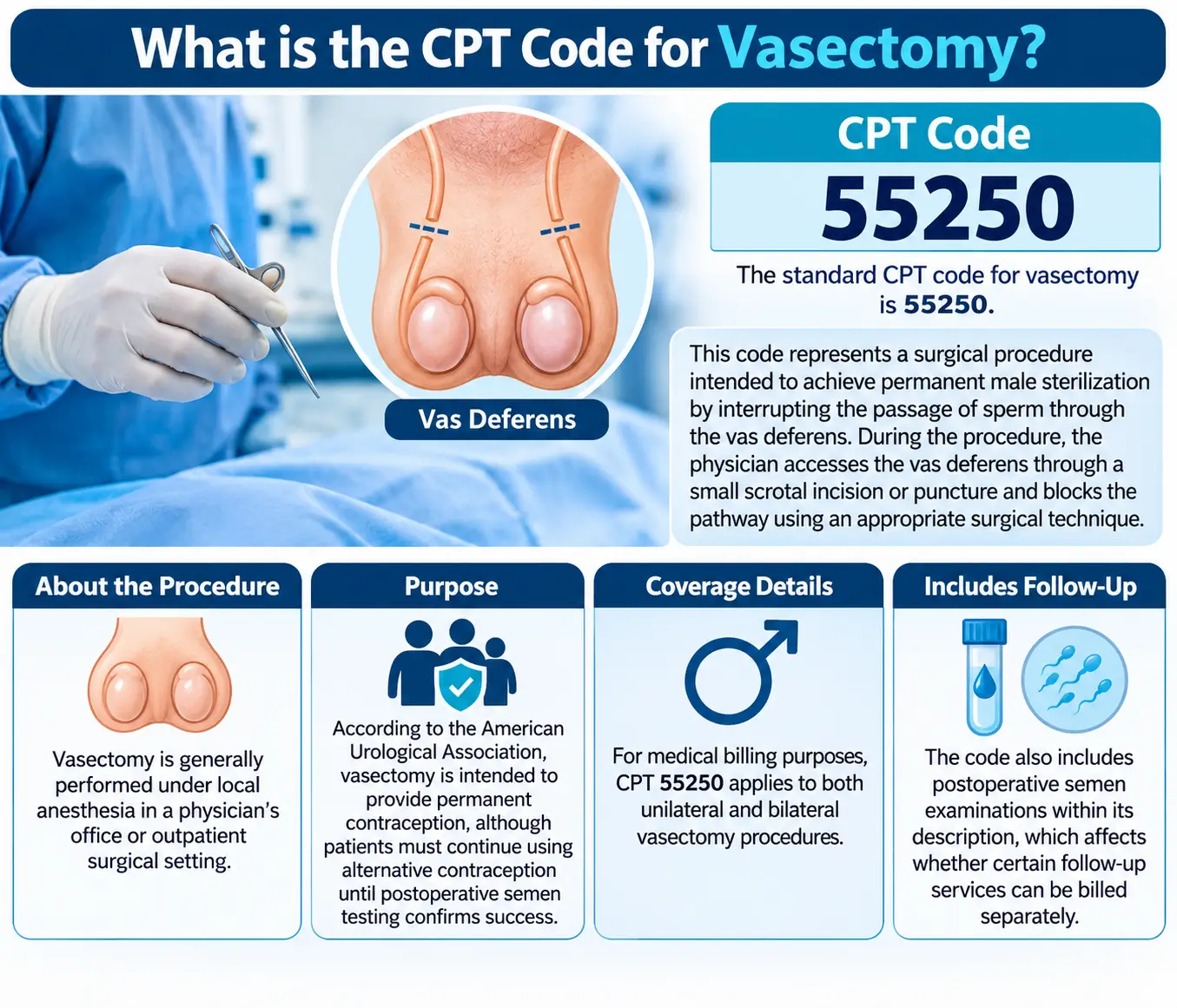
The standard CPT code for vasectomy is 55250. This code represents a surgical procedure intended to achieve permanent male sterilization by interrupting the passage of sperm through the vas deferens. During the procedure, the physician accesses the vas deferens through a small scrotal incision or puncture and blocks the pathway using an appropriate surgical technique.
Vasectomy is generally performed under local anesthesia in a physician’s office or outpatient surgical setting. According to the American Urological Association, vasectomy is intended to provide permanent contraception, although patients must continue using alternative contraception until postoperative semen testing confirms that the procedure has achieved the required result.
For medical billing purposes, CPT 55250 applies to both unilateral and bilateral vasectomy procedures. The code also includes postoperative semen examinations within its description, which affects whether certain follow-up services can be billed separately.
CPT code 55250 description and billing requirements
The official 55250 CPT code description identifies vasectomy performed unilaterally or bilaterally as a separate procedure, including postoperative semen examinations. This wording establishes several coding principles that medical billers must understand before preparing a claim.
First, CPT 55250 represents the surgical sterilization procedure regardless of whether the physician treats one or both vas deferens. Second, the code already accounts for bilateral work, which means reporting two units for a routine bilateral vasectomy is generally incorrect. Third, postoperative semen examinations included in the surgeon’s service should not automatically generate separate charges.
The designation separate procedure also affects surgical procedure reporting. If vasectomy is performed during another operation, the coding professional must determine whether separate reporting is permitted under CPT guidelines and the payer’s bundling policies.
For a routine office-based bilateral vasectomy, one unit of CPT 55250 generally represents the completed procedure. Any additional services must be evaluated independently to determine whether they satisfy the requirements for separate reimbursement.
Bilateral vasectomy CPT code and modifier 50 rules
A bilateral vasectomy involves interrupting both vas deferens to prevent sperm from entering the ejaculate. Because this is the usual approach to surgical male sterilization, the bilateral vasectomy CPT code is also 55250.
One of the most frequent coding questions concerns whether modifier 50 should be appended when the procedure is performed on both sides. Modifier 50 identifies a bilateral procedure when the applicable CPT code and payer payment rules permit bilateral reporting.
However, modifier 50 is generally not appropriate for CPT 55250 because the descriptor specifically includes both unilateral and bilateral procedures. Appending modifier 50 or reporting two units can result in incorrect reimbursement calculations, claim rejection, or requests for supporting documentation.
For example, consider a patient who undergoes a bilateral vasectomy during a single outpatient appointment. The physician documents successful identification, isolation, and occlusion of both the right and left vas deferens. The appropriate procedure code is CPT 55250, reported once without modifier 50.
If the physician performs only a unilateral vasectomy because the opposite vas deferens cannot be identified or another clinical circumstance prevents completion, CPT 55250 still describes unilateral work. The operative report should clearly explain why the bilateral procedure was not completed.
Vasectomy global period and postoperative billing
The vasectomy global period determines which postoperative services are included in the surgical payment and which services may qualify for separate reimbursement.
Under the Medicare Physician Fee Schedule, CPT 55250 has historically been assigned a 90-day global surgical period. Practices should confirm the applicable 2026 global surgery indicator in the current Medicare Physician Fee Schedule database and verify whether their commercial payer follows the same arrangement.
For a procedure assigned a 90-day Medicare global period, the global surgical package generally includes the day before surgery, the surgical procedure itself, and the 90 days following surgery. Routine postoperative care related to the operation is included in the surgical payment.
Expected wound examinations, uncomplicated recovery assessments, and ordinary postoperative management are typically included in the global package. These services should not automatically be reported using separate evaluation and management codes.
However, not every encounter during the postoperative period is necessarily included. A patient may receive treatment for a medical condition unrelated to the vasectomy, and that encounter may qualify for separate E/M reporting if the documentation supports it.
Modifier 24 may be appropriate for an unrelated E/M service provided by the same physician or another physician in the same group and specialty during the postoperative period. The medical record must establish that the separately reported evaluation was unrelated to the original surgical procedure.
ICD-10-CM diagnosis codes for vasectomy billing
Selecting the appropriate diagnosis code is an important part of vasectomy claim submission. The diagnosis must represent the actual reason for the patient’s encounter rather than simply indicate that the patient has undergone sterilization.
ICD-10-CM Z30.2, Encounter for sterilization, is commonly used when a patient undergoes an elective vasectomy for permanent contraception. This code identifies the purpose of the surgical encounter and is generally the appropriate diagnosis for routine sterilization.
For a consultation focused on contraceptive options, ICD-10-CM Z30.09, Encounter for other general counseling and advice on contraception, may be appropriate. This code can describe an encounter in which the physician discusses sterilization, alternative contraceptive methods, procedural risks, and the patient’s reproductive intentions.
ICD-10-CM Z98.52, Vasectomy status, identifies a patient who previously underwent vasectomy. It may be relevant during later medical encounters, fertility evaluations, or other situations where the patient’s sterilization history affects clinical decision-making. However, Z98.52 generally should not replace Z30.2 when reporting the original sterilization procedure.
For patients undergoing reversal of a previous sterilization procedure, ICD-10-CM Z31.0, Encounter for reversal of previous sterilization, may be appropriate when supported by the clinical documentation. Accurate diagnosis selection helps the payer distinguish elective sterilization, contraceptive counseling, prior vasectomy status, and fertility restoration.
Vasectomy consultation and counseling billing
A vasectomy consultation allows the healthcare provider to evaluate the patient’s medical history, reproductive goals, anatomical considerations, and understanding of permanent contraception. Counseling also provides an opportunity to discuss surgical risks, alternatives, the possibility of procedural failure, and postoperative requirements.
The American Urological Association’s 2026 vasectomy guideline addresses preoperative counseling and recognizes that consultation may be conducted through appropriate in-person or virtual arrangements.
A separately performed consultation may support an office evaluation and management code when the service meets applicable documentation and billing requirements. For example, a new patient evaluated several weeks before surgery may qualify for an office E/M code from CPT 99202 through 99205, depending on the documented medical decision-making or qualifying time.
However, routine preoperative services included in the surgical global package should not be billed separately. Billing professionals must consider the timing of the consultation, the physician’s role, the decision for surgery, and the payer’s rules.
When a qualifying evaluation results in the initial decision to perform a major surgical procedure, modifier 57 may be applicable under the appropriate circumstances. It should not be appended automatically to every vasectomy consultation.
Post-vasectomy semen analysis and CPT coding
Post-vasectomy semen analysis is performed to determine whether sperm remain in the ejaculate after surgical sterilization. The procedure does not establish immediate sterility, and patients must continue using alternative contraception until an appropriate healthcare professional confirms that the required testing criteria have been satisfied.
The description of CPT 55250 includes postoperative semen examinations. Consequently, separately billing an examination already included in the operating physician’s surgical service may result in unbundling.
CPT 89321 describes semen examination for the presence or motility of sperm. This code may be relevant when an independently billable laboratory performs the testing, depending on the payer’s policy, laboratory arrangement, and applicable bundling requirements.
The American Urological Association’s 2026 guideline recommends at least one appropriately collected postoperative semen sample, with testing potentially beginning as early as eight weeks after vasectomy. Clearance criteria depend on the sperm findings and laboratory handling conditions.
For an uncentrifuged sample examined within two hours of collection, the guideline permits clearance when testing demonstrates azoospermia or no more than 100,000 nonmotile sperm per milliliter. For samples examined more than two hours after collection, azoospermia is required before discontinuing alternative contraception.
Documentation should include the specimen collection date, laboratory findings, physician interpretation, and communication of the results to the patient. Billing staff should verify whether the testing service is already included before submitting a separate laboratory claim.
CPT code for vasectomy reversal and CPT 55400
A vasectomy reversal attempts to restore fertility by reconnecting portions of the male reproductive tract that were previously interrupted. The surgical technique depends on the condition of the vas deferens and findings identified during the operation.
The primary vasectomy reversal CPT code is 55400, which describes vasovasostomy or vasovasorrhaphy. Vasovasostomy involves surgically reconnecting divided ends of the vas deferens to restore the pathway through which sperm can travel.
Unlike CPT 55250, the description of CPT 55400 does not automatically incorporate bilateral work in the same manner. Consequently, bilateral vasovasostomy may be reported using modifier 50 when the payer’s bilateral surgery rules permit it.
For example, a surgeon performing bilateral vasovasostomy may report CPT 55400 with modifier 50 when the documentation confirms that both sides were reconstructed and the payer recognizes bilateral reporting for the procedure.
However, not every vasectomy reversal involves vasovasostomy. Some patients require vasoepididymostomy, a different reconstructive procedure connecting the vas deferens to the epididymis. Coding professionals must review the operative report to identify the actual reconstruction rather than assigning CPT 55400 to every reversal operation.
Operating microscope and CPT add-on code 69990
Microsurgical vasectomy reversal frequently involves an operating microscope to improve visualization of small anatomical structures. The microscope may assist with precise alignment and suturing during reconstructive surgery.
CPT 69990 describes the use of an operating microscope as an add-on service in qualifying procedures. However, microscope use alone does not establish eligibility for separate reimbursement.
Medicare restricts separate payment for CPT 69990 to designated qualifying procedures. CPT 55400 is not included among the procedures for which Medicare generally permits separate microscope reimbursement under those restrictions.
Commercial insurance policies may differ, so medical billing professionals should review the applicable payer’s coding guidelines before submitting CPT 69990.
The operative report should document microscope use when clinically relevant, but the presence of this documentation does not override CPT bundling rules or payer payment restrictions.
Vasectomy anesthesia coding guidelines
Routine vasectomy is usually performed under local anesthesia in an office or outpatient setting. When the operating physician administers local anesthesia as part of the surgical procedure, the service is generally included in the surgical payment.
Some patients may undergo vasectomy under general anesthesia or with additional sedation because of specific clinical circumstances, anatomical considerations, or the planned surgical environment.
When an independent anesthesia professional provides a separately reportable service, billing depends on the anesthesia actually administered, the provider’s documentation, and the applicable insurance requirements.
The medical record should explain why general anesthesia was selected when it differs from the usual approach. The anesthesia claim must accurately reflect the service performed rather than assume that every vasectomy qualifies for an additional anesthesia payment.
Commercial insurance and private-pay vasectomy billing
Insurance coverage for vasectomy depends on the patient’s health plan and the applicable benefit provisions. Commercial insurance policies may cover elective male sterilization, but coverage limitations, deductibles, prior authorization requirements, and network restrictions vary.
Original Medicare generally does not cover elective vasectomy performed solely for contraception. Medicare coverage for sterilization is limited to circumstances involving medically necessary treatment of an illness or injury.
Medicaid programs have additional sterilization consent requirements. Under 42 CFR 441.253, federal Medicaid funding for sterilization generally requires the patient to be at least 21 years old when consent is obtained and to provide informed consent within the required timeframe.
The standard waiting period between informed consent and sterilization is at least 30 days and no more than 180 days. Federal regulations provide limited exceptions for qualifying circumstances, but these exceptions should not be assumed for routine elective procedures.
For private-pay vasectomy billing, practices should explain the expected surgical charges, consultation costs, postoperative follow-up arrangements, and laboratory testing responsibilities before treatment.
Clear financial agreements help prevent disputes over services that patients may believe were included in the original procedure price.
Vasectomy procedure documentation requirements
Accurate vasectomy procedure documentation supports correct CPT coding, insurance reimbursement, and postoperative patient care. The operative report should describe the procedure actually performed and identify any circumstances that affected its completion.
Documentation should establish the reason for sterilization, informed consent, surgical approach, anesthesia administered, laterality, and technique used to interrupt the vas deferens.
For a bilateral procedure, the physician should record the treatment performed on both the right and left sides. If only one side was completed, the record should explain the circumstances instead of inaccurately describing a completed bilateral procedure.
Postoperative instructions should address expected recovery, signs requiring medical attention, continued contraceptive precautions, and the plan for semen analysis.
For vasectomy reversal, the surgeon should identify the reconstruction performed, document whether the procedure was unilateral or bilateral, and record findings that influenced the selection of surgical technique.
Medical necessity documentation must also reflect the actual clinical circumstances. Elective sterilization should not be represented as treatment for an unrelated medical condition solely to obtain insurance reimbursement.
Common vasectomy billing errors and how to prevent them
One common vasectomy billing error is reporting modifier 50 with CPT 55250. Since the code already describes unilateral or bilateral procedures, modifier 50 is generally unnecessary and may result in claim rejection or incorrect reimbursement.
Another issue involves reporting postoperative semen examinations separately when those services are already included in the surgical procedure. Billing professionals should review the code description and laboratory arrangements before assigning an additional CPT code.
Incorrect diagnosis coding can also produce avoidable claim problems. ICD-10-CM Z30.2 identifies an encounter for sterilization, while Z98.52 documents previous vasectomy status. Using these codes interchangeably can misrepresent the reason for the encounter.
Vasectomy reversal claims require additional attention because the surgery, diagnosis, laterality, and insurance coverage differ from routine sterilization. The coder must distinguish CPT 55400 from other reproductive reconstruction procedures and evaluate whether modifier 50 is appropriate.
Missing Medicaid sterilization consent documentation is another source of payment problems. Even a correctly coded surgical claim may be denied when required consent forms or waiting-period conditions have not been satisfied.
Before claim submission, billing professionals should compare the operative report, CPT code, diagnosis code, modifier selection, postoperative arrangements, and insurance benefits. This review can identify documentation gaps before they become denials or repayment issues.
Vasectomy CPT code guide: Summary for 2026
Accurate vasectomy billing depends on identifying the procedure performed, applying the correct CPT code, and documenting the services included in the surgical payment.
CPT 55250 is the standard vasectomy procedure code and covers unilateral or bilateral sterilization, including postoperative semen examinations described by the code. Modifier 50 should generally not be used for routine bilateral vasectomy because bilateral work is already included.
CPT 55400 describes vasovasostomy or vasovasorrhaphy performed during certain vasectomy reversal procedures. Bilateral reporting may be appropriate under the payer’s rules, while separate reimbursement for operating microscope code 69990 remains subject to specific restrictions.
The applicable global period, diagnosis selection, Medicaid sterilization consent requirements, anesthesia arrangements, and insurance coverage rules should be verified before submitting claims.
For healthcare providers and medical billing professionals, consistent documentation and careful application of CPT coding guidelines help ensure that vasectomy and vasectomy reversal claims accurately reflect the procedures performed.