
Managing denied insurance claims is one of the most challenging responsibilities in healthcare revenue cycle management. Every denied claim requires investigation, follow-up, and sometimes additional documentation or an appeal. Without an organized denial management process, healthcare organizations may experience delayed reimbursements, increased accounts receivable balances, and unnecessary administrative expenses.
The best denial management software helps healthcare providers identify denied claims, investigate payment issues, automate repetitive tasks, and improve reimbursement recovery. Modern platforms also offer artificial intelligence, predictive analytics, automated appeals, and integration with electronic health record (EHR) systems.
However, choosing suitable software depends on practice size, claim volume, existing billing systems, and operational requirements. A small physician practice may benefit from integrated medical billing software, while a hospital processing thousands of insurance claims may require advanced denial analytics and automated workflows.
This guide explores leading denial management software solutions in 2026, their important features, and the factors healthcare organizations should consider before selecting a platform.
What is denial management software?
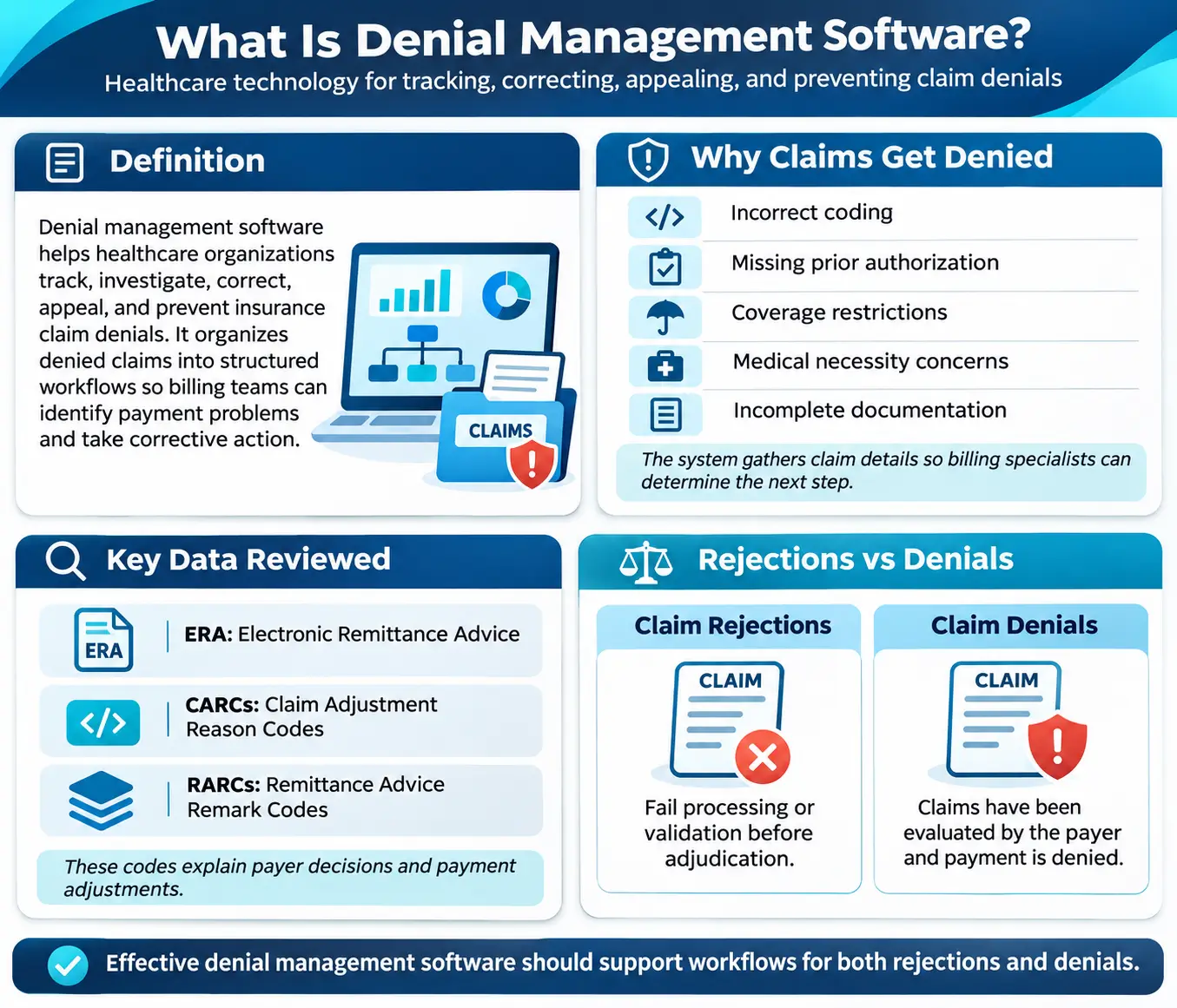
Denial management software is a healthcare billing technology that helps organizations track, investigate, correct, appeal, and prevent insurance claim denials. It organizes denied claims into manageable workflows so billing teams can identify payment problems and take appropriate corrective action.
When an insurance company processes a medical claim, it may deny payment because of incorrect coding, missing prior authorization, coverage restrictions, medical necessity concerns, or incomplete documentation. Denial management systems collect relevant information and help billing specialists determine the appropriate next steps.
These tools commonly analyze electronic remittance advice (ERA), claim adjustment reason codes (CARCs), and remittance advice remark codes (RARCs). These standardized codes help communicate payment adjustments and provide additional information about insurance company decisions.
Healthcare organizations should distinguish between claim rejections and denials. Rejections generally occur when a claim fails processing or validation before adjudication, while denials involve claims that have been evaluated by an insurance payer. Effective denial management software should support appropriate workflows for both situations.
Important features of the best denial management software
The effectiveness of healthcare denial management software depends on how well its features support daily medical billing operations. A suitable system should simplify claim tracking, improve staff productivity, and provide useful information for preventing recurring payment problems.
Automated denial identification and tracking
Automated denial management software can collect denial information from electronic remittances, claim status transactions, and connected billing systems. This reduces the need for billing specialists to review individual insurance portals manually.
A useful platform should display denial reasons, outstanding balances, responsible staff members, follow-up dates, and claim resolution status within an organized interface. These features help revenue cycle teams identify claims requiring immediate attention and prevent unresolved accounts from being overlooked.
AI-powered denial prediction
AI denial management software analyzes historical claim patterns to identify submissions that may be denied. Predictive models can flag potential coding, authorization, documentation, and reimbursement issues before claims reach insurance companies.
For example, software may identify a pattern of prior authorization denials associated with a particular procedure and payer. Billing professionals can review similar claims before submission and determine whether additional information is required.
Although predictive technology supports denial prevention, it cannot guarantee claim approval because insurance coverage requirements and payer decisions vary.
Automated appeals management
Denial and appeals workflow software helps billing teams prepare appeal documentation, assign tasks, monitor payer deadlines, and track appeal outcomes.
Some systems can generate draft appeal letters using claim information and supporting documentation. These capabilities may reduce repetitive administrative work and help staff manage large appeal inventories.
However, healthcare professionals should verify medical necessity, documentation accuracy, and payer-specific appeal requirements before submitting appeals.
Denial analytics and reporting
Denial analytics software helps healthcare organizations identify recurring reimbursement problems. Reporting tools can organize denials by insurance payer, provider, medical specialty, procedure, location, and adjustment reason.
Useful performance measurements include initial denial rate, appeal overturn rate, recovered reimbursement, denial-related write-offs, and the time required to resolve outstanding claims.
By reviewing these measurements, billing managers can identify operational weaknesses and develop targeted improvements.
EHR and medical billing system integration
The best healthcare denial management software should exchange information with existing EHR, practice management, clearinghouse, and payment posting systems.
Reliable integration reduces duplicate data entry and allows billing specialists to investigate denied claims without continually switching between disconnected applications. Integration capabilities should always be confirmed with the software vendor because supported interfaces vary.
Best denial management software solutions in 2026
Healthcare organizations have several established denial management software solutions available. Each platform offers different capabilities for claim tracking, reimbursement recovery, automation, and denial prevention.
1. Waystar Denial + Appeal Management
Waystar provides Denial + Appeal Management software designed to help healthcare organizations identify, prioritize, and resolve denied insurance claims. The platform combines denial tracking, workflow management, predictive analytics, and automated appeals capabilities.
Its technology helps billing departments evaluate denial information and prioritize accounts based on recovery opportunities. Organizations can assign denied claims to appropriate staff members and manage follow-up through customized workflows.
One of its notable capabilities is automated appeal preparation. Waystar supports payer-specific appeal forms, AI-assisted appeal letters, electronic submission options, and appeal status tracking.
The platform also provides reporting tools to help healthcare organizations examine denial patterns and identify the reasons claims are repeatedly rejected or denied.
Waystar may be suitable for hospitals, medical groups, and healthcare organizations that handle substantial denial volumes and require structured appeal management.
2. Experian Health Denial Workflow Manager
Experian Health offers Denial Workflow Manager, a healthcare denial management solution that combines claim status information, electronic remittance details, and reporting tools.
The software helps identify denied, suspended, pending, and zero-payment claims. Billing departments can organize accounts into worklists based on denial categories, outstanding balances, and operational priorities.
Experian Health also offers AI Advantage, which includes Predictive Denials and Denial Triage capabilities. These tools help organizations identify claims that may be denied and prioritize existing denials according to potential recovery opportunities.
The software provides reporting functions that allow billing managers to examine recurring payment issues across insurance payers and billing categories.
Denial Workflow Manager can operate independently or alongside Experian ClaimSource, depending on organizational requirements.
Hospitals and larger medical practices may find this system useful when they require detailed denial analytics, claim prioritization, and coordinated follow-up workflows.
3. FinThrive Denials Prevention Manager
FinThrive provides healthcare revenue cycle technology designed to help organizations identify reimbursement risks and manage payment problems.
Its Denials Prevention Manager uses AI-powered analysis to identify claims with a higher likelihood of denial before they are submitted to insurance companies.
The software examines claim information and historical reimbursement patterns to identify potential coding, authorization, documentation, and payer-related issues.
FinThrive also offers Denials and Underpayments Analyzer, which helps healthcare organizations investigate reimbursement problems after claims have been processed.
These solutions address different stages of the revenue cycle. Preventive analysis supports claim accuracy before submission, while denial and underpayment reporting helps organizations investigate existing payment issues.
FinThrive may be relevant for hospitals and health systems seeking predictive denial management software and detailed reimbursement analytics.
4. Infinx A/R Recovery & Denials Management
Infinx provides A/R Recovery and Denials Management software designed to support healthcare organizations managing unpaid insurance claims and denied accounts.
The platform combines artificial intelligence, predictive analytics, claim prioritization, and automated follow-up workflows.
Its technology examines outstanding accounts to identify recovery opportunities and prioritize claims requiring attention. Billing teams can use this information to organize work based on account value, denial reason, and potential reimbursement.
Infinx also provides reporting capabilities that help organizations monitor outstanding balances, payer performance, denial categories, and accounts receivable aging.
The platform supports connections with healthcare billing and EHR systems, although available integrations depend on the organization’s existing technology environment.
Infinx may be useful for medical groups and healthcare organizations handling significant accounts receivable inventories and seeking more organized denial recovery processes.
5. athenaOne by athenahealth
athenaOne is an integrated healthcare technology platform combining electronic health records, practice management, medical billing, and revenue cycle capabilities.
Its medical billing functionality helps practices identify claim errors before submission and manage reimbursement problems through connected workflows.
athenahealth also offers Enhanced Claim Resolution, a service that allows billing specialists to investigate and resolve qualifying claim issues within the athenaOne environment.
The platform includes automated billing features and reporting tools designed to help practices monitor financial performance and claim activity.
For healthcare providers already using athenaOne, integrated denial management capabilities may reduce the need to operate separate applications for claim submission, payment monitoring, and follow-up.
The system may be particularly relevant for physician practices and medical groups seeking combined EHR and medical billing denial management software.
6. AdvancedMD Medical Billing
AdvancedMD provides medical billing software alongside electronic health records, practice management, scheduling, and administrative tools.
Its billing functionality supports electronic claims processing, accounts receivable management, claim tracking, payment posting, and financial reporting.
When an insurance claim is denied, billing professionals can use available worklists and claim information to investigate the problem, correct errors, and manage appropriate follow-up activities.
AdvancedMD also offers reporting dashboards that help practices monitor payer activity, unpaid balances, and reimbursement performance.
Because its billing features are connected with broader practice management functions, AdvancedMD may be suitable for small and midsize practices seeking organized claim management without implementing a separate enterprise denial management platform.
Healthcare organizations should confirm which automated denial management capabilities are included in their selected software package.
7. Optum Claims Manager and denial management solutions
Optum provides healthcare revenue cycle solutions that support claims processing, payment management, and reimbursement operations.
Its Claims Manager focuses on identifying claim errors and supporting accurate claim submission. These capabilities can help healthcare organizations address problems that might otherwise result in denied reimbursement.
Optum also offers revenue cycle services and solutions associated with accounts receivable recovery and denial management.
Healthcare organizations can use relevant products to support claim processing, investigate reimbursement issues, and organize financial workflows.
Because Optum offers multiple revenue cycle products and services, organizations should carefully review the specific functionality available within each offering.
Its solutions may be appropriate for hospitals, health systems, and larger healthcare organizations managing complex insurance reimbursement operations.
How does AI denial management software improve medical billing?
Artificial intelligence has introduced additional capabilities into healthcare denial management systems. AI-based software can examine claim histories, identify recurring payment problems, and recommend appropriate follow-up activities.
For example, an automated denial management system may identify repeated authorization-related denials associated with a particular insurance plan. Billing managers can investigate whether authorization information is missing, recorded incorrectly, or inconsistent with payer requirements.
Predictive denial management software can also flag claims requiring additional review before submission. This gives billing professionals an opportunity to correct potential problems earlier in the revenue cycle.
After payer adjudication, AI tools may estimate which denied accounts have a greater likelihood of successful recovery and help prioritize staff assignments.
Some platforms also assist with appeal preparation by organizing claim information and drafting explanations based on available documentation.
However, AI recommendations require professional review. Historical billing data may contain errors, payer policies can change, and automated systems may misinterpret complex reimbursement requirements. Qualified billing professionals remain responsible for validating claim corrections and appeal documentation.
How to choose the best denial management software
Selecting suitable denial management software requires examining current billing challenges rather than focusing exclusively on advertised technology features.
Healthcare providers should begin by reviewing their most frequent denial categories, unpaid claim volumes, existing staffing resources, and revenue cycle performance.
A physician practice experiencing frequent eligibility-related denials may benefit from improved insurance verification and claim validation tools. A hospital managing substantial denied receivables may require advanced denial analytics, recovery predictions, and automated appeals workflows.
Integration compatibility is another important factor. Healthcare organizations should confirm whether the software supports existing EHR applications, electronic remittances, claim status transactions, and payment posting processes.
Pricing should also be evaluated carefully. Depending on the vendor and contract, expenses may include software subscriptions, implementation fees, integration costs, staff training, and additional service charges.
Healthcare organizations must also consider patient information security. Software vendors that access protected health information may qualify as business associates under HIPAA and generally require appropriate business associate agreements.
Before selecting a platform, healthcare providers should request product demonstrations using representative denial scenarios. This allows billing managers to evaluate how claim corrections, appeal preparation, reporting, and follow-up activities operate in practice.
Frequently asked questions about denial management software
What is the best denial management software for healthcare providers?
The best denial management software depends on an organization’s billing requirements, claim volume, and existing technology. Waystar and Experian Health offer dedicated denial management capabilities, while FinThrive emphasizes predictive denial prevention. athenaOne and AdvancedMD may be suitable for practices seeking integrated medical billing functionality.
Which denial management software offers automated claim appeals?
Waystar offers AI-assisted appeal preparation, electronic submission options, and appeal tracking. Other healthcare denial management systems provide appeal-related workflows, although the level of automation varies depending on the platform and selected features.
Can denial management software prevent insurance claim denials?
Denial management software can help prevent avoidable denials by identifying coding errors, authorization problems, missing documentation, and other potential reimbursement issues before submission. However, it cannot eliminate all denials because insurance coverage decisions and medical necessity requirements vary among payers.
Does denial management software integrate with EHR systems?
Many healthcare denial management platforms support integration with EHR and practice management software. However, compatibility depends on the systems involved, available interfaces, and vendor implementation requirements.
What is the difference between denial management software and revenue cycle management software?
Revenue cycle management software supports broader financial operations, including patient registration, eligibility verification, charge capture, claim submission, payment posting, and accounts receivable management.
Denial management software focuses specifically on identifying, investigating, correcting, appealing, and preventing denied insurance claims. Some RCM platforms include denial management features, while other organizations use specialized applications alongside existing billing systems.
Choosing the right denial management solution
The best denial management software should help healthcare organizations identify denied claims promptly, investigate payment problems, prioritize follow-up activities, and prevent recurring billing errors.
Waystar, Experian Health, FinThrive, Infinx, athenaOne, AdvancedMD, and Optum offer different combinations of denial analytics, automated workflows, artificial intelligence, appeals management, and revenue cycle functionality.
For healthcare providers, the most suitable platform is one that supports existing billing operations, integrates with necessary systems, and helps staff manage reimbursement recovery efficiently.
Medical billing professionals should evaluate software based on actual workflow performance, payer requirements, integration compatibility, reporting capabilities, and operating costs. A properly selected denial management system can support more accurate claim processing, organized appeals, and improved revenue cycle visibility.