A therapist in California sees a Medi-Cal patient for a first session, writes a thorough note and sends the claim to the managed care plan. Weeks later it comes back denied. The patient's symptoms had moved past the mild-to-moderate range, and the county, not the plan, was responsible for that care.
The mistake is easy to make. Medi-Cal covers behavioral health through two delivery systems that sit side by side, and the same member can use both. Which one pays depends on the service, the member's level of need and the member's age. Getting the routing wrong costs practices weeks of rework, and sometimes the payment itself.
This guide explains how the split works, what the No Wrong Door policy does and does not change, how to enroll and bill on each side, and where the deadlines and denials tend to come from.
Two systems under one Medi-Cal card
The majority of Medi-Cal participants are part of a managed care plan (MCP). The plan is in charge of both the physical health benefit and a specific category of mental health care known as non-specialty mental health services (NSMHS). NSMHS is provided by fee-for-service Medi-Cal to members who are not enrolled in a plan.
The counties own speciality mental health services (SMHS). Every county manages a behavioural health plan that offers or organises SMHS for county residents who fulfilll the California Department of Health Care Services' (DHCS) access requirements. These county bodies are now referred to by DHCS as Behavioural Health Plans (BHPs) under the current Medi-Cal behavioural health modifications.
Therefore, depending on who it contracts with and what the member wants, a practice may bill an MCP, a county, or both.
Who pays for what
Managed care plans and non-specialty services
For members 21 and older, NSMHS covers mild to moderate distress or mild to moderate impairment of mental, emotional or behavioral functioning from a mental health disorder. Covered services include mental health evaluation and treatment, such as individual, group and family psychotherapy, plus outpatient services to monitor medication. Psychological testing and psychiatric consultation fall in this group when clinically indicated.
MCPs must also provide medically necessary NSMHS to members under 21 through the Early and Periodic Screening, Diagnostic and Treatment (EPSDT) benefit.
County plans and specialty services
If a member is 21 years of age or older and has a diagnosed or suspected mental health problem, severe impairment, or a realistic prospect of considerable deterioration, they are eligible for the county's SMHS system. Section 14184.402 of the Welfare and Institutions Code contains these requirements.
The requirements for access are more lenient for members under 21. Among the qualifying circumstances listed by DHCS are a diagnosed or suspected disorder and serious trauma that increases the member's chance of developing a mental health illness in the future. The Katie A. settlement's intense services, such as intense Care Coordination, Intensive Home-Based Services, Therapeutic Behavioural Services, and Therapeutic Foster Care, are also covered by the counties.
Quick comparison
| Managed care plan or fee-for-service | County behavioral health plan | |
|---|---|---|
| Service category | Non-specialty mental health services | Specialty mental health services |
| Adults 21 and older | Mild to moderate distress or impairment | Significant impairment or probable deterioration |
| Under 21 | Medically necessary NSMHS through EPSDT | Access through the criteria in DHCS guidance, including trauma |
| Typical claim path | The member's plan, billed with CPT codes | The county plan or its network |
What No Wrong Door changes, and what it leaves alone
Before this policy, a member who asked for help in the wrong place could be turned away or billed into a denial. DHCS responded with the No Wrong Door policy, issued to counties as Behavioral Health Information Notice (BHIN) 22-011.
Under it, SMHS are covered and reimbursable even when the member has not yet received a diagnosis, when services start before the assessment finishes, or when NSMHS and SMHS are delivered at the same time as long as the services are coordinated and not duplicated. A member who walks into the county first, or the plan first, should still get care.
The policy protects payment for clinically appropriate care. It does not let a practice pick its payer. A claim for a service the member's plan covers still goes to the plan, and a claim for a specialty service still goes to the county. Practices that read No Wrong Door as "either system will pay" are the ones who see denials.
How to work out which payer owns the claim
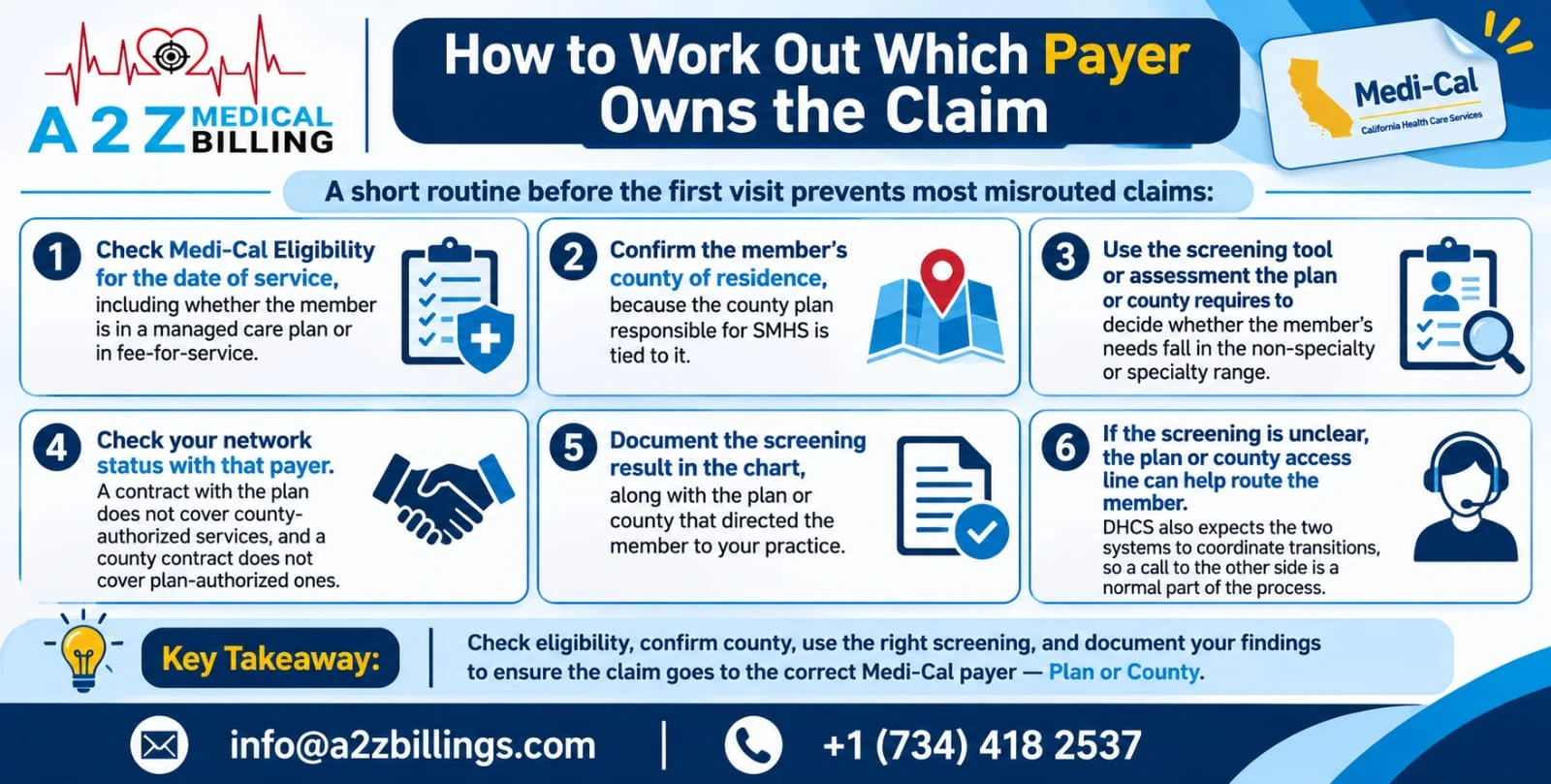
A short routine before the first visit prevents most misrouted claims:
- Check Medi-Cal eligibility for the date of service, including whether the member is in a managed care plan or in fee-for-service.
- Confirm the member's county of residence, because the county plan responsible for SMHS is tied to it.
- Use the screening tool or assessment the plan or county requires to decide whether the member's needs fall in the non-specialty or specialty range.
- Check your network status with that payer. A contract with the plan does not cover county-authorized services, and a county contract does not cover plan-authorized ones.
- Document the screening result in the chart, along with the plan or county that directed the member to your practice.
If the screening is unclear, the plan or county access line can help route the member. DHCS also expects the two systems to coordinate transitions, so a call to the other side is a normal part of the process.
Setting up on each side
The managed care route
A practice that wants to treat plan members contracts and credentials with each plan it plans to bill. Each plan has its own provider manual, claims portal, authorization rules and appeal steps. Plans generally tell providers to submit behavioral health claims using standard CPT codes. Anthem Blue Cross, for example, instructs providers rendering covered behavioral health services to bill it using behavioral health CPT codes.
Timely filing limits for plan claims are set in each plan's contract and provider manual, so a practice contracted with three plans may have three different deadlines. Counties that use a county-organized health system or a regional plan add more variation.
The county route
Billing for county SMHS is more organised. Medi-Cal fee-for-service enrollment through the Provider Application and Validation for Enrolment (PAVE) system is required for individual and group providers that bill the county. Additionally, organisational sites must be certified by Medi-Cal's Provider Enrolment Division for the services they bill. According to DHCS, SMHS certification and Medi-Cal enrolment are distinct processes.
Typically, network providers bill the county, which then uses the Short-Doyle/Medi-Cal system to submit claims to the state. CPT and HCPCS codes are used in claims since the CalAIM behavioural health payment reform, and documentation requirements have been simplified to align with national standards. Each county needs its own onboarding discussion because they still establish their own contracts, authorisation procedures, and network requirements.
Deadlines and the denials behind them
Under Welfare and Institutions Code section 14705 and federal rule 42 CFR 447.45(d), original SMHS claims must be submitted within 12 months of the month of service. DHCS's SMHS billing manual says a claim sent after that window is denied unless it carries an approved Delay Reason Code. Voids can be submitted at any time.
Medi-Cal is also the payer of last resort. A member with other health coverage needs that payer billed first, and the billing manual has separate steps for Medicare, including a rule for when Medicare does not respond within 90 days.
The denials that show up most often in this setup come from a short list of causes:
- A claim sent to the managed care plan for a service the county covers, or the reverse
- A rendering provider who is not enrolled or certified for the service billed
- A member whose Medi-Cal eligibility did not cover the month of service
- Other health coverage that was not billed first
- An original claim filed outside the deadline without a Delay Reason Code
- Authorization missing or expired where the payer requires one
The fix for most of these is upstream. The claim gets denied at billing, but the cause is a routing, enrollment or eligibility question that was settled badly weeks earlier.
What changed recently
Two changes affect how practices should read older guidance. In early 2026, DHCS issued BHIN 26-002, which superseded BHIN 21-073 as the statement of access criteria for the specialty mental health system. It also lists approved youth trauma screening tools. Later in the year, BHIN 26-030 updated how counties authorize outpatient SMHS, superseding BHIN 22-016.
Separately, the Behavioral Health Services Act took effect in mid-2026 and replaced the older county mental health funding rules with a county policy manual. In practice, a county's contract terms, authorization steps and network requirements can differ from last year's version.
Because county rules shift independently of state guidance, the county's current provider manual is the document to check before billing a new service type.
A short readiness checklist
- Decide which members the practice serves: plan members for non-specialty care, county members for specialty care, or both.
- Contract and credential with each plan and county the practice intends to bill.
- Enroll individual clinicians in Medi-Cal fee-for-service through PAVE, and confirm site certification where it applies.
- Build eligibility, county and plan checks into scheduling, so routing is decided before the first session.
- Record deadlines by payer, with the 12-month county rule and each plan's own limit on the same calendar.
- Review denials monthly by cause and trace them back to the routing step.
Where billing support fits
Payer decisions belong to DHCS, the plans and the counties. A billing company cannot approve a provider, grant a contract or change a member's category.
A billing team can verify eligibility and routing before claims are sent, match each clinician's enrollment to the services billed, track deadlines by payer and work denials back to their cause. Mental Health Billing does this review when it takes on a California account and again when a practice adds a payer or a service line.
Frequently asked questions
What is the difference between specialty and non-specialty mental health services in Medi-Cal?
Non-specialty services, delivered by managed care plans and fee-for-service providers, treat mild to moderate distress or impairment in adults and, through EPSDT, members under 21. Specialty services, delivered through county plans, serve members who meet the county's access criteria, such as significant impairment.
Can a member receive care from both a plan and a county?
Yes. DHCS allows NSMHS and SMHS to be provided at the same time when the services are coordinated and not duplicated.
How long do providers have to bill Medi-Cal for specialty mental health services?
Original claims are due within 12 months of the month of service, and later claims are denied unless a Delay Reason Code is approved. Managed care plans set their own timelines in their contracts.
Do all providers need a Medi-Cal enrollment to see members?
Providers billing the county for SMHS must be enrolled in Medi-Cal fee-for-service through PAVE, and organizational sites need certification. Providers who treat plan members contract and credential with the plan.