

The status says "in process." It said the same thing last week. The clinician has patients on the calendar, the front desk keeps asking when billing can start, and nobody can say which desk the file is sitting on.
That status is almost useless on its own. It can mean the payer has not opened the file, or that a reviewer wrote to the practice two weeks ago and the letter went to an old address. The fix starts with finding out which of those is true, and that takes a phone call to the right office with the right questions.
This guide covers who to call for Medicare, Medicaid and commercial plans, what to have in hand before dialing, what to ask once someone picks up, and what to do about billing while the file sits.
What "in process" means, and why it differs by payer
Every payer uses the phrase differently. Medicare enrollment runs through a Medicare Administrative Contractor (MAC) for the practice's state or region. Medicaid enrollment runs through the state Medicaid agency or its fiscal agent. Commercial plans each run their own credentialing department with their own steps.
Medicare gives the clearest picture. CMS's Medicare Provider Enrollment fact sheet (MLN9658742) says the filing date is the day the MAC receives the application. It also says the MAC will not fully process an application until it has a signature, the application fee where one applies, and the supporting documents.
So an application can be in the building and still not be moving. The clock that matters is the one the practice cannot see: whether the payer is waiting on the practice or the practice is waiting on the payer.
Before calling: gather these details
A call goes faster when the caller can answer the first three questions without looking anything up. Pull these together first:
- The date the application was submitted and the method used (online, paper or through a third party)
- The tracking, reference or application number
- The clinician's NPI, tax ID and the practice address on the application
- The name, date and reference number from any earlier call
- Copies of everything that was sent, including licenses, malpractice certificates and signature pages
One more check takes two minutes and prevents a surprising number of problems. Compare the clinician's NPI record with what was submitted. The NPI Registry on the CMS site shows the name, address and taxonomy on file. A mismatch between that record and the application is a common reason a reviewer stops.
Who to call, by payer type
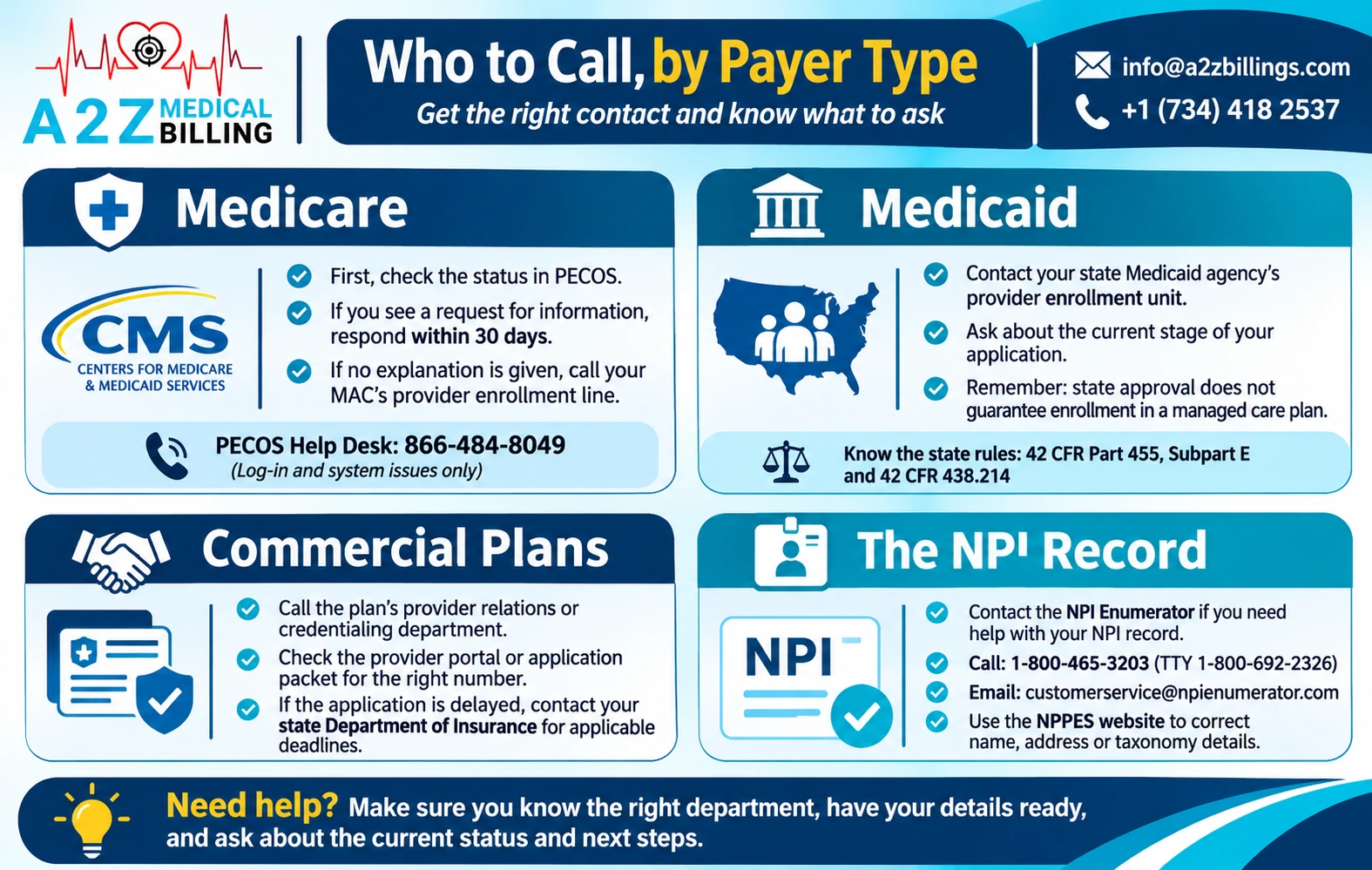
Medicare
Start by checking the status without calling. PECOS shows application status, and CMS says it can be viewed without logging in by selecting Application Status under Helpful Links.
If the status shows a request for information, that is the answer. CMS tells providers to respond to MAC information requests within 30 days, and a late response can lead to a rejected application.
If the status gives no explanation, call the MAC's provider enrollment line for the state. CMS publishes a Medicare Fee-For-Service Provider Enrollment Contact List with the enrollment contacts for each MAC. The PECOS system help desk, at 866-484-8049, handles log-in and system problems and does not review application status.
Medicaid
Medicaid enrollment belongs to the state. The practice calls the state Medicaid agency's provider enrollment unit or the fiscal agent that handles applications, which the state's provider enrollment page identifies.
Federal rules in 42 CFR Part 455, Subpart E require states to screen providers before enrolling them, and screening can include steps like license checks and database reviews. Ask which stage the application is in.
Managed care adds a second layer. Under 42 CFR 438.214, Medicaid managed care plans must follow a documented credentialing process, so approval from the state does not put a clinician in a plan's network. A practice with both a state application and a plan application has two files to track.
Commercial plans
Call the plan's provider relations or credentialing department, not general member services. The number is usually in the provider portal or on the application packet.
Federal law sets no single deadline for commercial credentialing. Some states do set deadlines for how long a plan can take to decide a complete application, so the state department of insurance is worth a look when a file has sat for months. Its website or consumer line can confirm whether the practice's state has such a rule.
The NPI record
If the question involves the NPI itself, the National Plan and Provider Enumeration System (NPPES) handles it. The NPI Enumerator can be reached at 1-800-465-3203 (TTY 1-800-692-2326) or customerservice@npienumerator.com. The NPPES website lets a provider correct name, address and taxonomy details online.
What to ask once someone answers
The goal of the call is to leave with a stage, an owner and a next step. These questions get there:
- Is the application complete, or is something missing? If something is missing, what exactly, and where should it be sent?
- What stage is it in: intake, primary source verification, committee review or contract loading?
- Was a request for information sent? On what date, and to which address or email?
- Does the file show the same NPI, tax ID, taxonomy and practice address that we submitted?
- Who is the reviewer or team handling the file, and what is the best way to reach them?
- Is there a decision date or a target date, and what happens if we miss a deadline?
- If approved, what will the effective date be, and does it depend on the date we filed or the date everything was complete?
- Can you give us a reference number for this call?
Question seven matters most for billing. A clinician can be approved and still have an effective date weeks after the first patient visit, which turns into denied claims.
Why applications stall
Most stalled files trace back to a short list of causes:
- A request for information that went to an old address or an unmonitored inbox
- A missing signature or an unpaid application fee, which CMS names as reasons a MAC cannot finish processing
- A name, address or taxonomy mismatch between the NPI record and the application
- An expired or soon-to-expire license or malpractice certificate in the file
- Unexplained gaps in work history
- Ownership or affiliation details that do not match across forms
None of these is hard to fix. All of them can sit for weeks unless someone asks the right question.
How often to follow up, and how to keep a record
A steady rhythm works better than occasional urgent calls. Check online status weekly where the payer offers it. Call when the status has not changed in a couple of weeks, or immediately after any letter or email requesting information.
Keep a log with the date, the person's name, the reference number and what was promised. When a file changes hands, that log is the only thing that carries the history. It also gives a practice a paper trail if an escalation is needed later.
Nothing here guarantees a faster decision, since payers set their own pace. What follow-up does is stop a fixable problem from sitting unnoticed.
Billing while the file sits
This is where "in process" costs money. Seeing a payer's patients before an effective date can lead to denials that cannot be appealed.
For Medicare, the effective date and the filing date are tied together. Federal rules at 42 CFR 424.521 allow some practitioners to bill for a limited period before the effective date, up to 30 days, but only in circumstances that kept them from enrolling in advance. A practice should not plan around that exception.
Medicaid and commercial effective dates follow each payer's own rules, and some are tied to the day the application was complete. The question about the effective date, asked early, tells the practice whether to hold claims, reschedule patients or bill under another provider where the payer allows it.
Hold claims for any date of service before the confirmed effective date, and check the approval letter before releasing them.
When to escalate
Escalate when an answer does not match what the file shows, or when a promised date passes with no update. Ask for a supervisor or the credentialing manager, and cite the reference numbers from the log.
For Medicare, a rejected or denied application comes with a notice that describes the next steps, including how to request reconsideration. For Medicaid, the state agency's provider enrollment unit is the next level. For commercial plans, the state department of insurance can answer questions about the plan's obligations.
How A2Z Billings handles stalled credentialing files
A2Z Billings takes over the follow-up that practices rarely have time to do. The team starts by pulling the application history and comparing it against the clinician's NPI record, license and tax information. It then contacts the right office for each payer, whether that is the MAC, the state Medicaid agency or the plan's credentialing department, and logs every call with a reference number.
The same team handles medical billing across specialties, with 150+ years of combined experience. That matters when a file stalls, because the billing side already knows which effective dates and claim rules each payer applies. The practice learns what is holding the application and what to expect for claims during the wait.
Practices with a file that has not moved can book an appointment or contact A2Z Billings for a review.
Frequently asked questions
What does "in process" mean on a credentialing application?
It means the payer has received the application and has not made a decision. It does not say whether the file is waiting on the payer or on the practice, so a call or a status check in the payer's portal is needed to learn which.
How long should a practice wait before following up?
Payers set their own timelines, and CMS does not promise a processing time for Medicare. A practice should check status weekly and call if nothing changes in a couple of weeks, or right away when it receives a request for information.
Who should a practice call about a stuck Medicare application?
The Medicare Administrative Contractor for its state, using the enrollment contact list that CMS publishes. PECOS also shows application status online.
Can a clinician see patients while the application is pending?
That depends on the payer's rules. Medicare limits retrospective billing, and effective dates for Medicaid and commercial plans vary, so the practice should confirm the effective date before treating that payer's patients.