

Pain management medical billing requires accurate procedure coding, complete clinical documentation, and a clear understanding of insurance reimbursement policies. Healthcare providers performing pain management services must follow applicable Medicare, Medicaid, and commercial payer requirements to receive appropriate reimbursement while maintaining compliance.
The 2026 Pain Management Billing Guidelines address the coding and billing requirements for office visits, therapeutic injections, nerve blocks, spinal procedures, and other treatments used to manage acute and chronic pain. Each service must be supported by medical necessity, appropriate diagnosis coding, and documentation that accurately describes the treatment performed.
Pain management specialists also face challenges involving prior authorization, procedure frequency limitations, modifier requirements, and payer-specific coverage policies. Understanding these requirements helps healthcare organizations reduce claim denials, improve billing accuracy, and maintain a more predictable revenue cycle.
This guide explains essential pain management CPT codes, ICD-10-CM diagnosis coding, documentation requirements, insurance verification, reimbursement considerations, and billing compliance guidelines for 2026.
What is pain management medical billing?
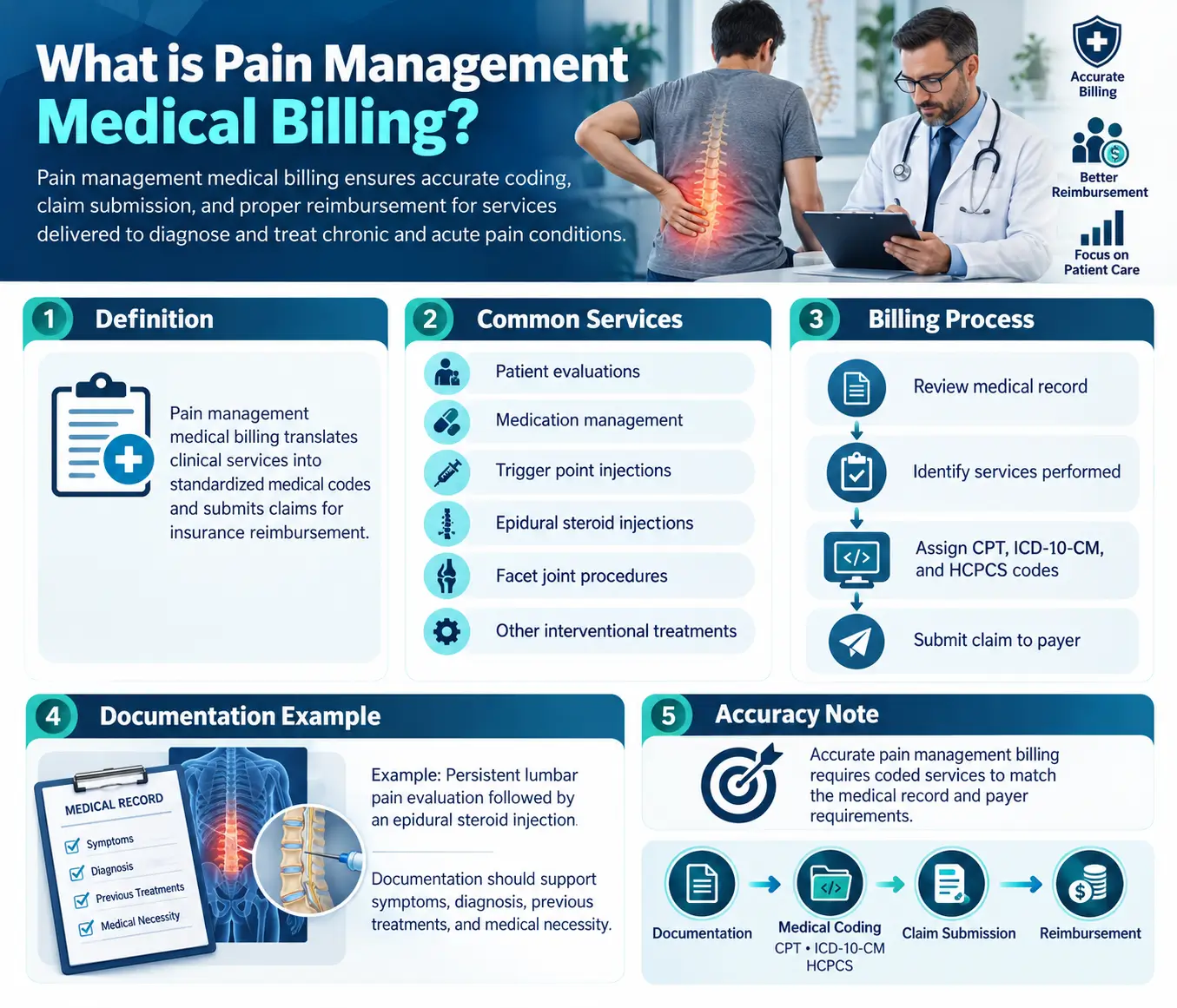
Pain management medical billing involves translating clinical services into standardized medical codes and submitting claims to insurance companies for reimbursement. These services include patient evaluations, medication management, trigger point injections, epidural steroid injections, facet joint procedures, and other interventional treatments.
The billing process begins with reviewing the patient’s medical record and identifying the services performed. Medical coders assign appropriate Current Procedural Terminology (CPT) codes, ICD-10-CM diagnosis codes, and HCPCS Level II codes when applicable.
For example, a patient experiencing persistent lumbar pain may undergo an evaluation followed by an epidural steroid injection. The physician must document the patient’s symptoms, diagnosis, previous treatments, and clinical justification for the procedure.
Accurate pain management billing and coding requires the reported procedure to match the medical record and satisfy applicable payer requirements.
Common pain management CPT codes in 2026
Pain management CPT codes identify specific medical procedures and professional services. Correct code selection depends on the type of treatment, anatomical location, number of muscles or spinal levels treated, and applicable imaging requirements.
Office-based pain management services commonly use CPT codes 99202 through 99205 for new patients and 99212 through 99215 for established patients. These evaluation and management codes represent different levels of professional assessment and medical decision-making.
For trigger point injections, CPT code 20552 describes treatment involving one or two muscles, while CPT code 20553 applies when three or more muscles are treated. The number of muscles, rather than the total number of needle insertions, determines the appropriate code.
Epidural injection procedures include CPT code 62321 for certain cervical or thoracic interlaminar injections with imaging guidance and CPT code 62323 for lumbar or sacral interlaminar injections with imaging guidance.
CPT code 64483 identifies a lumbar or sacral transforaminal epidural injection at the initial level, while CPT code 64479 applies to the cervical or thoracic region.
Other commonly reported pain management procedure codes include 64490 and 64493 for specified facet joint interventions and 64633 and 64635 for facet joint nerve destruction procedures.
Each code has specific reporting instructions. Billing professionals must review the current code set and applicable payer policies before submitting claims.
Pain management diagnosis codes and ICD-10-CM guidelines
Pain management diagnosis codes explain the patient’s medical condition and establish the clinical reason for treatment. Accurate diagnosis selection supports medical necessity and helps insurance companies evaluate whether the reported procedure qualifies for coverage.
Common ICD-10-CM categories include M54 for various back and neck conditions, M51 for certain intervertebral disc disorders, and G89 for specified pain conditions.
Category G89 includes codes describing acute pain, chronic pain, postprocedural pain, and other pain-related diagnoses. For example, G89.28 represents other chronic postprocedural pain when the documentation supports that condition.
However, chronic pain should not automatically be reported as the primary diagnosis for every pain management encounter.
When the primary purpose of treatment is pain control, an appropriate G89 code may be sequenced first according to ICD-10-CM guidelines. When treatment focuses on an underlying condition, that condition may require first-listed diagnosis reporting.
Medical coders should follow the ICD-10-CM guidelines applicable to the date of service. For services beginning October 1, 2026, the fiscal year 2027 ICD-10-CM code set applies.
Pain management documentation requirements
Complete documentation is necessary for accurate pain management medical coding and insurance reimbursement. The medical record must explain why the treatment was medically necessary and identify the services actually performed.
Clinical documentation should include the patient’s presenting symptoms, relevant medical history, examination findings, diagnosis, treatment history, and proposed care plan.
For interventional procedures, physicians should document the anatomical location, treatment technique, spinal levels or muscles treated, medications administered, and imaging guidance when applicable.
The procedure report should also describe relevant findings and the patient’s response to treatment.
Medical necessity documentation is particularly important for spinal injections and other specialized interventions. Insurers may require evidence of functional limitations, previous conservative treatment, or diagnostic findings supporting the requested service.
For example, a patient receiving a lumbar epidural steroid injection may need documentation explaining the clinical diagnosis, previous treatment attempts, and symptoms supporting the intervention.
Incomplete documentation can result in delayed reimbursement, medical record requests, or claim denials.
Medical necessity and repeat procedure billing
Repeat pain management procedures often involve additional coverage requirements because insurers may restrict treatment frequency.
Medicare Administrative Contractors establish certain Local Coverage Determinations that identify clinical conditions and documentation requirements for specific pain management procedures.
For example, applicable Medicare epidural steroid injection policies may require documented conservative treatment and evidence of measurable improvement before certain repeat injections qualify for reimbursement.
Some Medicare policies also establish limits on the number of treatment sessions permitted during a rolling 12-month period.
These requirements differ by procedure, coverage jurisdiction, and insurer. A frequency limitation established for epidural injections should not be applied automatically to trigger point injections or other interventions.
Healthcare providers should document treatment effectiveness, functional improvement, and the clinical justification for repeating a procedure.
Pain management insurance verification
Pain management insurance verification helps practices identify coverage restrictions and patient financial responsibilities before treatment.
Billing staff should confirm active insurance eligibility, network participation, deductible status, copayments, coinsurance, and referral requirements.
Insurance verification for pain management should also determine whether the planned procedure is covered under the patient’s specific insurance benefits.
For instance, a health plan may cover routine pain management consultations while requiring additional authorization for spinal injections, radiofrequency ablation, or implanted medical devices.
Verifying benefits using the intended procedure code can help identify these restrictions.
However, verification of insurance eligibility does not guarantee reimbursement. The service must still satisfy medical necessity, documentation, coding, and payer-specific coverage requirements.
Pain management prior authorization requirements
Pain management prior authorization involves obtaining approval from an insurance company before performing certain procedures.
Authorization requirements vary among Medicare, Medicaid programs, Medicare Advantage plans, and commercial insurers, including UnitedHealthcare and other major payers.
Spinal procedures, selected nerve interventions, and implanted pain management devices may require authorization depending on the insurance plan and treatment setting.
Authorization requests commonly include the patient’s diagnosis, clinical findings, previous treatment history, imaging results, and proposed procedure.
For traditional Medicare, selected hospital outpatient department procedures are subject to specific prior authorization requirements. These requirements should not be interpreted as applying universally to every office-based pain management service.
Before performing treatment, billing departments should confirm that any required authorization matches the planned procedure, provider, treatment location, and approved service details.
Pain management office visit coding and modifier rules
Pain management office visit coding follows the applicable evaluation and management guidelines. Physicians generally select office or outpatient E/M codes based on the documented level of medical decision-making or qualifying total time.
Patients may receive an evaluation and a therapeutic procedure during the same encounter. However, performing both services does not automatically justify separate E/M reimbursement.
Modifier 25 may be appropriate when a physician provides a significant, separately identifiable evaluation and management service on the same date as another procedure.
For example, a patient scheduled for a therapeutic injection may also require a separate evaluation of a new medical concern. If the additional evaluation meets the applicable billing requirements, separate reporting may be supported.
Routine assessments, informed consent discussions, and other services ordinarily included in the procedure do not independently justify modifier 25.
Documentation must clearly establish the separately identifiable professional service.
Billing rules for interventional pain management
Interventional pain management procedures involve specialized coding requirements related to anatomical regions, spinal levels, laterality, and treatment techniques.
Facet joint injection coding, for example, depends on the spinal region and number of qualifying joint levels treated.
Radiofrequency ablation procedures also require accurate identification of the treated joints and applicable reporting units.
Some procedure codes already include imaging guidance. Separately reporting imaging that is included in the primary service may result in an improper claim.
Billing specialists should review CPT instructions, the Medicare National Correct Coding Initiative edits, and applicable payer policies to determine whether services can be reported separately.
Modifiers should only be assigned when supported by the clinical record and the relevant coding rules.
Pain management reimbursement in 2026
Pain management reimbursement depends on several factors, including the selected CPT code, insurance payer, geographical location, treatment setting, and applicable fee schedule.
Medicare physician reimbursement generally reflects relative value units, geographic adjustments, and the conversion factor applicable to the service.
The payment amount may differ when the same procedure is performed in a physician’s office rather than a hospital outpatient department.
Commercial insurance plans may use independently negotiated reimbursement rates, while Medicaid payments depend on state-specific policies.
Consequently, a single reimbursement amount cannot accurately represent every pain management procedure across different payers and locations.
Billing professionals should verify current fee schedules, contractual rates, and payment policies before estimating reimbursement.
Common denials in pain management billing
Denial management in pain management billing involves investigating unpaid claims and identifying the underlying reason for nonpayment.
Common causes include incorrect procedure codes, missing prior authorization, insufficient medical necessity documentation, unsupported diagnosis codes, and inappropriate modifier usage.
Claims may also be denied when a procedure exceeds payer frequency limitations or when separately billed services are included in another procedure’s payment.
For example, reporting an imaging component separately when the primary CPT code already includes imaging guidance may create a coding conflict.
Effective denial management requires reviewing payer explanations, comparing the claim with the medical record, and submitting corrected claims or appeals when appropriate.
Preventing recurring denials also requires identifying common billing errors and improving documentation and claim review procedures.
HIPAA compliance in pain management billing
HIPAA compliance in pain management billing requires protecting patient information throughout registration, documentation, claim submission, and payment processing.
Billing teams routinely access sensitive records involving patient diagnoses, prescriptions, treatment histories, and insurance information.
Healthcare organizations should maintain appropriate administrative, physical, and technical safeguards to protect electronic protected health information.
Authorized access controls, secure data transmission, workforce training, and documented privacy procedures help practices meet applicable requirements.
Medical billing companies handling protected health information must also comply with relevant HIPAA obligations and business associate requirements.
Improving pain management revenue cycle management
Pain management revenue cycle management involves coordinating insurance verification, authorization, clinical documentation, coding, claim submission, payment posting, and accounts receivable follow-up.
Accurate patient registration and eligibility checks help prevent administrative errors before treatment begins.
Following the encounter, billing professionals should compare the procedure documentation with the assigned CPT and diagnosis codes.
Claims should undergo coding validation before submission to identify potential errors involving modifiers, bundled services, or missing information.
After submission, payment posting and accounts receivable monitoring help identify unresolved balances and payer processing delays.
Pain management billing software can assist with eligibility verification, claim tracking, payment reconciliation, and reporting. However, complex coding and coverage decisions still require professional review.
Consistent coordination between providers, coders, and billing staff supports accurate claims processing and timely reimbursement.
Key takeaways from the 2026 pain management billing guidelines
The 2026 Pain Management Billing Guidelines emphasize correct CPT coding, accurate diagnosis selection, complete documentation, medical necessity, and compliance with applicable insurance requirements.
Pain management specialists must understand the reporting differences among office visits, trigger point injections, epidural procedures, facet joint interventions, and other specialized treatments.
Insurance verification, appropriate prior authorization, and careful modifier selection can help prevent avoidable billing problems.
Healthcare providers and billing professionals should review current coding instructions and payer-specific policies before submitting claims. Maintaining accurate medical records and monitoring reimbursement results supports billing compliance, reduces preventable denials, and improves pain management revenue cycle performance.