

The 97112 CPT code is commonly used in physical therapy and rehabilitation to report neuromuscular re-education services. These treatments help patients improve balance, coordination, posture, proprioception, and movement control when neurological or musculoskeletal conditions interfere with normal physical function. Physical therapists use these interventions to help patients regain stability, perform movements more accurately, and complete daily activities with greater independence.
Although neuromuscular re-education is a frequently performed rehabilitation service, accurately billing CPT 97112 requires an understanding of coding guidelines, medical necessity, treatment documentation, and payer reimbursement policies. Incorrect treatment classification, unsupported billing units, or incomplete documentation can result in claim denials and payment delays.
This guide explains the 97112 CPT code description, appropriate clinical applications, Medicare billing requirements, modifiers, documentation standards, and reimbursement considerations for healthcare providers and medical billing professionals.
What is CPT code 97112?
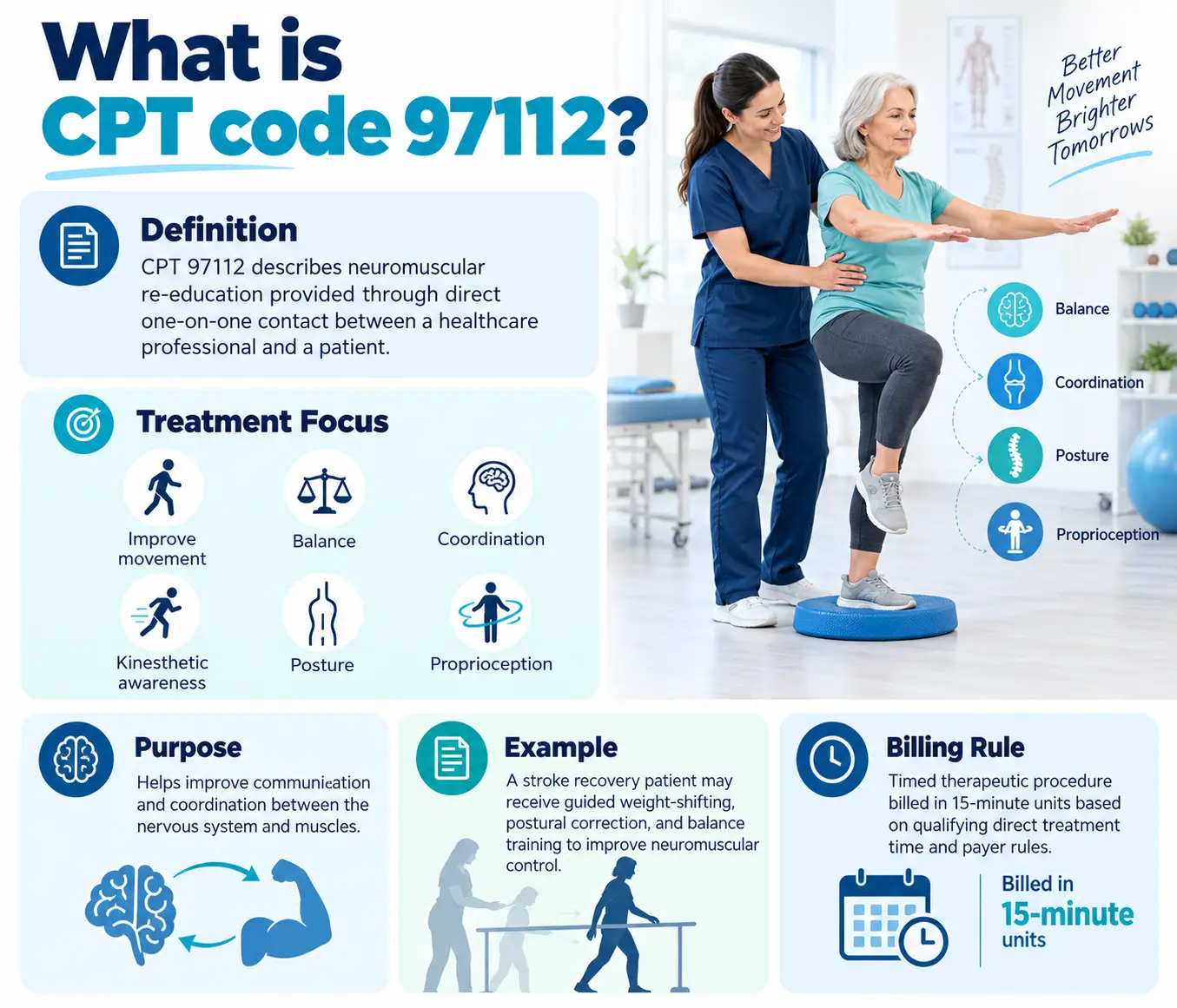
CPT code 97112 describes neuromuscular re-education performed through direct, individual contact between a healthcare professional and a patient. The treatment focuses on improving movement, balance, coordination, kinesthetic awareness, posture, and proprioception during therapeutic activities.
The primary purpose of neuromuscular re-education is to improve communication and coordination between the nervous system and muscles. Patients experiencing neurological impairments, joint instability, or abnormal movement patterns may have difficulty controlling their movements even when their muscles have sufficient strength.
For example, a patient recovering from a stroke may struggle to maintain balance while standing. A physical therapist may provide controlled weight-shifting exercises, guided postural corrections, and balance activities to improve neuromuscular control. When these interventions require skilled professional assistance and satisfy medical necessity requirements, CPT 97112 may be appropriate.
The 97112 CPT code definition identifies a timed therapeutic procedure reported in 15-minute units. The number of units billed depends on the qualifying direct treatment time and the applicable insurance billing rules.
What services are covered under CPT code 97112?
The neuromuscular reeducation CPT code covers therapeutic interventions designed to address impairments in motor control and movement coordination. Treatment may involve balance rehabilitation, proprioceptive exercises, postural stabilization, coordination training, and activities intended to correct abnormal movement patterns.
Balance training is commonly provided to patients who experience instability because of neurological disorders, orthopedic injuries, or impaired sensory processing. A therapist may use controlled standing activities, weight transfers, or progressive balance challenges to improve stability during functional movements.
Proprioceptive training focuses on a patient’s ability to recognize body position and joint movement. Following certain ligament injuries or surgical procedures, patients may demonstrate reduced joint-position awareness, increasing their difficulty with controlled movement. Skilled interventions can help retrain these responses.
Coordination and motor-control training may also qualify when treatment addresses documented neuromuscular deficits. However, simply performing a balance exercise does not automatically justify CPT 97112. The medical record must explain the impairment being treated and why professional therapeutic intervention was necessary.
When is CPT code 97112 appropriate in physical therapy?
The CPT code 97112 physical therapy application is particularly relevant when a patient experiences limitations involving movement accuracy, stability, coordination, or postural control.
Patients recovering from strokes, traumatic brain injuries, certain neurological conditions, orthopedic surgeries, and musculoskeletal injuries may benefit from neuromuscular re-education when clinically indicated. The treatment approach depends on the patient’s documented impairments and functional goals.
Consider a patient recovering from ankle reconstruction who demonstrates reduced proprioception and difficulty maintaining single-leg balance. The therapist may introduce controlled balance activities while providing manual assistance and specific movement corrections. If the intervention primarily addresses impaired neuromuscular control, CPT 97112 may accurately represent the service.
The therapist should establish how the treatment relates to the patient’s functional limitations, what skilled assistance was provided, and whether the patient is progressing toward measurable goals.
CPT 97112 vs. CPT 97110: What is the difference?
Understanding the distinction between therapeutic exercise and neuromuscular re-education is important for accurate physical therapy billing.
CPT 97110 describes therapeutic exercises intended to improve strength, endurance, range of motion, or flexibility. In comparison, CPT 97112 addresses neuromuscular impairments affecting balance, posture, proprioception, coordination, and motor control.
For example, a patient performing resistance exercises to strengthen weakened quadriceps muscles would generally receive treatment reported under CPT 97110. If the therapist subsequently provides targeted weight-shifting activities to improve balance and joint-position awareness, CPT 97112 may apply.
Some therapeutic activities produce overlapping benefits. An exercise may improve both strength and coordination, but providers should select the code that most accurately describes the primary skilled treatment objective.
The documented clinical purpose, rather than the exercise name alone, should guide code selection.
Can CPT 97112 and 97110 be billed together?
Yes, 97112 and 97110 can be billed together when a patient receives distinct, medically necessary therapeutic services during the same treatment session.
For instance, a physical therapist may provide strengthening exercises to address muscle weakness and then perform neuromuscular re-education to improve coordination and postural stability. Both procedures may be reportable when documentation establishes separate treatment objectives and supports the billed time.
However, the same treatment minutes cannot be counted toward both procedures. Medicare requires timed therapy units to be calculated using the total qualifying treatment time, with units appropriately allocated among the services performed.
Suppose a therapist provides 24 minutes of neuromuscular re-education and 23 minutes of therapeutic exercise. The combined treatment time is 47 minutes, supporting three total timed units under Medicare rules. In this example, two units may be reported under CPT 97112 and one unit under CPT 97110.
Providers should also review applicable National Correct Coding Initiative edits and payer requirements. Modifier 59 should not be added automatically merely because both services appear on the same claim.
CPT 97112 billing guidelines and the Medicare 8-minute rule
CPT 97112 is a timed procedure, meaning reimbursement units depend on the qualifying duration of direct treatment. Medicare uses the 8-minute rule to determine how many units may be reported for services billed in 15-minute increments.
Under this methodology, a total of 8 to 22 treatment minutes supports one unit, while 23 to 37 minutes supports two units. Treatment lasting 38 to 52 minutes supports three units, and 53 to 67 minutes supports four units.
When multiple timed therapy procedures are provided during the same session, the total qualifying treatment time determines the maximum number of units. Individual services cannot be rounded independently in a way that exceeds the number of units supported by the combined minutes.
For example, if a therapist performs nine minutes of neuromuscular re-education and nine minutes of therapeutic exercise, the combined 18 minutes supports only one Medicare timed unit.
Only qualifying direct treatment time should be included in the calculation. Administrative work, routine documentation, and unrelated preparation activities are not billable treatment minutes.
Commercial insurers may follow different billing methodologies, making payer-specific verification necessary.
CPT 97112 documentation requirements
Accurate neuromuscular re-education documentation supports medical necessity and demonstrates why skilled treatment was required. A medical record that only states “balance training performed” may not adequately explain the services provided.
Documentation should identify the patient’s functional impairment, treatment objective, intervention performed, and professional assistance required. The therapist should describe the specific activities used to improve neuromuscular function and explain how these activities relate to the patient’s established rehabilitation goals.
For example, a treatment note might describe standing weight-shifting activities performed to address impaired postural control, including manual stabilization, verbal correction, and the patient’s response to treatment.
Objective findings strengthen the clinical record. Balance assessment results, movement observations, assistance levels, and functional performance measurements can help demonstrate treatment needs and progress.
Treatment notes should also support the reported billing units through accurate documentation of the qualifying timed treatment. Medicare generally requires the total timed treatment minutes to be documented, while additional detail about individual interventions can help support the services billed.
Medical necessity requirements for CPT code 97112
Medical necessity determines whether neuromuscular re-education is reasonable and necessary for the patient’s condition. Providers must demonstrate that the treatment addresses a documented impairment and requires skilled professional intervention.
A patient experiencing repeated falls because of impaired balance may require specialized therapeutic activities to improve stability. The evaluation should describe the relevant deficits, establish measurable functional goals, and explain why neuromuscular re-education is appropriate.
The treatment plan should reflect the patient’s condition, expected therapeutic outcomes, and required frequency of care. Progress documentation should explain whether treatment goals are being achieved or why continued intervention remains necessary.
Medicare may also cover appropriate skilled maintenance therapy when professional skills are required to maintain function or prevent deterioration. Therefore, improvement is not the only factor considered in determining coverage.
Diagnosis codes must accurately represent the patient’s documented medical condition, but the presence of a diagnosis does not independently guarantee reimbursement.
Which modifiers are used with CPT code 97112?
Selecting the appropriate 97112 CPT code modifier depends on the therapy discipline, provider qualifications, treatment circumstances, and payer billing policies.
Modifier GP identifies services furnished under an outpatient physical therapy plan of care. For Medicare claims, it is generally required when CPT 97112 is provided as part of covered physical therapy services.
Modifier KX is used when Medicare therapy expenses exceed the applicable annual threshold and the provider confirms that continued treatment is medically necessary and supported by documentation. For 2026, the KX modifier threshold is $2,480 for physical therapy and speech-language pathology services combined, with a separate $2,480 threshold for occupational therapy.
Modifier CQ may apply when services are furnished in whole or in part by a physical therapist assistant under Medicare’s applicable requirements. Its use depends on the assistant’s contribution to the service and the relevant payment rules.
Modifier 59 identifies certain distinct procedural services when permitted by applicable coding edits. Providers should use it only when the circumstances and medical documentation support the modifier.
Correct modifier selection helps ensure that the claim accurately represents the service and satisfies payer reporting requirements.
CPT code 97112 reimbursement in 2026
The 97112 CPT code reimbursement amount varies according to insurance coverage, geographic location, treatment setting, applicable fee schedules, and the number of medically necessary units performed.
Medicare reimbursement is influenced by the Medicare Physician Fee Schedule, relative value units, geographic practice cost adjustments, and payment policies effective for the date of service.
Medicare also applies a multiple procedure payment reduction to the practice expense component of certain qualifying therapy services furnished on the same day. This adjustment can affect total reimbursement when multiple therapy procedures are billed during one encounter.
Commercial insurance companies may reimburse CPT 97112 through negotiated contracts or established fee schedules. Payment can also depend on authorization requirements, plan benefits, and patient financial responsibility.
Because these factors vary, providers should not assume that CPT 97112 has one universal reimbursement rate. Reviewing the applicable payer fee schedule and contract is necessary when estimating expected payment.
Common CPT 97112 billing mistakes and denial prevention
One common billing error involves reporting CPT 97112 for routine strengthening exercises without sufficient documentation of neuromuscular deficits. Another occurs when providers calculate timed units incorrectly or count the same treatment minutes toward multiple services.
Incomplete documentation can also create reimbursement problems. Treatment notes that lack measurable impairments, functional goals, or evidence of skilled therapeutic intervention may fail to support the billed procedure.
Incorrect modifiers, missing authorizations, and inaccurate diagnosis coding may contribute to claim denials. Billing staff should verify payer requirements and review the medical record before submitting claims.
Regular communication between therapists and billing teams can improve coding accuracy. Reviewing denied claims and identifying recurring documentation problems can also help prevent similar errors in future submissions.
Key takeaways for CPT code 97112 billing
The 97112 CPT code represents skilled neuromuscular re-education intended to improve balance, coordination, proprioception, posture, and movement control. Accurate reporting requires a documented clinical need, appropriate treatment selection, reliable time calculations, and compliance with insurance billing requirements.
Healthcare providers should ensure that each reported service corresponds to a clearly documented impairment and skilled intervention. For medical billers and coders, reviewing treatment objectives, timed units, modifiers, and payer policies before claim submission can reduce avoidable denials and support accurate reimbursement.