

The 97124 CPT code reports therapeutic massage, billed in 15-minute units, and it carries a 2026 Medicare national payment of $29.73 per unit. The descriptor fits on one line. The payer rules attached to it do not.
Medicare will pay for massage only as an add-on to other therapy. The VA authorizes it as a stand-alone service. Oregon’s Medicaid program caps it at two units a day, and some commercial plans refuse to pay licensed massage therapists at all. A biller who learns only the code description will see denials, so this guide works through units, modifiers, coverage by payer, reimbursement, and the chart notes that hold up under review.
What the 97124 CPT code describes
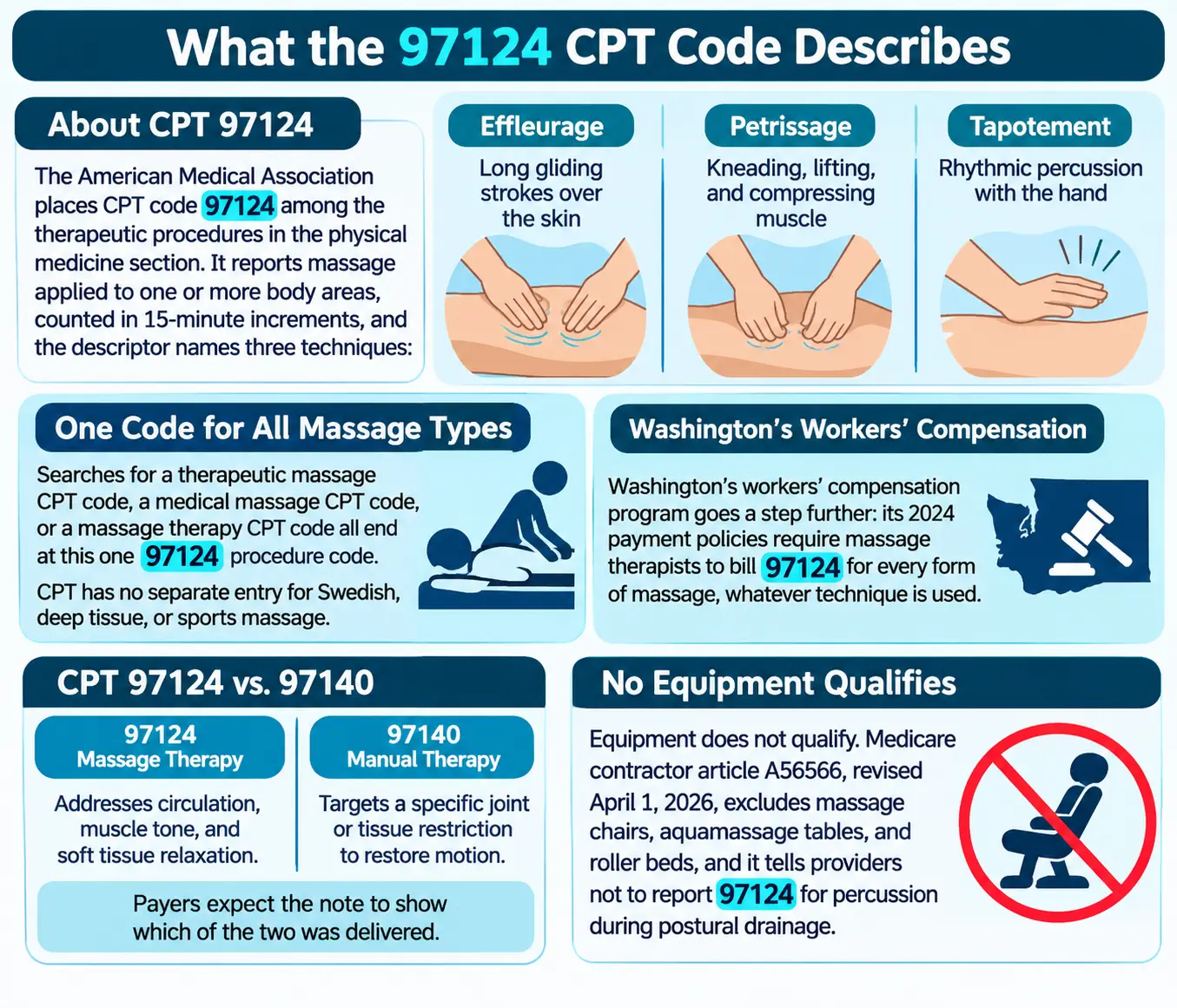
The American Medical Association places CPT code 97124 among the therapeutic procedures in the physical medicine section. It reports massage applied to one or more body areas, counted in 15-minute increments, and the descriptor names three techniques:
- Effleurage: long gliding strokes over the skin
- Petrissage: kneading, lifting, and compressing muscle
- Tapotement: rhythmic percussion with the hand
Searches for a therapeutic massage CPT code, a medical massage CPT code, or a massage therapy CPT code all end at this one 97124 procedure code. CPT has no separate entry for Swedish, deep tissue, or sports massage. Washington’s workers’ compensation program goes a step further: its 2024 payment policies require massage therapists to bill 97124 for every form of massage, whatever technique is used.
The code most often confused with it is CPT 97140, manual therapy techniques, which covers joint mobilization, manual traction, and manual lymphatic drainage. Massage addresses circulation, muscle tone, and soft tissue relaxation. Manual therapy targets a specific joint or tissue restriction to restore motion, and payers expect the note to show which of the two was delivered.
Equipment does not qualify. Medicare contractor article A56566, revised April 1, 2026, excludes massage chairs, aquamassage tables, and roller beds, and it tells providers not to report 97124 for percussion during postural drainage.
How the 97124 CPT time unit is counted
Each unit represents 15 minutes of direct, individual patient care. Room setup, time the patient spends resting on the table, and charting are excluded.
Medicare converts minutes to units with the “8-minute rule” in the Medicare Claims Processing Manual, Chapter 5, Section 20.2:
Timed minutes | Billable units |
8 to 22 | 1 |
23 to 37 | 2 |
38 to 52 | 3 |
53 to 67 | 4 |
Medicare applies that chart to the sum of every timed code in the visit. The session included 33 minutes of therapeutic exercise (CPT 97110) and 7 minutes of massage therapy. The 40-minute total supports three units: two of 97110 and one of 97124.
Many commercial plans count each code separately, and under that method the same 7 minutes of massage earns nothing. PacificSource’s Oregon Health Plan therapy guidance sets the floor in plain terms, with at least 8 minutes of massage required before 97124 can be billed.
Daily caps sit on top of the arithmetic. Article A56566 denies more than four units of 97124 per day per discipline, and Oregon Medicaid stops at two.
Choosing a 97124 CPT code modifier
No modifier is built into the code. The payer and the credential of the rendering provider decide what belongs on the claim line.
- GP or GO. Medicare requires GP when massage falls under a physical therapy plan of care and GO under an occupational therapy plan.
- CQ or CO. Report these when a physical therapist assistant or occupational therapy assistant furnishes more than 10 percent of the unit. Medicare has paid those lines at 85 percent since January 1, 2022, according to CMS.
- KX. Needed once a Medicare beneficiary passes the 2026 threshold of $2,480 for physical therapy and speech-language pathology combined. Occupational therapy has its own $2,480 threshold.
- 59 or XE, XS, XP, XU. These show that massage was distinct from another service, most often chiropractic manipulation (98940 to 98942) performed on a different region.
- GY. This marks a service Medicare excludes by statute, such as massage billed by a chiropractor, so the denial can be sent on to a secondary payer.
The 97124 and 97140 problem
Several billing guides say modifier 59 allows massage and manual therapy to be paid on the same date. For Medicare, that advice is unsafe. WebPT’s table of NCCI edits lists 97124 against 97140 with an “n” indicator, meaning no modifier bypasses the edit, and article A56566 says massage is not covered on the same visit date as manual therapy.
NCCI files are reissued every quarter, so confirm the current indicator before billing the pair. Commercial payers set their own rules. Blue Cross and Blue Shield of Kansas, in its 2026 physical medicine manual, lists 97124 and 97140 on the same body part on the same date among problem billing patterns.
Massage therapy insurance coverage by payer
Check eligibility and benefits before the first visit. The same claim line can be paid, bundled, or rejected depending on the plan and on who performed the massage.
Payer | Pays a licensed massage therapist (LMT)? | Main condition or limit |
Original Medicare | No | Adjunct to another therapy procedure only |
VA community care | Yes | Referral for a listed pain or complex condition |
Oregon Health Plan | No | 2 units per day, billed with another procedure |
Blue Shield of California | No | Reduced payment from the second unit |
Highmark | Yes | No separate payment to four other specialties |
CPT 97124 Medicare coverage
Medicare.gov says Medicare does not cover massage therapy and the patient pays all costs. That describes massage from a massage therapist, a provider type Medicare does not enroll.
Inside a therapy plan of care the code can be paid. Local coverage determination L34049 allows massage as an adjunct to another procedure on the same day to reduce edema, improve joint motion, or relieve muscle spasm, and never as an isolated treatment. Medicare Advantage plans may add massage as an extra benefit, so each plan needs its own check.
CPT 97124 VA coverage
VA health benefits treat massage differently. The VA’s clinical determination CDI 00036, effective June 1, 2025, authorizes medical massage therapy in community care for conditions such as back pain, neck pain, fibromyalgia, headaches, and post-operative pain. It lists both 97124 and 97140, names massage therapists as the typical provider, and excludes general massage for well-being. Continued visits require documented progress toward the original goals.
CPT 97124 in Oregon and California
Oregon Medicaid coverage is set by OAR 410-131-0120. Massage is limited to two units per day and authorized only with another therapeutic procedure or modality. Enrollment under that rule division is restricted to licensed physical and occupational therapists, and prior authorization starts after 30 rehabilitative or 30 habilitative visits in a calendar year.
In California, Blue Shield of California’s physical medicine payment policy, revised January 1, 2024, does not reimburse 97124 when a massage therapist provides it. The same policy pays the second unit at 85 percent, the third and fourth at 40 percent, and later units at 10 percent.
Medi-Cal massage therapy CPT 97124 coverage should be confirmed in the current Medi-Cal Provider Manual and with the patient’s managed care plan before treatment. Medicare and commercial rules do not transfer to Medicaid programs.
CPT 97124 Blue Cross Blue Shield coverage
Blue Cross Blue Shield is a federation of independent companies, and each writes its own policy. Highmark is a current example. Since October 26, 2026, it no longer pays 97124 separately to chiropractic, physical therapy, occupational therapy, and physiatry providers on commercial and Medicare Advantage products, and the denial cannot be billed to the member. Massage therapists billing as the rendering provider are unaffected.
97124 CPT code reimbursement rate for 2026
Medicare assigns 97124 a total of 0.89 relative value units: 0.35 for work, 0.53 for practice expense, and 0.01 for malpractice. Multiplied by the 2026 conversion factor of $33.4009, the national payment is $29.73 per unit, the same in facility and office settings. The 2025 figure was $29.76.
Few claims pay that exact amount. Geographic adjustment moves it up or down by locality, and two reductions apply to therapy codes:
- Multiple procedure payment reduction. Medicare pays full practice expense only on the highest-valued therapy unit of the day and halves it on the rest. A reduced unit of 97124 works out to about $20.88 at national rates.
- Assistant differential. A unit carrying CQ or CO pays 85 percent, or about $25.27.
Because Medicare covers massage only beside another procedure, the first reduction applies on most Medicare claims that include it. Commercial rates are set by contract. California’s workers’ compensation fee schedule tracks the Medicare file directly, and the state adopted the April 2026 RVU update by order on March 18, 2026.
Massage therapy documentation requirements
Reviewers look for proof of medical necessity in the treatment note itself. Article A56566 asks for three items at least every 10 visits:
- The area or areas treated
- Objective findings, such as range of motion measurements, a description of muscle spasm, and the effect on function
- Subjective findings, including pain ratings, pain location, and the effect on function
Add the technique used, the start and stop time or total timed minutes, and the name and credential of the person who delivered the massage. Oregon also requires a referral and a plan of care signed and dated by the prescribing practitioner.
Visit count matters. The same Medicare article expects the record to justify massage beyond six to eight visits and to show that the patient or caregiver was taught to continue care at home where appropriate. A note that repeats “tolerated well” for 12 sessions will not meet that standard.
Diagnosis coding should match the payer’s covered indications and use the most specific ICD-10-CM code available. Common pairings include M54.2 (cervicalgia), M62.830 (muscle spasm of back), and M79.18 (myalgia, other site). G24.3, spasmodic torticollis, is the code for cervical dystonia. Because it is a neurological diagnosis, the plan of care should state what massage adds to the primary treatment.
A payable 97124 CPT code claim passes four checks: the plan pays the rendering provider’s credential, 97140 is not on the same date where the payer bundles the two, the units match the documented minutes, and the note records measurable change. Highmark’s October 2026 policy shows that these rules can change mid-year. Recheck payer policies each quarter, when CMS also reissues its RVU and NCCI files.