


Orthopedic clinics manage highly complex financial ecosystems. A single patient visit might include digital X-rays, durable medical equipment (DME) dispensing, a localized joint injection, and scheduling for an upcoming outpatient surgery. Securing payment for these overlapping services requires specialized orthopedic medical billing software. Standard administrative tools frequently misinterpret the relationship between different procedural codes and fail to attach the correct modifiers for surgical procedures.
Multi-specialty orthopedic practices handle thousands of claims each month across multiple payers, including Medicare, commercial insurance companies, and workers’ compensation programs. When medical billers rely on manual data entry, denial rates increase and accounts receivable age past the 90-day mark. The margin for error is narrow. Choosing the proper software structure reduces clerical mistakes and accelerates cash flow across all practice locations.
Medical billing software comparison
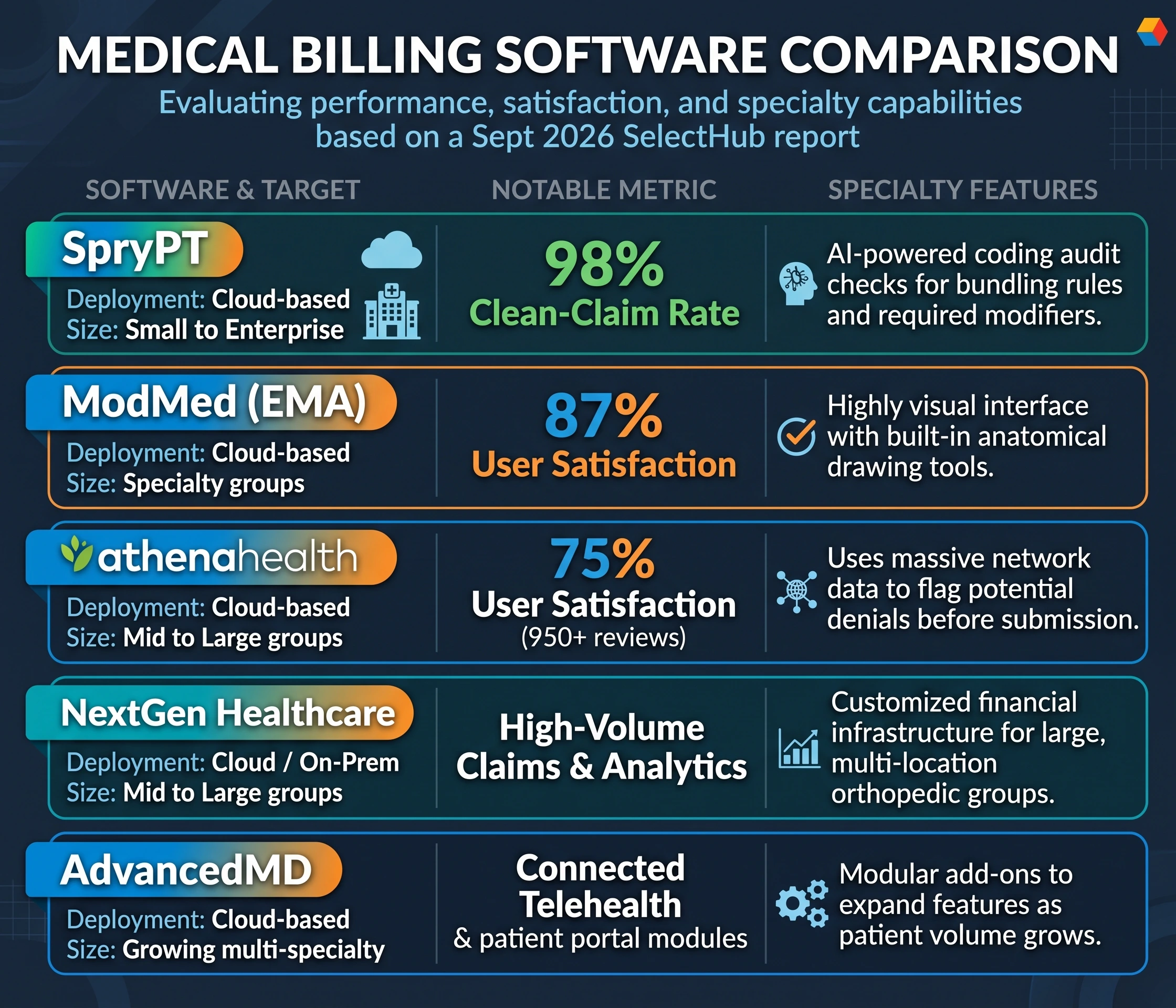
Selecting the right system requires comparing objective data, user satisfaction, and orthopedic-specific capabilities. According to a September 2026 report published by SelectHub, performance and pricing vary heavily between major vendors.
Software Platform | Deployment | Target Practice Size | Notable Metric |
SpryPT | Cloud-based | Small to Enterprise | Maintains a 98 percent clean-claim rate. |
ModMed (EMA) | Cloud-based | Specialty groups | Achieves an 87 percent user satisfaction rating. |
athenahealth | Cloud-based | Mid to Large groups | Holds a 75 percent user satisfaction rating across 950+ reviews. |
NextGen Healthcare | Cloud/On-premise | Mid to Large groups | Specializes in high-volume claims and analytics. |
AdvancedMD | Cloud-based | Growing multi-specialty | Features connected telehealth and patient portal modules. |
SpryPT utilizes an AI-powered coding audit system that checks for bundling rules and required modifiers before the claim leaves the facility. ModMed offers a highly visual interface with built-in anatomical drawing tools. athenahealth operates as a massive network, using data from thousands of other practices to flag potential denials before submission. NextGen Healthcare provides the necessary infrastructure for large, multi-location orthopedic groups that require heavy financial customization. AdvancedMD allows practices to add individual software modules as their patient volume expands.
Essential features for orthopedic revenue cycles
An effective billing department relies on medical billing automation to handle repetitive tasks. When human staff manually type ICD-10 codes into a database, transposition errors occur. Software minimizes this risk by pulling data directly from the physician’s clinical notes.
Effective denial management software organizes rejected claims by payer and reason code. Instead of forcing staff to search through disorganized files, the system pushes high-value, easily correctable denials to the top of the work queue. This prioritization recovers revenue that would otherwise expire due to timely filing limits.
Charge capture software tracks every supply used during a patient encounter. If a physician applies a fiberglass cast and issues a walking boot, the system ensures both items appear on the final superbill.
Practices must also implement real-time insurance eligibility verification. This feature pings the payer’s database before the patient arrives, confirming active coverage, copayment amounts, and remaining deductible balances. Staff can collect outstanding balances at the front desk instead of sending paper statements weeks or months after the visit.
Surgical authorization management tracks the approval status for upcoming operations. Joint replacements and spinal fusions require strict prior authorization. The software flags cases missing proper clearance, preventing surgeons from performing unapproved, uncompensated procedures.
Advanced systems also feature coding error detection and denial prevention. These background algorithms scan the claim for contradictory codes. If a biller accidentally codes a bilateral knee injection without the proper bilateral modifier, the system halts the claim and alerts the user.
Integrating orthopedic EHR and billing software
Clinical data and financial data must communicate constantly. Orthopedic EHR and billing software integration eliminates the need for double data entry. A 2026 software analysis published by EHR in Practice emphasizes that clinical workflows dictate financial outcomes.
When a surgeon documents a rotator cuff repair, an integrated system automatically translates the clinical text into the correct CPT codes. ModMed approaches this through interactive 3D anatomical models. The physician taps the exact location of the injury on a digital tablet, and the software generates the corresponding diagnostic codes.
EHR and practice management integration ensures that demographic updates entered by the front desk instantly sync with the billing office. When a patient updates their insurance details in the online portal, the billing module automatically directs all future claims to the new payer. Medical billing and coding software functions at its highest capacity when it reads directly from the physician’s original chart.
Managing multi-location medical billing
Multi-specialty practices frequently operate out of several physical buildings, including main offices, satellite clinics, and ambulatory surgery centers. Multi-location medical billing requires centralized databases to prevent duplicate patient profiles. If a patient visits the physical therapy branch on Tuesday and the surgical center on Thursday, the staff must access a single unified account.
Cloud-based orthopedic RCM software connects these distinct locations through secure servers. Administrators can monitor the financial health of the entire organization from one dashboard.
Billing analytics and financial reporting tools allow management to segment data mathematically. Practice managers can generate reports showing the exact collection rate of the spine division compared to the sports medicine division. They can also isolate specific payer behavior, calculating exactly how many days a specific insurance company takes to reimburse arthroscopic procedures.
Enterprise-level orthopedic RCM software automatically routes claims based on location-specific tax identification numbers. This prevents funds from depositing into the wrong corporate bank account.
Handling orthopedic workers’ compensation billing software
Workers’ compensation claims follow entirely different rules than commercial medical insurance. They require distinct authorization numbers, specific fee schedules, and mandatory attachments of clinical notes. General medical billing platforms often lack the fields necessary to process these claims correctly.
Orthopedic workers’ compensation billing software automatically attaches the required operative reports and physical therapy progress notes to the electronic claim. It tracks the specific date of injury and the assigned adjuster’s contact information. By isolating accident-related claims from standard commercial claims, the billing staff can apply the correct state-mandated fee schedules and avoid underpayment.
Medical billing software cost
Financial executives must evaluate medical billing software cost based on deployment models. SelectHub’s September 2026 pricing data shows that independent software vendors use a variety of subscription models.
Cloud-based software usually charges a flat monthly fee per provider. ModMed costs approximately $500 per provider monthly. Other vendors, like RXNT, publish lower entry-level pricing for basic claim submission tools.
Practices choosing full revenue cycle management (RCM) services pay a percentage of their total monthly collections. This rate typically ranges from 4 to 8 percent, depending on the practice’s claim volume and the complexity of their specific orthopedic procedures. Upfront implementation costs, data migration fees, and staff training sessions add to the initial investment.
Frequently asked questions
What is the best medical billing software for orthopedic practices?
The optimal choice depends on practice size and specific clinical needs. ModMed ranks highly for its specialty-specific anatomical charting, while SpryPT maintains a 98 percent clean-claim rate through aggressive AI auditing. athenahealth is heavily favored by large groups needing network-driven denial prevention.
Which orthopedic billing platforms support multi-location practices?
NextGen Healthcare, athenahealth, and AdvancedMD handle enterprise-level scaling efficiently. They allow centralized billing offices to manage claims for dozens of satellite clinics while keeping financial reporting distinct for each physical location.
What features should multi-specialty orthopedic practices look for in billing software?
Practices require software that handles complex modifier logic, DME billing rules, and global surgical periods. The system must automatically flag claims that attempt to unbundle procedures that payers require to be billed together.
Which orthopedic RCM software integrates with EHR and practice management systems?
Major vendors like eClinicalWorks, ModMed, and AdvancedMD operate as unified platforms. Clinical documentation, patient scheduling, and claims processing are managed within one database, eliminating the need for third-party integration software.
Which medical billing platforms automate coding error detection and denial prevention?
SpryPT utilizes an AI-powered engine specifically trained on orthopedic surgical codes to detect errors prior to submission. athenahealth uses millions of data points from its national network to update its rules engine daily, catching payer-specific changes before claims are denied.
What orthopedic billing software supports workers’ compensation claims?
SpryPT and AdvancedMD offer specialized workflows for accident-related billing. They provide the necessary fields to input injury dates, employer details, and adjustor data while automatically attaching the clinical documentation required by state workers’ compensation boards.
Which orthopedic billing systems offer advanced financial analytics?
NextGen Healthcare and eClinicalWorks provide highly detailed financial dashboards. Administrators can track accounts receivable aging, calculate net collection ratios, and isolate the exact financial performance of individual surgeons or physical therapists.
Which platforms support surgical authorizations and real-time eligibility checks?
Nearly all modern platforms, including Tebra and CareCloud, ping payer databases to verify patient coverage in real time. Advanced systems integrate prior authorization tracking modules to ensure all surgical procedures receive clearance before the operation date.
How much does orthopedic medical billing software cost?
Standard cloud-based systems charge flat monthly fees ranging from $300 to $800 per provider. Full-service RCM partnerships charge between 4 and 8 percent of the practice’s monthly collected revenue.
Selecting the Best Medical Billing Software for Multi-Orthopedics relies entirely on matching the platform’s specific mechanical capabilities to the clinic’s daily workflow. Multi-specialty groups require systems that process high-volume claims, apply complex surgical modifiers correctly, and provide clear financial visibility across every location. Utilizing integrated systems that verify eligibility, capture every chargeable supply, and audit codes prior to submission protects the practice’s revenue cycle from predictable payer denials.