


Medical billers process the metabolic panel CPT code millions of times every year. The comprehensive metabolic panel blood test remains one of the most frequently ordered diagnostic tools in modern medicine. Hospitals, independent laboratories, and primary care clinics rely on this single code to secure payment for chemical analysis of a patient’s blood. Proper assignment of the CPT code for comprehensive metabolic panel testing ensures accurate provider compensation. It also prevents costly compliance audits from federal and commercial payers.
This text outlines the exact 80053 CPT code description, current Medicare reimbursement data, and the specific ICD-10 diagnosis requirements necessary to process claims without denials.
Understanding the 80053 CPT code description
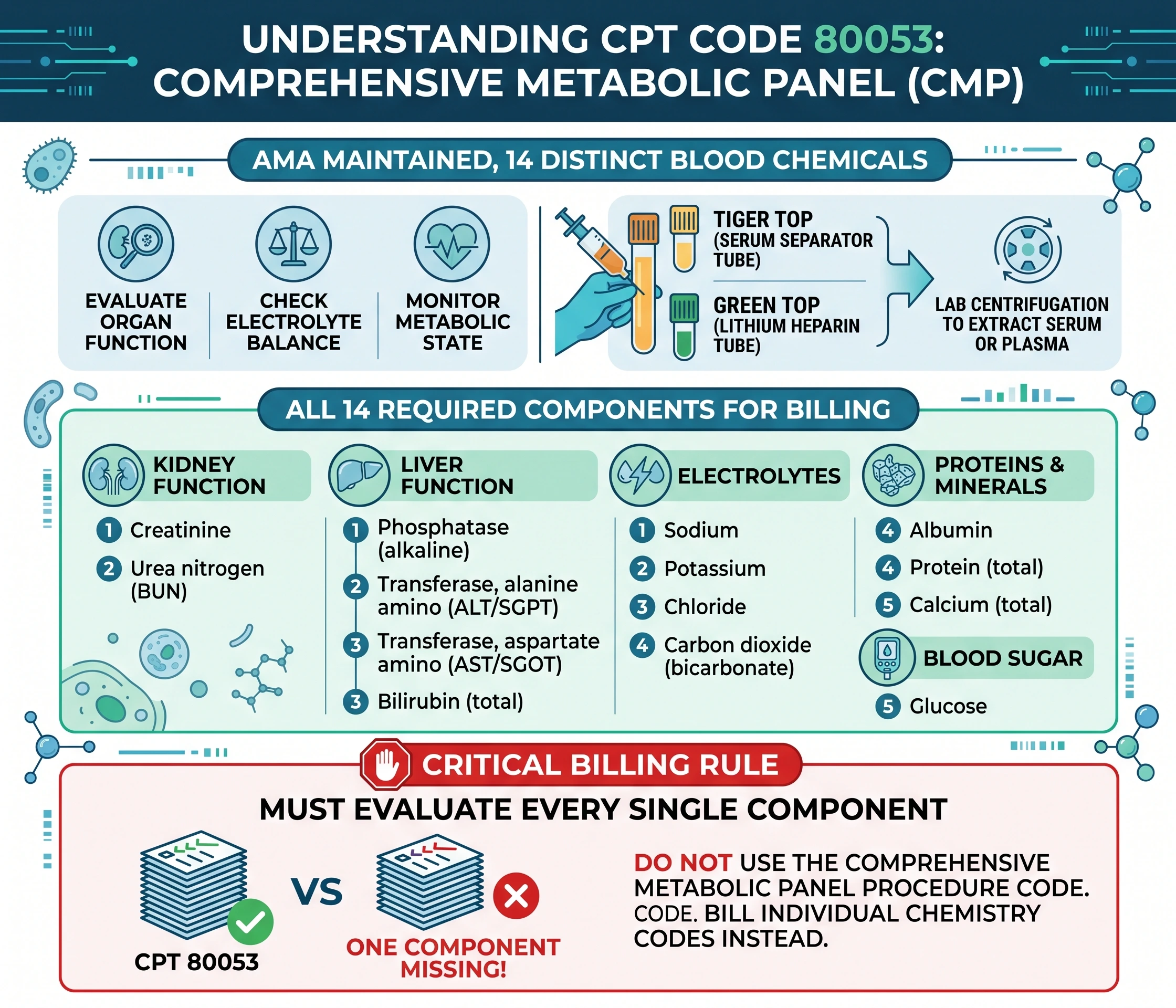
The American Medical Association maintains the Current Procedural Terminology (CPT) manual. According to the official manual, CPT code 80053 represents a defined group of 14 distinct blood chemicals. Medical providers order this test to evaluate a patient’s organ function, electrolyte balance, and metabolic state.
Laboratories perform this analysis using either a CMP serum or plasma CPT code protocol. Phlebotomists draw the patient’s blood into specific evacuated tubes, usually a serum separator tube (tiger top) or a lithium heparin tube (green top), which the lab then centrifuges to extract the serum or plasma for chemical testing.
To bill 80053 legally, the laboratory equipment must evaluate every single one of the following 14 components:
- Albumin
- Bilirubin (total)
- Calcium (total)
- Carbon dioxide (bicarbonate)
- Chloride
- Creatinine
- Glucose
- Phosphatase (alkaline)
- Potassium
- Protein (total)
- Sodium
- Transferase, alanine amino (ALT/SGPT)
- Transferase, aspartate amino (AST/SGOT)
- Urea nitrogen (BUN)
If a physician orders only 13 of these specific tests, you cannot use the comprehensive metabolic panel procedure code. You must bill the individual chemistry codes instead. A missing component immediately invalidates the use of the panel code.
Component details of the CMP blood test
Each of the 14 substances measured under code 80053 serves a specific diagnostic function. Medical coders must understand what these tests measure to accurately link them to the provider’s diagnosis codes.
The kidney function markers include Blood Urea Nitrogen (BUN) and creatinine. High levels of these waste products indicate that the kidneys are failing to filter the blood efficiently.
The liver function markers include alkaline phosphatase (ALP), alanine aminotransferase (ALT), aspartate aminotransferase (AST), and total bilirubin. Elevated liver enzymes point toward cellular damage in the liver, often caused by hepatitis, medication toxicity, or alcohol use.
The panel also measures blood proteins. Total protein and albumin levels help doctors diagnose nutritional deficiencies, kidney disease, and liver dysfunction.
The electrolyte section of the panel measures sodium, potassium, carbon dioxide, and chloride. These minerals regulate hydration, nerve impulses, and muscle contractions. A severe potassium imbalance can cause cardiac arrest.
Finally, the panel measures fasting or non-fasting blood glucose to monitor diabetes, and total calcium to evaluate parathyroid function and bone health.
CPT code 80053 reimbursement and Medicare policies
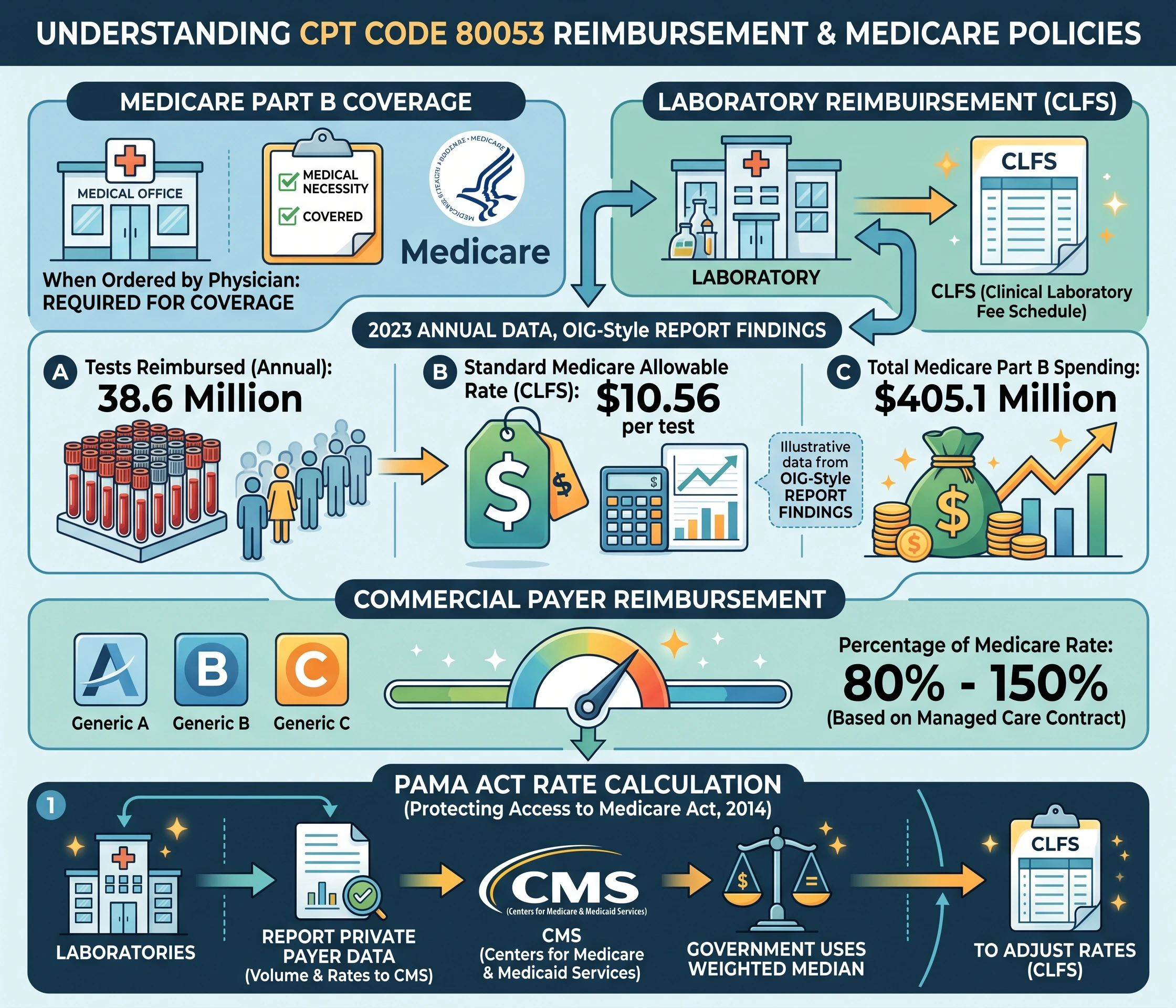
Many patients ask medical office staff if Medicare covers the comprehensive metabolic panel. Medicare Part B does cover this test when the ordering physician establishes clear medical necessity.
Reimbursement rates for laboratory services fall under the Clinical Laboratory Fee Schedule (CLFS). According to a December 2024 report published by the Department of Health and Human Services Office of Inspector General, Medicare reimbursed the 80053 test 38.6 million times in 2023.
The standard Medicare CLFS allowable rate for 80053 is $10.56 per test. Total Medicare Part B spending on this specific code reached $405.1 million during that annual reporting period.
Commercial payers generally set their 80053 CPT reimbursement rates based on a percentage of this Medicare baseline. Depending on the specific managed care contract, private insurers may pay anywhere from 80 percent to 150 percent of the standard Medicare rate.
The Protecting Access to Medicare Act of 2014 dictates how the Centers for Medicare and Medicaid Services (CMS) calculates these rates. The law requires designated laboratories to report their private payer reimbursement data to CMS. The government then uses the weighted median of these private market rates to adjust the Medicare fee schedule.
Linking 80053 medical necessity ICD-10 codes
Accurate billing requires a direct link between the CMP CPT code and the patient’s medical condition. Medicare and commercial insurers utilize National Coverage Determinations (NCDs) and Local Coverage Determinations (LCDs) to evaluate claim validity. You must assign an appropriate CMP ICD-10 code to justify the 14-part chemical analysis.
Providers frequently order this test to monitor chronic conditions. A patient with essential hypertension (ICD-10 code I10) taking diuretic medications requires routine electrolyte monitoring. The diuretic lowers blood pressure but forces the kidneys to excrete potassium. The physician orders 80053 to ensure the patient’s potassium remains in a safe range.
Patients with Type 2 diabetes mellitus (ICD-10 code E11.9) also meet the medical necessity criteria for this code. The panel allows the physician to monitor the patient’s blood glucose levels while simultaneously checking kidney function, which diabetes frequently damages.
Other common medical necessity codes include N18.30 (Chronic kidney disease, stage 3), K76.0 (Fatty (change of) liver, not elsewhere classified), and E87.5 (Hyperkalemia).
Processing the CMP screening ICD-10 code
Preventive medicine introduces specific billing constraints. When a physician orders a CMP screening ICD-10 code (such as Z00.00 for a general adult medical examination without abnormal findings), Medicare will routinely deny the 80053 claim.
Medicare covers diagnostic testing to treat, diagnose, or monitor specific illnesses. Medicare does not cover asymptomatic routine blood screening under code 80053.
When a Medicare patient requests a routine screening CMP that lacks medical necessity, the clinic must issue an Advance Beneficiary Notice (ABN). Form CMS-R-131 informs the patient that Medicare will likely deny the claim. The patient must sign the ABN agreeing to take financial responsibility for the $10.56 laboratory fee before the phlebotomist draws the blood.
To secure payment directly from the insurer, the patient’s medical record must document a specific symptom, complaint, or known condition that warrants the ICD-10 code for CMP testing. If a patient arrives for an annual physical but complains of severe fatigue, the provider can use R53.83 (Other fatigue) as the primary diagnosis code to support medical necessity.
Comparing the CMP CPT code to other laboratory panels
Medical billers often confuse the comprehensive metabolic panel details with smaller, similar test groupings. Billing the wrong panel generates immediate claim denials due to mismatched test counts.
The following table contrasts the 80053 requirements with other common chemistry panels ordered in primary care.
CPT Code | Panel Name | Number of Tests | Key Distinctions |
80053 | Comprehensive Metabolic Panel | 14 | Contains all basic electrolytes, kidney function markers, and complete liver enzymes. |
80048 | Basic Metabolic Panel (BMP) | 8 | Excludes all liver function tests (Albumin, ALP, ALT, AST, Bilirubin, Total Protein). |
80076 | Hepatic Function Panel | 7 | Focuses exclusively on liver health. Excludes electrolytes, BUN, glucose, and Creatinine. |
80050 | General Health Panel | 17+ | Combines the 80053 panel with a complete blood count (85025) and TSH (84443). |
Coders must read the laboratory report directly to count the resulting tests. Relying entirely on the physician’s electronic health record order can lead to coding errors if the laboratory equipment failed to process one of the requested components.
Billing guidelines and avoiding claim denials
Insurance payers aggressively audit laboratory claims for a practice known as unbundling. Unbundling occurs when a billing department separates a panel into individual test codes to artificially inflate reimbursement.
For example, a coder might attempt to bill 80048 (Basic Metabolic Panel) alongside individual codes for AST, ALT, and Bilirubin. Medicare’s National Correct Coding Initiative edits automatically flag and reject claims that separate bundled services. The system forces the coder to combine those tests into the single 80053 comprehensive metabolic panel CPT code.
Billing individual chemistry codes (like 82947 for glucose and 82310 for calcium) when the lab performed all 14 components of the CMP violates standard billing practices.
Clinical scenarios occasionally require multiple tests on the same day. If an emergency room physician orders a CMP at 8:00 AM, discovers dangerously low sodium, administers intravenous saline, and orders a second CMP at 2:00 PM, the coder must bill 80053 twice.
To prevent the payer software from denying the 2:00 PM test as a duplicate charge, the coder must append Modifier 91 (Repeat clinical diagnostic laboratory test) to the second 80053 entry. Failing to attach Modifier 91 results in an automatic denial.
Coders should never use Modifier 59 (Distinct procedural service) for repeat laboratory tests. Modifier 91 exists specifically for clinical pathology and laboratory repetition.
Audit risks and documentation standards
The high volume of 80053 claims makes this code a frequent target for commercial payer audits. Reviewers look for specific documentation failures during an audit.
The most common failure involves a missing physician signature on the original laboratory requisition form. A valid claim requires a signed, dated order from a credentialed healthcare provider.
Auditors also check for diagnosis code inflation. This happens when a clinic attaches severe diagnosis codes to a claim simply to pass the payer’s medical necessity software, even though the physician’s clinical notes do not mention those conditions. The ICD-10 code on the 80053 claim must exactly match the assessment and plan written in the provider’s progress note for that specific date of service.
Proper processing of the metabolic panel CPT code demands exact alignment between the physician’s signed order, the 14 executed laboratory tests, and the supporting ICD-10 diagnosis. Data shows that 80053 generates hundreds of millions of dollars in laboratory revenue annually. Billing departments protect this revenue by verifying medical necessity prior to claim submission, avoiding unbundled chemistry codes, and applying correct modifiers for same-day testing protocols.