

CPT Code 90791 is what most psychologists, clinical social workers and counselors report for a new patient’s first appointment. The code dates to January 1, 2013, when the American Medical Association retired intake codes 90801 and 90802 and split the initial psychiatric evaluation into two: 90791 and 90792.
Medicare’s 2026 national rate for the service is $173.35 in an office setting. That makes it one of the higher-paid single encounters in behavioral health billing, and one that payers restrict closely. Most rejected claims trace back to three issues: the code was billed too often, the wrong clinician type billed it, or the note reads like a therapy session instead of an evaluation.
90791 CPT code description: what the service includes
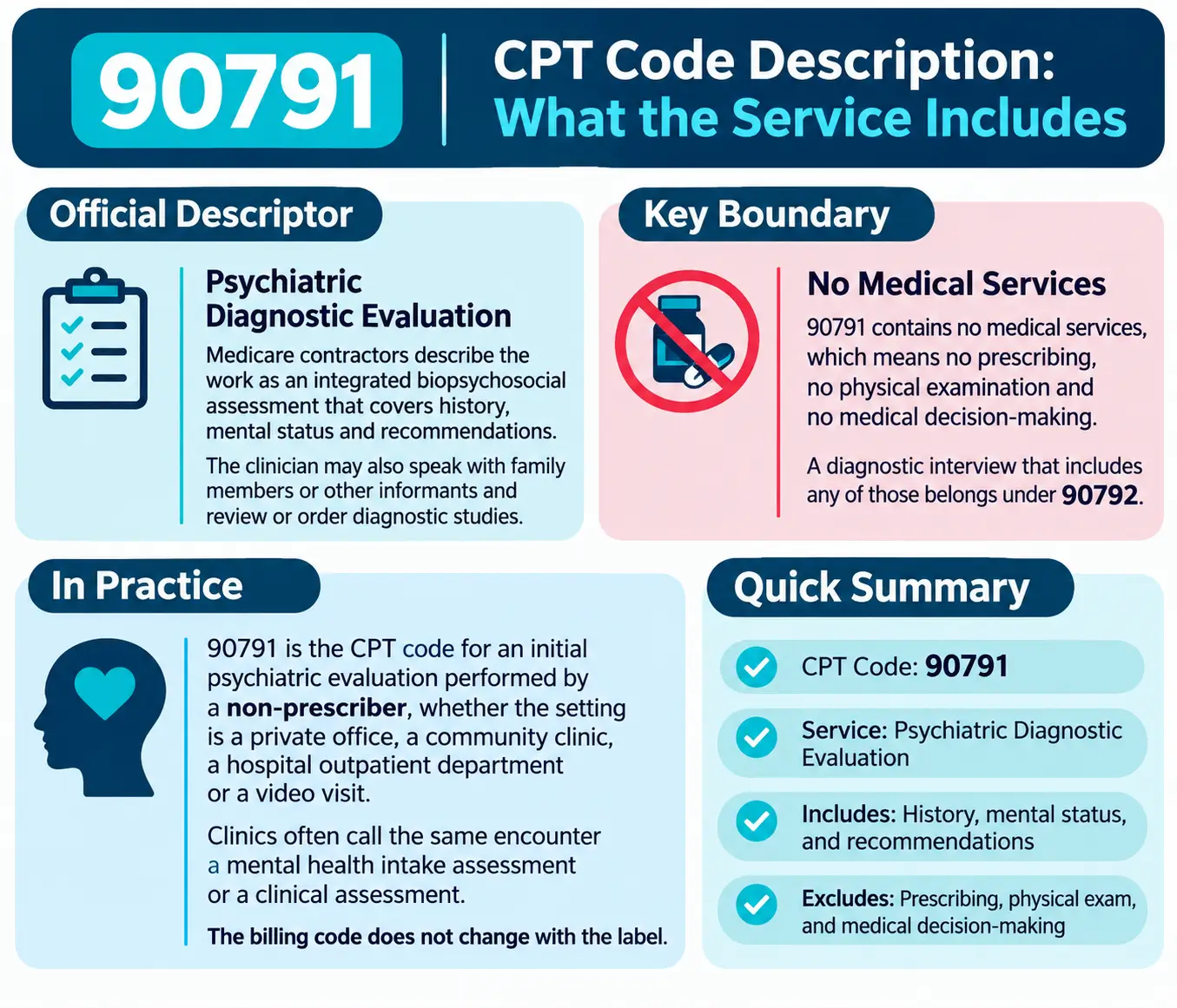
The official descriptor is two words long: psychiatric diagnostic evaluation. Medicare contractors describe the work as an integrated biopsychosocial assessment that covers history, mental status and recommendations. The clinician may also speak with family members or other informants and review or order diagnostic studies.
One boundary defines the code. It contains no medical services, which means no prescribing, no physical examination and no medical decision-making. A diagnostic interview that includes any of those belongs under 90792.
In practice, 90791 is the CPT code for an initial psychiatric evaluation performed by a non-prescriber, whether the setting is a private office, a community clinic, a hospital outpatient department or a video visit. Clinics often call the same encounter a mental health intake assessment or a clinical assessment. The billing code does not change with the label.
Is 90791 a time-based code?
No. CPT sets neither a minimum nor a maximum number of minutes, so the 90791 time requirements that circulate online (45 minutes, 60 minutes, 90 minutes) come from payer policy or habit, not from the code. The Center to Advance Palliative Care notes in its billing guidance that these visits typically run 60 minutes or longer because of how much ground the evaluation covers.
Time still belongs in the note. Noridian, a Medicare contractor serving western states, asks clinicians to keep a time log for mental health services, and several commercial plans set their own minimum durations. A 25-minute intake does not violate CPT. It will be hard to defend in an audit, though, because the fee assumes 3.84 work RVUs of clinician effort.
Who can bill 90791
Any qualified healthcare professional whose state license permits diagnosing mental disorders can report the code, subject to payer enrollment. Under Medicare Part B, that list covers psychiatrists and other physicians, nurse practitioners, physician assistants, clinical psychologists and clinical social workers.
Two groups joined on January 1, 2024. Section 4121 of the Consolidated Appropriations Act, 2023 allowed marriage and family therapists (MFTs) and mental health counselors (MHCs) to enroll and bill independently. CMS requires a master’s or doctoral degree, at least 2 years or 3,000 hours of supervised post-degree clinical experience, and a state license or certification. Addiction counselors who meet every MHC criterion may enroll as MHCs.
Provider credentials also set the payment. Psychologists and physicians receive 100% of the fee schedule amount, nurse practitioners 85%, and clinical social workers, MFTs and MHCs 75%.
One limitation catches group practices. Noridian states that 90791 and 90792 are never billed “incident to” another practitioner. For Medicare, the clinician who performs the evaluation must be the one enrolled and named on the claim. Rules for pre-licensed associates under Medicaid and commercial plans differ by state and contract.
90791 documentation requirements
The CPT manual says little about what the note must contain, so Medicare contractor checklists have become the working documentation standards. CGS Administrators looks for an initial diagnosis, an evaluation of the patient’s ability and capacity to respond to treatment, and an initial plan of treatment. Noridian adds the chief complaint, the biopsychosocial assessment, medications and any lab or diagnostic results.
A note that satisfies both, and most commercial reviewers, records:
- Chief complaint and presenting symptoms, in the patient’s words where possible
- Psychiatric history, including prior treatment, hospitalizations and medication trials
- Medical history and current medications
- Family and social history
- Substance use history
- Mental status examination
- Risk assessment for suicide, self-harm and harm to others
- Diagnostic formulation with ICD-10-CM codes
- Treatment recommendations and an initial treatment plan
Medical necessity runs through all of it. The clinical findings have to explain why this patient needed a full diagnostic interview on this date.
First Coast Service Options, the contractor for Florida, Puerto Rico and the U.S. Virgin Islands, sets a mechanical standard in article A57520: every page must be legible, identify the patient and carry the signature of the responsible clinician. Auditors also notice a mental status examination that repeats what the patient reported instead of what the clinician observed.
90791 vs 90792
Both codes describe the same diagnostic interview. The difference is whether medical work was performed.
90791 | 90792 | |
Descriptor | Psychiatric diagnostic evaluation | Psychiatric diagnostic evaluation with medical services |
Medical services | None | Prescribing, physical exam or other medical assessment |
Typical billers | Psychologists, clinical social workers, MFTs, MHCs | Psychiatrists, psychiatric nurse practitioners, physician assistants |
Interactive complexity add-on (90785) | Allowed | Allowed |
E/M code on the same day, same clinician | Not allowed | Not allowed |
A psychiatrist may report 90791 when the visit involved no medical services. The reverse does not hold: a psychologist or social worker cannot report 90792, because medical services fall outside their scope. The two codes are never billed together for the same evaluation.
How often can 90791 be billed?
Once per day is the only limit CPT sets. Coverage policy is narrower. CGS describes the service as covered once at the outset of an illness or suspected illness, with exceptions listed in its local coverage determination.
The exceptions are specific. First Coast’s LCD L33252 allows the code on a second date when a separate diagnostic assessment is conducted with another informant, such as a parent or caregiver. Noridian permits more than one evaluation per year when a separate evaluation is clinically warranted.
Commercial and Medicaid plans write their own 90791 CPT code frequency rules. The AAPC’s Evaluation and Management Coding Alert reports that payers generally limit the evaluation to once per provider per episode of care, and that some allow it every 6 to 12 months.
A practical scenario: a patient returns after 14 months away with new symptoms. A second evaluation is usually defensible if the note states what changed and why the earlier assessment no longer applies. Check the plan’s insurance coverage terms and any prior authorization requirement before the visit, not after the denial.
90791 billing guidelines
Code combinations
Add-on code 90785 (interactive complexity) may accompany 90791 when communication factors complicate the session. Noridian’s examples include the involvement of child welfare, probation or parole officers. First Coast bars 90785 when the patient cannot communicate by any means.
Three combinations are excluded on the same date by the same clinician: an E/M visit, a psychotherapy code, and psychotherapy for crisis (90839, 90840).
Telehealth billing
Medicare covers 90791 by telehealth with no geographic restriction. Place of service 10 identifies a patient at home and 02 a patient anywhere else, and CMS has paid home telehealth claims at the non-facility rate since January 1, 2024.
Modifier 95 (real-time audio and video) is where payer-specific billing guidelines diverge. Most commercial and Medicare Advantage plans require it. Medicare fee-for-service instructions vary by contractor, and the CMS telehealth FAQ updated October 2026 does not address it, so confirm with your MAC. Modifier 93 marks audio-only visits. The same FAQ introduces telehealth modifiers BB and BC, required from January 1, 2027, with no effect on payment.
One date matters for intake planning. Federal law requires an in-person visit within 6 months before a patient’s first mental health telehealth service at home. Congress has delayed that rule until after December 31, 2027. Patients who start home telehealth before January 1, 2028 will count as established and will need one in-person visit every 12 months.
90791 reimbursement in 2026
Medicare values the code at 5.19 total RVUs in an office and 4.11 in a facility. At the 2026 conversion factor of $33.4009, that produces national payments of $173.35 and $137.28 before locality adjustment. The office rate was $166.91 in 2025, a 3.9% increase.
Payer and clinician type | 90791 rate |
Medicare, physician or psychologist | $173.35 |
Medicare, nurse practitioner (85%) | $147.35 |
Medicare, clinical social worker, MFT or MHC (75%) | $130.01 |
Cigna, national average | $205.36 |
Blue Cross/Anthem, national average | $184.47 |
Aetna, national average | $164.22 |
UnitedHealthcare, national average | $160.15 |
Medicare figures are 2026 national non-facility amounts from the CMS relative value files. Commercial figures are PayerPrice payer-file averages verified in August 2026, as published by JotPsych. They are not split by clinician type, so a contracted rate for a master’s-level clinician may sit well below them.
Medicaid reimbursement rates are set state by state and are often lower than Medicare.
Why 90791 claims are denied
A claim denial on this code usually has one of five causes:
- A second 90791 inside the payer’s frequency window, with no documented change in condition
- An E/M, psychotherapy or crisis code on the same date from the same clinician
- A rendering provider who is not credentialed with the plan, or a Medicare claim billed incident to
- A telehealth claim with the wrong place of service or a missing modifier
- A note with no mental status examination, diagnosis or treatment plan
Four of the five can be caught before claim submission with an eligibility check and a note review. The fifth, frequency, requires knowing each plan’s limit and when the patient last had the service, including evaluations by other clinicians in the same group.
CPT Code 90791 pays $173.35 under Medicare in 2026 for a single untimed encounter, and payers audit it in proportion to that fee. Bill it once at the start of an episode of care, under the clinician who performed it, with a note that shows history, mental status, diagnosis and plan. Before any telehealth intake, confirm the plan’s modifier rule.