

CPT code 99212 is the second-lowest of the five established patient office visit codes, and the lowest that requires a physician or other qualified health professional (QHP) to evaluate the patient personally. Medicare’s 2026 national rate for it is $59.45 in an office setting, which is $35.74 less than a 99213. The boundary between those two codes therefore has a fixed dollar value on every claim.
It is also a code many clinicians rarely reach for. An American College of Gastroenterology analysis of public Medicare data, published February 27, 2026, found that 99212 made up 3.64% of established patient E/M visits reported by gastroenterologists, against 39.17% for 99213 and 49.71% for 99214. Low volume does not mean low scrutiny. A 99212 claim still needs a note that shows why a QHP was required and what was decided.
What CPT code 99212 covers
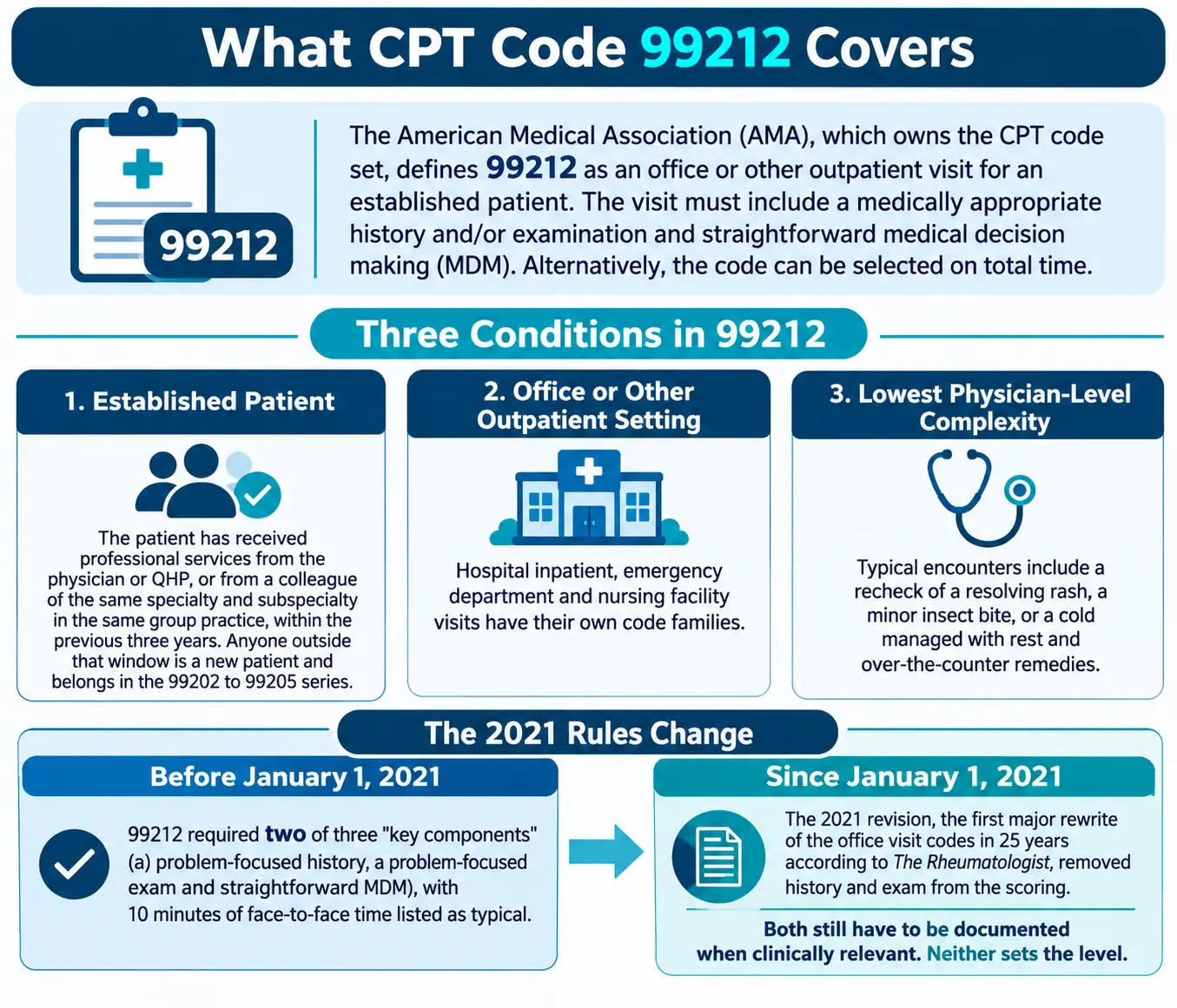
The American Medical Association (AMA), which owns the CPT code set, defines 99212 as an office or other outpatient visit for an established patient. The visit must include a medically appropriate history and/or examination and straightforward medical decision making (MDM). Alternatively, the code can be selected on total time.
Three conditions sit inside that 99212 CPT code description:
- Established patient. The patient has received professional services from the physician or QHP, or from a colleague of the same specialty and subspecialty in the same group practice, within the previous three years. Anyone outside that window is a new patient and belongs in the 99202 to 99205 series.
- Office or other outpatient setting. Hospital inpatient, emergency department and nursing facility visits have their own code families.
- Lowest physician-level complexity. Typical encounters include a recheck of a resolving rash, a minor insect bite, or a cold managed with rest and over-the-counter remedies.
The current rules date from January 1, 2021. Before then, 99212 required two of three “key components” (a problem-focused history, a problem-focused exam and straightforward MDM), with 10 minutes of face-to-face time listed as typical. The 2021 revision, the first major rewrite of the office visit codes in 25 years according to The Rheumatologist, removed history and exam from the scoring. Both still have to be documented when clinically relevant. Neither sets the level.
99212 time requirement in 2026
The 99212 time requirement is 10 minutes of total time on the date of the encounter, and that figure must be met or exceeded. The American Academy of Family Physicians (AAFP) lists the thresholds as single minimums: 10 minutes for 99212, 20 for 99213.
Many references, including the title of the AMA’s own 99212 page, still describe the code as “10-19 minutes.” Both readings produce the same result in practice, because a visit that reaches 20 minutes qualifies for 99213 on time.
What counts toward 99212 CPT code time
Total encounter time belongs to the billing physician or QHP only. According to Medicare contractor First Coast Service Options, it includes face-to-face and non-face-to-face work on the visit date:
- Reviewing records and test results before the visit
- Taking the history and performing the exam
- Counseling the patient or caregiver
- Ordering medications, tests or procedures
- Documenting in the record and coordinating care
Clinical staff time is excluded. So is anything done on a different calendar day, such as finishing the note the next morning.
Can a visit under 10 minutes be billed as 99212?
Yes, if the code is chosen on MDM. A six-minute visit with straightforward decision making is a valid 99212. Time only has to be recorded when time is the basis for the level.
99212 medical decision making: what “straightforward” means
MDM is scored on three elements, and a level is reached when two of the three are met, as Noridian Healthcare Solutions summarizes in its E/M guidance. For 99212, the AMA table sets each element at its minimum:
- Problems: one self-limited or minor problem
- Data: minimal or none reviewed or ordered
- Risk: minimal risk of morbidity from additional testing or treatment
The most common leveling error runs in the opposite direction from upcoding. A follow-up for one stable chronic illness, such as controlled hypertension, already meets the “low” problem element. Add a prescription refill and the visit supports 99213, a point the documentation company JotPsych makes in its 2026 review of 99212 claims. Billing that encounter as 99212 leaves $35.74 unclaimed at Medicare’s national rate.
The reverse case matters too. A visit does not become low complexity because the note is long. If the only problem addressed is minor and no data were reviewed, the MDM stays straightforward regardless of how much history is recorded.
99212 documentation requirements
Auditors no longer count history and exam bullets for office visits. They read the note for two things: medical necessity for a QHP-level visit, and support for whichever basis, MDM or time, was used to pick the code. Provider documentation that is brief but specific passes. A long templated note with no stated assessment does not.
99212 documentation checklist
- Reason for the visit, in the patient’s or clinician’s words
- History and/or exam relevant to that problem (a focused exam of one area is enough)
- Assessment naming the problem addressed, with a matching ICD-10-CM code
- Plan, including advice that involves no prescription, such as rest or wound care
- Total minutes on the date of service, with a short list of activities, if time is the basis
- Dated signature and credentials of the billing clinician
CPT does not require start and stop times for office visits, though individual payers can. A single attested total (“12 minutes spent today on record review, exam and counseling”) satisfies the code’s own rule.
How to bill CPT 99212
Report 99212 on the CMS-1500 claim with the place of service (11 for a physician office) and a diagnosis pointer to the problem addressed. Place of service changes the payment: Medicare’s facility rate for the same code is roughly half the office rate. Nurse practitioners and physician assistants billing under their own numbers are paid 85% of the physician fee schedule, or $50.53 nationally.
Can CPT 99212 be billed with modifier 25?
Yes. Modifier 25 applies when the visit is a significant, separately identifiable E/M service on the same day as a procedure with a 0-day or 10-day global period, according to First Coast’s modifier 25 fact sheet. The note must show evaluation work beyond the routine pre- and post-procedure care. The same fact sheet states that modifier 25 should never be appended to 99211.
G2211 and the 2027 changes
Medicare’s visit complexity add-on, G2211, can accompany 99212 when the clinician has an ongoing care relationship with the patient. It is not paid if the 99212 carries modifier 25, with one exception in place since January 1, 2025: a same-day annual wellness visit, vaccine administration or other Part B preventive service (Wu and Beveridge, FPM, January 15, 2025).
Two rules change on January 1, 2027. Under the CY 2027 final rule released November 4, 2026, modifier B1 replaces G2211 and raises the E/M payment by 16%. A modifier 25 visit billed with a zero-day global procedure will also see the lower-paid service cut to 80%, as Holland & Knight reported on November 13, 2026. On a 99212-25 claim, the lower-paid line is usually the office visit.
CPT code 99212 reimbursement in 2026
Medicare prices 99212 from three relative value units (RVUs): 0.70 for physician work, 1.02 for office practice expense (0.17 in a facility) and 0.06 for malpractice. That totals 1.78 RVUs in an office and 0.93 in a facility, per RVU Tracker’s summary of the 2026 CMS file.
Multiplied by the 2026 conversion factor of $33.4009, the national payment is $59.45 non-facility and $31.06 facility. Clinicians who qualify as advanced alternative payment model participants use a separate factor of $33.5675, which works out to about $59.75. Local amounts differ because each RVU is adjusted by a geographic practice cost index.
The 2026 factor rose 3.26% from $32.3465, and E/M services were exempt from the 2.5% efficiency cut CMS applied to work RVUs for most non-time-based codes. Part of that increase was a one-year provision. The 2027 non-qualifying factor falls 2.31% to $32.6286, so practices should reprice 99212 once the 2027 RVU file is loaded.
These are Medicare fee-for-service figures. Commercial, Medicaid and Medicare Advantage rates for 99212 are set by contract or state fee schedule and should be checked payer by payer.
How 99212 compares with 99211, 99213 and 99202
Code | Patient | MDM level | Time threshold (minutes) | 2026 Medicare national office rate |
99211 | Established | Not applicable | Not applicable | $24.38 |
99212 | Established | Straightforward | 10 | $59.45 |
99213 | Established | Low | 20 | $95.19 |
99202 | New | Straightforward | 15 | $75.15 |
Rates are total office RVUs multiplied by $33.4009, before geographic adjustment.
99211 vs 99212
CPT 99211 is for a visit that may not require a physician or QHP to be present, such as a nurse-performed blood pressure check under an existing plan. Neither MDM nor time applies to it. Once a QHP personally evaluates the patient and makes a decision, 99212 is the floor.
99212 vs 99213 medical decision making
The problem element usually decides this one. One self-limited or minor problem is straightforward. Two or more minor problems, one stable chronic illness, or one acute uncomplicated illness or injury is low, and that points to 99213 if either data or risk also reaches the low level.
99202 vs 99212
Both codes require straightforward MDM. They differ in patient status under the three-year rule, in the time threshold (15 minutes against 10) and in payment, with 99202 paying $15.70 more nationally for the added work of a first visit.
When CPT code 99212 is the right choice
CPT code 99212 fits an established patient visit in which a physician or QHP personally addresses one minor problem, or spends at least 10 and fewer than 20 minutes on the patient that day. Medicare pays $59.45 for it in an office in 2026. The note needs a stated problem, a relevant history or exam, a plan, and a documented time total when time is the basis.
Two checks are worth building into a practice’s review process before year end. Audit a sample of 99212 claims for stable chronic conditions with refills, which often qualify for 99213. Then list every 99212 billed with modifier 25 alongside a zero-day global procedure, because from January 1, 2027 Medicare will pay the lower-valued line on those claims at 80%.