

How long does insurance credentialing take? Healthcare providers should generally plan for 30 to 180 days to complete insurance credentialing and related enrollment activities. Many commercial insurance applications take approximately 60 to 120 days, although processing times vary by insurance company, provider specialty, state regulations, and application requirements.
For physicians, nurse practitioners, therapists, and other healthcare professionals, credentialing determines whether an insurance company will approve them for participation in its provider network. Delays can affect practice operations, patient scheduling, and insurance reimbursement.
Understanding the insurance credentialing timeline helps medical practices prepare documentation, monitor applications, and avoid preventable billing problems.
What is insurance credentialing?
Insurance credentialing is the process health insurance companies use to verify a healthcare provider’s professional qualifications before approving participation in their networks.
During credentialing, insurers review medical licenses, education, training, board certifications, work history, malpractice insurance, and professional disciplinary records.
A major part of this process involves primary source verification, where credentials are confirmed directly with licensing authorities, educational institutions, or other recognized verification sources.
Credentialing is often confused with provider enrollment and insurance paneling.
Credentialing establishes whether a provider meets professional qualification standards. Provider enrollment registers the provider in an insurer’s administrative system, while insurance paneling generally includes approval to participate in a specific network.
A provider may complete credentialing but still need contracting and enrollment approval before receiving in-network reimbursement.
How long does insurance credentialing take with different payers?
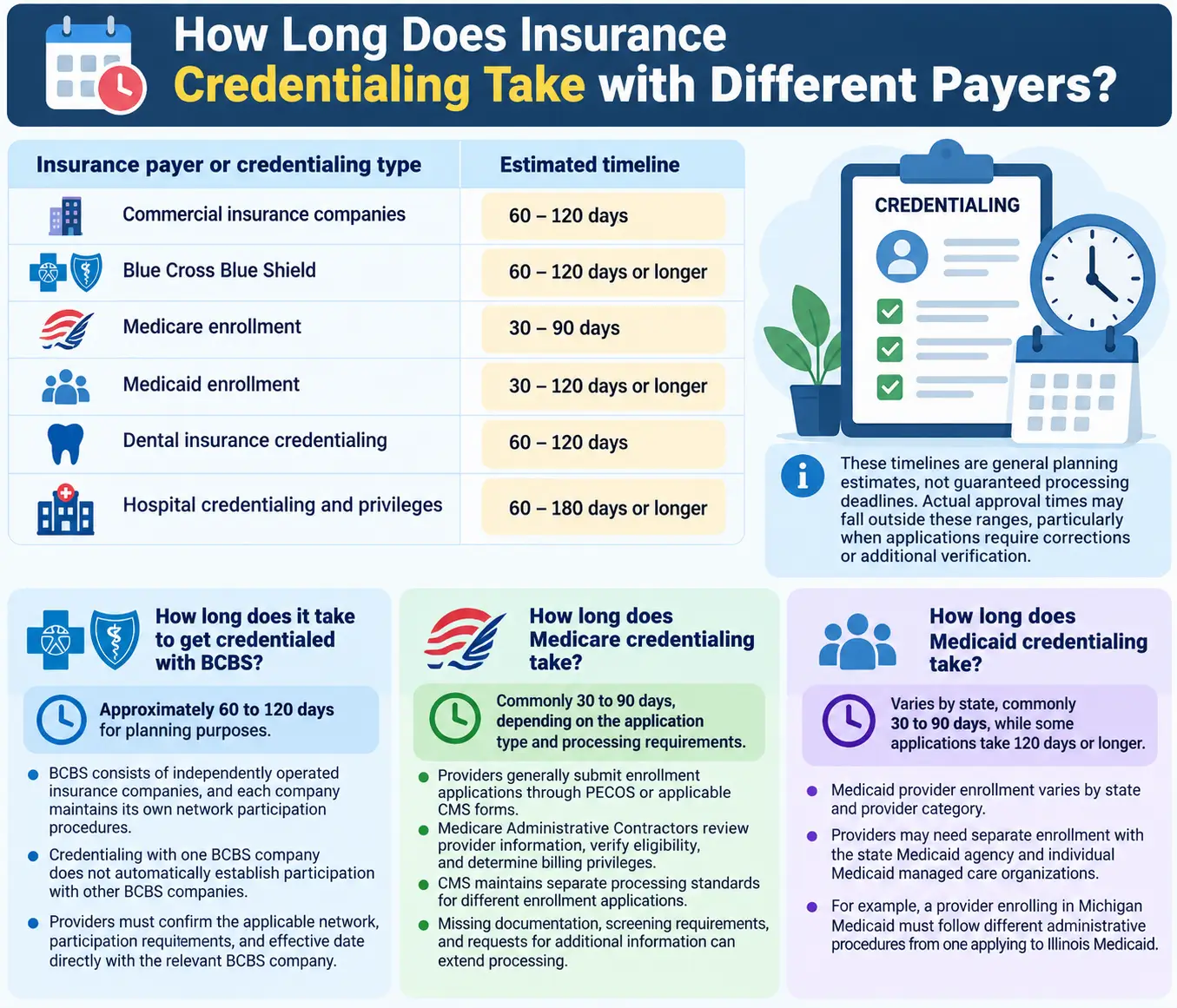
The insurance credentialing process timeline depends on the payer’s verification procedures, network requirements, and application workload.
The following ranges are general planning estimates, not guaranteed processing deadlines.
Insurance payer or credentialing type | Estimated timeline |
Commercial insurance companies | 60–120 days |
Blue Cross Blue Shield | 60–120 days or longer |
Medicare enrollment | 30–90 days |
Medicaid enrollment | 30–120 days or longer |
Dental insurance credentialing | 60–120 days |
Hospital credentialing and privileges | 60–180 days or longer |
Actual approval times may fall outside these ranges, particularly when applications require corrections or additional verification.
How long does it take to get credentialed with BCBS?
Blue Cross Blue Shield credentialing commonly requires approximately 60 to 120 days for planning purposes.
However, BCBS consists of independently operated insurance companies, and each company maintains its own network participation procedures.
For example, credentialing with Blue Cross Blue Shield of Michigan does not automatically establish participation with Horizon Blue Cross Blue Shield of New Jersey.
Providers must confirm the applicable network, participation requirements, and effective date directly with the relevant BCBS company.
How long does Medicare credentialing take?
Medicare provider enrollment commonly requires several weeks to several months, depending on the application type and processing requirements.
Providers generally submit enrollment applications through the Provider Enrollment, Chain, and Ownership System (PECOS) or applicable CMS forms.
Medicare Administrative Contractors review provider information, verify eligibility, and determine billing privileges.
The Centers for Medicare & Medicaid Services (CMS) maintains separate processing standards for different enrollment applications. Missing documentation, screening requirements, and requests for additional information can extend processing.
How long does Medicaid credentialing take?
Medicaid provider enrollment varies by state and provider category.
Some applications may be processed within 30 to 90 days, while others take considerably longer.
Providers may need separate enrollment with the state Medicaid agency and individual Medicaid managed care organizations.
For example, a provider enrolling in Michigan Medicaid must follow different administrative procedures from one applying to Illinois Medicaid.
Insurance credentialing process timeline: Step-by-step
The insurance credentialing process includes documentation, application submission, verification, review, and network activation.
Step 1: Gather provider documentation
Estimated preparation time: 3–10 business days
Before submitting an application, healthcare providers must collect the information required by the insurance company.
Common insurance credentialing requirements include:
- Active professional license and National Provider Identifier (NPI).
- Education, training, and work history.
- Professional liability insurance information.
- Board certification, when applicable.
- Practice address, tax information, and contact details.
Missing or inconsistent documentation can prevent an application from advancing to verification.
Step 2: Complete the CAQH profile
Estimated preparation time: 1–5 business days
Many commercial insurance companies use CAQH ProView to access standardized provider information.
Providers must complete their profiles, upload supporting documentation, authorize insurers to access their information, and attest to its accuracy.
CAQH generally requires reattestation every 120 days, although exceptions apply.
An active CAQH profile does not automatically establish insurance network participation. Providers must still complete any required payer applications and contracting procedures.
Step 3: Submit insurance applications
Estimated preparation time: 1–10 business days
After documentation is complete, the provider submits an application through the insurer’s enrollment portal or designated submission process.
Some insurers require additional forms, network participation requests, or provider agreements.
Practices should confirm receipt and retain the application reference number.
Step 4: Primary source verification
Estimated review time: 2–6 weeks or longer
The insurer verifies professional qualifications through appropriate primary sources.
This may include license verification, education and training confirmation, malpractice history review, and checks for professional sanctions or exclusions.
Discrepancies between submitted information and verification records may result in additional requests.
Step 5: Credentialing review and approval
Estimated review time: 2–6 weeks or longer
After verification, the insurer evaluates the provider’s application according to its credentialing policies.
Some insurers require credentialing committee review before issuing a decision.
Approval may be followed by additional contracting or enrollment procedures.
Step 6: Confirm network participation
The final stage involves confirming the provider’s participation agreement, network status, billing information, and effective date.
A provider should not assume that credentialing approval automatically permits billing for earlier services.
Insurance claims reimbursement depends on the payer’s participation and effective-date rules.
Why does insurance credentialing take so long?
Several administrative factors can extend the credentialing turnaround time.
Incomplete applications are a frequent cause. Missing malpractice documents, expired licenses, incorrect addresses, and inaccurate employment dates may require clarification.
Inconsistent information across CAQH, NPI records, and payer applications can also delay verification.
Network availability presents another challenge. Insurance companies may restrict new provider participation in geographic areas or specialties where their networks already meet applicable access requirements.
Credentialing committee schedules, application backlogs, and outstanding contracts can create additional waiting periods.
A provider may satisfy every professional qualification requirement but still experience delays because of network contracting or administrative processing.
How long does credentialing take for different healthcare providers?
Credentialing requirements vary by professional license, specialty, and insurer.
Physician credentialing timeline
The average time to credential a physician with commercial insurance is often estimated at 60 to 120 days for planning.
Medical doctors and doctors of osteopathic medicine may undergo verification of medical education, residency training, licensure, board certification, and malpractice history.
Physicians joining an established medical group may have different enrollment requirements from those opening an independent practice.
Insurance credentialing for nurse practitioners
How long does credentialing take for NPs? Nurse practitioners should generally allow approximately 60 to 120 days for commercial insurance credentialing, while recognizing that individual applications may take longer.
Verification may include advanced practice licensure, national certification, prescriptive authority, and supervisory or collaborative arrangements where applicable.
Independent billing eligibility depends on the payer and relevant state requirements.
Insurance credentialing time for chiropractors
Chiropractors must satisfy insurer-specific requirements involving professional licensure, practice information, malpractice coverage, and network participation.
Credentialing may take several months, particularly when an insurer requires additional documentation or has limited network openings.
How long does dental credentialing take?
Dental insurance credentialing frequently requires approximately 60 to 120 days for planning.
Insurers verify dental licenses, professional qualifications, malpractice coverage, and practice information.
Dentists applying to multiple insurance networks should track each application separately because approval dates may differ.
How long does hospital credentialing take?
Hospital credentialing and clinical privileging may take 60 to 180 days or longer.
The process can include medical staff review, qualification verification, clinical privilege evaluation, and approval by the hospital’s authorized governing body.
Hospital privileges do not automatically establish participation with commercial insurance networks.
How to speed up insurance credentialing
Although providers cannot control payer processing schedules, several administrative practices can reduce avoidable delays.
Begin preparing credentialing documentation before the anticipated practice start date. Confirm that professional licenses, malpractice insurance, NPI records, and CAQH information are accurate.
Review each payer’s application requirements before submission. Some insurance companies require separate participation requests, contracts, or location-specific enrollment forms.
Maintain an application tracking system that records submission dates, payer reference numbers, outstanding documents, follow-up communications, and effective dates.
Follow up according to the insurer’s published processing guidance and respond promptly to requests for additional information.
For practices credentialing multiple providers, assigning responsibility for application tracking can prevent overlooked requests and missed deadlines.
How much does it cost to get credentialed with insurance companies?
Insurance credentialing costs depend on the provider’s circumstances and whether applications are managed internally or through an outside credentialing service.
CAQH ProView is generally free for individual healthcare providers.
However, practices may incur expenses associated with staff administration, professional documentation, licensing, and third-party credentialing services.
Some credentialing companies charge per provider or per payer application, while others offer bundled enrollment services.
Before purchasing assistance, practices should confirm whether the fee includes application submission, payer follow-up, contracting support, and effective-date verification.
Frequently asked questions
Can providers bill insurance before credentialing is complete?
Eligibility for billing is determined by the insurer’s enrollment requirements and effective-date guidelines. Some payers permit limited retroactive billing under specific circumstances, but pending credentialing does not guarantee in-network reimbursement.
Which insurance company has the fastest credentialing turnaround?
There is no universally verified insurer with the fastest credentialing process. Processing times vary by network, specialty, location, and application completeness.
How long does it take to get paneled with insurance?
Insurance paneling often requires approximately 60 to 120 days for planning, although network contracting and administrative activation can extend the timeline.
How often is insurance recredentialing required?
Many commercial health plans conduct recredentialing approximately every three years, subject to applicable accreditation standards, state laws, and payer policies.
Does credentialing approval guarantee an effective date?
No. The insurer determines the applicable participation or billing effective date under its enrollment and contracting policies.
How long does insurance credentialing take? Key takeaways
Insurance credentialing and related enrollment activities generally require 30 to 180 days for planning, with many commercial payer applications estimated at 60 to 120 days. Actual timelines depend on the insurance company, provider qualifications, application accuracy, and network requirements.
Healthcare providers should begin applications early, maintain accurate CAQH and NPI information, and track each payer’s progress.
Most importantly, practices should verify their approved network participation and effective dates before assuming that services qualify for in-network insurance reimbursement.