


The Centers for Medicare & Medicaid Services introduced a new billing pathway for physicians on January 1, 2024. This change allows clinics to generate revenue for the uncompensated cognitive work involved in long-term patient tracking.
For years, doctors performed extensive chart reviews, coordinated with specialists, and managed chronic diseases without a dedicated way to bill for that specific mental effort. The activation of the G2211 CPT code changes the financial arithmetic for primary care and specialty clinics. Successfully capturing this revenue requires understanding exactly how Medicare and commercial payers define a continuous medical relationship.
Defining the G2211 Add-On Code
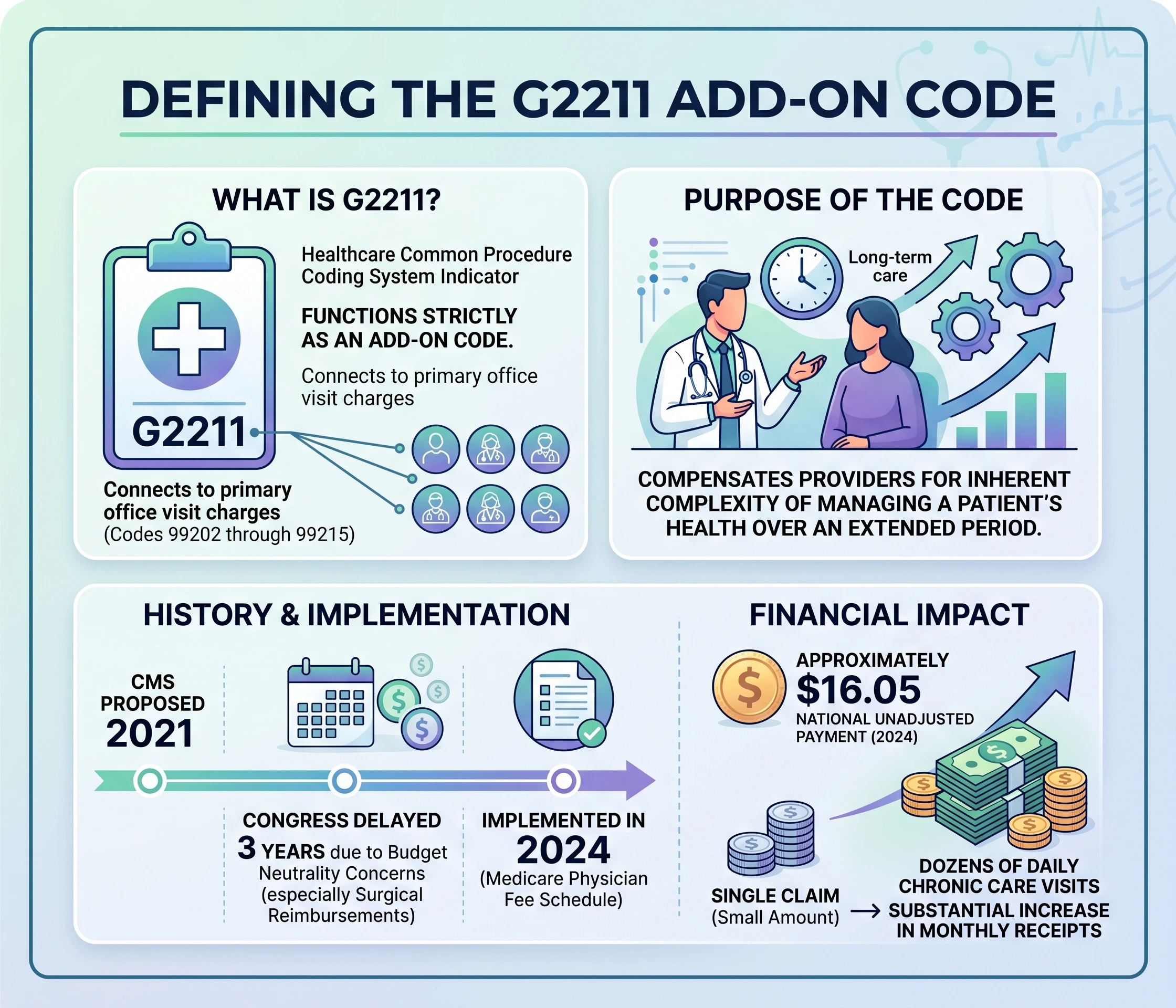
G2211 is a Healthcare Common Procedure Coding System indicator. It functions strictly as an add-on code. Medical billers must attach it to a primary office visit charge, specifically codes 99202 through 99215.
The code compensates providers for the inherent complexity of managing a patient’s health over an extended period. CMS originally proposed this payment adjustment for the 2021 calendar year. Congress delayed the implementation for three years due to concerns about how the payout would affect the budget neutrality of the broader Medicare fee schedule, particularly regarding surgical reimbursements.
According to the 2024 Medicare Physician Fee Schedule, the national unadjusted payment for this specific code sits at approximately $16.05. While a single claim yields a small amount, clinics that process dozens of chronic care visits daily see a substantial increase in monthly receipts.
Primary Clinical Scenarios for Billing
You cannot apply this code to every patient who walks into the clinic. Medicare requires the provider-patient interaction to fit one of two specific frameworks.
The Central Hub of Medical Care
This first category primarily applies to family medicine, internal medicine, and pediatric providers. The physician must act as the primary coordinator for the patient’s overall well-being.
Consider a 65-year-old patient who visits their primary care doctor for a routine blood pressure check. The physician evaluates the blood pressure, but they also carry the mental load of knowing the patient’s entire medical history, their adverse drug reactions, and their recent consultations with a cardiologist. The physician takes responsibility for the patient’s total health picture. In this situation, the clinic reports the appropriate standard office visit code and attaches G2211.
Managing a Singular, Complex Disease
Specialists utilize the second approved framework. A provider qualifies for the additional reimbursement if they manage a severe, singular disease over a long timeline, even if they do not coordinate the patient’s general preventative care.
An infectious disease specialist managing a patient’s HIV treatment protocol meets this requirement. An oncologist monitoring a patient’s response to targeted radiation therapy also qualifies. The disease must demand ongoing evaluation, medication adjustments, and continuous risk assessment. Treating a patient for a temporary sinus infection does not meet the threshold for a complex, longitudinal condition.
Strict Billing Limitations and Exclusions
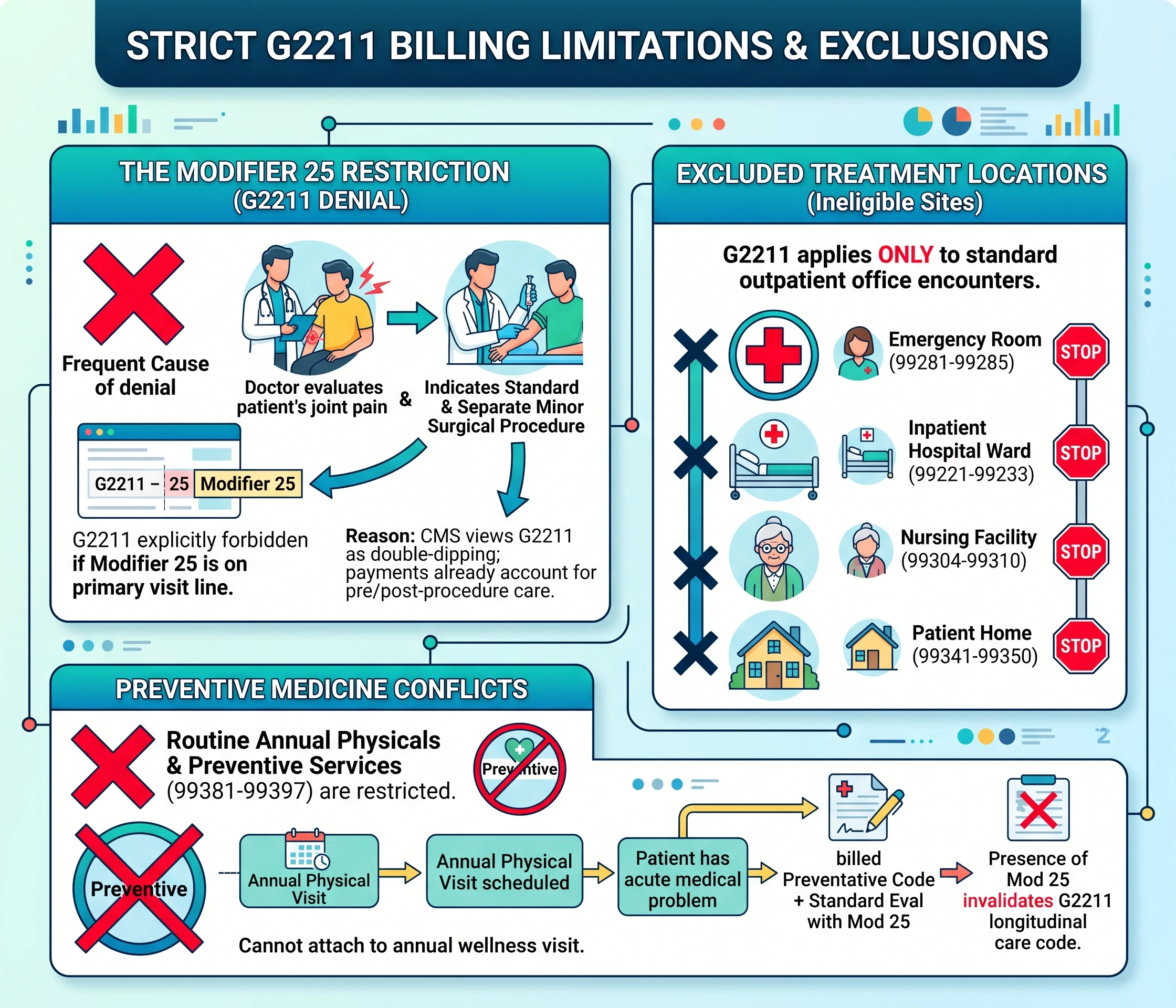
CMS implemented rigid boundaries to prevent clinics from inflating their daily claim totals. Billing departments face immediate denials if they ignore these structural rules.
The Modifier 25 Restriction
The most frequent cause of a G2211 denial involves Modifier 25. This modifier indicates that a doctor performed a standard evaluation and a separate minor surgical procedure during the exact same appointment.
If a physician evaluates a patient’s joint pain and then administers a steroid injection into the knee on the same day, the clinic attaches Modifier 25 to the evaluation code. When this modifier is present on the primary visit line, CMS explicitly forbids the use of G2211.
Medicare established this rule because the payment values for minor procedures already account for the pre-procedure evaluation and post-procedure monitoring. CMS views adding G2211 to a procedure visit as double-dipping into federal funds.
Excluded Treatment Locations
The add-on code only applies to standard outpatient office encounters. You cannot report it for work performed in other medical settings. Ineligible locations include:
- Emergency rooms (99281-99285)
- Inpatient hospital wards (99221-99233)
- Nursing facilities (99304-99310)
- Patient homes (99341-99350)
Preventive Medicine Conflicts
Routine annual physicals and preventive medicine services fall under the 99381-99397 code range. Medicare restricts the longitudinal care add-on code strictly to the 99202-99215 standard visit range. You cannot attach the add-on code to an annual wellness visit.
If a patient schedules an annual physical but also requires treatment for a newly discovered, acute medical problem during the same time slot, the clinic might bill the preventative code alongside a standard evaluation code using Modifier 25. As noted earlier, the presence of that modifier automatically invalidates the use of the longitudinal care code.
Comparing G2211 and G2212
Medical coders occasionally confuse these two indicators due to their numerical similarity. They measure entirely different aspects of medical care.
G2211 measures the cognitive weight of a long-term medical relationship. It does not matter if the actual face-to-face appointment lasts 10 minutes or 40 minutes. The reimbursement covers the continuity of care.
G2212 strictly measures time. It is a prolonged services code. A clinic bills this code only when the physician spends at least 15 minutes beyond the maximum time threshold allowed for a high-level office visit (codes 99205 or 99215). One code pays for relationship continuity, while the other pays for the clock running out.
Chart Documentation Requirements
Medical necessity drives all healthcare reimbursement. In the event of a federal audit, the physician’s chart notes must prove the existence of a continuous medical relationship.
The clinical documentation should state the provider’s specific role. The assessment and plan section of the note must detail the long-term management strategy. Standard boilerplate text will fail an audit. The notes should reflect active medication reconciliation, reviews of outside laboratory data, and specific instructions for future follow-up appointments.
The diagnosis codes attached to the claim must logically match the condition being managed. If a pulmonologist claims the extra reimbursement for managing severe chronic obstructive pulmonary disease, the primary ICD-10 code on the claim form must specify that exact respiratory condition. Listing an ingrown toenail as the primary diagnosis will trigger a manual review and likely a denial.
Payer Adoption Variables
Traditional Medicare Part B implemented the payment schedule without exception on the first day of 2024. Federal regulations require Medicare Advantage organizations to match standard Medicare benefits, forcing those managed care plans to reimburse the code as well.
The commercial insurance sector presents a highly fragmented picture. National carriers such as Cigna, UnitedHealthcare, and Aetna updated their internal fee schedules to recognize the code for their commercial members. However, regional health maintenance organizations and self-funded employer plans operate under different rules.
Some commercial payers refuse to recognize the code entirely, treating it as an unbundled service that is already included in the primary visit payment. Billing managers must review explanation of benefits documents closely to determine which private insurers actually remit payment and which simply deny the line item.
Measuring the Financial Impact
The business impact of this coding change depends heavily on a clinic’s patient demographics and the physicians’ compensation models.
The code carries a work relative value unit (wRVU) assignment of 0.33. Many physicians receive their salary based on total annual wRVU production.
Consider a physician who logs 4,000 standard office visits in a calendar year. If the billing department successfully applies the add-on code to 50% of those encounters excluding the appointments blocked by minor procedures or preventative care rules the physician logs 2,000 instances of the code.
Multiplying 2,000 claims by the 0.33 value yields 660 additional wRVUs for the year. Using the 2024 Medicare conversion factor of $33.2875, that single billing change generates nearly $22,000 in additional annual revenue for the practice. For a medical group employing ten primary care doctors, mastering this single coding rule represents over $200,000 in top-line growth without seeing a single extra patient.
Integrating this process requires disciplined chart documentation and alert billing staff. Providers must dictate the ongoing nature of their treatment plans clearly. Coders must block the code from hitting claims containing competing modifiers. Practices that align their clinical notes with these strict Medicare guidelines secure the revenue meant to compensate the heavy cognitive demands of modern medical care.