

Fort Worth had 918,915 residents in the 2020 Census, inside a county of 2,110,640. A physician, nurse practitioner or therapist who wants to bill insurance there has to clear payer enrollment first. Health insurance credentialing in Fort Worth means doing that separately for each commercial plan, for Medicare and for Texas Medicaid, each with its own application, reviewer and renewal cycle.
Searches for health insurance credentialing FT Worth come mostly from two groups: providers opening or joining a practice, and billing and coding students learning how enrollment works. This guide covers the Texas rules both groups need, plus the filing windows that cost money when missed.
How health insurance credentialing works for Fort Worth providers
Credentialing and enrollment get used as synonyms, but they are two steps. Credentialing is the payer’s verification of your license, education, board certification, work history, malpractice record and sanctions history. Enrollment is the application that places you on an insurance panel or, for Medicare and Medicaid, grants billing privileges. A credentialing approval and a contract effective date are separate events. The date on the letter decides which claims get paid.
Insurance credentialing requirements in Texas
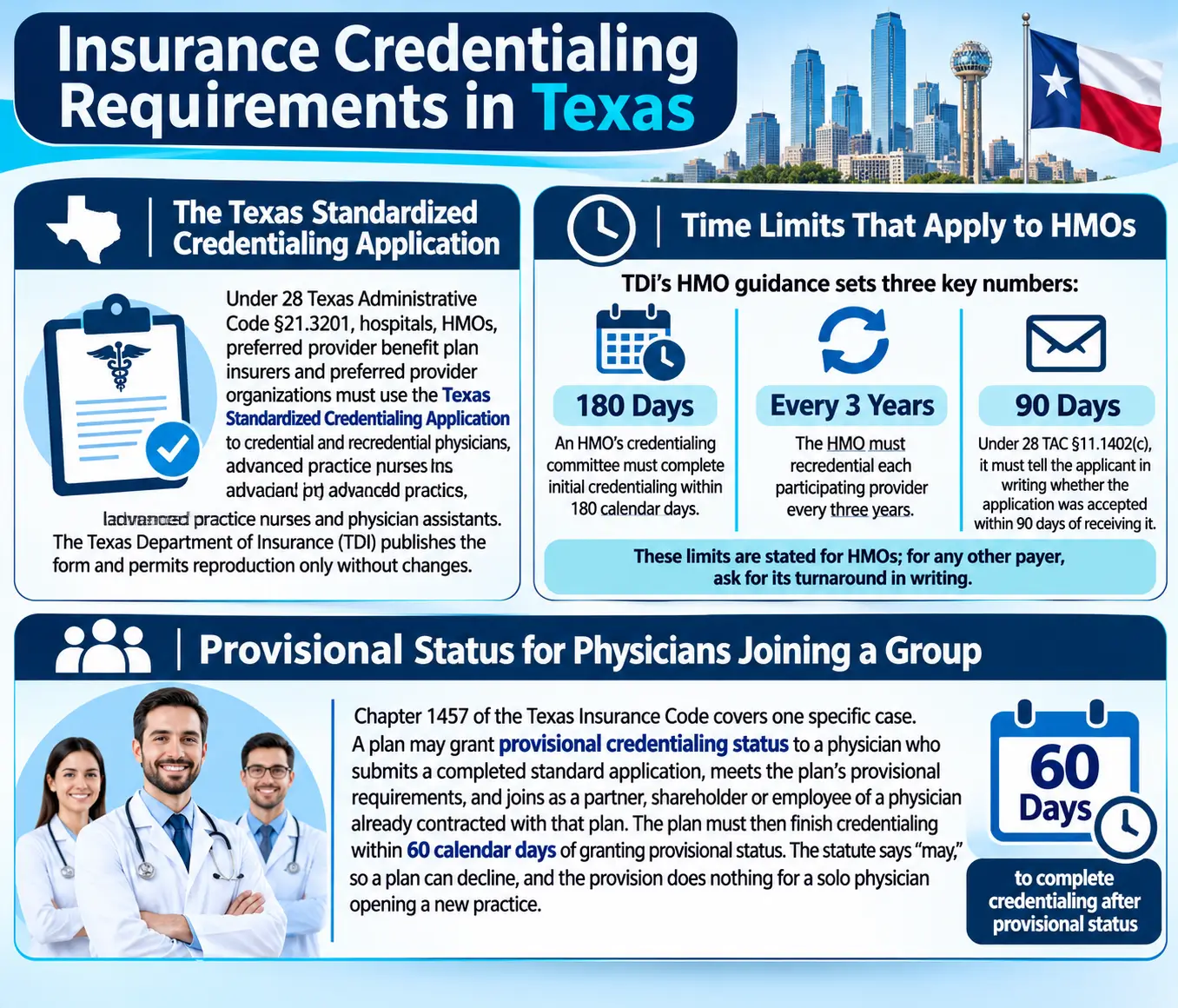
The Texas Standardized Credentialing Application
Under 28 Texas Administrative Code §21.3201, hospitals, HMOs, preferred provider benefit plan insurers and preferred provider organizations must use the Texas Standardized Credentialing Application to credential and recredential physicians, advanced practice nurses and physician assistants. The Texas Department of Insurance (TDI) publishes the form and permits reproduction only without changes.
Time limits that apply to HMOs
TDI’s HMO guidance sets three numbers. An HMO’s credentialing committee must complete initial credentialing within 180 calendar days. The HMO must recredential each participating provider every three years. And under 28 TAC §11.1402(c), it must tell the applicant in writing whether the application was accepted within 90 days of receiving it. Those limits are stated for HMOs; for any other payer, ask for its turnaround in writing.
Provisional status for physicians joining a group
Chapter 1457 of the Texas Insurance Code covers one specific case. A plan may grant provisional credentialing status to a physician who submits a completed standard application, meets the plan’s provisional requirements, and joins as a partner, shareholder or employee of a physician already contracted with that plan. The plan must then finish credentialing within 60 calendar days of granting provisional status. The statute says “may,” so a plan can decline, and the provision does nothing for a solo physician opening a new practice.
CAQH ProView, NPI and the records payers compare
Many commercial payers pull provider data from CAQH ProView, which is free to providers, according to a CAQH quick-reference guide reproduced by the Maryland Department of Health. The guide says providers must re-attest at least every 120 days (180 in Illinois). In a February 2025 notice to dentists, Anthem said participating plans can access a profile only after re-attestation is complete.
Have these items ready before opening any application:
- Active Texas license, with the expiration date on file
- NPI from NPPES, with the correct taxonomy and practice address
- DEA registration for the Texas practice address
- Current malpractice certificate
- Board certification, or training documentation if not certified
- Work history with any gaps explained
- Tax ID, billing address and each practice location
Payers compare these records against one another. An address written one way in NPPES and another in CAQH can stall an application, so keep the address, tax ID and taxonomy identical in NPPES, PECOS, CAQH and every payer form.
Medicare enrollment through PECOS
Medicare enrollment runs through the online PECOS system or a paper CMS-855I. The Texas Medical Association identifies Novitas Solutions as the Medicare payer for Texas. Under 42 CFR 424.520(d), the effective date is the later of two dates: when the contractor received an application it later approved, or when the provider began furnishing services at a new location.
Retroactive billing reaches back at most 30 days from the effective date, and only when circumstances prevented enrollment in advance. A presidentially declared disaster extends that to 90 days, according to First Coast Service Options’ enrollment guidance on 42 CFR 424.521(a). Take a physician whose complete application reaches Novitas on July 1 and is approved in September. Services from June 1 onward are billable. A visit on May 28 is not.
The CMS revalidation page says providers generally revalidate every five years, DMEPOS suppliers every three, and that CMS can request an off-cycle revalidation. The purpose is to maintain Medicare billing privileges.
Medicaid provider enrollment in Fort Worth
Texas Medicaid enrollment is a separate process from Medicare. The Texas Health and Human Services Commission (HHSC) says providers who want to participate in state health-care programs must enroll in Texas Medicaid, and that every application goes through the Provider Enrollment and Management System (PEMS), accessed through the Texas Medicaid & Healthcare Partnership (TMHP). The Affordable Care Act requires revalidation at least every five years. A provider who misses the due date must file a re-enrollment application instead.
TMHP accepts revalidation applications up to 180 calendar days before the due date, according to a Texas Children’s Health Plan notice updated in July 2025. The same notice warns that late providers may be disenrolled from Texas Medicaid and go unpaid for services rendered to members.
Medicaid managed care plans in the Tarrant service area
State enrollment is one layer. Medicaid managed care plans add contracting on top of it. HHSC’s service area map, revised in January 2026, lists Aetna, Cook Children’s and Wellpoint for STAR in the Tarrant service area, and Molina and United for STAR+PLUS. The area covers Denton, Hood, Johnson, Parker, Tarrant and Wise counties.
Plan lists change. In October 2024, a Travis County district judge blocked HHSC from finalizing contracts that would have dropped Cook Children’s Health Plan from the area, according to Cook Children’s. The January 2026 map still lists the plan. Check HHSC’s current map before drafting a contracting plan.
Three enrollment tracks compared
Commercial HMO and PPO | Medicare (Texas) | Texas Medicaid | |
Where to apply | Texas Standardized Credentialing Application or CAQH ProView | PECOS or paper CMS-855I | PEMS |
Reviewer | Each payer’s credentialing committee | Novitas Solutions | TMHP for HHSC |
Renewal | HMO recredentialing every 3 years; CAQH re-attestation every 120 days | Revalidation every 5 years | Revalidation at least every 5 years |
Time rule | HMO initial credentialing within 180 days | Retroactive billing up to 30 days before the effective date | Revalidation accepted up to 180 days before the due date |
The clocks run independently. A provider can be current in CAQH and overdue in PEMS.
Credentialing in Arlington, Burleson, Keller, Weatherford, Denton and Dallas
Medicare rules and the state Medicaid enrollment system apply the same way everywhere in Texas. What shifts by location is the Medicaid plan list and each commercial payer’s network. Practices in Arlington and Keller (Tarrant County), Burleson (Johnson and Tarrant counties), Weatherford (Parker County) and Denton (Denton County) sit in the same Medicaid service area as Fort Worth, so the same STAR and STAR+PLUS plans apply.
Dallas is a separate service area. HHSC’s January 2026 map lists Molina, Parkland and Wellpoint for Dallas STAR, so a group with offices in both cities contracts with two different sets of Medicaid plans. A new location in any of these cities also has to be added to PECOS, PEMS and CAQH before billing from it.
Starting health insurance credentialing in Fort Worth: a working order
- Match the Texas license, DEA registration and NPPES record, including address and taxonomy.
- Complete and attest the CAQH ProView profile.
- File the Medicare enrollment in PECOS before seeing Medicare patients, so the 30-day retroactive window stays a safety net.
- Enroll in Texas Medicaid through PEMS, then approach the plans in the Tarrant service area.
- Submit one application per commercial payer, using the Texas Standardized Credentialing Application where a payer requires it.
- Calendar the renewals: CAQH every 120 days, HMO recredentialing every three years, and Medicare and Medicaid revalidation every five.
Health insurance credentialing in Fort Worth runs on at least three clocks: 120 days for CAQH, three years for HMO recredentialing and five years for Medicare and Medicaid revalidation. A late Medicare filing costs billable days that cannot be recovered beyond the 30-day window. A missed Medicaid due date means a new enrollment application instead of a renewal.