
ICD-10 tick bite coding takes at least two codes, and a claim listing W57.XXXA alone is incomplete. W57.XXXA is an external cause code, and the official guidelines bar external cause codes from the first-listed position. The injury code for the body site goes first. The external cause follows.
Anyone searching for a tick bite ICD 10 code wants one answer, and ICD-10-CM does not supply one. This guide covers the FY 2027 code set (effective October 1, 2026), seventh character choice, and the chart details a payer will look for. Check each code against the current tabular list before loading it into a claim scrubber.
ICD-10 tick bite coding: the external cause and the injury code
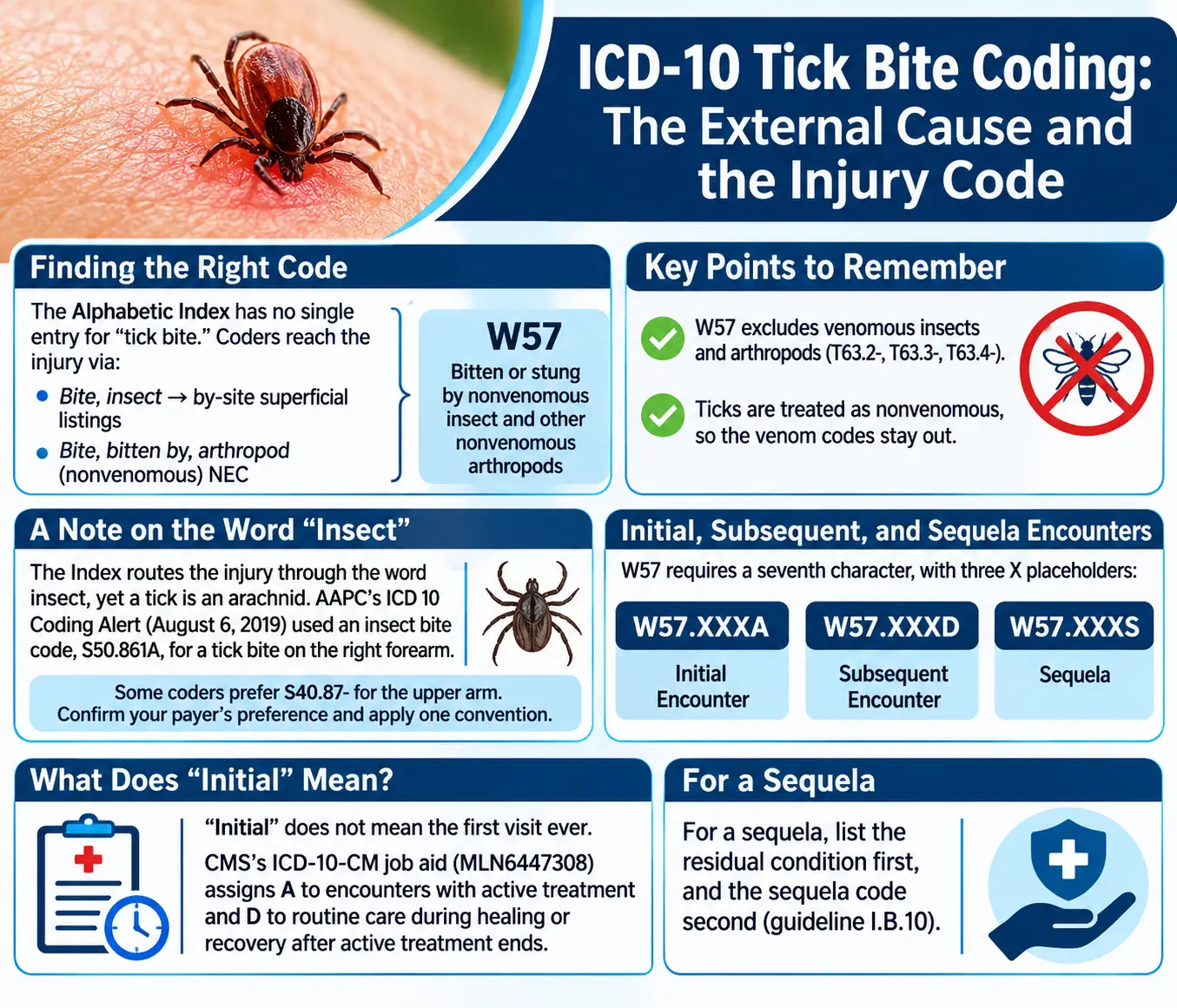
The Alphabetic Index has no entry that sends “tick bite” to a single code. Coders reach the injury by following Bite, insect, to the by-site superficial listings, and reach the cause through Bite, bitten by, arthropod (nonvenomous) NEC. The second path ends at W57, bitten or stung by nonvenomous insect and other nonvenomous arthropods. W57 excludes venomous insects and arthropods (T63.2-, T63.3-, T63.4-), and ticks are treated as nonvenomous, so the venom codes stay out.
One wrinkle deserves a flag. The Index routes the injury through the word insect, yet a tick is an arachnid. AAPC’s ICD 10 Coding Alert (August 6, 2019) used an insect bite code, S50.861A, as the example for a tick bite on the right forearm. Some coders on AAPC’s member forum favor the other superficial bite family instead (S40.87- for the upper arm). Confirm your payer’s preference, then apply one convention consistently.
Initial, subsequent, and sequela encounters
W57 requires a seventh character: A for initial encounter, D for subsequent encounter, S for sequela. Three X placeholders fill positions four through six, giving W57.XXXA, W57.XXXD, and W57.XXXS. Without the final letter the code is invalid.
“Initial” does not mean the first visit ever. CMS’s ICD-10-CM job aid (MLN6447308) assigns A to encounters with active treatment and D to routine care during healing or recovery after active treatment ends. For a sequela, the residual condition is listed first and the sequela code second (guideline I.B.10).
Tick bite by body site: scalp, neck, back, abdomen, arm, and leg
Site codes come from the superficial injury subcategories in Chapter 19, one family per body region. Each takes its own seventh character, and W57.XXXA is added after it.
Body site | Initial encounter code |
Scalp | S00.06XA |
Neck, other specified part | S10.86XA |
Neck, unspecified part | S10.96XA |
Upper back (back wall of thorax), right / left | S20.461A / S20.462A |
Lower back and pelvis | S30.860A |
Abdominal wall | S30.861A |
Upper arm, right / left | S40.861A / S40.862A |
Forearm, right / left | S50.861A / S50.862A |
Thigh, right / left | S70.361A / S70.362A |
Lower leg, right / left | S80.861A / S80.862A |
“Leg” is not a single site. Thigh codes (S70.36-) and lower leg codes (S80.86-) sit in separate blocks, and “arm” divides into upper arm and forearm. A note reading only “tick bite, right leg” needs a provider query. Laterality may come from another clinician’s documentation, such as a nursing intake note (guideline I.B.14), though the diagnosis must come from the provider.
Tick bite unspecified site and multiple sites
When the chart names no body region, the available code is T14.8XXA, other injury of unspecified body region, initial encounter. Some lookup sites list T14.03 as a fallback. That code does not exist; category T14 holds only T14.8 and T14.9.
Multiple bites are coded by site. Guideline I.B.20 defines multiple as two or more sites, directs coders to assign each documented site individually, and allows a multiple-sites code only when the sites go undocumented. Each code is reported once per encounter (I.B.12). Bites on the right thigh, left thigh, and abdominal wall produce S70.361A, S70.362A, and S30.861A, plus one W57.XXXA.
Tick removal, infected bites, exposure, and history
Tick removal. ICD-10-CM has no diagnosis code for the removal itself. The claim carries the site code and W57.XXXA, and the service is reported in CPT. Code 10120 (incision and removal of foreign body, subcutaneous tissues, simple) requires an incision. A tick pulled out with forceps belongs to the E/M visit. Retained mouthparts, when the provider documents them, support a superficial foreign body code at the same site (the S40.85- family for the upper arm, for example).
Infected tick bite. A documented infection adds its own code, usually cellulitis by site (L03.-), or L08.9 for a local skin infection without cellulitis.
Possible or recent tick bite. A bite the provider observed or the patient reports can be coded as a bite. A diagnosis qualified as possible, probable, or suspected cannot. Outpatient guideline IV.H tells coders to report the highest certainty available at that visit: symptoms, signs, or the reason for the encounter. A rash with no confirmed cause is R21.
History and exposure. Z86.19 (personal history of other infectious and parasitic diseases) covers inactive Lyme disease, per AAPC’s ICD 10 Coding Alert of May 2, 2022. No code is titled history of tick bite; Z87.828, personal history of other (healed) physical injury and trauma, is the nearest fit. Z20.818, contact with and suspected exposure to other bacterial communicable diseases, is the tick exposure code once the provider orders testing for a possible bacterial infection.
Tick-borne illness codes
A tick bite and a tick-borne disease are separate diagnoses. Maine’s Bureau of Insurance lists the disease codes in its instructions for the annual tick-borne disease claim report that state law requires of insurers (revised October 6, 2023):
- Lyme disease: A69.20 (unspecified), A69.21 (meningitis), A69.22 (other neurologic disorders), A69.23 (arthritis), A69.29 (other conditions)
- Rocky Mountain spotted fever: A77.0
- Ehrlichiosis: A77.40, A77.41; anaplasmosis: A79.82; babesiosis: B60.0-
- Colorado tick fever: A93.2; tick-borne relapsing fever: A68.1; Powassan virus disease: A84.81
Report Lyme disease only after the provider diagnoses it. Kent Moore, senior strategist for physician payment at the American Academy of Family Physicians, explained in AAPC’s ICD 10 Coding Alert (May 2, 2022) that a common error is coding a definitive diagnosis when the chart supports only the signs and symptoms behind the visit. A missing rash settles nothing: according to CDC figures cited in the same article, 20 to 30 percent of infected people never develop the bull’s-eye rash. CDC counted more than 89,000 reported Lyme cases in 2023 and estimates about 476,000 people are diagnosed and treated yearly, a figure that likely includes patients treated on clinical suspicion who did not have the disease.
Rocky Mountain spotted fever compresses the same problem into days. CDC guidance calls for doxycycline on suspicion, most effective within the first five days of symptoms, because 20 to 25 percent of untreated cases are fatal. The chart will therefore read suspected RMSF with a prescription attached. On an outpatient claim, report the presenting symptoms, such as fever (R50.9) and headache (R51.9), until the provider confirms the diagnosis. A chart that says only tick bite fever needs a query for the organism, since the A77.- spotted fever codes differ by pathogen.
What the provider needs to document
Code assignment rests on the provider’s diagnostic statement, so the chart has to carry the details below.
- Site and side of each bite, in terms a coder can map to a code (“lower leg,” not “leg”).
- Whether the tick was attached or already removed, the removal method, and any retained mouthparts.
- Tick species, degree of engorgement, and estimated attachment time, when known.
- Local findings (erythema, size, signs of infection) and any fever, headache, or rash, with onset dates.
- Encounter phase (active treatment or follow-up), plus the reason for any test ordered, which supports medical necessity.
Attachment time drives the prophylaxis decision. CDC’s clinician guidance (September 29, 2019) sets the conditions for single-dose doxycycline after a bite: a high-incidence area or one where more than 20 percent of ticks carry Borrelia burgdorferi, an adult or nymphal blacklegged tick, attachment of at least 36 hours, and treatment started within 72 hours of removal. The same document advises against antibiotics to prevent other tick-borne diseases. Without these facts, a prophylaxis prescription has no documented basis.
The official guidelines do not require external cause codes unless a state mandate or payer calls for them (Section I.C.20.a), so check each payer’s edits on W57.XXXA.
Coding two visits after one tick bite
AAPC’s August 6, 2019 alert walked through a case that shows the pieces together. A parent removed a tick from a child’s right forearm at home. The provider evaluated the bite, ordered no testing, and asked the family to return in two weeks for blood work. The first visit counted as an initial encounter because it was the first professional evaluation, so the claim carried S50.861A followed by W57.XXXA. Z20.818 was held back, since nothing at that visit pointed to exposure to a bacterial disease. At the return visit, with blood work ordered, it became appropriate.
ICD-10 tick bite claims hold up when the chart supplies a site, a side, an encounter phase, and a diagnostic statement the provider will stand behind. The disease codes wait for that statement. Until it exists, the claim reports the bite, the cause, and the symptoms the provider actually recorded.