


Revenue cycle management requires exact financial tracking. When insurance payers audit payments, they frequently identify discrepancies that result in either a payment reversal or a recoupment. Understanding the difference between reversal and recoupment in medical billing determines how a practice manages its accounts receivable and maintains compliance with payer contracts. The American Medical Association indicates that approximately 7.1 percent of paid medical claims contain errors that require subsequent financial correction.
Medical billing software registers these two events differently. A biller must know exactly how to post the adjustment to ensure the patient’s ledger reflects the true balance. Improper posting leads to inaccurate patient statements and distorted revenue reports.
Understanding claim reversal in medical billing
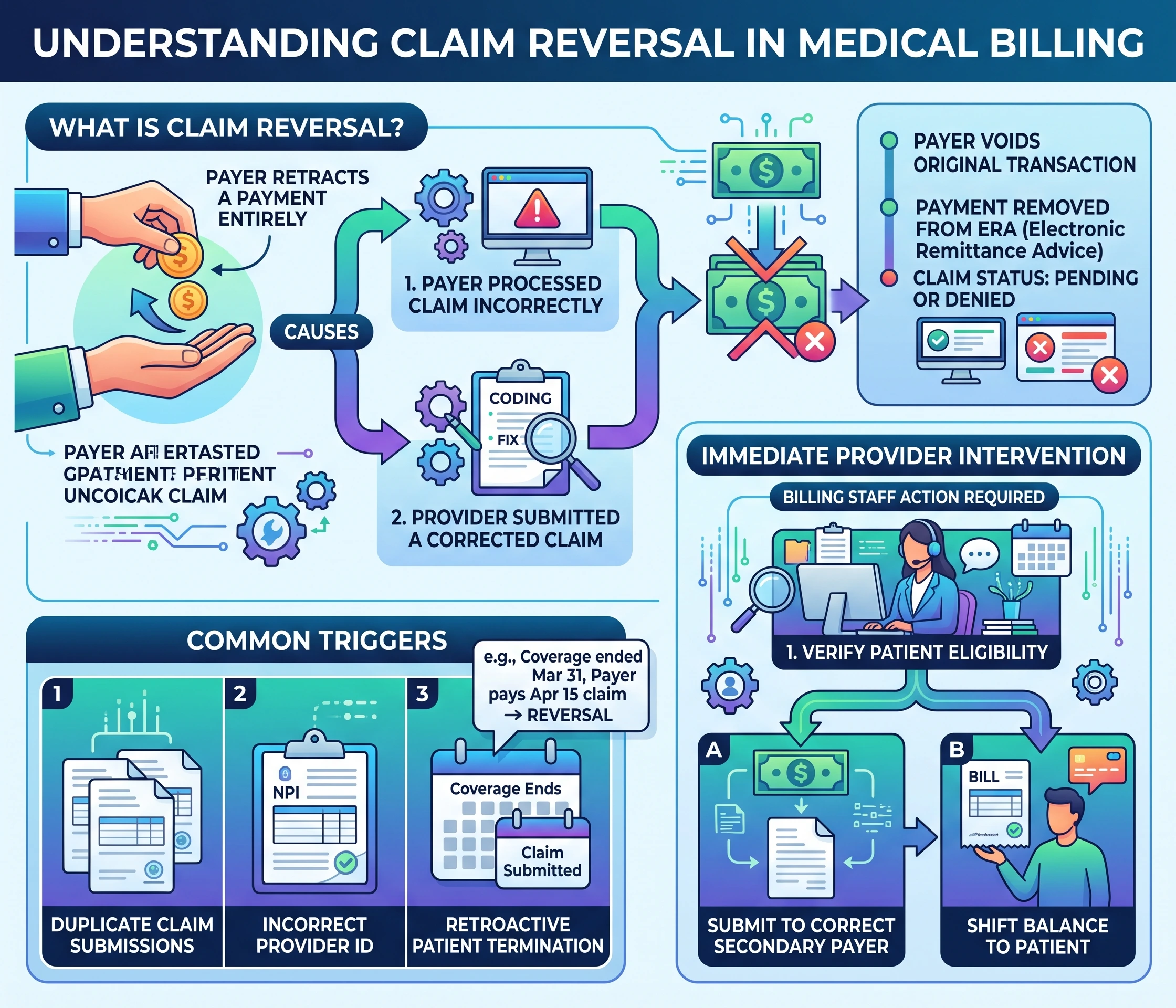
A claim reversal occurs when a payer retracts a payment entirely. This happens when the claim was processed incorrectly on the payer’s end or because the provider submitted a corrected claim to fix a coding error. During an insurance payment reversal, the payer voids the original transaction in their system. The payment is removed from the provider’s electronic remittance advice. The claim then returns to a pending or denied status.
Common triggers for reversed claims
Frequent triggers include duplicate claim submissions, incorrect provider identification numbers, and retroactive patient termination. Consider a scenario where a patient’s health coverage ended on March 31. If the payer mistakenly pays a claim for an April 15 visit, the payer will subsequently initiate a payment reversal.
The reversed claim requires the billing staff to intervene immediately. The biller must verify the patient’s eligibility at the time of service. Once verified, the biller submits the claim to the correct secondary payer or shifts the balance to the patient directly.
Recoupment meaning in medical billing
Recoupment in medical billing is a specific mechanism for healthcare overpayment recovery. It happens when an insurance company determines they have overpaid a provider for a previously processed claim. The payer actively reclaims those funds by deducting the overpayment amount from future remittances.
The role of recovery audit contractors
The Centers for Medicare and Medicaid Services manages this directly through the Recovery Audit Contractor program. According to the CMS fiscal year 2023 report to Congress, Medicare Recovery Audit Contractors identified and corrected 2.14 billion dollars in overpayments.
A recoupment process usually begins when the payer sends a formal recoupment letter. This document details the specific claim, the patient name, the date of service, and the exact reason for the overpayment. Audits targeting medical necessity, unbundling of services, and coordination of benefits errors frequently trigger these demands.
Difference between recoupment and offset in medical billing
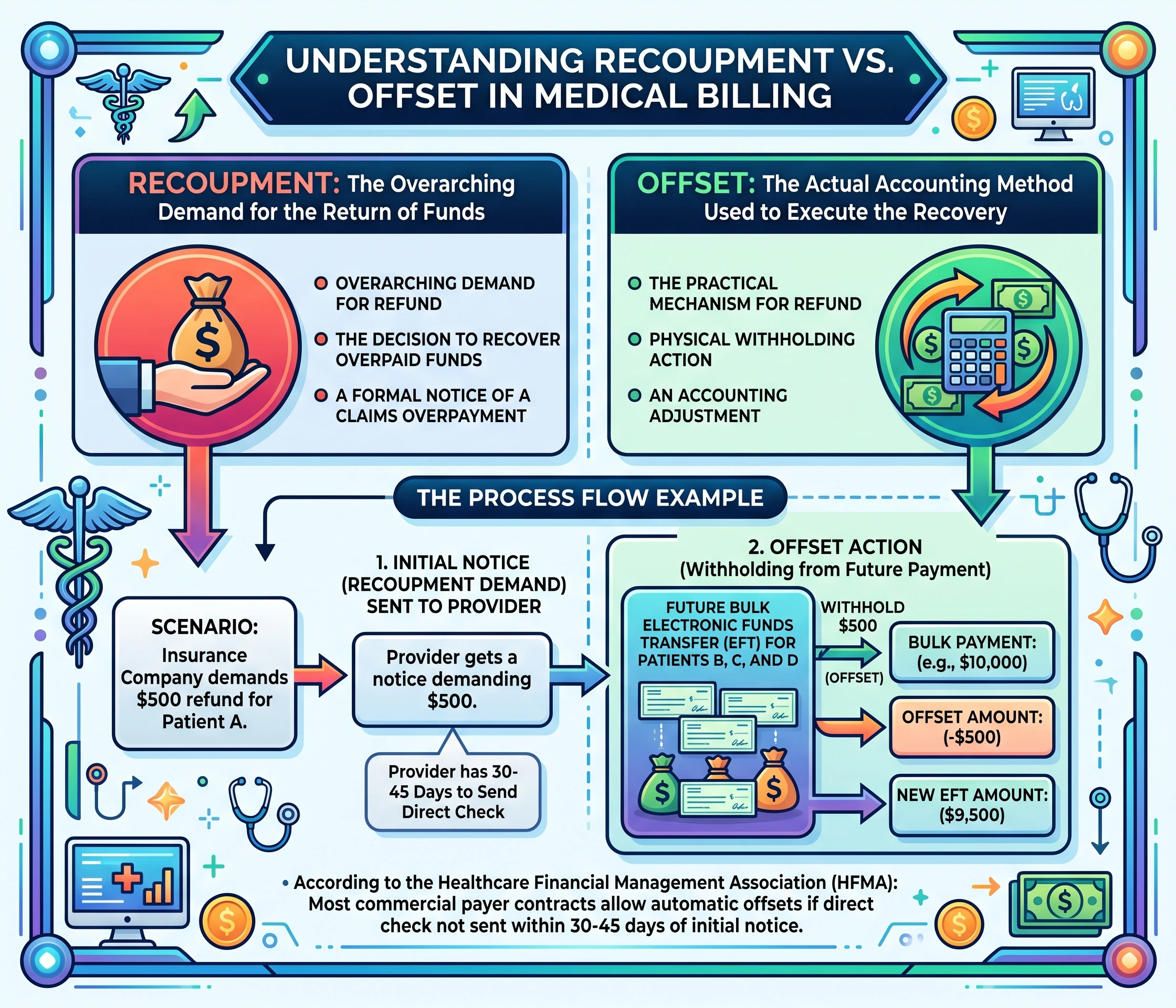
Medical billers often use recoupment and offset interchangeably, but they represent distinct accounting concepts. A payment recoupment is the overarching demand for the return of funds. An offset payment is the actual accounting method used to execute the recovery.
If an insurance company demands a 500-dollar refund for Patient A, they may withhold 500 dollars from a future bulk electronic funds transfer meant to pay for Patients B, C, and D. That physical withholding action is the offset. The Healthcare Financial Management Association notes that most commercial payer contracts allow automatic offsets if the provider does not send a direct check within 30 to 45 days of the initial notice.
Difference between reversal and recoupment in medical billing
Both actions reduce practice revenue. They differ primarily in timing, the initiating party, and the required resolution workflow.
Feature | Claim Reversal | Payment Recoupment |
Initiator | Payer or Provider | Payer exclusively |
Timing | Often immediate upon detecting a processing error | Usually months or years after the original payment |
Mechanism | Voids the original transaction entirely | Deducts funds from future unrelated claim payments |
Next Step | Provider submits a corrected claim | Provider accepts the deduction or files a formal appeal |
A reversal simply erases the payment as if it never happened. A recoupment acknowledges the original payment but reclaims the money later based on new audit findings.
The medical billing refund process and corrected claims
Providers must handle payment corrections systematically to avoid accounting imbalances. Sometimes a practice identifies an overpayment before the payer does. Standard compliance guidelines require the practice to initiate the medical billing refund process voluntarily.
Billing departments isolate the overpaid funds in a specific credit balance account to manage this workflow. Once the practice verifies the exact overpayment amount, they issue a direct refund check to the payer. Alternatively, they explicitly authorize a future offset. If the overpayment originated from a coding mistake, the biller must submit a reprocessed claim. This ensures the patient’s medical history matches the final financial record.
Federal regulations on overpayment recovery
Federal law regulates this strictly for government payers. Section 6402 of the Affordable Care Act mandates that providers report and return Medicare and Medicaid overpayments within 60 days of identification. Failing to meet this 60-day rule can trigger financial penalties and liability under the False Claims Act.
Managing the recoupment letter and appeals
Upon receiving a recoupment letter, a medical billing department has a limited window to respond. Commercial payers typically allow 30 to 60 days for the provider to review the findings. The biller reviews the patient’s medical record. If the documentation supports the original billing, the provider must submit a written appeal.
The Medical Group Management Association advises practices to halt automatic offsets during an active appeal process. The biller must send a formal written request to the payer’s provider relations department to suspend the offset.
A complete appeal packet requires several specific documents. The biller includes the original claim, the electronic remittance advice, the recoupment notice, and the full clinical documentation. The clinical notes must clearly support the medical necessity of the billed codes.
State laws and recovery timelines
State laws heavily regulate the recoupment timeline for commercial insurance. The Texas Department of Insurance, for example, restricts commercial health maintenance organizations and preferred provider organizations from initiating a recoupment more than 180 days after the original payment date. Exceptions exist only in cases of proven fraud. Providers must know their state regulations to identify and reject expired recoupment demands.
Reconciling the electronic remittance advice
Both reversals and recoupments complicate the payment posting process. When an offset payment occurs, the electronic remittance advice will show a lower total deposit than the sum of the individual claim payments. The biller must manually post the negative adjustment to the specific patient account that triggered the recoupment.
If the biller simply applies the reduced bulk payment across all current claims, multiple patient accounts will show incorrect balances. This leads to improper patient billing. Patients may receive statements for balances they do not actually owe.
Utilizing provider level adjustment codes
Accurate payment correction requires cross-referencing the offset code with the original overpayment notice. Standard coding for these adjustments utilizes Provider Level Adjustment reason codes on the remittance advice. Code 51 indicates a generic overpayment recovery, while Code 72 signifies a refund requested by the payer.
Precise accounts receivable management requires distinguishing between a reversed claim and an active recoupment offset. A reversal demands immediate investigation into the processing error and swift resubmission. A recoupment requires auditing past payments, tracking appeal deadlines, and matching future bulk checks to specific offset codes. Medical coders and billers who accurately identify and process these financial corrections maintain accurate ledger balances and ensure adherence to federal billing statutes.