

Choosing an electronic health record system means choosing how your practice will document visits, manage appointments, communicate with patients, and move charges into billing. The top EHR systems for small practices in the U.S. deserve comparison on those daily tasks, alongside subscription costs.
A solo therapist and a three-provider primary care clinic need different software. Even practices in the same specialty may need different billing arrangements, staff permissions, and connections to outside laboratories.
This guide compares six options using official vendor information checked on October 16, 2026. Recommendations reflect published features and likely practice fit, rather than hands-on performance testing. Prices below exclude temporary introductory discounts.
Comparing the top EHR systems for small practices in the U.S.
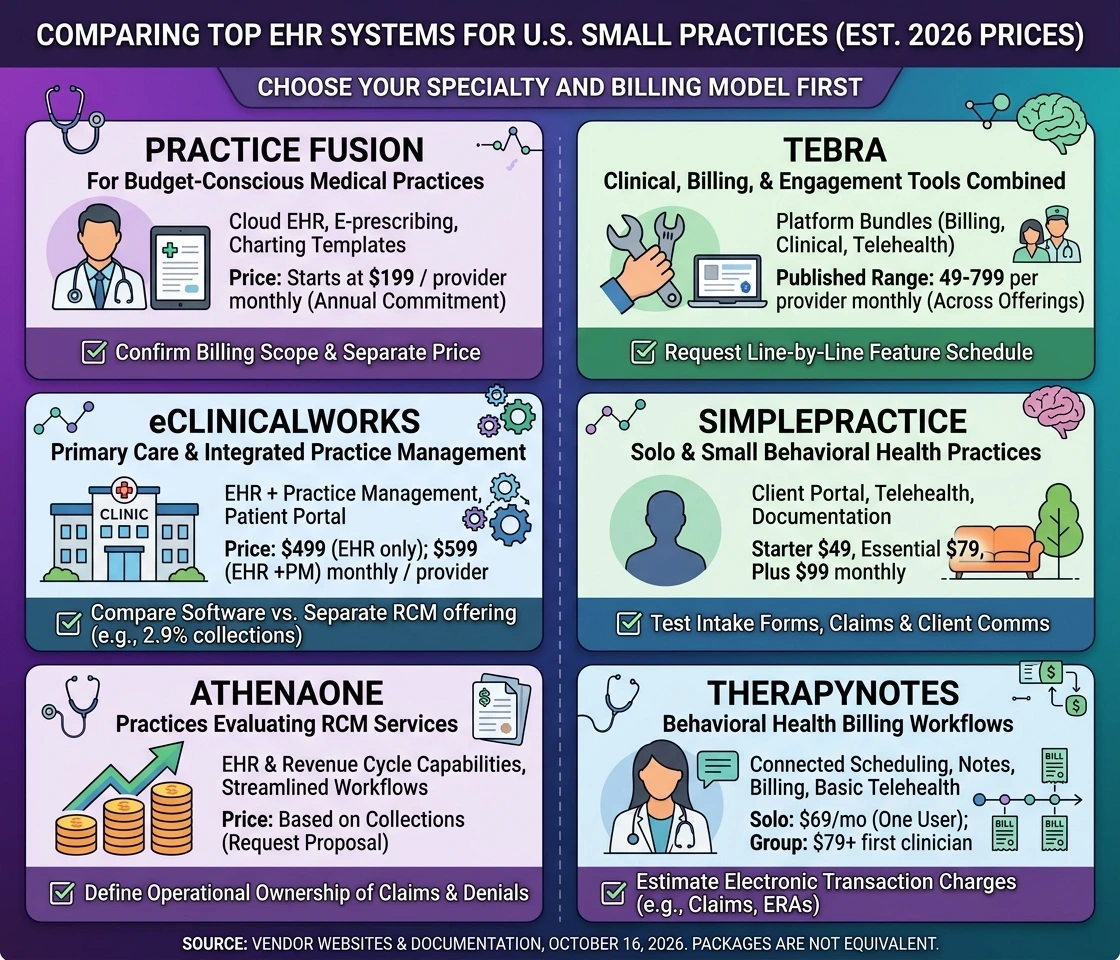
These products belong on different shortlists. Start with your specialty and billing model before comparing prices.
EHR system | Suggested practice fit | Published pricing or model | Main purchasing consideration |
Practice Fusion | Small medical practices seeking a lower starting EHR subscription | Starts at $199 per provider monthly, with an annual commitment | Confirm the separate scope and price of billing |
eClinicalWorks | Primary care and medical groups seeking EHR plus practice management | $499 per provider monthly for EHR; $599 with practice management | Compare software licensing with its separate RCM offering |
athenaOne | Practices considering collections-based pricing and revenue cycle services | Pricing tied to collections; request a proposal | Model costs at different collection levels |
Tebra | Independent practices evaluating clinical, billing, and patient engagement tools together | Vendor publishes a 49–799 per-provider monthly range across offerings | The lowest price is not a complete EHR-and-billing bundle |
SimplePractice | Solo and small behavioral health practices | Starter $49, Essential $79, Plus $99 monthly | Compare plan features and additional practitioner charges |
TherapyNotes | Behavioral health practices seeking connected scheduling, documentation, and billing | Solo $69 monthly; Group $79 for the first clinician plus $50 per additional clinician | Solo pricing requires the clinician to be the account’s only user |
Sources: vendors’ official pricing pages and TherapyNotes’ subscription documentation, accessed October 16, 2026. Packages are not equivalent, so these figures should not be treated as an apples-to-apples cost ranking.
Practice Fusion: A starting point for budget-conscious medical practices
Practice Fusion publishes a starting price of $199 per provider per month, billed monthly under an annual commitment. Its cloud EHR includes customizable charting templates, e-prescribing, and laboratory and imaging workflows. The provider subscription also includes three signing staff licenses and unlimited non-signing staff licenses.
It is worth evaluating for a small medical office that wants a defined starting subscription and needs staff access without purchasing a provider license for every administrative employee.
Check billing separately. Practice Fusion markets both billing software and billing services, so request an itemized proposal identifying which arrangement you are buying. Ask the demonstrator to move a completed visit into a claim and show where corrections occur.
eClinicalWorks: A candidate for primary care and integrated practice management
eClinicalWorks lists EHR-only pricing at $499 per provider monthly and EHR with practice management at $599. Published features include a patient portal, referral management, e-prescribing, reporting, cloud hosting, and support. Its separate RCM service is advertised at 2.9% of practice collections.
For a small primary care practice, those capabilities justify a demonstration covering medication renewal, referral tracking, laboratory review, and charge entry.
The purchasing decision requires careful scope comparison. Ask which services accompany the RCM percentage, how collections are defined, and whether your proposed agreement contains additional charges. A software subscription and an outsourced billing arrangement assign different responsibilities to your staff.
athenaOne: An option for practices evaluating revenue cycle services
athenahealth offers athenaOne to small practices with EHR and revenue cycle capabilities. Its published pricing explanation ties fees to organizational collections rather than providing a universal monthly provider rate.
Request a written proposal before comparing it with fixed-fee systems. Calculate the proposed charge using a slow month, a typical month, and a higher-volume month.
Also define operational ownership. Who resolves missing documentation? Who handles rejected claims, payer appeals, patient balances, and old accounts receivable? Ask the vendor to demonstrate how your staff can inspect outstanding work and identify the person responsible for each next action.
Tebra: An option for combining clinical and administrative tools
Tebra’s pricing page distinguishes individual products from platform bundles. Practice Essentials combines billing, clinical EHR, and telehealth; Practice Automation adds patient experience and engagement tools. Its published 49–799 range covers different offerings and configurations.
For a small clinic with limited staff, evaluate whether the proposed package covers the entire appointment cycle: booking, intake, documentation, claim submission, and patient payment.
Request a line-by-line feature schedule. Identify which tools are included, which require another subscription, and which generate transaction charges. Avoid budgeting from the lowest figure on a page that describes several products.
SimplePractice: A shortlist option for solo behavioral health providers
SimplePractice offers clinical documentation, a client portal, telehealth, and insurance claim functionality. Its standard monthly plans are $49, $79, and $99; additional practitioners are available through Plus, with published standard pricing starting at $74 per additional practitioner. E-prescribing is a separately priced add-on.
The best EHR for solo practice should match the clinician’s actual caseload. A therapist handling private-pay appointments should compare a different workflow from a psychologist submitting insurance claims for testing services.
Use the trial to check treatment plans, intake forms, claim corrections, and client communications. For group or family appointments, verify the required plan and telehealth arrangement before committing.
TherapyNotes: A shortlist option for behavioral health billing workflows
TherapyNotes connects scheduling, documentation, and billing. Its subscription documentation lists a client portal and basic telehealth among included features. Solo pricing is $69 monthly for one user; adding administrative access requires evaluating the Group arrangement, which starts at $79 for the first clinician.
Usage charges deserve attention. TherapyNotes lists electronic claims at 14 cents each, eligibility requests at 14 cents each, and ERA processing at 14 cents per claim within an ERA.
For an insurance-based practice, estimate those transactions using a normal month. During the demonstration, test how the biller finds incomplete notes, corrects claim information, and reconciles insurer payments with patient responsibility.
How much does EHR software cost?
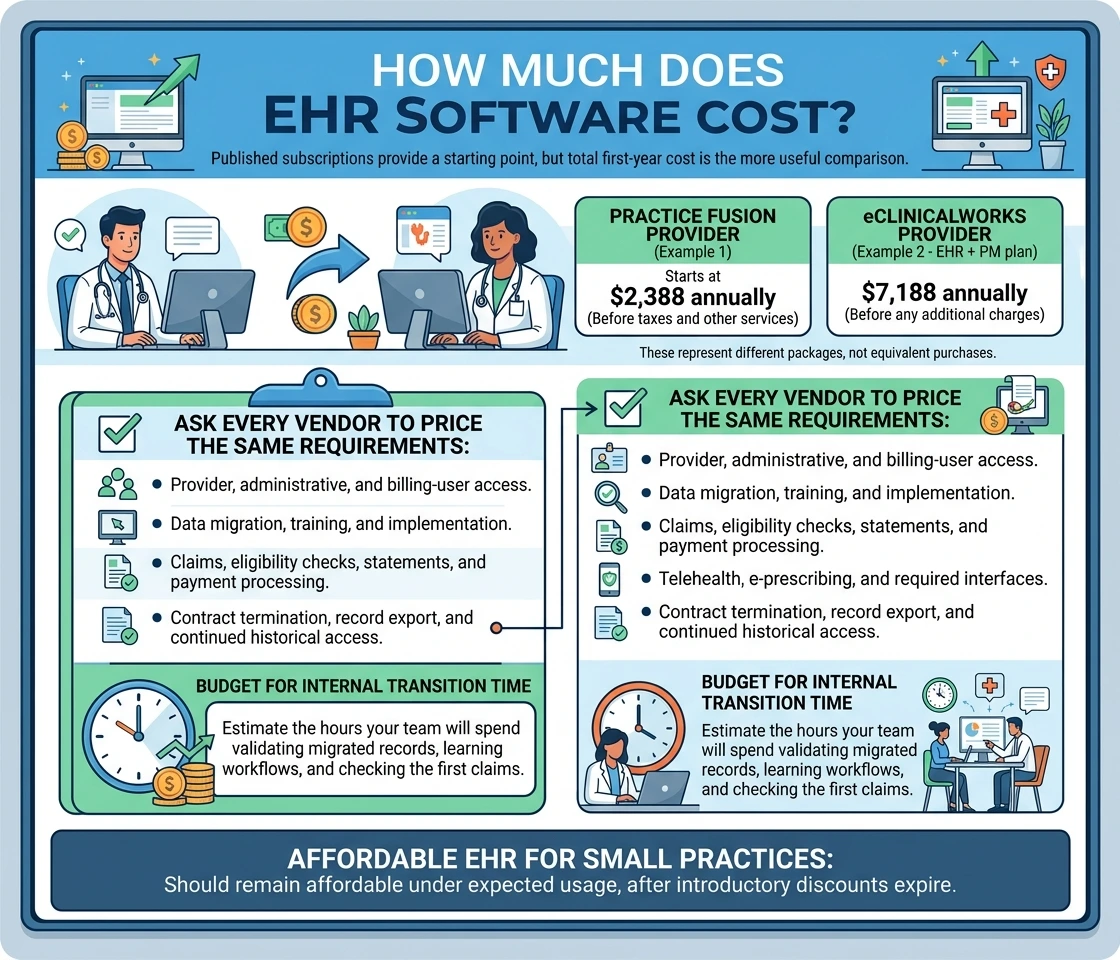
Published subscriptions provide a starting point, but total first-year cost is the more useful comparison.
Using the rates above, one Practice Fusion provider starts at $2,388 annually before taxes and other services. One eClinicalWorks provider on the EHR-plus-practice-management plan costs $7,188 annually before any additional charges. These calculations represent different packages, not equivalent purchases.
Ask every vendor to price the same requirements:
- Provider, administrative, and billing-user access.
- Data migration, training, and implementation.
- Claims, eligibility checks, statements, and payment processing.
- Telehealth, e-prescribing, and required interfaces.
- Contract termination, record export, and continued historical access.
Include internal transition time in your budget. Estimate the hours your team will spend validating migrated records, learning workflows, and checking the first claims.
An affordable EHR for small practices should remain affordable under expected usage, after introductory discounts expire.
How to evaluate EHR billing integration
The best EHR with billing should pass a complete workflow demonstration using a fictional patient.
Ask the vendor to show registration, eligibility verification, documentation, charge review, claim submission, rejection correction, remittance posting, and patient balance reporting. Record every point where staff must re-enter information or move into another application.
For medical billing and coding students, distinguish three purchasing categories:
Category | What to verify |
Clinical EHR | Documentation, orders, medications, and clinical information |
Practice management and billing software | Scheduling, charges, claims, payments, and financial reporting |
Managed billing service | Contracted staff responsibilities for billing operations and follow-up |
Ask whether the practice can see claim status and export financial reports independently. If you retain an outside billing company, include its staff in the demonstration and confirm their access permissions before signing.
How to choose an EHR for a small practice
Test specialty workflows and usability
An easy-to-use EHR should be tested by the people who will use it. Have a clinician, receptionist, and biller complete their own tasks during the trial.
For primary care, test medication reconciliation, laboratory results, referrals, and follow-up tracking. For behavioral health, test treatment plans, recurring appointments, documentation access, and the services your clinicians actually bill.
For an EHR with a patient portal, try intake and appointment requests from a patient’s phone. For telehealth, test joining instructions and guest access. For e-prescribing, confirm the functionality, setup requirements, and cost your prescribers need.
Check security and data portability
A “HIPAA-compliant EHR” label does not complete the practice’s compliance work. HHS’s Guidance on HIPAA & Cloud Computing, accessed October 16, 2026, explains the need for an appropriate business associate agreement and risk analysis when using cloud services for electronic protected health information.
Ask about access controls, audit records, authentication, backups, and incident procedures.
Where certification is relevant, verify the exact product in the federal Certified Health IT Product List. Federal guidance for the EHI export certification criterion also provides for publicly available export-format documentation. Request a sample export and ask a prospective receiving vendor whether it can import the contents.
Choose based on a demonstrated workflow
The top EHR systems for small practices in the U.S. offer different combinations of clinical tools, billing capabilities, and pricing structures. Practice Fusion and eClinicalWorks provide published medical-practice subscription benchmarks; SimplePractice and TherapyNotes offer behavioral health options; athenaOne and Tebra require careful comparison of the proposed service or product package.
Reduce your shortlist to two or three systems. Select only after your team completes representative tasks, reviews a written total-cost proposal, and confirms how records and billing data can be retrieved when the agreement ends.
Vorbelutrioperbir
It’s actually a nice and helpful piece of info. I am glad that you shared this helpful information with us. Please stay us informed like this. Thanks for sharing.