

A patient with a deep finger laceration can walk into an urgent care center or a hospital emergency department. The sutures may be identical. The claims will not be. One visit usually produces a single professional claim; the other produces at least two, built on different forms, different code sets, and different payment rules.
This guide gives you urgent care vs emergency room billing explained from the coder’s side of the desk: which codes apply, where the place of service and revenue codes go, how payers reimburse each setting, and which insurance rules decide whether an emergency claim gets paid.
Difference between ER and urgent care billing: one claim or two
The biggest structural difference is the facility fee.
A freestanding, physician-owned urgent care center typically bills like a physician office. Services go out on the CMS-1500 (837P) with place of service 20, and the payment covers both the clinician’s work and the center’s overhead.
A hospital emergency department splits the encounter. The hospital bills its facility charge on the UB-04 (837I) using revenue codes in the 045X series, and the emergency physician or advanced practice provider bills a separate professional claim with POS 23. Peterson-KFF researchers describe this directly: after an ED visit, both the clinician and the facility bill separately, and both use a CPT evaluation and management code.
That split explains most of the cost gap discussed later in this article.
How does urgent care billing work?
Urgent care CPT codes and the place of service code
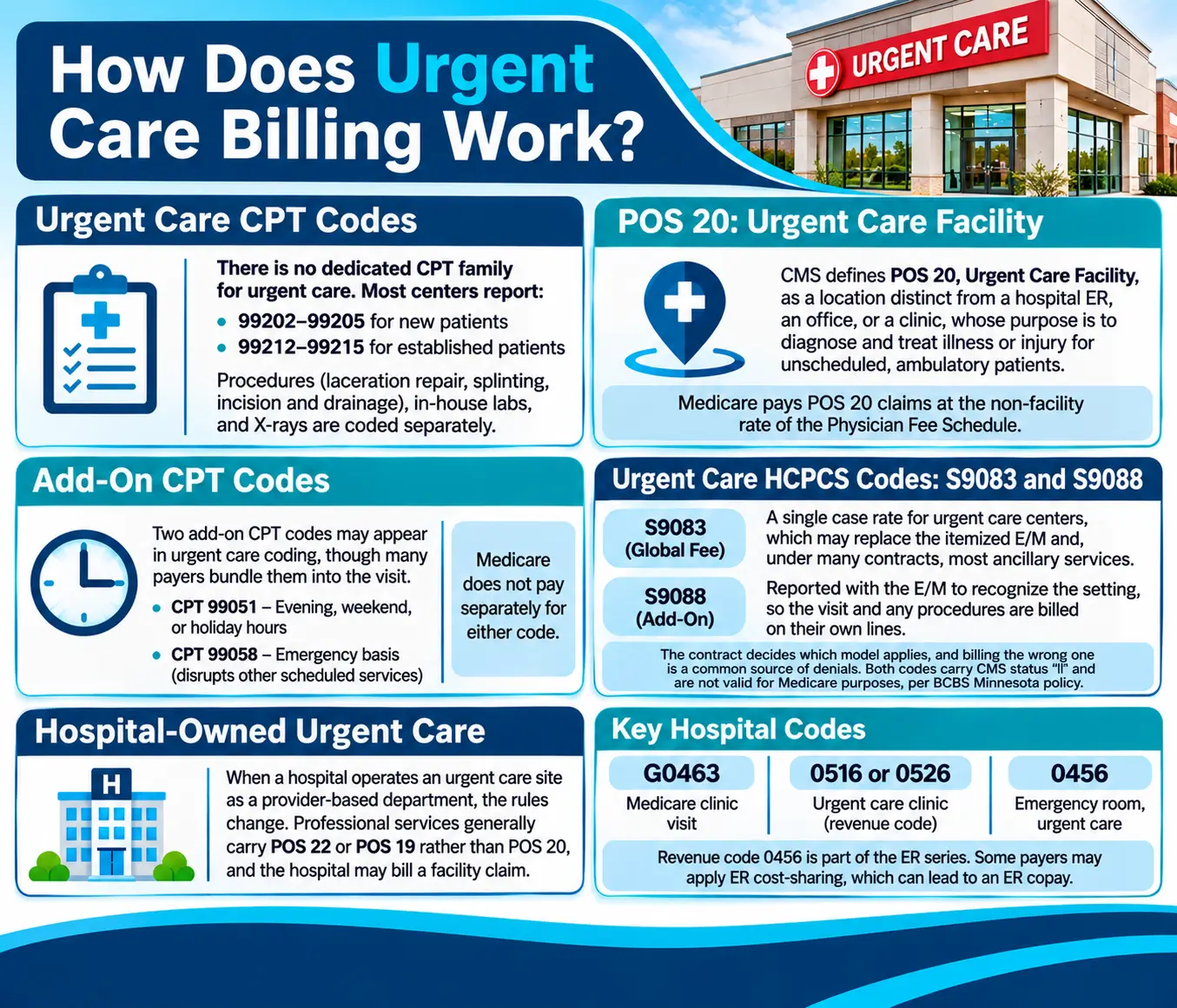
There is no dedicated CPT family for urgent care. Most centers report the office and outpatient E/M codes, 99202-99205 for new patients and 99212-99215 for established patients, leveled by medical decision making or total time under the AMA rules in effect since 2021. Procedures (laceration repair, splinting, incision and drainage), in-house labs, and X-rays are coded separately.
CMS defines POS 20, Urgent Care Facility, as a location distinct from a hospital emergency room, an office, or a clinic, whose purpose is to diagnose and treat illness or injury for unscheduled, ambulatory patients seeking immediate medical attention. Medicare pays POS 20 claims at the non-facility rate of the Physician Fee Schedule, because the center carries its own practice expense.
Two add-on CPT codes also appear in urgent care coding, although many payers bundle them into the visit. CPT 99051 reports services provided during regularly scheduled evening, weekend, or holiday office hours, and CPT 99058 reports services provided on an emergency basis in the office that disrupt other scheduled services. Medicare does not pay separately for either code.
Urgent care HCPCS codes: S9083 and S9088
Commercial and Medicaid managed care contracts often require one of two HCPCS Level II S-codes. S9083 (global fee, urgent care centers) is a single case rate that replaces the itemized E/M and, under many contracts, most ancillary services. S9088 (services provided in an urgent care center) is an add-on reported with the E/M to recognize the setting, so the visit and any procedures are still billed on their own lines.
The contract decides which model applies, and billing the wrong one is a common source of denials. Medicare does not pay either code. Blue Cross and Blue Shield of Minnesota’s Medicare coding policy notes that both carry CMS status indicator “I” (not valid for Medicare purposes) and will be denied.
Hospital-owned urgent care is a separate case
When a hospital operates an urgent care site as a provider-based department, the rules change. Professional services generally carry POS 22 or POS 19 (on-campus or off-campus outpatient hospital) rather than POS 20, and the hospital may bill a facility claim, typically with G0463 for a Medicare clinic visit and a clinic revenue code such as 0516 (urgent care clinic) or 0526 (free-standing urgent care clinic).
Revenue code 0456 sits inside the emergency room series (“Emergency room, urgent care”). Some payers apply ER cost-sharing when they see it, which is why a patient at a hospital-branded urgent care may be charged an ER copay. Coders working for health systems should confirm which revenue code each payer expects for each site.
How does emergency room billing work?
Professional claims: CPT codes for emergency room visits
Emergency physicians report 99281-99285 with POS 23. The AMA revised these codes effective January 1, 2023.
Under the revised descriptors, 99281 describes a visit that may not require the presence of a physician or other qualified health care professional. The remaining four levels follow medical decision making: 99282 requires straightforward MDM, 99283 low, 99284 moderate, and 99285 high.
History and exam no longer count toward level selection; documentation needs only to be “medically appropriate.” Unlike office visits, ED levels cannot be chosen by time, because the AMA treats emergency care as variable-intensity work across many simultaneous patients. Critical care (99291, 99292) was not affected by the 2023 changes and can still be reported by time.
Facility claims: emergency room revenue codes
The hospital’s UB-04 uses the 045X revenue code series. Revenue code 0450 is the general emergency room code, 0451 covers the EMTALA medical screening examination, and 0452 covers ER services beyond that screening. Code 0456 is labeled urgent care, and 0459 captures other emergency room services.
The Texas HHS Office of Inspector General lists “services billed without an associated HCPCS code” among common outpatient emergency billing errors; revenue codes 0450, 0456, and 0459 require a procedure code on the line.
Hospital facility levels follow different logic from professional levels. Under the Outpatient Prospective Payment System (OPPS), CMS requires each hospital to write and consistently apply its own internal guidelines that tie the visit level to hospital resources used, and CMS has published 11 general principles those guidelines must meet. The professional level and the facility level for the same visit do not have to match.
Type A and Type B emergency departments
Under OPPS, a Type A department is open 24 hours a day, 7 days a week, and reports facility visits with 99281-99285. A Type B department meets the regulatory definition of an emergency department but operates fewer hours, and reports G0380-G0384 instead.
ER vs urgent care billing at a glance
Side by side, the two settings differ on almost every claim element. A freestanding urgent care center files only the CMS-1500 with POS 20, reports 99202-99215 (or S9083 or S9088 where the contract requires it), uses no revenue codes, and selects the E/M level by medical decision making or total time. Medicare pays its clinicians the non-facility fee schedule rate.
A hospital emergency department files a UB-04 for the facility and a CMS-1500 for the professional, with POS 23 on the professional claim. Its visit codes are 99281-99285, or G0380-G0384 for a Type B facility, alongside revenue codes 0450-0459. The professional level rests on medical decision making alone and the facility level on the hospital’s internal resource guidelines; Medicare pays the clinician the facility rate, while the hospital is paid under OPPS.
Federal surprise billing protection splits along the same line. It always applies to emergency department visits, but it reaches an urgent care center only when the state licenses that center to provide emergency services.
ER vs urgent care reimbursement and cost differences
The most cited cost data come from claims analyses rather than list prices. A Peterson-KFF Health System Tracker analysis of 2019 large-employer claims (Schwartz, Rae, Claxton, Cotliar, Amin, and Cox, December 2022) found that the average ED visit cost $2,453, with enrollees paying $646 out of pocket.
A follow-up Peterson-KFF brief published in March 2023 traced much of that cost to the facility side. ED facility fees for E/M services rose 531% between 2004 and 2021, roughly four times the 132% growth in professional fees over the same period.
Urgent care sits at a different price point. FAIR Health’s 2018 Healthcare Indicators report put the median charge for an urgent care visit at $242, lower than the $294 median for a 30-minute new-patient office visit.
These figures come from different years and payer populations, so treat them as directional, not as a side-by-side price.
For Medicare, the 2026 Physician Fee Schedule final rule (CMS-1832-F, released October 31, 2025) set two conversion factors: $33.4009 for most clinicians and $33.5675 for qualifying Advanced APM participants. Urgent care centers billing POS 20 receive the higher non-facility payment for each E/M code, while emergency physicians receive the facility rate and the hospital is paid separately under OPPS. Commercial urgent care reimbursement rates are negotiated contract by contract, which is why the S9083 case rate a center accepts matters more to its revenue than any national average.
Insurance rules for emergency and urgent care visits
The prudent layperson standard
Federal law requires most health plans to judge emergency coverage by the patient’s symptoms at presentation, not by the final diagnosis. The test asks whether a prudent layperson with an average knowledge of health and medicine would reasonably expect that the absence of immediate care could cause serious harm. The Balanced Budget Act of 1997 applied the standard to Medicare Advantage and Medicaid managed care, and the Affordable Care Act extended it to most private plans.
The No Surprises Act regulations, issued as an interim final rule on July 1, 2021, went further. CMS guidance for plans states that the prudent layperson analysis must use presenting symptoms, not final diagnosis codes alone, and must happen before an initial denial of an emergency services claim. Plans also cannot require prior authorization for emergency services.
Where urgent care fits under the No Surprises Act
The Act’s emergency protections apply to hospital emergency departments and independent freestanding emergency departments. An urgent care center qualifies only if the state licenses it to provide emergency services. In most states urgent care centers are not licensed as health care facilities at all, so out-of-network urgent care visits usually fall outside the federal ban on balance billing. Billing staff should check their state’s licensure category before quoting surprise-billing protections to patients.
Emergency versus non-emergency claims: handling CARC 40 denials
When a payer decides a visit did not qualify for emergency or urgent benefits, the remittance often carries claim adjustment reason code 40: “Charges do not meet qualifications for emergent/urgent care.” The group code tells you who carries the balance: CO-40 assigns it to the provider under contract, while PR-40 shifts it to the patient.
A typical scenario: a patient arrives with chest pressure and shortness of breath, receives an ECG, troponin testing, and a chest X-ray, and leaves with a diagnosis of gastroesophageal reflux. A payer that denies the claim from the reflux code alone has skipped the presenting-symptom review federal rules require.
An effective appeal for this kind of denial starts with the chief complaint and triage notes, recorded in the patient’s own description of symptoms. Add the vital signs and any abnormal findings at arrival, then show the diagnostic workup ordered to rule out life-threatening causes. Close with a citation to the prudent layperson standard under the Affordable Care Act and the No Surprises Act regulations (45 CFR 149.110 for individual and group market plans).
Coding symptom diagnoses (for example, R07.89 for other chest pain) as secondary codes alongside the final diagnosis also gives payer editing systems the presenting picture.
Urgent care billing and coding guidelines that prevent rework
Most rework in urgent care billing traces back to the payer contract. Before a claim goes out, confirm whether that payer pays S9083, S9088 with an E/M, or itemized fee-for-service, because a claim built on the wrong model is usually denied in full.
Place of service is the next check. POS 20 belongs only to sites that meet the CMS definition, while provider-based hospital sites take POS 19 or POS 22. Codes 99281-99285 describe a hospital emergency department and should never be reported for an urgent care center visit.
On the hospital side, every ED facility line under revenue codes 0450, 0456, and 0459 needs a CPT or HCPCS code. Keep the hospital’s internal ED leveling criteria on file, since payers and auditors routinely request them. When a procedure and a significant, separately identifiable E/M service fall on the same date, check the payer’s modifier 25 policy before submitting.
Summary
With urgent care vs emergency room billing explained side by side, the differences come down to structure. A freestanding urgent care center sends one professional claim with POS 20, office E/M codes, and often a contract-specific S-code. A hospital ED sends a professional claim with POS 23 and 99281-99285 leveled by medical decision making, plus a facility claim with 045X revenue codes leveled by the hospital’s own resource guidelines. That second claim is where most of the price difference sits: Peterson-KFF found ED facility fees grew 531% in 17 years. On the coverage side, the prudent layperson standard protects ED claims from final-diagnosis denials, while most urgent care centers remain outside the No Surprises Act unless their state licenses them for emergency services.