


Medical practices process thousands of claims electronically using standardized data formats. The current standard for healthcare claims in the United States is the ASC X12 Version 5010 format. When a practice submits a medical claim, the data travels through a clearinghouse to the payer. If the submitted data contains unrecognized provider or patient information, the system generates an immediate error.
Understanding what an entity code rejection in medical billing is requires examining how electronic data interchange (EDI) software categorizes information. Medical billers and coders must identify these errors quickly to maintain a consistent revenue cycle.
What is an entity code in medical billing?
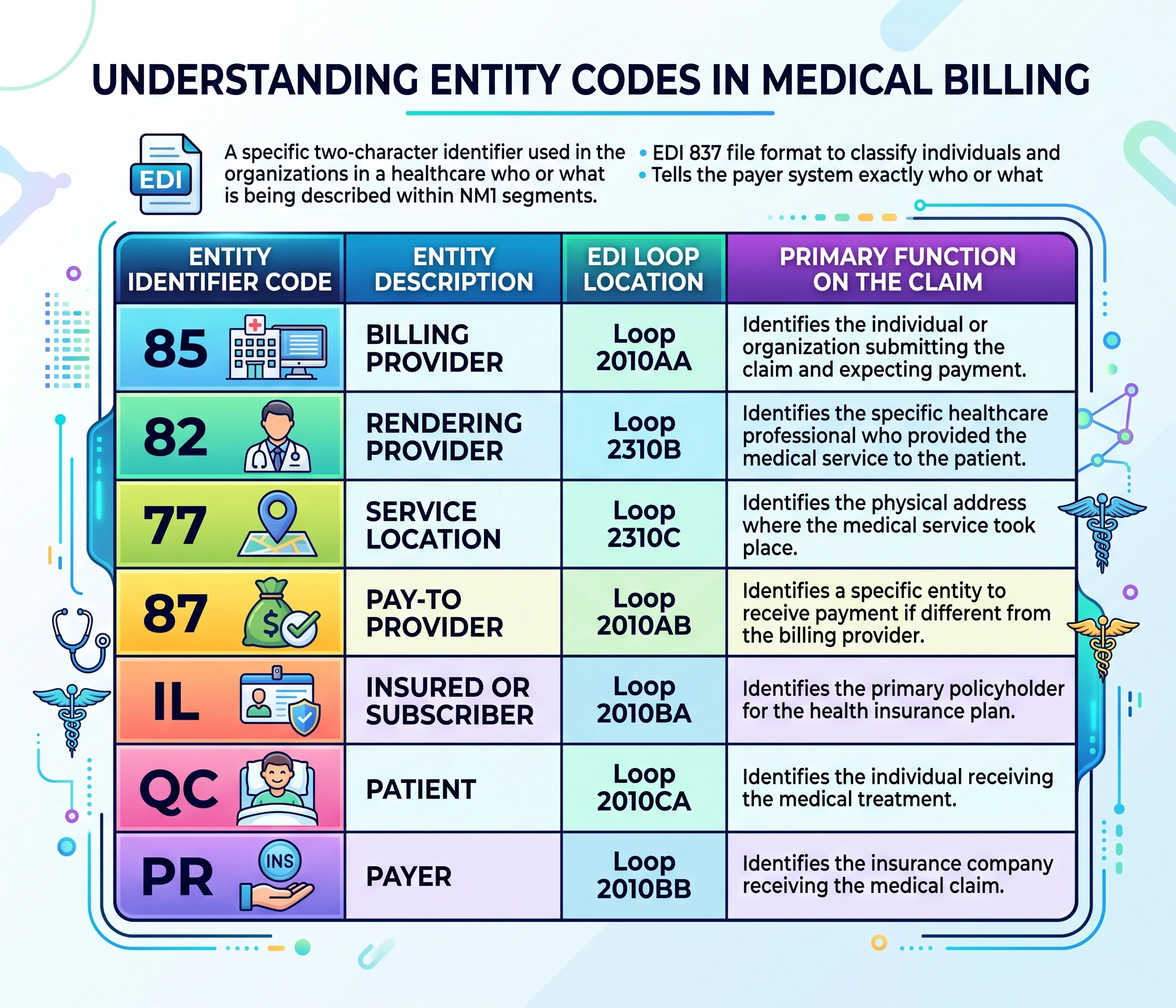
An entity code in medical billing refers to a specific two-character identifier used within the EDI 837 file format to classify the individuals and organizations involved in a healthcare transaction. The EDI 837 file is the electronic version of the CMS-1500 or UB-04 claim form.
Within this electronic file, data is organized into segments and loops. The NM1 segment contains the names of the parties involved in the claim. The entity identifier code sits within the NM101 data element. This code tells the payer system exactly who or what is being described in that specific section of the claim.
The entity code meaning is highly literal. It identifies whether the National Provider Identifier (NPI) and name listed belong to the physician performing the service, the clinic billing for the service, the insurance company receiving the claim, or the patient receiving the care.
Common entity identifier codes on a claim
To understand how claims function mechanically, billers must recognize the standardized codes that categorize every participant. The table below compares the most frequent entity identifier codes found in an 837 healthcare claim file.
Entity Identifier Code | Entity Description | EDI Loop Location | Primary Function on the Claim |
85 | Billing Provider | Loop 2010AA | Identifies the individual or organization submitting the claim and expecting payment. |
82 | Rendering Provider | Loop 2310B | Identifies the specific healthcare professional who provided the medical service to the patient. |
77 | Service Location | Loop 2310C | Identifies the physical address where the medical service took place. |
87 | Pay-to Provider | Loop 2010AB | Identifies a specific entity to receive payment if different from the billing provider. |
IL | Insured or Subscriber | Loop 2010BA | Identifies the primary policyholder for the health insurance plan. |
QC | Patient | Loop 2010CA | Identifies the individual receiving the medical treatment. |
PR | Payer | Loop 2010BB | Identifies the insurance company receiving the medical claim. |
What is an entity code rejection in medical billing?
An entity code rejection in medical billing is a front-end EDI rejection indicating that the payer or clearinghouse system cannot validate the identity of a specific party listed on the claim.
This error happens before the claim ever reaches a claims adjuster for medical review. Claim scrubbers automatically check the submitted entity codes against provider credentialing databases, patient eligibility files, and payer identification records. If a data element attached to an entity code does not match the database exactly, the system aborts the process.
The software returns an EDI 277CA (Claim Acknowledgement) file containing an alphanumeric error code. This report alerts the medical biller that the file failed transmission.
What does entity not found mean on a medical claim?
When a medical biller sees an entity not found rejection, the payer system is stating that the identifying numbers submitted do not match any known records.
This happens frequently when a newly hired physician is not yet fully loaded into a specific insurance company’s system. The practice transmits the claim using the new physician’s NPI as the rendering provider (Entity Code 82). The insurance company searches its active provider directory for that NPI. If the credentialing department has not finalized the provider’s contract, the system returns an entity not found error.
This also occurs when a practice submits a claim to the wrong payer identification number. If the electronic routing number for the insurance company (Entity Code PR) is outdated, the clearinghouse will stop the claim.
What does entity not eligible mean?
An entity not eligible rejection usually points to an issue with the patient or the subscriber (Entity Codes QC or IL). It indicates that the system successfully identified the person, but the database shows their insurance coverage was inactive on the specific date of service.
In some cases, the issue may be associated with a specific provider. If a provider is excluded from participating in Medicare or Medicaid, CMS systems may identify the billing entity or rendering provider as ineligible to receive federal healthcare funds.
Why does a claim say no related entity can be identified?
The error message stating no related entity can be identified is a relational field error. EDI files require specific pieces of data to link together logically.
For example, a claim might include a rendering provider (Code 82) but fail to include a billing provider (Code 85). The payer software requires a billing provider to know where to send the payment. Because the system cannot find the required primary entity linked to the secondary entity, the validation fails.
Primary causes of entity identification errors
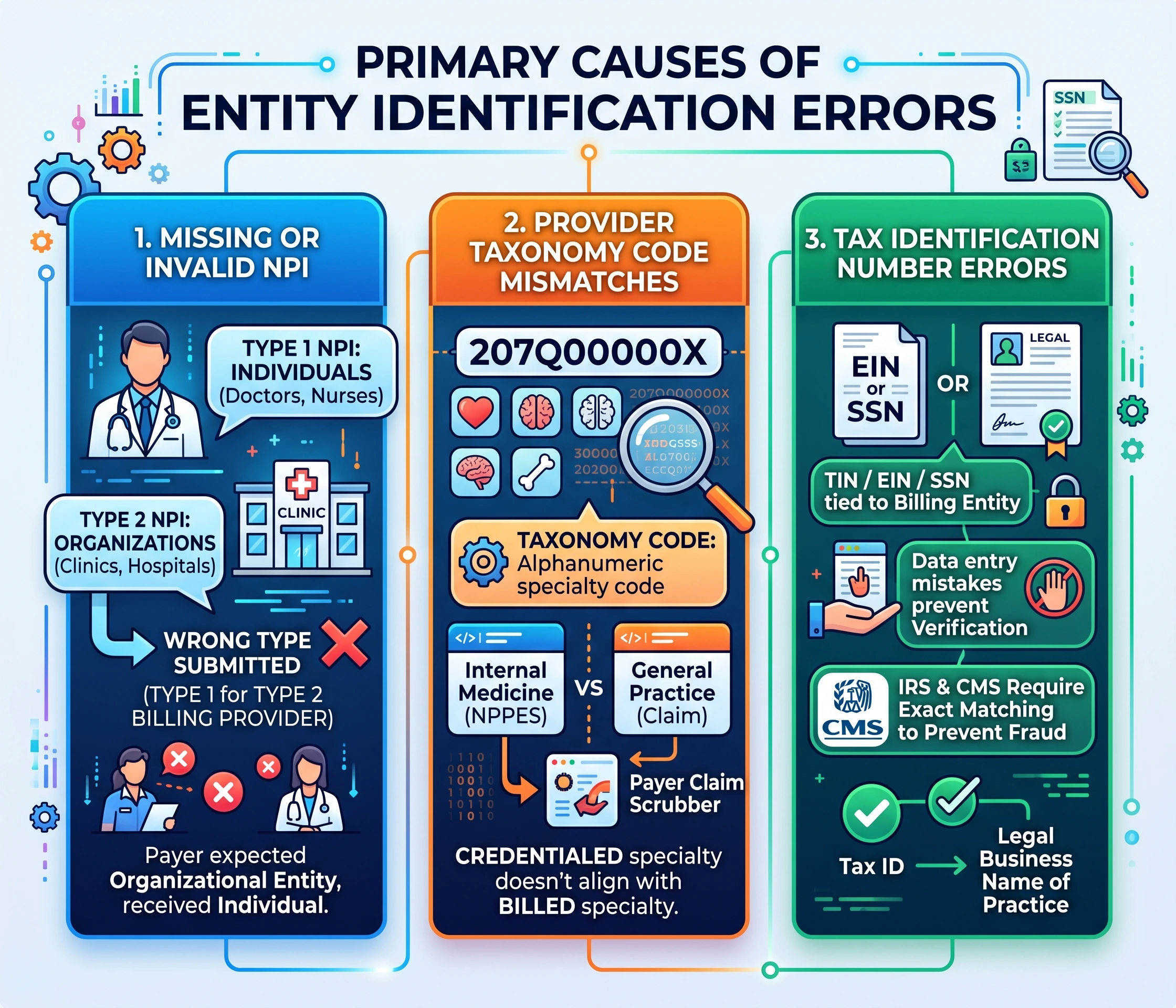
Medical billers encounter these front-end rejections due to specific clerical and data entry mistakes. Identifying the root cause requires analyzing the exact provider information submitted on the date of service.
Missing or invalid National Provider Identifier
Federal law requires all covered healthcare providers to use a 10-digit NPI for administrative and financial transactions.
There are two types of NPIs. Type 1 NPIs belong to individual healthcare professionals. Type 2 NPIs belong to organizations and incorporated practices. Submitting a Type 1 NPI in the billing provider loop when the payer requires the clinic’s Type 2 NPI will trigger a validation failed for one or more entities rejection. The payer expects an organizational entity but receives an individual entity.
Provider taxonomy code mismatches
A taxonomy code is a 10-character alphanumeric string that designates a healthcare provider’s specialty at the national level. Payer systems often require the taxonomy code to match the NPI exactly as registered in the National Plan and Provider Enumeration System (NPPES).
If a physician registers as an internal medicine specialist but the billing software transmits a taxonomy code for a general practice physician, the payer claim scrubber detects the discrepancy. This frequently results in an entity identifier code error because the credentialed specialty does not align with the billed specialty.
Tax Identification Number errors
Claims must include the exact Employer Identification Number (EIN) or Social Security Number tied to the billing entity. Data entry mistakes in the Tax ID field prevent the payer from verifying the legal business name of the practice. The IRS and CMS require exact matching of the Tax ID to the legal business name to prevent fraud.
Decoding complex EDI rejection messages
Clearinghouse reports often display technical language that requires translation into actionable steps.
What does “this code requires use of an entity code” mean?
This specific message indicates a structural failure in the 837 file format. A segment of the claim was triggered that legally requires a modifying entity code, but the software left the NM101 field blank. This is usually a software glitch within the practice management system. The system attempted to list a provider or facility but failed to attach the two-digit qualifier (like 85 or 82) that tells the payer what type of facility it is.
Invalid participant identification
When an invalid participant identification error appears, the focus should shift to the patient’s ID number. Insurance companies update policy numbers and member prefixes annually. If a patient presents a medical card from 2023 for a service rendered in 2025, the old member ID number will fail the system’s eligibility check.
How to fix an entity code rejection
Resolving an entity-related EDI rejection requires systematic verification of the data transmitted compared to the data on file with the payer.
Verify the NPI and Taxonomy Code
The first step in claim correction involves checking the National Plan and Provider Enumeration System registry. Billers must type the provider’s NPI into the public database to verify the exact legal name, Type 1 or Type 2 status, and primary taxonomy code attached to the number.
If the practice management system contains an outdated taxonomy code or a misspelled provider name, the biller must update the internal software to match the federal registry exactly.
Check provider enrollment status
If the NPI and names match, the biller must verify the provider’s credentialing status with the specific insurance company issuing the rejection.
A provider can hold a valid NPI and state license but lack an active contract with a commercial payer. The medical biller must contact the practice’s credentialing department or the payer’s provider enrollment hotline to confirm the effective date of the provider’s contract. If the date of service occurred before the contract effective date, the claim will remain rejected until the provider secures retroactive credentialing.
Review the billing versus rendering loops
Billers must examine the EDI file output to ensure the practice management system populated the correct loops.
If a sole proprietor is billing for services, some payers require the provider’s information to appear in both the Billing Provider loop (2010AA) and the Rendering Provider loop (2310B). Other payers strictly require the rendering loop to remain blank if the billing provider and rendering provider are the same person. Submitting redundant data against payer-specific formatting rules causes immediate entity rejections.
Update patient demographics
If the rejection involves the patient entity, the medical biller must utilize the clearinghouse eligibility tool. By running a real-time 270/271 EDI eligibility transaction using the patient’s date of birth and social security number, the biller can pull the current, active member identification number directly from the payer’s database.
Executing claim resubmission protocols
Front-end rejections do not require formal appeals. Because the claim never entered the payer’s adjudication system, it does not exist in their claims history.
Once the medical biller identifies the typographical error, updates the NPI, or fixes the taxonomy code in the practice management system, they can simply generate a new batch file. The corrected claim is transmitted as an original submission.
Preventing future entity identification errors
According to the Healthcare Financial Management Association (HFMA), accurate data capture at the front desk reduces back-end administrative costs significantly.
Practices that experience high volumes of entity code rejections usually suffer from outdated provider dictionaries within their billing software. Conducting a quarterly audit of the practice’s provider database prevents these errors. Billers should verify that every physician’s NPI, Tax ID, and taxonomy code match the current NPPES registry and payer contracts.
Automated claim scrubbers within the practice management system can be programmed to flag missing entity codes before the file transmits to the clearinghouse. Setting up internal rules to verify that Loop 2010AA always contains an organizational NPI and Loop 2310B always contains an individual NPI stops bad data from leaving the building.
Medical billing depends entirely on exact data matching. When an entity code rejection in medical billing occurs, it halts the payment process at the very first digital checkpoint. By understanding the specific X12 loop locations, the function of the two-digit identifier codes, and the precise credentialing data required by payers, medical billers can correct these electronic errors quickly and maintain a consistent cash flow for the practice.