

A denied claim is revenue the practice has already earned but cannot collect yet. What frustrates most billing teams is how ordinary the causes usually are: a transposed member ID, an authorization that expired two days before the procedure, a diagnosis code that does not support the procedure billed.
If you keep asking why are my medical claims getting denied, start with the remittance advice. The payer has already told you the reason in code. Below you will find what the latest federal and industry data show about denial rates, the reasons payers give most often, how to read those codes, and which workflow changes stop the same denial from coming back next month.
What is a claim denial, and how is it different from a rejection?
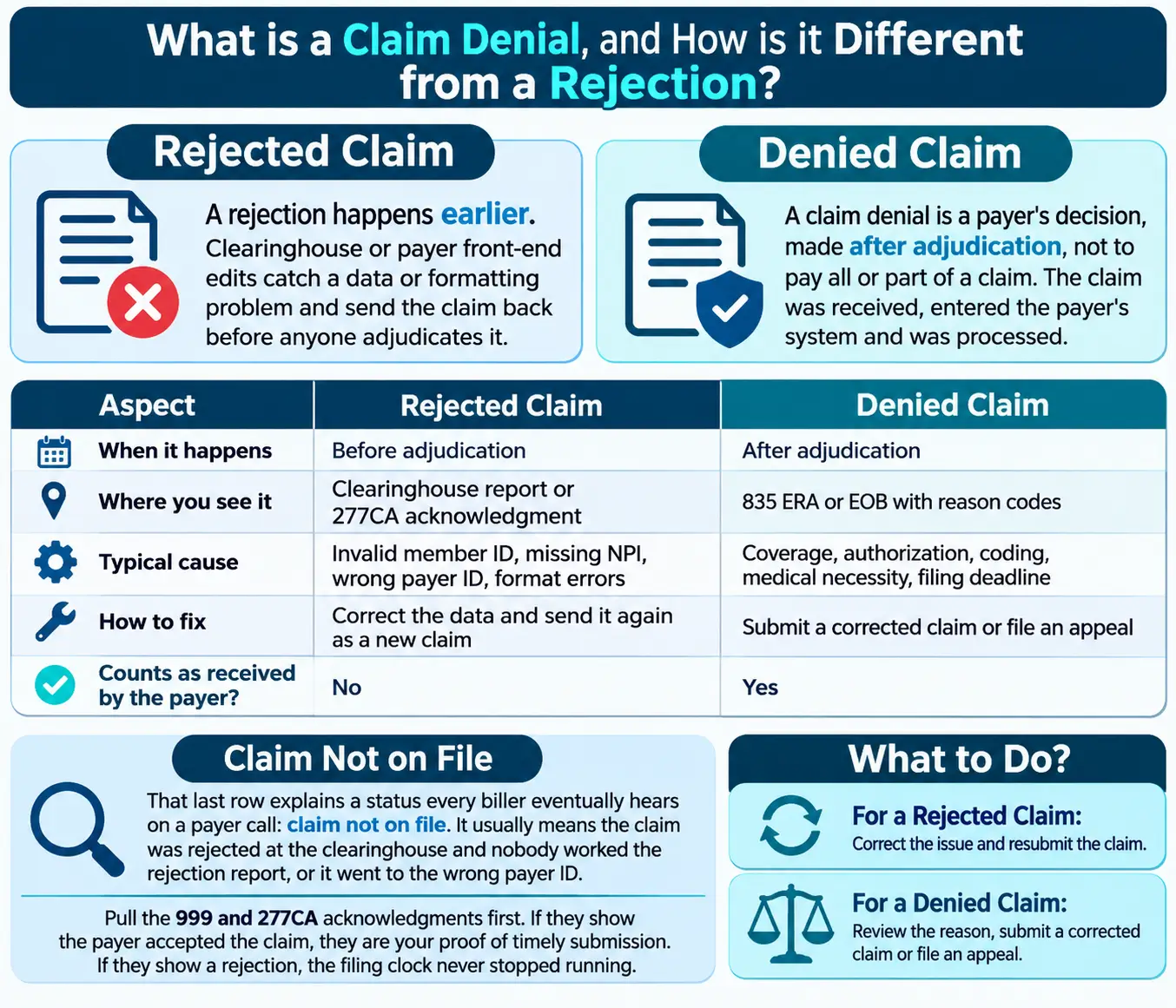
A claim denial is a payer’s decision, made after adjudication, not to pay all or part of a claim. The claim was received, entered the payer’s system and was processed. The reason for nonpayment comes back on the electronic remittance advice (the X12 835 transaction) or on a paper explanation of benefits.
A rejection happens earlier. Clearinghouse or payer front-end edits catch a data or formatting problem and send the claim back before anyone adjudicates it. Students often treat the two words as synonyms. Payers do not.
Rejected claim | Denied claim | |
When it happens | Before adjudication | After adjudication |
Where you see it | Clearinghouse report or 277CA acknowledgment | 835 ERA or EOB with reason codes |
Typical cause | Invalid member ID, missing NPI, wrong payer ID, format errors | Coverage, authorization, coding, medical necessity, filing deadline |
How to fix | Correct the data and send it again as a new claim | Submit a corrected claim or file an appeal |
Counts as received by the payer? | No | Yes |
That last row explains a status every biller eventually hears on a payer call: claim not on file. It usually means the claim was rejected at the clearinghouse and nobody worked the rejection report, or it went to the wrong payer ID. Pull the 999 and 277CA acknowledgments first. If they show the payer accepted the claim, they are your proof of timely submission. If they show a rejection, the filing clock never stopped running.
Health insurance claim denial rates: what the data shows
No single national denial rate exists, because each payer reports differently and most commercial plans report nothing publicly. Three sources give the clearest picture.
The spread between insurers is wide. In the 2024 KFF data, in-network denial rates ranged from 3% to 36% depending on insurer and state. Premier put the provider cost of fighting a denial at $43.84 per claim, or roughly $19.7 billion a year across the industry.
The KFF numbers carry a caveat that billers will recognize. Insurers coded the largest share of in-network denials as “other” (36%), followed by administrative reasons (25%). Public data rarely shows the specific cause, which is why your own remittance codes are a better diagnostic tool than any national average.
Why are my medical claims getting denied? The most common reasons
Eligibility and coverage gaps
Patients change jobs, lose Medicaid at redetermination and switch plans every January. A card scanned at the first visit in March says nothing about coverage in November. Run a real-time eligibility check (the X12 270/271 transaction) before every encounter, including established patients.
Missing or incorrect patient information
In Experian Health’s 2025 State of Claims survey, 50% of respondents named missing or inaccurate claim data as the top driver of rising denials. Typical culprits are a misspelled name, a wrong date of birth, a subscriber listed as the patient, or an outdated address.
Prior authorization problems
A claim denied for authorization usually falls into one of three cases: no authorization on file, an authorization that expired, or an approved service that differs from the one performed. Picture an approval for a lumbar MRI without contrast (CPT 72148) when the radiologist performs the study with and without contrast (72158). The authorization exists, but it does not match.
The rules here have shifted. Since January 1, 2026, the CMS Interoperability and Prior Authorization Final Rule (CMS-0057-F) requires Medicare Advantage plans, Medicaid and CHIP programs to answer urgent requests within 72 hours and standard requests within 7 calendar days, and to state a specific reason when they deny one. Employer plans are not covered by those timeframes.
Coding errors
Diagnosis codes that do not support the procedure, missing or wrong modifiers, and bundled services billed separately under National Correct Coding Initiative (NCCI) edits all trigger denials. Code sets also change on fixed dates. New ICD-10-CM codes take effect every October 1 and CPT updates every January 1, so a claim using a deleted code for a later date of service will fail.
Medical necessity and missing documentation
Payers deny services they judge unnecessary for the documented diagnosis. For Medicare patients, National and Local Coverage Determinations list which diagnoses support a given test. If the chart does not show why the service was needed, the claim and any appeal are weak.
Duplicate claim submissions
These usually come from resending an original claim to fix an error instead of submitting a corrected (replacement) claim, or from rebilling a claim that is still in process.
Missed timely filing limits
Medicare requires fee-for-service claims within 12 months of the date of service under 42 CFR 424.44. Federal rules cap Medicaid at 12 months, but many state programs and managed care contracts set shorter windows. Commercial limits depend on the contract and can be as short as 90 days.
Coordination of benefits
When a patient has two plans, the secondary payer denies until the primary has paid, and the primary may deny if its records show another plan is primary. Medicare Secondary Payer rules and the birthday rule for dependent children are the usual sources of confusion.
Non-covered services and benefit limits
Some services are excluded by the plan, and others hit annual visit caps (common with physical therapy and chiropractic care). In the corrected 2023 KFF data, excluded services accounted for 14% of in-network denials where a reason was given.
How to check claim denial reasons
Every adjustment on an 835 carries three pieces of information. The group code says who is financially responsible: CO (contractual obligation, which you cannot bill to the patient), PR (patient responsibility), OA (other adjustment) or PI (payer-initiated reduction). The Claim Adjustment Reason Code (CARC) says why. A Remittance Advice Remark Code (RARC), when present, adds detail, such as which data element was missing. X12 maintains both code lists.
These are the codes that most often show up on a denied claim in a medical office:
CARC | Meaning | First thing to check |
16 | Claim lacks information or has a billing error | The RARC, which names the missing item |
27 | Expenses incurred after coverage terminated | Eligibility on the date of service |
197 | Precertification or authorization absent | Auth number, dates and approved CPT codes |
4 | Modifier inconsistent with procedure, or missing | Payer modifier policy |
11 | Diagnosis inconsistent with procedure | ICD-10-CM to CPT linkage on the claim |
97 | Service included in payment for another service | NCCI edits and modifier use |
50 | Not deemed a medical necessity | Coverage policy and chart documentation |
18 | Exact duplicate claim or service | Whether a corrected claim was needed instead |
29 | Time limit for filing has expired | Clearinghouse acceptance reports |
22 | May be covered by another payer per coordination of benefits | Primary and secondary order |
Pay attention to the group code before the reason code. A CO-29 is usually a write-off. A PR-1 (deductible) is a bill to the patient. One is closed out internally; the other belongs on the patient statement.
How to prevent medical claim rejections and reduce denials
Most denials start at the front desk or in the coding queue, weeks before the 835 arrives. Prevention means moving the checks earlier.
- Verify insurance coverage at every visit. Confirm active coverage, plan type, copay, deductible status and whether the service needs authorization. Re-verify for recurring services such as infusions or therapy.
- Tie each authorization to the exact codes. Record the auth number, approved CPT codes, units, rendering provider and date range. If the plan of care changes, update the authorization before the service, not after the denial.
- Scrub claims before submission. Claim scrubbing software checks NCCI edits, diagnosis-to-procedure linkage, modifier rules and payer-specific requirements. Update its rules every October and January when code sets change.
- Work rejections daily. A rejection sitting in a clearinghouse queue for three weeks becomes a timely filing denial later.
- Keep a payer filing calendar. List each contracted payer’s filing limit and corrected-claim deadline. A 90-day commercial contract leaves far less room than Medicare’s 12 months.
- Log every denial by code, payer and root cause. If CARC 197 keeps appearing for one orthopedic payer, the fix is a scheduling workflow change, not another appeal.
- Feed findings back to the source. Front desk staff need to hear about demographic errors. Providers need to hear about documentation gaps. Coders need payer-specific edit trends.
Track your clean claim rate (claims paid on first submission with no edits or rework) every month. It shows whether those fixes are working faster than any annual audit will.
How to correct, resubmit or appeal a denied claim
The right path depends on what went wrong.
- Your error, fixable on the claim (wrong code, missing modifier, demographic mistake): submit a corrected claim using claim frequency code 7 (replacement) and reference the original claim number. Do not send a new original claim, or it will deny as a duplicate.
- Payer error or disputed judgment (medical necessity, bundling you disagree with, authorization the payer cannot find): request reconsideration or file a formal appeal with the chart notes, the authorization record and the payer’s own policy language.
- Rejected claims: fix the data and transmit again. No appeal is needed because the payer never adjudicated the claim.
Deadlines apply to appeals too. For Medicare, a first-level appeal (redetermination) must be filed within 120 days of receiving the initial determination, under 42 CFR 405.942. Commercial appeal windows are set by the provider contract.
Persistence pays off more often than many offices assume. In the Premier survey, 54.3% of initially denied private-payer claims were eventually paid, although it took an average of three review rounds of 45 to 60 days each. Patients appeal far less: KFF found fewer than 1% of denied in-network marketplace claims were appealed in 2024, and insurers upheld 66% of the denials that were.
Managing denials in accounts receivable
Sort open denials by appeal deadline first and dollar value second. A $4,000 surgical claim with 10 days left outranks a $90 office visit with 100 days left. Assign denial categories to specific staff (eligibility to front-end staff, coding denials to certified coders) so each denial goes to the person who can fix it, and review aging buckets weekly so nothing drifts past 90 days unworked.
The short answer
Why are my medical claims getting denied? In most offices, the answer comes down to a few repeat causes: outdated eligibility, data entry errors, authorizations that do not match the service, and codes that do not line up with the diagnosis. Federal data shows HealthCare.gov insurers denied 19% of in-network claims in 2024. Premier found that more than half of private-payer denials are eventually paid. Each of those denials cost the provider staff time and delayed payment, and many were preventable at registration. Read the CARC and group code on each denial, log the root cause, and fix the step that produced it.