


The 99233 CPT code reports subsequent hospital inpatient or observation care involving high medical decision making (MDM). It can also be selected based on at least 50 minutes of qualifying practitioner time on the encounter date. These are alternative selection methods; the encounter does not have to satisfy both.
For providers and billing teams, the practical challenge is documenting the work that supports the selected level. The correct code cannot be determined solely by the severity of a diagnosis, the length of a progress note, or the duration of a hospital stay. The record must explain the service provided that day. The American Medical Association’s 2023 CPT E/M Descriptors and Guidelines establishes the framework for these subsequent hospital services.
What does the 99233 CPT code cover?
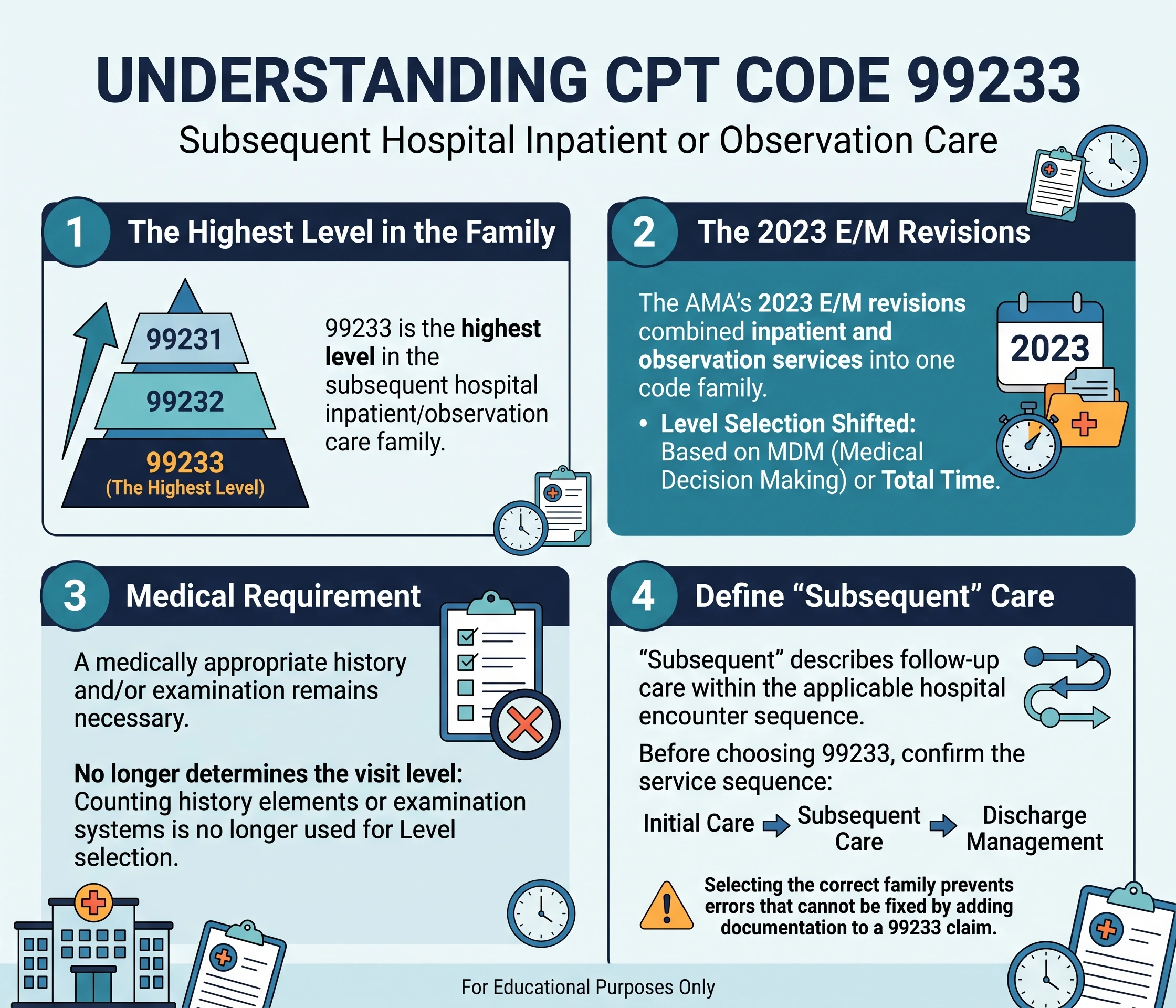
99233 is the highest level in the subsequent hospital inpatient or observation care family, which includes 99231, 99232, and 99233.
The AMA’s 2023 E/M revisions combined inpatient and observation services into one code family. They also shifted level selection to MDM or total time. A medically appropriate history and/or examination remains necessary, but counting history elements or examination systems no longer determines the visit level.
“Subsequent” describes follow-up care within the applicable hospital encounter sequence. Before choosing a level, confirm whether the service belongs to initial care, subsequent care, or discharge management. Selecting the correct family prevents errors that cannot be fixed by adding documentation to a 99233 claim.
99231 vs. 99232 vs. 99233
The three subsequent hospital care codes have different MDM levels and time thresholds.
CPT code | MDM level | Minimum total time when selecting by time |
99231 | Straightforward or low | 25 minutes |
99232 | Moderate | 35 minutes |
99233 | High | 50 minutes |
The time threshold must be met when time determines the code. A 45-minute encounter does not qualify for 99233 through time, although it may qualify through documented high MDM.
How high medical decision making supports 99233
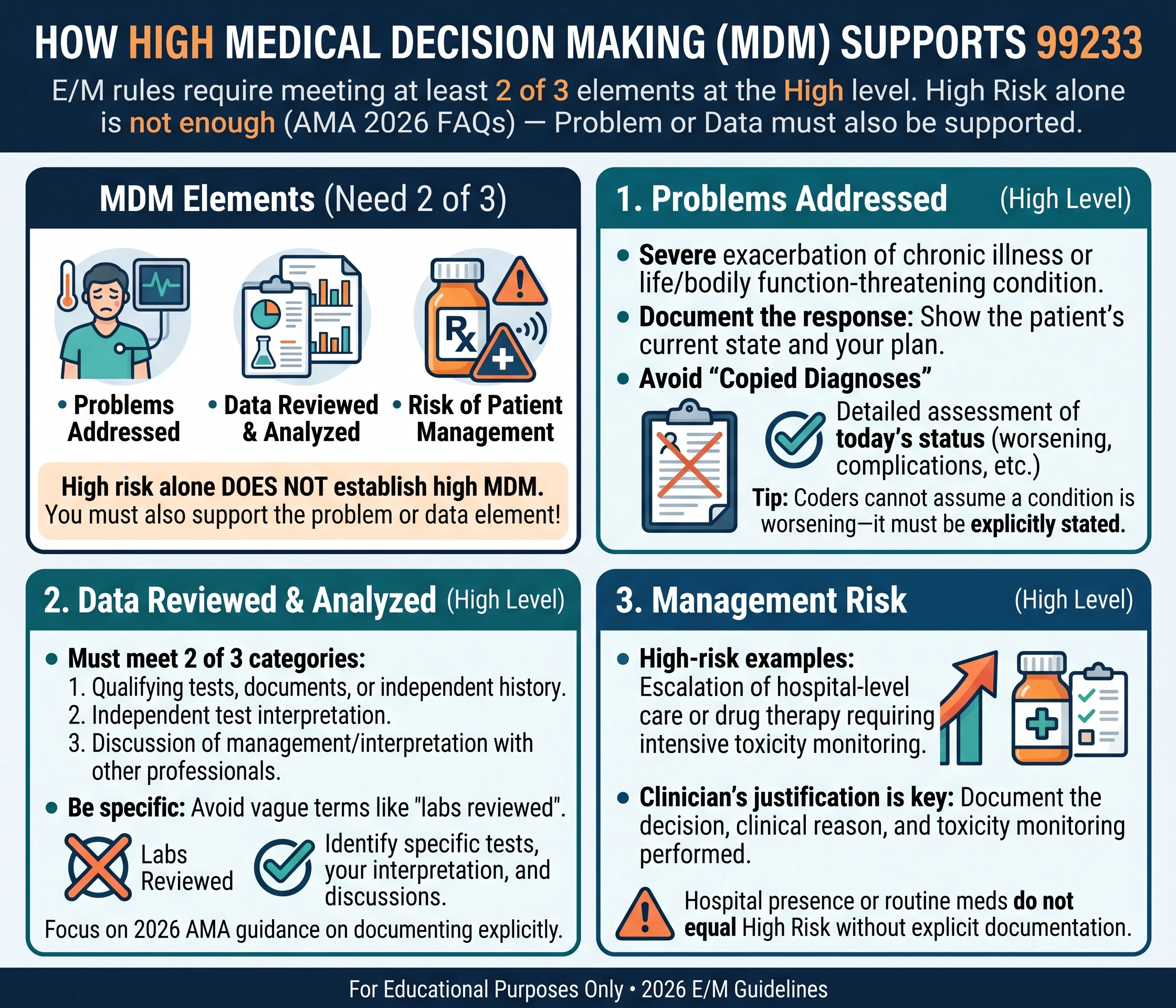
MDM evaluates three elements:
- Problems addressed during the encounter.
- Data reviewed and analyzed.
- Risk associated with patient management.
At least two of the three elements must reach the high level. The AMA’s E/M Revisions FAQs, updated January 26, 2026, confirms that high risk alone does not establish high MDM. The clinician must also support the relevant problem or data element.
Problems addressed
A severe exacerbation of a chronic illness or a condition threatening life or bodily function may satisfy the high-level problem element. The assessment should describe the patient’s current condition and the clinician’s response.
A diagnosis copied from the admission note provides limited insight into today’s work. Explain whether the condition remains severe, has improved, or has developed complications. Coders should not independently decide that an illness is worsening when the clinician has not documented that assessment.
Data reviewed and analyzed
High-level data requires meeting two of three data categories: qualifying tests, documents, or independent history; independent test interpretation; and qualifying management or interpretation discussions.
A useful progress note identifies the tests assessed, the clinician’s interpretation where applicable, and substantive discussions with other professionals. “Labs reviewed” leaves the reviewer with little information about what was analyzed.
The AMA’s 2026 Inpatient Documentation and Coding educational session emphasizes documenting data work and management risk explicitly rather than expecting a diagnosis list to establish them.
Management risk
Examples of high-risk management include escalation of hospital-level care and drug therapy requiring intensive toxicity monitoring. The documentation should identify the decision, its clinical reason, and the monitoring performed.
Routine medication management should not automatically be described as intensive toxicity monitoring. Similarly, the patient’s presence in a hospital does not explain the specific management decision made during today’s encounter.
Using the 50-minute time requirement correctly
Time-based coding captures qualifying work personally performed by the physician or other qualified healthcare professional. It can include direct patient care and related work away from the bedside.
Qualifying activities include:
- Preparing for the encounter and reviewing relevant records.
- Evaluating the patient.
- Counseling the patient or caregiver.
- Ordering treatment or diagnostic testing.
- Communicating with other healthcare professionals.
- Documenting the encounter and coordinating care.
Exclude separately reported services, travel, and general teaching unrelated to managing that patient. Count only eligible work on the applicable encounter date. The AMA’s E/M time documentation guidelines outline which activities qualify and which must be excluded.
A hypothetical time statement might read:
I personally spent 54 minutes on this encounter today, including record review, patient evaluation, treatment planning, discussion with the consulting clinician, and documentation. Separately billed procedure time was excluded.
Use an actual total. A prefilled 50-minute statement does not establish that the work occurred.
Documentation tips for a reviewable claim
Focus the note on the patient’s care and the rationale supporting the selected code. CMS’s Evaluation and Management Services booklet, revised May 2026, calls for documentation supporting the encounter, assessment, plan, and reported services.
A practical review should answer these questions:
- What required attention today? Describe interval changes, symptoms, findings, and treatment response.
- Which problems did the practitioner address? Link every relevant condition to the corresponding assessment or treatment decision.
- What information influenced the decisions? Identify meaningful record review, testing, interpretation, and discussions.
- Why was the management approach necessary? Describe any adjustments to treatment, ongoing monitoring, escalation of care, or alternative options considered.
- What supports the selected level? Make the high-MDM elements identifiable or document qualifying total time.
For internal audits, highlight the exact sentences supporting the code. If a reviewer cannot locate them without making assumptions, ask for clarification before submission.
Avoid adding severity labels merely to support billing. An effective clarification explains the clinician’s actual evaluation and the services performed.
Billing rules that require separate attention
Multiple visits on the same day
Medicare treats subsequent hospital care as a daily service. Physicians in the same group and specialty generally report one subsequent hospital service for the patient per day. A morning visit followed by an afternoon reassessment does not, by itself, justify submitting two separate claims.
Observation care
The combined CPT family does not eliminate Medicare’s practitioner-role restrictions. Medicare generally reserves observation care codes for the treating practitioner responsible for observation care. Other practitioners providing consultation or additional evaluation generally use the appropriate outpatient service codes.
Discharge day
The attending practitioner generally reports discharge management instead of a separate subsequent visit on the discharge date. A different specialist managing a concurrent inpatient problem may report a medically necessary final subsequent visit when Medicare’s requirements are met.
These distinctions appear in CMS’s Medicare Claims Processing Manual revisions issued February 9, 2023, effective January 1, 2023.
Split or shared services
For qualifying Medicare facility visits shared by a physician and a nonphysician practitioner in the same group, the claim is submitted under the practitioner who performs the substantive portion of the service. This may be determined by more than 50% of the total time spent or by performing a substantive portion of the medical decision-making (MDM). Modifier FS is required, and any overlapping time must be counted only once.
Prolonged services
CMS’s May 2026 booklet lists 65 minutes as the threshold for reporting the first G0316 unit with time-selected 99233. Reaching 50 minutes supports the base code; it does not independently support prolonged services. Check the applicable payer’s prolonged-service policy.
How 99233 reimbursement is determined
There is no single payment amount that applies to every 99233 claim.
Medicare’s Physician Fee Schedule uses relative value units for physician work, practice expense, and malpractice expense. Geographic adjustments apply to each component, and the adjusted total is multiplied by the applicable conversion factor. Hospital professional services use the relevant facility pricing.
CMS’s Calendar Year 2026 Physician Fee Schedule Final Rule fact sheet, published October 31, 2025, identifies two rounded conversion factors:
Clinician category | 2026 conversion factor |
Qualifying APM participants | $33.57 |
Clinicians who are not qualifying APM participants | $33.40 |
These figures are calculation inputs, not the reimbursement amounts for 99233.
To estimate the expected Medicare payment, look up CPT 99233 for the relevant service year and geographic payment locality, then apply the corresponding facility rate. CMS’s PFS Quick Reference Search Guide explains the lookup process. Compare commercial claims against the payer’s contracted allowance rather than assuming Medicare pricing applies.
Keep billed charges, allowed amounts, and actual collections in separate fields during payment review. This makes discrepancies easier to investigate.
Practical examples of code selection
These hypothetical examples illustrate the selection process, not guaranteed payment outcomes.
High-MDM pathway: A patient develops life-threatening respiratory deterioration. The physician assesses the change and decides to escalate care. If the documentation supports both a high-level problem and high management risk, 99233 may be appropriate without meeting 50 minutes.
Time pathway: A practitioner performs 54 minutes of qualifying, medically necessary work during a subsequent encounter. The documented total may support 99233 even when MDM is moderate.
Insufficient support: A note lists several diagnoses and says “continue current treatment,” without establishing high MDM or qualifying time. The reviewer should evaluate the supported level rather than assume 99233 from the number of conditions.
Accurate 99233 CPT code reporting requires a supported selection method, the correct hospital service category, and documentation specific to that day. Before submitting the claim, confirm the MDM or time basis and verify the payer’s billing and payment rules.