
Before a health plan pays claims for a new physician, someone has to verify that physician’s license, training, and history. Delegated vs non-delegated credentialing for providers comes down to who does that work. In a delegated arrangement, the plan assigns it to the provider organization. In a non-delegated one, the plan keeps it. The choice affects how quickly a clinician can see plan members, how many staff hours each file takes, and which party answers to auditors. This guide is for providers and medical billing students who want a working picture of both models, the oversight attached to each, and where credentialing ends and enrollment begins.
What delegated credentialing means in healthcare
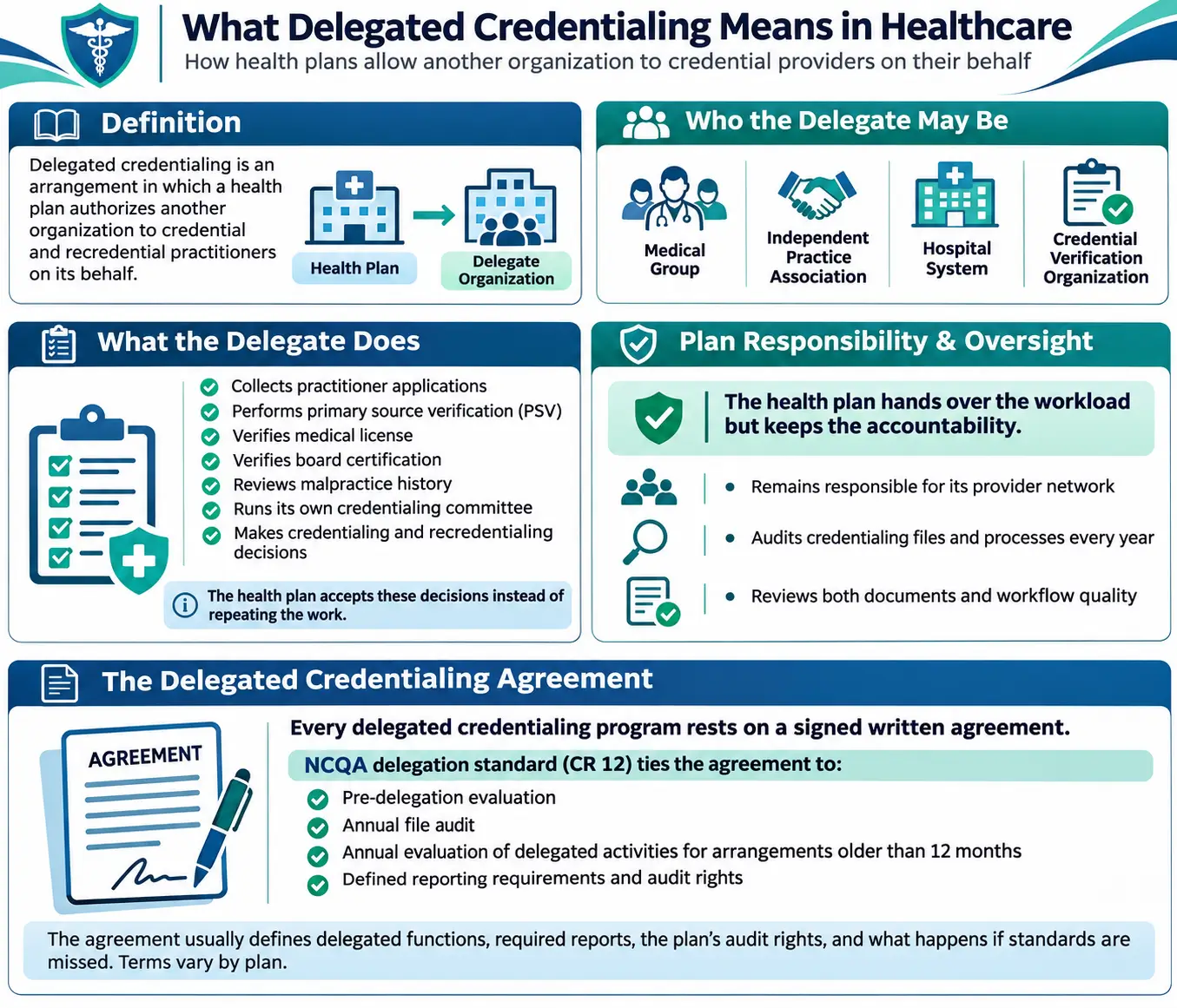
Delegated credentialing is an arrangement in which a health plan authorizes another organization to credential and recredential practitioners on its behalf. The delegate is usually a medical group, an independent practice association, a hospital system, or a credential verification organization. It collects applications, performs primary source verification (PSV) of items such as medical license, board certification, and malpractice history, and runs its own credentialing committee. The plan then accepts those decisions instead of repeating the work.
The plan hands over the workload and keeps the accountability. A health plan remains responsible for its network and is expected to audit the delegate’s credentialing files and processes every year, not only before approval.
The delegated credentialing agreement
Every delegated credentialing program rests on a signed written agreement. NCQA’s delegation standard (CR 12) pairs the agreement with a pre-delegation evaluation, an annual file audit, and, for arrangements older than 12 months, an annual evaluation of the delegated activities. The agreement usually names the functions delegated (initial credentialing, recredentialing, or both), the reports the delegate must send, the plan’s audit rights, and what happens if standards are missed. Terms differ from plan to plan.
How non-delegated credentialing works
In non-delegated credentialing, the payer performs every verification step. The provider, or the practice acting for the provider, submits an application, and almost every commercial payer draws on CAQH ProView for professional details. Plan staff complete PSV and send the file to the plan’s own credentialing committee. The practice’s job is to keep data current and answer requests quickly, because one missing document can stall a file.
Cycle time sits outside the practice’s control. A Bloomberg Law commentary on delegation noted that some insurers take up to 180 days to credential a practitioner, and delayed panel placement can leave services ineligible for reimbursement. The same source points to NCQA’s rule that recredentialing occur at least every 36 months. Each payer runs its own clock, so a clinician on six panels can have six different due dates.
Delegated vs non-delegated credentialing for providers: a side-by-side view
Area | Delegated | Non-delegated |
Who performs PSV | Delegate (group, IPA, health system) | Health plan |
Who approves practitioners | Delegate’s credentialing committee | Plan’s credentialing committee |
What the plan receives | Roster of credentialed practitioners | Application and documents for each practitioner |
Oversight | Pre-delegation evaluation, reports, annual audit | None beyond the plan’s own process |
Main burden on the provider organization | Running an audit-ready program | Keeping CAQH and payer data current |
Ultimate accountability | Plan | Plan |
For daily work, delegated credentialing vs traditional payer credentialing shifts the task from submitting applications to each plan toward maintaining one program that survives audits and sending accurate rosters. Provider roster management becomes a routine duty, and billing depends on correct group and location relationships in the payer’s claims system, so roster errors can resurface as claim problems.
The delegated credentialing process
Plans vary in detail, but most delegation follows this sequence:
- The prospective delegate writes credentialing policies and procedures, forms a committee, and sets up PSV workflows.
- The plan runs a pre-delegation evaluation. One health plan’s published policy requires it to be documented within 12 months before delegation begins.
- Both parties sign the delegation agreement.
- The delegate credentials practitioners and submits rosters of approved providers.
- The plan monitors through reports and audits. The same policy calls for an annual audit of randomly selected initial and recredentialing files, using NCQA’s file audit tool, when the delegate is not NCQA accredited.
Audit deficiencies or missed recredentialing cycles can bring corrective action or loss of delegation. Credentialing compliance is therefore a continuing duty.
Requirements to become a delegated credentialing entity
Plans want evidence that a delegate already runs a sound program. A pre-delegation review typically covers policies, file audits, committee minutes, and verification procedures. Passing thresholds belong to each plan. Canopy Health’s published policy, for example, requires a score of 95% or higher on both pre-delegation and annual oversight audits. Another California plan’s policy refers to an annual audit of credentialing and recredentialing files using the 8/30 methodology. Plans sometimes reduce oversight for delegates that hold NCQA accreditation or certification, and one county plan’s policy waives the pre-delegation evaluation, annual evaluation, and audit for such delegates. Each plan sets its own rules.
Medicare Advantage rules
Delegated credentialing requirements are partly set by federal rules for Medicare Advantage (MA). Under 42 CFR 422.204, an MA organization must have written policies and procedures for selecting and evaluating providers, and initial credentialing includes a written application, primary source verification of licensure or certification, disciplinary status, Medicare payment eligibility, and site visits as appropriate. When a plan delegates credentialing, 42 CFR 422.504(i)(4)(iv) applies: the MA organization must review and approve the delegate’s process or audit it on an ongoing basis. If provider selection is delegated, the plan keeps the right to approve, suspend, or terminate the arrangement.
One caution on timing. Verification time limits (how recent a verification can be on the committee decision date) differ by element and NCQA program, and the standards are revised periodically. Confirm the figure in the edition your plan applies.
Delegated credentialing pros and cons
Advantages
- The group controls its own committee calendar and onboarding pace for new clinicians.
- One internal process can serve several delegating plans, cutting repeated verification.
- Multi-site provider credentialing can follow a single standard across locations.
Drawbacks
- Dedicated staff, tracking software, and committee time are required.
- Audit exposure sits with the delegate, along with the risk of losing delegation.
- Individual plans may add requirements on top of NCQA’s.
Non-delegated credentialing asks less setup effort and leaves audit risk with the plan, but timelines depend on each payer’s queue.
Difference between provider credentialing and enrollment
Credentialing verifies qualifications. Enrollment places the provider in a payer’s network and billing system. It ties the provider to a contract, a fee schedule, and an effective date, and most commercial payers do not backdate billing to the application date. Approval alone does not settle payment: until a participation agreement is signed and an effective date set, there are no in-network rates to bill against. The same source notes that Medicare and Medicaid use “enrollment” for their formal process.
In most delegation arrangements, only the credentialing function moves to the delegate. Contracting and effective dates remain with the plan. Billing teams should hold claims until the effective date is confirmed in writing.
Example: a mid-sized group choosing a model (hypothetical)
Suppose a 40-physician multispecialty group contracts with three plans. Plans A and B offer delegation to groups that pass a pre-delegation evaluation, and Plan C does not. The group builds its committee and file process once, passes both evaluations, and sends rosters to A and B. Plan C still receives individual applications, so the group keeps CAQH profiles current for those physicians as well. A new hire’s start date then depends on the group’s committee calendar for A and B and on Plan C’s queue. Other plans may handle this differently.
Matching the model to your organization
Delegated vs non-delegated credentialing for providers is a question of capacity. Delegation suits organizations that can staff a committee, maintain audit-ready files, and absorb recurring plan oversight. Non-delegated credentialing suits smaller practices that prefer to let the payer carry the verification work. In both models the plan remains accountable, and credentialing approval does not make a provider billable until the effective date is confirmed.
For provider credentialing at healthcare organizations considering delegation, one practical step is to pull a sample of recent files and audit them against NCQA’s file requirements and the target plan’s checklist. The gaps you find are the ones the plan’s auditor will find.