

Knowing how to bill Medicare as a provider starts before you prepare a claim. Your enrollment must support the services you furnish, the patient’s coverage must be verified, and the claim must reach the correct payer within Medicare’s filing deadline.
This guide focuses on professional claims under Original Medicare Part B. It explains the process from provider enrollment through payment review, with attention to the mistakes that create avoidable rework.
How to bill Medicare as a provider, step by step
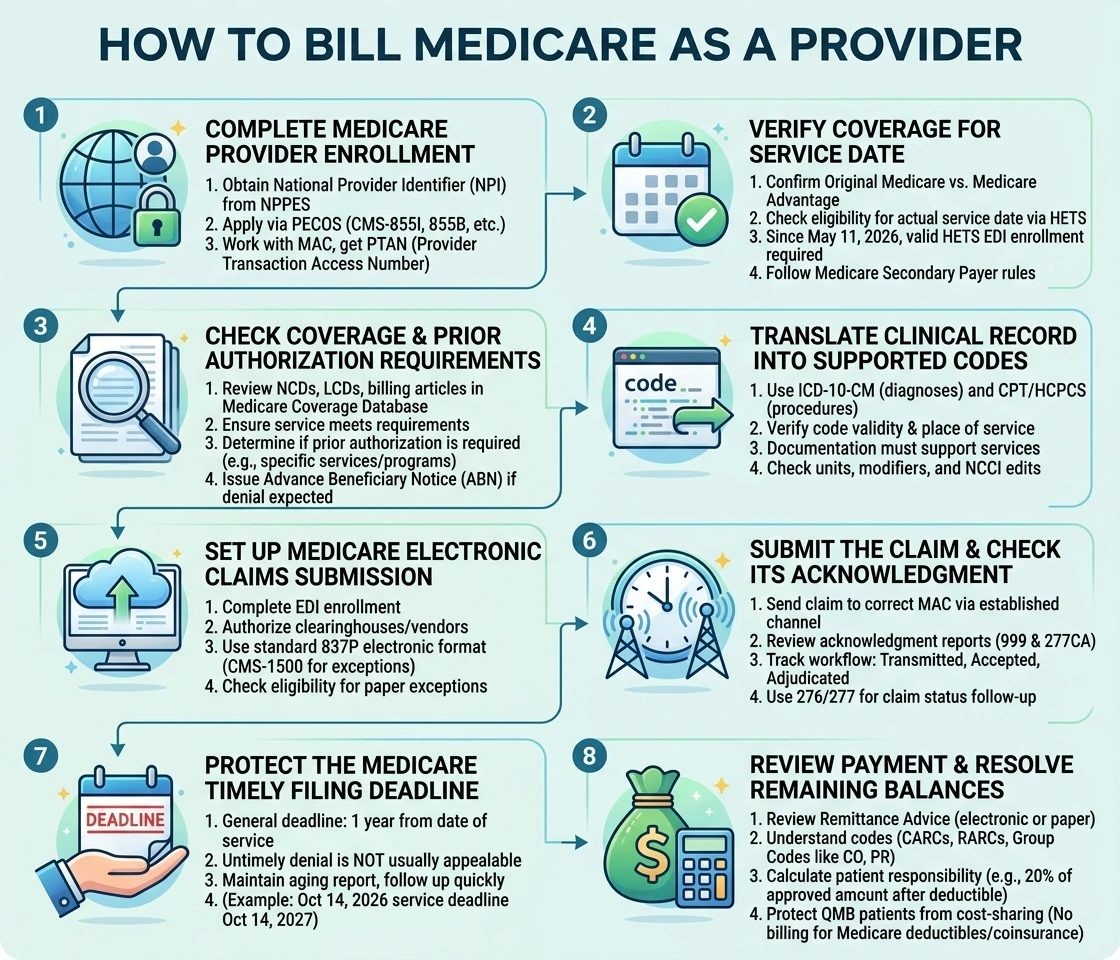
1. Complete Medicare provider enrollment
Start by obtaining a National Provider Identifier (NPI) through the National Plan and Provider Enumeration System. Then apply through PECOS, the Provider Enrollment, Chain, and Ownership System.
CMS’s Become a Medicare Provider or Supplier guidance, updated June 2, 2026, identifies the basic sequence: obtain an NPI, complete enrollment, pay an application fee if applicable, and work with your Medicare Administrative Contractor (MAC) during application review. An NPI alone does not establish Medicare billing privileges.
The appropriate CMS-855 application depends on your provider type:
Application | Typical purpose |
CMS-855I | Enrollment for individual physicians and nonphysician practitioners, including reassignment arrangements |
CMS-855B | Enrollment for clinics, group practices, and certain organizational suppliers |
CMS-855A | Institutional provider enrollment |
CMS-855S | Durable medical equipment, prosthetics, orthotics, and supplies supplier enrollment |
CMS-855O | Enrollment solely to order or certify eligible services, rather than submit claims for payment |
CMS has merged the former CMS-855R reassignment application into CMS-855I. For a clinician joining a group, check both the individual enrollment and the reassignment arrangement before submitting claims under the group.
Keep your approval information accessible. Your PTAN, or Provider Transaction Access Number, identifies your Medicare enrollment and supports contractor authentication. Use the NPI on Medicare claims; the PTAN does not replace it.
2. Verify coverage for the service date
Medicare eligibility verification should establish whether the patient has Original Medicare or a Medicare Advantage plan.
For routine Medicare Advantage services, follow the plan’s claims instructions rather than automatically sending the claim to an Original Medicare MAC. Specific exceptions exist, so investigate unusual coverage situations before choosing the payer.
Use an authorized eligibility system to check coverage for the actual date of service. CMS’s HIPAA Eligibility Transaction System (HETS) provides real-time Medicare eligibility information.
There is a relevant 2026 requirement: since May 11, 2026, every NPI submitted for HETS eligibility verification must have valid HETS EDI enrollment on file. Practices using a vendor or clearinghouse should confirm that this enrollment is complete.
Also ask about other insurance. Medicare Secondary Payer rules may place another insurer first, including in certain employment-related or injury-related situations. CMS requires providers to determine payer order rather than assume Medicare is primary because the patient presents a Medicare card.
3. Check coverage and prior authorization requirements
Eligibility confirms coverage status. It does not establish that every proposed service meets Medicare’s payment requirements.
Search the Medicare Coverage Database for applicable National Coverage Determinations, Local Coverage Determinations, and billing articles. Match the policy to the service, contractor jurisdiction, and effective date. Review covered indications, documentation requirements, and any frequency restrictions before treatment.
Do not assume Original Medicare never uses prior authorization. Requirements depend on the service and applicable program.
For example, CMS’s WISeR Model Provider and Supplier Operational Guide 4.0, dated July 24, 2026, describes prior authorization or prepayment medical review for selected services within the model. Providers submitting affected claims without prior authorization face prepayment review under the model’s rules. This is a service-specific requirement, not a universal authorization rule for Part B.
If a normally covered service is expected to be denied in circumstances requiring an Advance Beneficiary Notice of Noncoverage, issue the applicable ABN before furnishing it. A signature obtained afterward cannot substitute for advance notice. Follow CMS’s notice instructions rather than treating an ABN as a blanket financial waiver.
4. Translate the clinical record into supported codes
For professional claims, use ICD-10-CM for diagnoses and CPT or HCPCS codes for services, procedures, and supplies. Select codes valid for the service date and report the appropriate place of service.
CMS’s December 2025 booklet, Medicare Billing: CMS-1500 & 837P, explains these coding requirements and the need to support Medicare coverage and payment with documentation.
Before releasing a claim, check:
- Whether the documentation supports each reported service.
- Whether diagnosis pointers connect services to the relevant diagnoses.
- Whether units reflect the service actually furnished.
- Whether modifiers are supported by the circumstances.
- Whether applicable National Correct Coding Initiative edits affect the code combination.
CMS distinguishes NCCI coding edits from medical-necessity review. Passing a coding edit does not establish coverage. Similarly, a modifier should describe a supported circumstance, rather than serve as a routine method of bypassing an edit.
5. Set up Medicare electronic claims submission
Medicare enrollment and electronic billing setup are separate tasks.
Complete the required Electronic Data Interchange enrollment before submitting electronic transactions. If a billing company or clearinghouse transmits claims, authorize the transactions it may submit or receive on your behalf. CMS retains provider responsibilities for safeguarding beneficiary information even when another organization handles transmission.
For professional billing, the standard electronic claim format is 837P. CMS-1500 is the paper alternative for providers who qualify for an electronic-filing exception or waiver.
CMS generally requires initial claims electronically. Its December 2025 billing booklet identifies an exception for qualifying professional providers and suppliers with fewer than 10 full-time-equivalent employees. Verify eligibility for an exception before switching to paper.
Your MAC can provide connectivity instructions, supported transaction information, and testing assistance. Ask your software vendor to confirm that its configuration follows the applicable MAC requirements.
6. Submit the claim and check its acknowledgment
Send the claim to the correct Medicare contractor through your established submission channel.
After transmission, review acknowledgment reports. Medicare’s electronic transactions include the 999 implementation acknowledgment and 277CA claim acknowledgment. These reports belong in the billing team’s daily review process, alongside claim-status checks.
A useful internal workflow records three separate events: transmission, acceptance for processing, and adjudication. This prevents staff from treating a software status such as “sent” as evidence that Medicare has processed the claim.
For follow-up, CMS supports electronic 276 claim-status requests and 277 responses. Use the available status information to investigate unresolved claims before retransmitting them.
7. Protect the Medicare timely filing deadline
The Medicare timely filing limit is generally one calendar year after the date of service. Claims must reach the correct MAC by that deadline.
For example, a service furnished October 14, 2026, generally has an October 14, 2027, filing deadline. Treat that as an outer limit, not a submission target.
CMS states that an untimely-filing denial is not an initial determination and is not subject to the ordinary appeal process. Limited exceptions include qualifying administrative errors and certain retroactive entitlement or disenrollment situations.
Maintain an aging report for unsubmitted and rejected claims. Give each unresolved item an owner, a correction deadline, and evidence of its latest submission status.
8. Review payment and resolve remaining balances
After claim adjudication, Medicare sends an electronic or paper remittance advice. Review payment amounts, adjustments, and responsibility codes before posting balances.
The remittance may include Claim Adjustment Reason Codes and Remittance Advice Remark Codes. Group codes also matter: CO identifies contractual obligation, while PR identifies patient responsibility. Review the complete explanation instead of interpreting an unpaid amount by itself.
For most Part B physician services, the patient’s coinsurance is 20% of the Medicare-approved amount after the deductible. Certain preventive services have different cost-sharing treatment. Calculate responsibility from the adjudicated claim rather than the practice’s billed charge.
Apply Qualified Medicare Beneficiary protections before issuing a statement. QMB patients cannot be billed for Medicare Part A or Part B deductibles, coinsurance, or copayments for Medicare-covered services, including when Medicaid does not pay the entire cost-sharing amount.
Common Medicare billing errors and the correct response
An unprocessable claim and an adjudicated denial require different handling.
If a claim is returned as unprocessable, fix the missing or incorrect information and resubmit it in accordance with the contractor’s instructions. CMS distinguishes these returns from determinations that carry appeal rights.
For an adjudicated denial, review the reason before choosing a correction, reopening, or appeal route. Where redetermination is appropriate, the first-level appeal deadline is generally 120 days from receipt of the initial determination. Follow the notice’s instructions and submit evidence addressing the actual denial reason.
Organize follow-up by the problem requiring action: enrollment, eligibility, coding, missing documentation, or coverage disagreement. This gives staff a specific task instead of leaving every unpaid claim in one general queue.
Keep enrollment and billing controls current
Learning how to bill Medicare as a provider includes maintaining the ability to bill after initial approval. CMS generally requires enrollment revalidation every five years, or every three years for DMEPOS suppliers, with possible off-cycle requests.
Build those dates into the same operating calendar used for filing limits and appeal deadlines. A completed billing cycle should account for claim acceptance, Medicare’s decision, any required follow-up, and the correct handling of remaining balances.