

Patients ask their front desk this question almost every week: is there a CPT code for Mona Lisa laser treatment, and will my insurance pay for it? The short answer is no. No CPT code exists that was written specifically for MonaLisa Touch, and understanding why matters just as much as knowing which codes providers use as substitutes.
MonaLisa Touch is a fractional CO2 laser procedure marketed to treat vaginal dryness, painful intercourse, burning, and urinary discomfort tied to menopause, childbirth, or cancer treatment. It has been sold in the United States since 2014 and in Europe since 2012. For medical billers, coders, and the providers who order the procedure, the coding gap creates real financial exposure, and it traces back to a regulatory story that most front-office staff never hear.
Why no CPT code exists for MonaLisa Touch
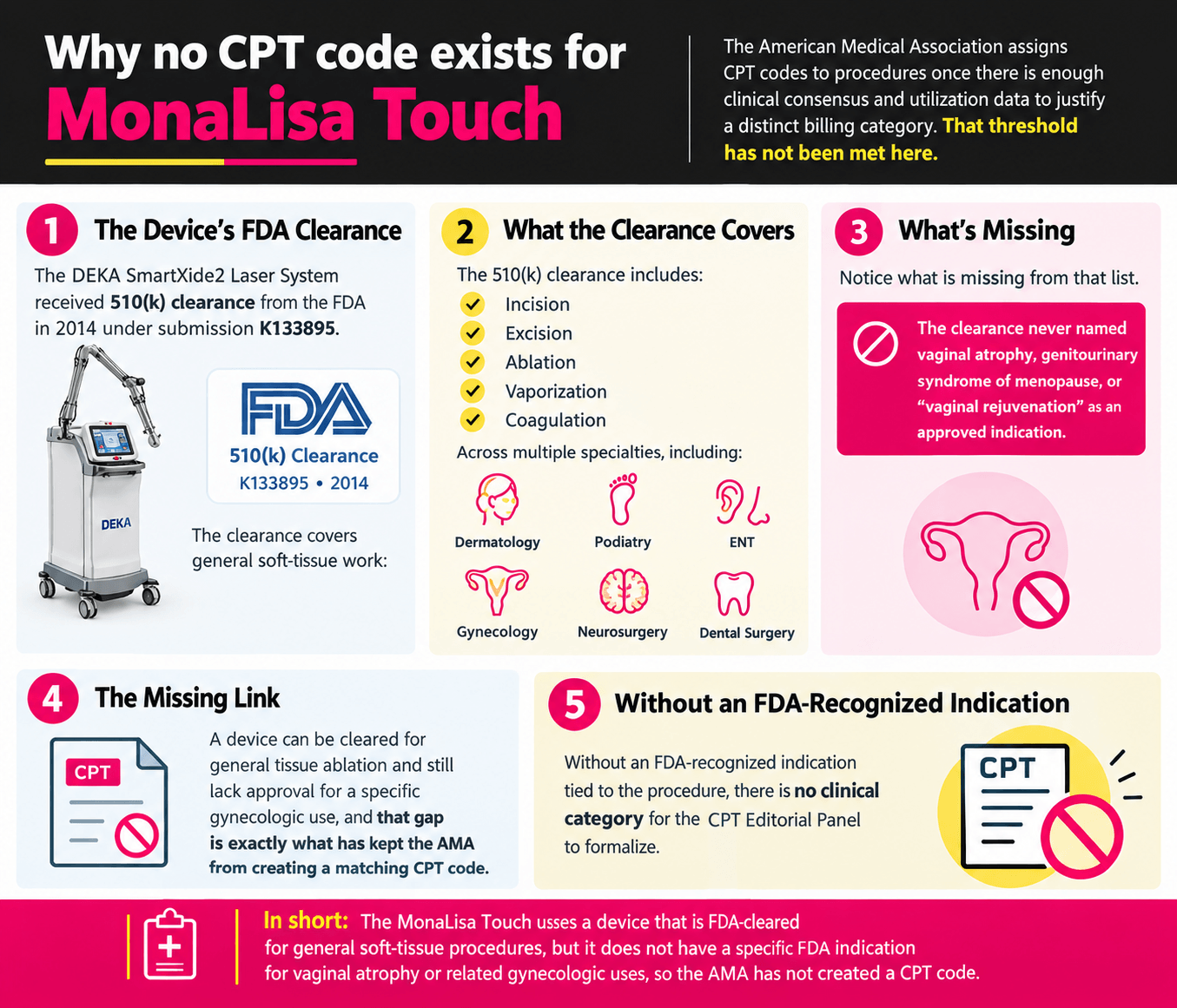
The American Medical Association assigns CPT codes to procedures once there is enough clinical consensus and utilization data to justify a distinct billing category. That threshold has not been met here. The underlying device, the DEKA SmartXide2 Laser System, received 510(k) clearance from the FDA in 2014 under submission K133895. That clearance covers general soft-tissue work: incision, excision, ablation, vaporization, and coagulation across specialties including dermatology, podiatry, ENT, gynecology, neurosurgery, and dental surgery.
Notice what is missing from that list. The clearance never named vaginal atrophy, genitourinary syndrome of menopause, or “vaginal rejuvenation” as an approved indication. A device can be cleared for general tissue ablation and still lack approval for a specific gynecologic use, and that gap is exactly what has kept the AMA from creating a matching CPT code. Without an FDA-recognized indication tied to the procedure, there is no clinical category for the CPT Editorial Panel to formalize.
The codes providers actually use
Since no dedicated code exists, practices lean on a handful of workarounds. None of them describe the procedure accurately, which is part of why claims get denied so often.
Code | Official description | How it’s used for MonaLisa Touch | Fit |
58999 | Unlisted procedure, female genital system (non-obstetrical) | Most common choice; requires a full operative note and letter of medical necessity attached to the claim | Closest available option, but reimbursement is inconsistent and often low |
57150 | Irrigation of vagina and/or application of medicament for treatment of bacterial, parasitic, or fungoid disease | Occasionally used as a workaround | Poor fit; the code describes rinsing and medicating the vaginal canal for infection, not laser tissue ablation |
57022 | Incision and drainage of vaginal hematoma | Rarely mentioned | Describes a surgical incision procedure, not applicable to laser therapy |
CPT 58999 is the option most billing specialists recommend, precisely because it is honest about the fact that no existing code matches the procedure. Payers still frequently deny it, and coders should expect to submit detailed documentation, including the specific laser system used, the treatment area, and the diagnosis driving the visit, most often ICD-10 code N95.2 for postmenopausal atrophic vaginitis.
Using CPT 57150 to bill MonaLisa Touch is a documentation risk. That code exists for treating an active bacterial, parasitic, or fungal infection through irrigation or topical medication, a completely different clinical scenario from laser ablation of vaginal tissue. Auditors who see 57150 paired with a laser-related operative note and a menopause-related diagnosis are likely to flag the claim.
The FDA warning that changed the coverage picture
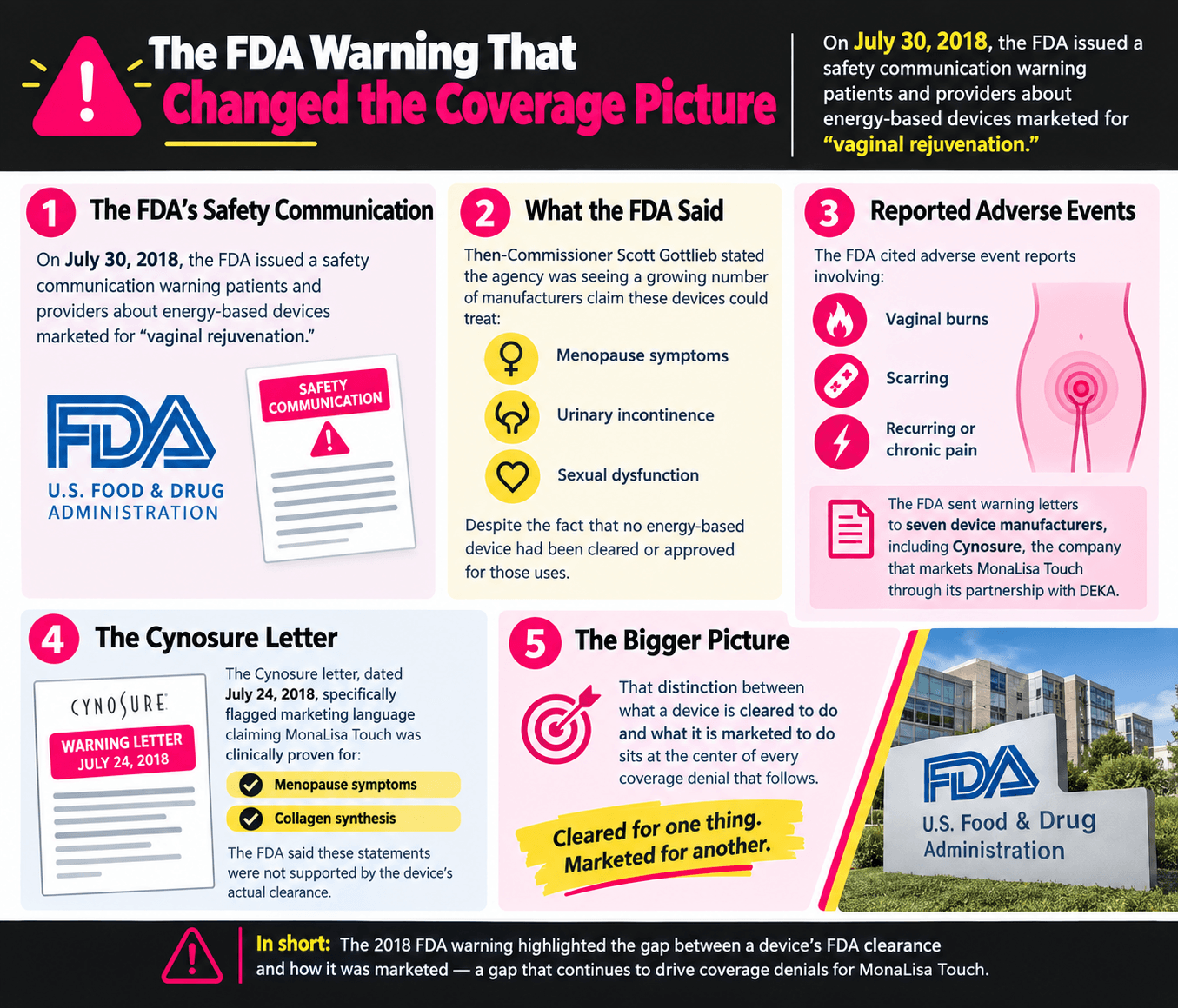
On July 30, 2018, the FDA issued a safety communication warning patients and providers about energy-based devices marketed for “vaginal rejuvenation.” Then-Commissioner Scott Gottlieb stated the agency was seeing a growing number of manufacturers claim these devices could treat menopause symptoms, urinary incontinence, or sexual dysfunction, despite the fact that no energy-based device had been cleared or approved for those uses. The FDA cited adverse event reports involving vaginal burns, scarring, and recurring or chronic pain, and it sent warning letters to seven device manufacturers, including Cynosure, the company that markets MonaLisa Touch through its partnership with DEKA.
The Cynosure letter, dated July 24, 2018, specifically flagged marketing language claiming MonaLisa Touch was clinically proven for menopause symptoms and collagen synthesis, statements the FDA said were not supported by the device’s actual clearance. That distinction between what a device is cleared to do and what it is marketed to do sits at the center of every coverage denial that follows.
Why insurance won’t pay for it
Every major payer that has published a formal coverage policy on vaginal laser therapy classifies it as experimental, investigational, or not medically necessary. Aetna’s Clinical Policy Bulletin 0427 categorizes CO2 laser treatment for vaginal atrophy, dyspareunia, stress urinary incontinence, and female sexual dysfunction as unproven. Capital BlueCross labels the procedure investigational when used for vulvovaginal atrophy and outright cosmetic when marketed for vaginal tightening, placing it in the non-covered services category either way. Arkansas Blue Cross and Blue Shield’s coverage policy manual lists MonaLisa Touch by name alongside competing devices like FemiLift and IntimaLase, stating none of them meet the plan’s primary coverage criteria because there is no established evidence of improved health outcomes.
Appeals rarely succeed. Because the claim typically arrives under an unlisted code with no matching FDA indication and a payer policy that already classifies the treatment category as investigational, reviewers have a straightforward basis for denial regardless of how well the claim is documented.
What the research actually shows
The strongest clinical trial on this question was published in JAMA in October 2021. Fiona Li and colleagues at a teaching hospital in Sydney, Australia ran a double-blind, sham-controlled randomized trial, enrolling 85 postmenopausal women with symptoms consistent with genitourinary syndrome of menopause. Forty-three women received three fractional CO2 laser treatments spaced four to eight weeks apart; forty-two received a sham procedure using the same equipment set to settings with no tissue effect. At twelve months, there was no statistically significant difference in symptom severity between the two groups. An accompanying editorial by Michael Adelman and Ingrid Nygaard, also in JAMA, was blunt in its title: “Time for a pause on the use of vaginal laser.”
Professional societies have responded cautiously rather than dismissively. The International Urogynecological Association’s 2018 committee opinion concluded that laser-based vaginal devices should only be recommended for genitourinary syndrome of menopause, vaginal laxity, or stress urinary incontinence once robust clinical trials establish long-term safety and effectiveness. A February 2019 best-practice consensus statement from the International Continence Society and the International Society for the Study of Vulvovaginal Disease went further, stating that laser is not recommended for routine treatment of vaginal atrophy or urinary incontinence outside of a formal clinical trial. The American Urogynecologic Society reassessed the evidence again in March 2022 and reached consensus on only 28 of 40 statements evaluated, citing insufficient evidence as the main reason the remaining 12 fell short.
What it costs out of pocket
Pricing varies by practice and region, but the pattern is consistent. Rush University Medical Center charges $2,500 for an initial series of three treatments, with additional sessions and annual touch-ups at $833 each. Duke Health lists $1,800 for the initial series, with $500 touch-up visits every 12 to 18 months. Per-session pricing at other practices runs roughly $500 to $1,200. Patients are generally told upfront that the treatment is self-pay, though some clinics note that flexible spending account or health savings account funds can be applied since it is a medical, not purely cosmetic, procedure.
Alternatives worth discussing with patients
Vaginal atrophy has treatment options with a longer track record. The North American Menopause Society’s 2020 position statement on genitourinary syndrome of menopause identifies low-dose vaginal estrogen as the primary treatment when over-the-counter lubricants and moisturizers are not enough. Oral ospemifene and vaginal prasterone (DHEA) are FDA-approved non-estrogen options for women who cannot or prefer not to use estrogen therapy. None of these carry the coding ambiguity that MonaLisa Touch does, since they are billed through standard pharmacy or E/M pathways with well-established coverage rules.
Practical guidance for billing teams
For practices that still offer MonaLisa Touch, a few habits reduce downstream disputes. Get financial consent in writing before treatment, using an Advance Beneficiary Notice where applicable so the patient understands they are responsible for the full cost regardless of what gets submitted to insurance. If a claim is submitted at all, use CPT 58999 with a complete operative note rather than forcing the procedure into a code like 57150 that describes something else entirely. Keep documentation of the diagnosis, most commonly N95.2, separate from any implication that the treatment is expected to be covered. Given the FDA’s 2018 safety communication and the current payer landscape, framing this as a self-pay elective service from the first patient conversation prevents most billing disputes before they start.