


According to the Food and Drug Administration Mammography Quality Standards Act national statistics from 2023, facilities perform over 39 million mammography procedures annually in the United States. Each of these procedures requires exact medical coding to ensure provider reimbursement and patient coverage.
Medical coders and billers handle high volumes of mammogram claims daily. A single coding error on a routine breast screening can result in claim denials, delayed payments, or unexpected bills sent directly to patients. The Affordable Care Act mandates that most private health insurance plans cover preventive services without charging a copayment or coinsurance. This financial protection relies entirely on the facility reporting the correct ICD-10 for screening mammogram.
Primary ICD-10 code for screening mammogram
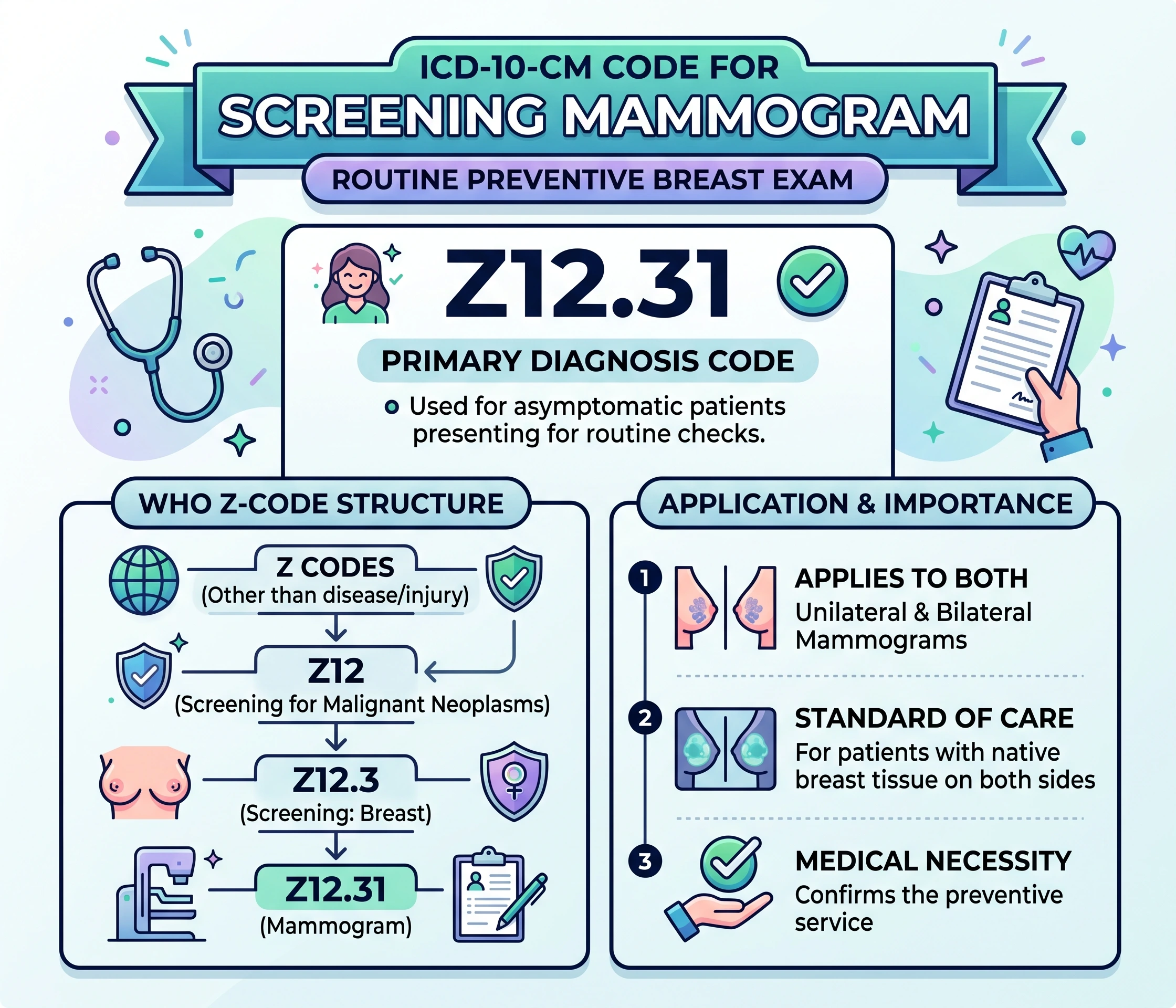
The standard ICD-10-CM code for a routine preventive breast exam is Z12.31. The official description for this alphanumeric code is an encounter for screening mammogram for malignant neoplasm of breast.
Coders use Z12.31 as the primary diagnosis code when an asymptomatic patient presents for a routine check. The World Health Organization structures ICD-10 Z codes to classify occasions when circumstances other than a disease or injury result in an encounter. Under this structure, Z12 designates an encounter for screening for malignant neoplasms, Z12.3 isolates the breast, and the final digit specifies the mammogram.
This Z12.31 diagnosis code applies to both unilateral and bilateral screening mammograms. A bilateral screening mammogram is the standard of care for patients with native breast tissue on both sides. Z12.31 confirms the medical necessity of the preventive service.
Differentiating screening from diagnostic mammography
A screening mammography ICD-10 code requires an asymptomatic patient. The American College of Radiology guidelines dictate that screening mammograms are strictly preventive.
If a patient reports a symptom, the examination legally transitions to a diagnostic mammogram. Symptoms that change the nature of the visit include:
- Nipple discharge
- Breast pain
- Palpable breast lumps
- Skin dimpling or retraction
When a provider notes any of these symptoms in the order, the coder cannot use Z12.31. The primary diagnosis must change to represent the specific symptom, such as N63.00 (Unspecified lump in breast) or N64.52 (Nipple discharge). Submitting the ICD-10 code for mammogram screening on a claim where the radiologist documented a diagnostic symptom results in an automatic denial from commercial payers and Medicare.
Coding comparison
Feature | Screening Mammogram | Diagnostic Mammogram |
Patient Status | Asymptomatic | Symptomatic or follow-up |
Primary ICD-10 | Z12.31 | Symptom-specific |
Standard CPT | 77067 | 77065 or 77066 |
Preventive Coverage | Covered completely by ACA regulations | Subject to deductible and copay |
Secondary diagnosis codes and specific patient scenarios
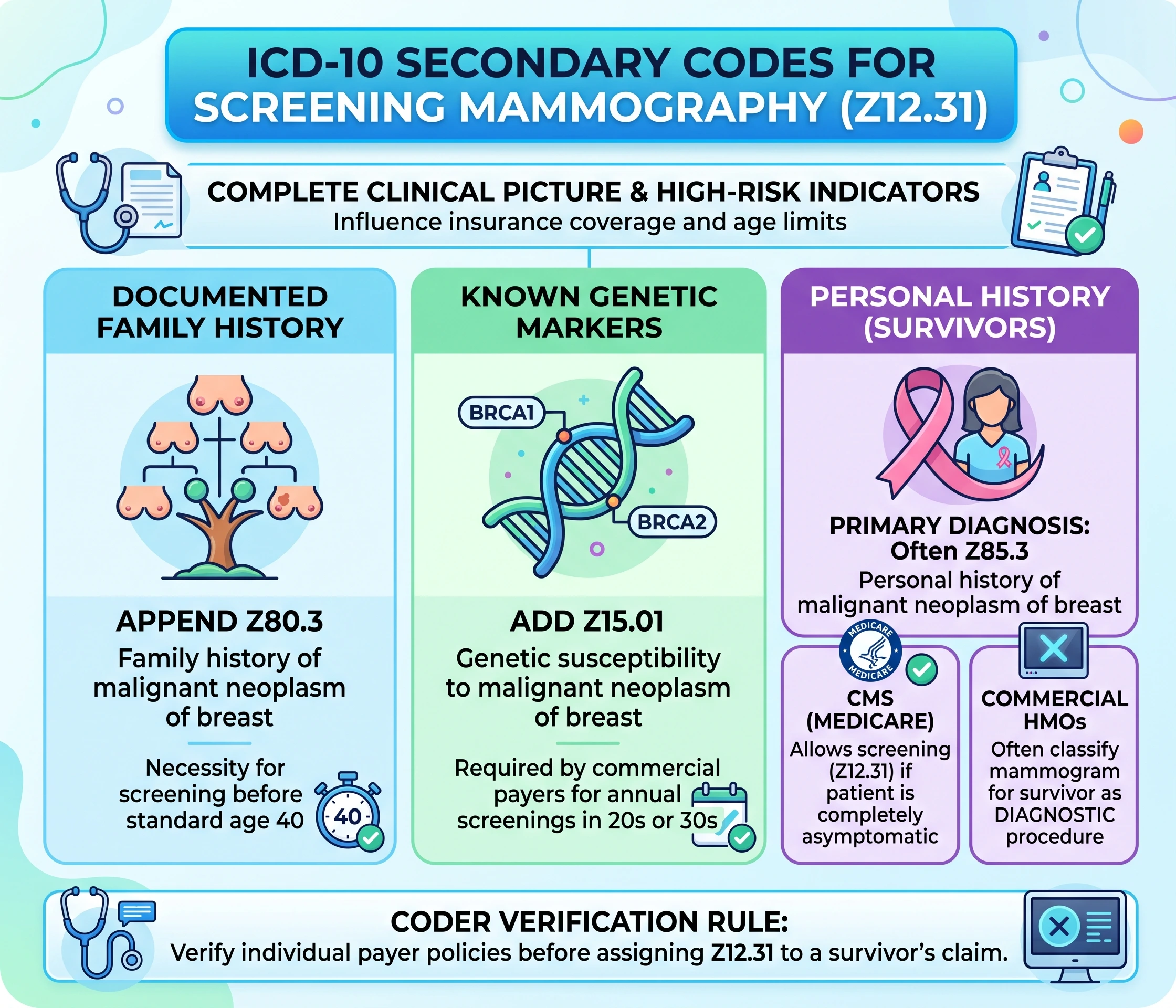
The Z12.31 ICD-10 code often requires secondary codes to provide a complete clinical picture. High-risk indicators influence both insurance coverage and age limits for mammography screening.
When a patient has a documented family history of breast cancer, coders append Z80.3 (Family history of malignant neoplasm of breast) as a secondary diagnosis. This code is frequently necessary for patients seeking a screening before the standard age of 40.
Patients carrying specific genetic markers require different secondary documentation. For patients with known BRCA1 or BRCA2 mutations, coders add Z15.01 (Genetic susceptibility to malignant neoplasm of breast). Some commercial payers require this specific secondary code to authorize annual screening mammograms for patients in their twenties or thirties.
A personal history of breast cancer introduces specific billing rules. The primary diagnosis for these patients is often Z85.3 (Personal history of malignant neoplasm of breast). The Centers for Medicare & Medicaid Services allows providers to bill a screening mammogram for patients with a personal history if they remain completely asymptomatic. However, many commercial health maintenance organizations classify any mammogram for a breast cancer survivor as a diagnostic procedure. Coders must verify individual payer policies before assigning Z12.31 to a survivor’s claim.
CPT codes paired with ICD-10 for breast cancer screening
An accurate medical claim requires alignment between the diagnosis (ICD-10) and the procedure (CPT). The current Current Procedural Terminology code for an annual mammogram screening is 77067.
The American Medical Association defines 77067 as a screening mammography, bilateral (2-view study of each breast), including computer-aided detection (CAD) when performed. Historically, Medicare required the Healthcare Common Procedure Coding System code G0202 for this service. CMS retired G0202 in 2017, and standard billing now relies entirely on 77067 for all payers.
Modern radiology departments frequently use digital breast tomosynthesis, commonly known as 3D mammography. When a facility performs 3D imaging during a routine screening, coders add CPT 77063. This is an add-on code designated specifically to accompany 77067.
Medicare billing guidelines and frequency limits
The Centers for Medicare & Medicaid Services maintains rigid coverage rules for the breast cancer screening ICD-10. Medicare Part B covers one baseline mammogram for female beneficiaries between the ages of 35 and 39.
For women aged 40 and older, Medicare covers an annual screening mammogram. CMS defines an annual screening as a procedure taking place at least 11 full months after the previous screening.
If a patient had a routine screening mammogram on January 15, she becomes eligible for her next Medicare-covered screening on December 16 of the same year. Submitting a mammogram claim using Z12.31 before the 11-month limit expires triggers a denial. The patient becomes financially responsible for the full cost of the procedure.
Clinical guidelines often conflict with payer policies. In 2024, the United States Preventive Services Task Force updated its guidelines to recommend biennial screening mammography for women starting at age 40 and continuing through age 74. The American Cancer Society recommends annual screenings starting at age 45. Medical billers must follow the legal payer policy rather than the clinical recommendation when submitting claims.
Coding for dense breast tissue
The Food and Drug Administration requires mammography facilities to notify patients about breast tissue density following their exams. Dense breast tissue obscures tumors on standard mammograms and increases a patient’s risk of developing breast cancer.
When a radiologist documents dense breast tissue on a screening exam, coders use R92.2 (Inconclusive mammogram) as a secondary diagnosis. The primary encounter for screening mammogram ICD-10 remains Z12.31.
Many states now mandate that insurance companies cover supplemental screening procedures, such as breast ultrasounds or magnetic resonance imaging, for patients with dense breasts. The R92.2 code acts as the medical justification for these subsequent diagnostic procedures.
Billing for screening converted to diagnostic
Radiologists sometimes identify an abnormality during a preventive screening and immediately order additional diagnostic views while the patient is still in the facility. This creates a specific coding scenario.
The intent of the visit dictates the primary diagnosis. Because the patient arrived for a routine preventive mammogram, the primary diagnosis remains Z12.31.
To bill for the additional diagnostic work, coders must append Modifier GG (Performance and payment of a screening mammogram and diagnostic mammogram on the same patient, same day) or Modifier GH (Diagnostic mammogram converted from screening mammogram on same day) to the diagnostic CPT code, depending on specific payer contracts.
Medicare requires these modifiers to track the conversion. The modifiers ensure the patient does not pay a copayment or deductible for the initial screening portion of the examination, applying financial responsibility only to the diagnostic portion.
Specific ICD-10 coding guidelines for male patients
Standard medical protocols do not recommend routine mammograms for asymptomatic men. Most male mammograms are diagnostic procedures.
If a male patient presents with gynecomastia (N62) or an unspecified breast lump (N63.00), the provider bills a diagnostic mammography code. The Z12.31 code is rarely used for male patients.
Exceptions exist for male patients with a severe genetic predisposition to breast cancer. If a male patient carries a known BRCA2 mutation, some commercial insurers cover a preventive screening mammogram. In these isolated cases, coders use Z12.31 as the primary diagnosis code alongside the secondary genetic susceptibility code.
Documentation requirements for medical billers
Accurate medical coding depends on exact provider documentation. The radiology report must explicitly state the exam is a screening to support the Z12.31 diagnosis code.
Discrepancies between the patient’s stated reason for the visit and the physician’s order cause immediate compliance issues. If the technician’s notes indicate the patient complained of right breast pain, but the physician’s order requests a routine screening mammogram, the coder must query the provider before billing. Processing the claim as a screening when pain is documented constitutes fraudulent billing.
Facilities must regularly audit their mammography claims. Z12.31 is the standard diagnosis code for asymptomatic patients receiving preventive care. Assigning this code correctly guarantees the facility receives proper reimbursement and protects patients from inaccurate billing statements. Validating age restrictions, frequency limits, and the presence of symptoms prior to claim submission eliminates the most common sources of mammogram denials.