


A form asks for your “policy number” and nothing on your Blue Cross Blue Shield card says that. Instead there’s a Member ID, a Group No., an RxBIN, and a line like OV/SPEC $25/$50. As a medical billing team, we read these cards every day. Here’s each field decoded, the information is verified against official BCBS and CMS sources (linked below).
One Card, 33 Companies
Blue Cross Blue Shield isn’t one insurer it’s a federation of 33 independent, locally operated companies (BCBS of Texas, Florida Blue, Anthem, Highmark, and others) covering more than 115 million Americans. That’s why cards vary by state, though the core fields are standard. Blue Cross began in 1929 covering hospital care, Blue Shield in 1939 covering physician services; the two merged in 1982.
Member ID Yes, This Is Your “Policy Number”
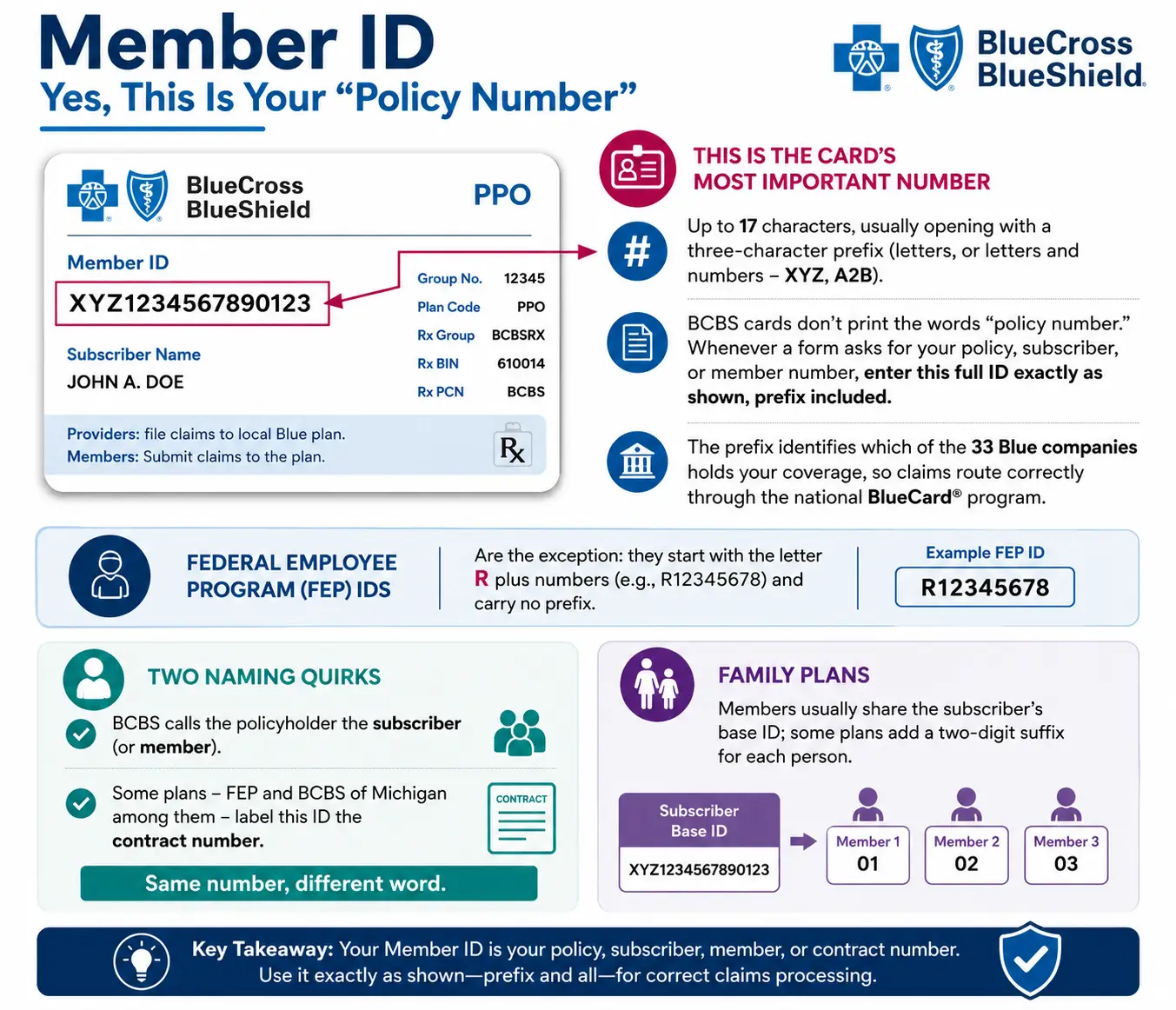
Labeled Identification Number, Member ID, or Subscriber ID, this is the card’s most important number: up to 17 characters, usually opening with a three-character prefix (letters, or letters and numbers XYZ, A2B). BCBS cards don’t print the words “policy number,” so whenever a form asks for your policy, subscriber, or member number, enter this full ID exactly as shown, prefix included.
The prefix identifies which of the 33 Blue companies holds your coverage, so claims route correctly through the national BlueCard® program. Federal Employee Program (FEP) IDs are the exception: they start with the letter R plus numbers (e.g., R12345678) and carry no prefix.
Two naming quirks: BCBS calls the policyholder the subscriber (or member), and some plans FEP and BCBS of Michigan among them label this ID the contract number. Same number, different word. On family plans, members usually share the subscriber’s base ID; some plans add a two-digit suffix for each person.
Group Number
The group number identifies the benefit package your employer purchased coworkers share it, while your member ID is unique to you. No group number? Individual and marketplace plans often skip it or print a generic program number; that’s normal, so write “N/A” if a form insists. It’s also not your policy number.
Plan Type and the Copay Line: OV, SPEC, UC, ER
The front also shows your plan name and type PPO, HMO, EPO, or POS plus your copays:
- OV = Office Visit (primary care copay)
- SPEC / SPC = Specialist so OV/SPEC $25/$50 means $25 for your regular doctor, $50 for a specialist
- UC = Urgent Care
- ER = Emergency Room
These are in-network amounts, and on high-deductible plans some copays apply only after the deductible. A printed doctor’s name indicates your assigned primary care provider, which is a common sign of an HMO, as HMOs typically require referrals.
The Suitcase Logo Is Retiring (2026 Update)
For years a suitcase icon showed how coverage travels: PPO in a suitcase = PPO/EPO with nationwide BlueCard network access; empty suitcase = traditional, HMO, or POS (out-of-area benefits may be limited); no suitcase = usually Medicaid or Medigap. Since January 1, 2025, Blue plans have been phasing the suitcase out, replacing it with plain product labels such as PPO or HMO. The multi-year rollout means both card styles circulate in 2026 benefits don’t change, only the artwork.
Pharmacy Fields: RxBIN, RxPCN, RxGRP
- RxBIN a six-digit code routing your prescription claim to the right pharmacy benefit manager. BIN stands for Bank Identification Number a naming leftover, nothing to do with banks; newer cards may say RxIIN, the current NCPDP term. There’s no universal “BCBS BIN” each of the 33 companies uses its own, so check your card or member app.
- RxPCN the Processor Control Number. CMS compares BIN and PCN to a ZIP code and its +4: BIN reaches the processor, PCN pinpoints your plan. A blank PCN is normal, and it isn’t your policy number.
- RxGRP your pharmacy group, which can differ from your medical group number.
No Rx fields at all? Pharmacy benefits are probably processed through a different PBM card, or your plan may not include drug coverage.Please check your portal or contact customer service for more information.
The Back of the Card
Member services phone, pharmacy assistance line, claims mailing address, plan website, and (on FEP cards) a fraud hotline number.If you’re unsure, contact the number listed on the back of your card.
Quick Glossary
| Code | Meaning |
| OV / SPEC | Office visit/specialist copays |
| UC / ER | Urgent care/emergency room copays |
| PCP | Primary care physician |
| DED / COINS / OOPM | Deductible / coinsurance / out-of-pocket maximum |
| RxBIN, RxPCN, RxGRP | Pharmacy claim routing codes |
| GRP | Group (employer plan) number |
| MH/CD | Mental health / chemical dependency benefits |
“Which BCBS Plan Do I Have?”
Read the plan name and type on the card, or log in to your Blue company’s member portal or app it shows your exact plan, digital ID card, and Summary of Benefits and Coverage (SBC). Employer coverage?The HR department has the necessary documents.If not, please call the number listed on the back. PCP name plus referrals = HMO; in- and out-of-network cost columns = PPO.
Lost Card or Missing Numbers
Your Blue portal or app shows a digital ID card you can download, add to your phone wallet, or share, and lets you order replacements and proof-of-coverage letters. No account? HR or member services can verify your identity and provide your ID. Card stolen? Request a new ID number.
Conclusion
Your BCBS card’s member ID including its three-character prefix is what every form means by “policy number,” so enter it exactly as printed. The group number links you to your employer’s plan, OV/SPEC, UC, and ER show your in-network copays, and RxBIN, RxPCN, and RxGRP quietly route your pharmacy claims. Since January 2025, the familiar suitcase logo is being replaced by plain PPO/HMO labels, so both card styles are valid in 2026. And for anything the card can’t answer coverage details, plan type, or a replacement your member portal or the number on the back settles it in minutes.
FAQs
What is the policy number on a BCBS card?
Your member identification number the long number beginning with the three-character prefix. There is no separate “policy number.”
What does OV/SPEC mean?
Office Visit / Specialist copays: “$25/$50” means $25 primary care, $50 specialist, in-network.
Where is the RxBIN?
In the Rx cluster on the front (sometimes the back), six digits, possibly labeled RxIIN. Missing? Check your member app pharmacy benefits may use a separate card.
Is the subscriber number the same as the member ID?
For practical purposes, yes the subscriber is the primary policyholder, and the printed ID is what forms want.
